
High-Water-Cut Oilfield Pipeline Corrosion & Wear Case Study
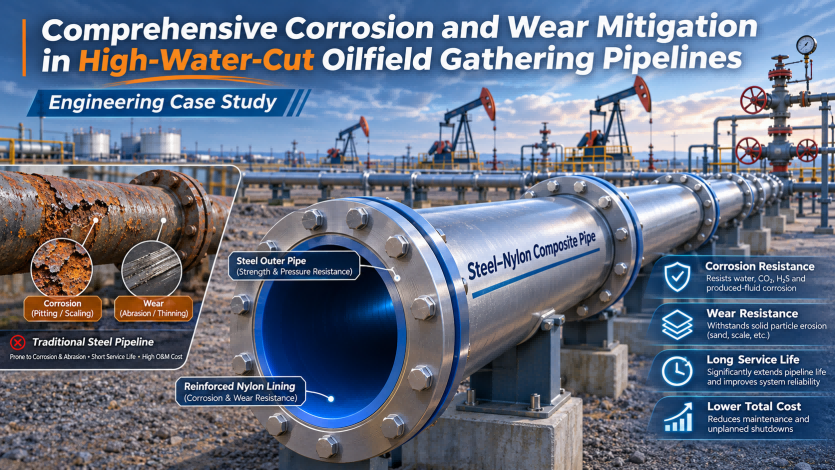
Comprehensive Corrosion and Wear Mitigation in High-Water-Cut Oilfield Gathering Pipelines: An Engineering Case Study
Introduction: Why High-Water-Cut Oilfields Present Growing Challenges for Pipeline Integrity
As many oilfields worldwide enter the middle and late stages of production, increasing water cut has become one of the most significant challenges affecting oilfield gathering and transportation systems.
In mature oilfields, gathering pipelines no longer transport predominantly crude oil. Instead, they handle complex multiphase mixtures consisting of crude oil, produced water, natural gas, formation sand, dissolved salts, corrosion products, and other impurities.
These changes create increasingly severe operating conditions for conventional carbon steel pipelines.
Major challenges include:
-
Internal electrochemical corrosion caused by highly mineralized produced water.
-
CO₂ corrosion and potential H₂S-related corrosion in sour oilfield environments.
-
Erosion and abrasive wear caused by formation sand and suspended solid particles.
-
Localized corrosion associated with deposits, scaling, and sludge accumulation.
-
Accelerated material degradation at elbows, reducers, manifolds, and valves.
-
Pipeline perforation, leakage, frequent maintenance, and unplanned production shutdowns.
For oilfield operators, effective pipeline management is no longer simply a matter of repairing leaks or replacing damaged sections.
The fundamental objective is to develop an integrated solution that combines corrosion resistance, abrasion resistance, mechanical strength, installation safety, and optimized total cost of ownership (TCO).
This article examines a pipeline upgrading project at the Gudong Oil Production Plant of Shengli Oilfield in China.
It explores the combined mechanisms of corrosion and erosion in high-water-cut oilfield gathering pipelines and explains how reinforced MC nylon–steel composite pipes can provide an alternative engineering solution for demanding oil and gas transportation environments.
1. Why Are Gathering Pipelines Particularly Vulnerable in High-Water-Cut Oilfields?
1.1 Increasing Water Cut Changes the Internal Corrosion Environment
During the early stages of oilfield development, some gathering pipelines transport fluids with relatively high oil content.
Under certain flow conditions, the oil phase may partially cover the internal steel surface, reducing direct contact between corrosive water and the metal.
However, as an oilfield matures and water injection continues, produced water becomes an increasingly dominant component of the transported fluid.
This transformation increases the likelihood of continuous water wetting on the internal pipeline surface.
When highly mineralized produced water remains in contact with carbon steel, electrochemical corrosion may occur.
The risk becomes particularly significant in:
-
Low-lying pipeline sections.
-
Water accumulation zones.
-
Areas experiencing flow regime transitions.
-
Dead legs and low-flow regions.
-
Locations where sediment accumulates.
Importantly, water cut alone does not determine the actual corrosion rate.
Other critical factors include water wetting behavior, CO₂ partial pressure, temperature, flow velocity, pH, dissolved oxygen, and the stability of corrosion product films.
Therefore, pipeline material selection must consider the actual operating environment rather than relying solely on the percentage of produced water.
1.2 Combined Effects of CO₂, H₂S, and Highly Mineralized Produced Water
Many oilfield gathering systems contain dissolved corrosive gases and high concentrations of inorganic salts.
When CO₂ dissolves in the aqueous phase, it establishes carbonic acid–related chemical equilibria that can promote carbon steel corrosion under suitable conditions.
In sour oilfields, H₂S may introduce additional corrosion and material integrity risks, including sulfide stress cracking in susceptible metallic materials.
Meanwhile, chloride ions and other dissolved salts influence solution conductivity and localized corrosion behavior.
Consequently, corrosion assessment should consider the combined effects of:
Water chemistry + Corrosive gases + Temperature + Pressure + Flow conditions + Material properties
In high-water-cut oilfields containing elevated salinity and suspended solids, conventional carbon steel pipelines may require extensive corrosion control measures, chemical treatment, inspection, and maintenance.
1.3 The Combined Effects of Erosion and Corrosion
Another major challenge in mature oilfields is the transportation of solid particles.
Formation sand, scale particles, and corrosion products may be transported through gathering pipelines along with produced fluids.
When these particles pass through elbows, reducers, tees, and valves, changes in flow direction and local velocity can create concentrated particle impacts.
For carbon steel pipelines, mechanical erosion and electrochemical corrosion may reinforce each other.
A typical erosion-corrosion process involves:
-
Corrosion initiates localized damage on the internal steel surface.
-
Solid particles remove or damage protective corrosion product films.
-
Fresh metal surfaces become exposed to the corrosive fluid.
-
Material loss accelerates through combined mechanical and electrochemical effects.
-
Progressive wall thinning may eventually lead to perforation and leakage.
This interaction is commonly referred to as erosion-corrosion synergy.
In high-water-cut oilfields containing sand, improving corrosion resistance alone may not eliminate the underlying pipeline failure mechanisms.
A more effective approach requires simultaneous consideration of corrosion resistance, abrasion resistance, and fluid flow conditions.
1.4 Under-Deposit Corrosion and Microbiologically Influenced Corrosion
Sediments, sludge, scale, and corrosion products can accumulate in low-velocity regions of gathering pipelines.
The chemical environment underneath these deposits may differ significantly from that of the bulk fluid.
Such localized conditions can promote under-deposit corrosion.
Where suitable microbial conditions exist, microbiologically influenced corrosion (MIC) may also contribute to pipeline degradation.
These mechanisms can produce highly localized damage.
Even when the overall average corrosion rate appears relatively low, deep localized pits may develop and eventually cause leakage.
This is one reason why conventional wall-thickness monitoring alone may not fully capture the integrity risks of aging oilfield gathering systems.
2. Engineering Case Study: Gathering Pipeline Upgrading at Shengli Oilfield's Gudong Oil Production Plant
2.1 Project Background
The Gudong Oil Production Plant at Shengli Oilfield represents a typical mature oilfield production environment in China.
According to published project information from Guangdong Kejin New Materials Co., Ltd., the area has experienced an overall water cut of approximately 97.2%, with some production blocks exceeding 98%.
Under these conditions, gathering pipelines must continuously transport complex mixtures of high-water-cut crude oil, produced water, formation sand, and associated fluids.
As existing infrastructure ages and production conditions change, conventional steel gathering pipelines may experience increasing risks of corrosion, erosion, localized leakage, and maintenance requirements.
For oilfield operators, repeated welding repairs or frequent replacement of damaged pipeline sections may not adequately address the underlying material degradation mechanisms.
A more sustainable solution requires a pipeline system capable of addressing three fundamental engineering requirements:
Corrosion protection, wear resistance, and reliable mechanical performance under industrial operating conditions.
2.2 Project Overview
| Parameter | Project Information |
|---|---|
| Project location | Gudong Oil Production Plant, Shengli Oilfield, China |
| Industry | Oil and gas production |
| Application | High-water-cut oilfield gathering pipeline upgrading |
| Transported media | Heavy crude oil, produced water, and multiphase fluids |
| Operating challenges | High water cut, high viscosity, sand content, and multiphase flow |
| Pipeline material | PAMC Reinforced MC Nylon–Steel Composite Pipe |
| Initial application | 2015 |
| Cumulative installed length | Approximately 2.6 km |
| Connection system | Flanged connections |
The information above is based on publicly available company project materials. Detailed operating pressures, temperatures, and individual pipeline specifications should be verified against original engineering documentation.
2.3 Major Challenges of the Existing Pipeline System
The upgrading project addressed several common challenges associated with mature high-water-cut oilfield gathering systems.
Challenge 1: Persistent internal corrosion risk
Highly mineralized produced water increases the potential for continuous water contact with carbon steel surfaces.
Corrosive gases and dissolved salts can further complicate corrosion control.
Challenge 2: Severe localized wear conditions
Elbows, reducers, manifolds, and valve assemblies experience complex flow patterns that can increase solid-particle impact and localized material loss.
Challenge 3: Increasing maintenance and repair requirements
Pipeline leakage may result in more than direct repair expenses.
Additional consequences can include production interruption, fluid containment requirements, environmental remediation, and operational disruption.
Challenge 4: Restrictions on field welding
Oil and gas production facilities often impose strict safety procedures for hot work.
Conventional welded pipeline modifications may require additional isolation procedures, work permits, safety supervision, and construction coordination.
These combined challenges created an opportunity to adopt a more integrated pipeline material and connection solution.
3. Integrated Solution: Reinforced MC Nylon–Steel Composite Pipes
To address the combined risks of corrosion and mechanical wear, PAMC reinforced MC nylon–steel composite pipes were introduced in selected pipeline sections.
Unlike conventional single-material pipes, this composite system combines the structural advantages of steel with the functional properties of reinforced engineering nylon.
3.1 Steel Structure Provides Mechanical Strength
The steel component serves as the primary structural and pressure-bearing element of the composite pipe.
This design helps provide the mechanical strength, stiffness, and load-bearing capability required in industrial gathering systems.
Compared with pipes relying entirely on polymer materials for structural strength, a properly engineered steel-reinforced configuration can offer higher structural rigidity and additional resistance to external mechanical loads.
The actual allowable operating pressure depends on the pipe structure, dimensions, material properties, manufacturing quality, and applicable design criteria.
3.2 Reinforced MC Nylon Provides an Internal Corrosion Barrier
Reinforced MC nylon is based on PA6 (Nylon 6), with material formulation and manufacturing processes optimized for engineering applications.
In a nylon–steel composite pipe, the reinforced nylon layer is positioned on the internal fluid-contact surface.
Its primary function is to separate the transported medium from the steel structural layer.
This separation can reduce the direct exposure of steel to corrosive produced water.
The protection mechanism differs from conventional corrosion control strategies.
Traditional carbon steel pipeline systems may rely on corrosion inhibitors, corrosion allowance, internal coatings, or other protective measures.
A nylon–steel composite structure introduces a continuous non-metallic fluid-contact layer as an additional corrosion barrier.
The concept is straightforward:
Use steel for mechanical strength and reinforced nylon for fluid contact, corrosion isolation, and wear protection.
However, effective long-term corrosion protection depends on maintaining liner integrity and reliable sealing at pipe ends and connections.
3.3 Enhanced Wear Resistance for Sand-Containing Fluids
Under suitable conditions, reinforced MC nylon provides useful resistance to frictional wear and particle abrasion.
For oilfield gathering pipelines transporting sand-containing fluids, the nylon internal layer can offer improved adaptability to certain abrasive operating environments.
Potential application areas include:
-
Pipeline elbows and directional changes.
-
Reducers and transition sections.
-
Wellhead gathering manifolds.
-
Processing station piping.
-
Sections experiencing combined erosion and corrosion.
Unlike conventional carbon steel, which may experience simultaneous mechanical erosion and electrochemical attack, the non-metallic inner layer is not subject to the same metallic electrochemical corrosion mechanism.
This creates an opportunity to reduce erosion-corrosion interactions associated with exposed steel surfaces.
Nevertheless, actual wear resistance must be evaluated against particle size, concentration, impact angle, velocity, temperature, and the specific nylon formulation.
3.4 Integrated Flanges Reduce Dependence on Field Welding
Pipeline installation and maintenance methods are important considerations in operating oilfields.
Reinforced MC nylon–steel composite pipes can be manufactured with integrated flanged connection structures.
Straight pipes, elbows, reducers, and other fittings can be assembled into complete piping systems using bolted flange connections.
Potential advantages include:
-
Reduced field welding requirements for suitable pipe sections.
-
Lower dependence on hot-work operations.
-
Simplified installation of prefabricated pipe assemblies.
-
Easier replacement of individual fittings and pipeline sections.
-
Greater flexibility for phased pipeline renovation projects.
Flanged connections still require proper gasket selection, bolt tightening, sealing inspection, and pressure testing.
Connections to existing steel infrastructure may also require welding or additional transition components.
Therefore, the objective is to reduce unnecessary field hot work rather than claim that every installation activity is completely welding-free.
4. Why a Phased Pipeline Upgrading Strategy Makes Engineering Sense
Mature oilfields commonly contain extensive existing pipeline networks.
Replacing an entire gathering system without detailed integrity assessment may result in significant capital expenditure and operational disruption.
A more practical strategy is to identify high-risk locations and implement targeted upgrades in stages.
According to the published Gudong Oil Production Plant project information, reinforced MC nylon–steel composite pipes were gradually applied to wellhead manifolds, reducers, elbows, headers, and major process piping within gathering facilities.
The cumulative installed length reached approximately 2.6 kilometers.
This application approach provides several important engineering lessons.
4.1 Prioritize High-Risk Corrosion and Erosion Locations
Pipeline operators should identify areas with a history of leakage, severe corrosion, erosion, sediment accumulation, or abnormal wall-thickness loss.
Typical priority locations include:
-
Frequently repaired elbows.
-
High-velocity flow transitions.
-
Pipeline low points.
-
Gathering manifolds.
-
Water accumulation areas.
-
Sand erosion hotspots.
Using more corrosion- and wear-resistant materials in these locations can improve the efficiency of pipeline upgrading investments.
4.2 Expand from Individual Fittings to Complete Pipeline Sections
A staged upgrading project may begin with a frequently damaged elbow or manifold.
Following successful installation and verification of material compatibility, the application can potentially expand to additional sections.
This approach allows operators to evaluate actual field performance while controlling project investment.
4.3 Apply a Coordinated Design to Straight Pipes and Fittings
Protecting only straight pipeline sections may not sufficiently improve system reliability if elbows and fittings remain exposed to severe erosion conditions.
A complete solution should consider the continuity of corrosion and wear protection across:
-
Straight pipe sections.
-
Elbows.
-
Reducers.
-
Tees.
-
Flanged connections.
-
Pipe-end transitions.
The key engineering principle is that successful pipeline rehabilitation requires system-level design rather than simply replacing one pipe material with another.
5. Engineering Comparison: Nylon–Steel Composite Pipes vs. Conventional Pipeline Materials
Different pipe materials offer distinct benefits and limitations.
For high-water-cut oilfield applications, material selection must account for corrosion conditions, sand concentration, operating pressure, temperature, mechanical loads, and long-term maintenance requirements.
| Pipeline Material | Main Advantages | Key Engineering Considerations |
|---|---|---|
| Carbon steel | High strength, mature engineering standards, wide availability | Internal corrosion and localized wall loss |
| Stainless steel | Good corrosion resistance in selected environments | Chloride compatibility, material grade, and cost |
| FRP pipe | Resistance to many chemical environments | Joint performance, impact resistance, temperature limits, and long-term mechanical properties |
| HDPE pipe | Lightweight and resistant to many corrosive media | Pressure-temperature limitations, stiffness, and long-term creep |
| Nylon–steel composite pipe | Steel structural support combined with corrosion isolation and wear-resistant nylon lining | Liner compatibility, end sealing, and long-term service performance |
In high-water-cut oilfield environments containing salts and suspended solids, nylon–steel composite pipes provide a distinctive material combination.
The structural steel supports mechanical loads, while the reinforced nylon internal layer provides a protective fluid-contact surface.
This functional separation can be advantageous where a single conventional material must simultaneously withstand pressure, corrosion, and particle erosion.
6. How Should the Performance of a Pipeline Upgrading Project Be Evaluated?
A pipeline replacement project should not automatically be considered successful solely because a new material has been installed.
A meaningful engineering assessment requires measurable operating data.
Four major performance categories should be evaluated.
6.1 Pipeline Integrity
Important indicators include:
-
Frequency of pipeline leakage.
-
Condition of flange connections and end seals.
-
Internal liner wear and integrity.
-
Relevant nondestructive examination results.
-
External corrosion protection of steel components.
6.2 Hydraulic Performance
Operating performance should be assessed through:
-
Pipeline pressure drop.
-
Flow capacity.
-
Changes in pumping energy consumption.
-
Scaling and deposit formation.
-
Abnormal flow restrictions.
A smooth internal surface may help maintain favorable hydraulic conditions in some applications.
However, no pipeline material can guarantee complete elimination of scaling under all fluid chemistry conditions.
6.3 Maintenance Requirements
Operators should compare conditions before and after upgrading, including:
-
Annual maintenance frequency.
-
Unplanned shutdown events.
-
Replacement frequency of elbows and fittings.
-
Emergency repair expenditure.
-
Inspection and maintenance intervals.
6.4 Total Cost of Ownership
Economic evaluation should consider the combined cost of purchasing, installing, operating, maintaining, and eventually replacing the pipeline system.
For the Gudong Oil Production Plant project, published information establishes the application period, general operating conditions, product type, installation locations, and approximate cumulative installed length.
Specific reductions in maintenance expenditure, leakage frequency, or improvements in service life should be stated only when supported by verified operating records.
This evidence-based approach is particularly important for international oilfield operators and EPC engineering companies evaluating alternative pipeline materials.
7. How Can Nylon–Steel Composite Pipes Help Reduce Total Cost of Ownership?
Traditional pipeline procurement decisions often focus heavily on the initial purchase price per meter.
However, in oilfields where corrosion, erosion, and difficult maintenance access create significant operational risks, the initial purchase price represents only part of the overall economic picture.
A more comprehensive approach is to evaluate the Total Cost of Ownership (TCO).
A simplified calculation is:
TCO = Initial Procurement Cost + Installation Cost + Inspection and Maintenance Cost + Replacement Cost + Production Downtime Losses + Safety and Environmental Costs
A material with a lower initial price may ultimately generate higher lifetime expenses if it requires frequent repairs or replacement.
Nylon–steel composite pipes may create economic value through several mechanisms.
7.1 Reduced Corrosion-Related Maintenance
When the nylon liner remains intact and compatible with the transported medium, it can reduce exposure of the steel structure to corrosive fluids.
This may help decrease internal corrosion-related maintenance requirements.
7.2 Potentially Longer Replacement Intervals for Wear-Prone Fittings
In sand-containing applications, properly selected reinforced nylon-lined fittings may experience lower wear under certain operating conditions.
This can potentially extend replacement intervals for elbows, reducers, and other critical components.
7.3 Reduced Risk of Unplanned Production Shutdowns
Unplanned gathering pipeline shutdowns may create substantial economic losses.
Reducing leakage and emergency repair risks can therefore offer operational benefits that exceed the difference in initial pipe purchasing costs.
7.4 Improved Installation and Maintenance Efficiency
Prefabricated flanged piping systems can simplify selected installation activities and reduce reliance on site welding.
These advantages may be particularly valuable at production facilities with strict hot-work management requirements.
The broader lesson is that pipeline procurement should evaluate long-term reliability and lifecycle value rather than purchase price alone.
8. Critical Engineering Considerations When Selecting Nylon–Steel Composite Pipes
Although reinforced MC nylon–steel composite pipes provide useful material and structural advantages, successful deployment still requires careful engineering validation.
8.1 Chemical Compatibility
The transported medium should be evaluated for:
-
Water cut and salinity.
-
pH level.
-
CO₂ and H₂S content.
-
Crude oil composition.
-
Corrosion inhibitors and production chemicals.
-
Temperature and exposure duration.
PA6 absorbs moisture, and its properties may change under prolonged exposure to hot water or certain aggressive chemical environments.
Hydrolysis, dimensional stability, aging, and chemical compatibility must therefore be considered.
The performance of a finished reinforced MC nylon pipe should be evaluated using relevant product-specific data rather than assuming that general PA6 material properties apply directly.
8.2 Pressure and Temperature Compatibility
Guangdong Kejin's nylon–steel composite pipe series can be engineered for different pressure classes, including approximately 1.0–4.0 MPa, depending on the product design.
The applicable operating pressure and temperature must be determined according to the specific pipe structure, material formulation, dimensions, design life, and service conditions.
High-temperature water-containing applications deserve particular attention because long-term mechanical behavior and liner stability may differ from short-term test performance.
8.3 Erosion Risk Assessment
Sand concentration, particle size, flow velocity, and pipe geometry should be analyzed when assessing erosion risk.
General laboratory abrasion resistance alone is insufficient to establish the actual service life of a pipeline exposed to complex multiphase flow.
8.4 Connection and End-Sealing Reliability
Flange faces, gaskets, bolts, and liner-end structures should be designed for the intended operating conditions.
Pressure fluctuations, temperature variations, and fluid permeation should also be considered.
8.5 Inspection and Operating Monitoring
Before commissioning, the piping system should undergo the required inspections, pressure tests, and leak-tightness verification.
After commissioning, risk-based inspection and integrity management remain essential.
For sour-service environments, additional material qualification and integrity assessments may be necessary.
Corrosion-resistant materials can reduce certain failure risks, but they cannot replace proper engineering design, installation quality, or operating discipline.
9. Five Engineering Lessons from the Gudong Oilfield Pipeline Application
The application of reinforced MC nylon–steel composite pipes at Shengli Oilfield's Gudong Oil Production Plant offers several insights for operators of other mature oilfields.
Lesson 1: Increasing Water Cut Should Trigger Pipeline Material Reassessment
As water cut increases, the internal corrosion environment may change significantly.
Pipeline materials originally selected for earlier production conditions should therefore be reassessed against actual operating requirements.
Lesson 2: Corrosion and Erosion Must Be Addressed Together
For high-salinity, sand-containing produced fluids, corrosion protection alone may not adequately control pipeline damage.
An effective solution should address chemical corrosion, mechanical wear, and localized flow conditions simultaneously.
Lesson 3: Composite Structures Offer Functional Material Advantages
Nylon–steel composite pipes combine the mechanical support of steel with the protective properties of reinforced engineering nylon.
This approach provides an alternative to relying exclusively on conventional metallic or polymer pipe materials.
Lesson 4: Pipeline Upgrading Can Begin at Critical Failure Locations
A phased strategy focusing on elbows, reducers, manifolds, and other vulnerable locations can help operators manage project investment and installation requirements.
Lesson 5: Long-Term Value Must Be Verified Through Operating Data
Installation is only the beginning of performance evaluation.
Reliable engineering conclusions require maintenance records, inspection results, failure data, and actual operating cost information.
These data are essential for accurately evaluating pipeline reliability and lifecycle economics.
10. The Future of Pipeline Solutions for Mature Oilfields
As more oilfields move into high-water-cut production stages, pipeline material selection is becoming increasingly complex.
Future gathering pipeline systems will need to consider far more than mechanical strength alone.
Important engineering priorities include:
-
Long-term chemical resistance to complex produced fluids.
-
Resistance to particle erosion and abrasion.
-
Reliable structural and pressure-bearing performance.
-
Safe and efficient installation methods.
-
Reduced maintenance requirements.
-
Improved total cost of ownership.
-
Adaptability to changing oilfield production conditions.
These priorities are encouraging greater interest in composite materials, functional material combinations, and risk-based pipeline design.
Reinforced MC nylon–steel composite pipes represent one engineering approach within this broader development trend.
By combining steel structural support with the corrosion isolation and abrasion-resistant properties of reinforced engineering nylon, these products offer an alternative solution for demanding oilfield gathering and transportation applications.
Conclusion: Moving from Repeated Repairs to Integrated Corrosion and Wear Management
Pipeline reliability challenges in high-water-cut oilfields result from the combined effects of complex produced fluids, material behavior, flow conditions, and long-term operating practices.
When corrosion, particle erosion, and deposition occur simultaneously, simply increasing pipe wall thickness or repeatedly repairing localized leaks may not adequately address the underlying causes of failure.
The reinforced MC nylon–steel composite pipe application at Shengli Oilfield's Gudong Oil Production Plant illustrates a practical upgrading strategy.
By combining a corrosion-resistant and wear-resistant internal layer with a steel structural component, operators can explore targeted replacement of vulnerable gathering pipeline sections.
For oilfield companies planning pipeline rehabilitation projects, material selection should increasingly focus on operating reliability, technical suitability, and total lifecycle cost.
The real value of pipeline upgrading is not simply replacing one material with another. It is reducing long-term failure risks, minimizing unnecessary maintenance, and improving the sustainable operation of the entire gathering system.
About Guangdong Kejin New Materials Co., Ltd.
Guangdong Kejin New Materials Co., Ltd. specializes in the development, manufacturing, and engineering application of reinforced MC nylon pipes and nylon–steel composite pipes.
Our products are designed for industrial applications involving demanding corrosion, abrasion, and mechanical performance requirements.
Major application sectors include:
-
Oil and gas gathering and transportation.
-
Oilfield water injection systems.
-
Chemical processing plants.
-
Mining and mineral slurry transportation.
-
Industrial water and wastewater systems.
-
Other corrosive or abrasive fluid transportation applications.
Through reinforced engineering nylon materials, composite pipe structures, integrated molded flanges, and compatible pipeline fittings, we aim to provide industrial customers with solutions focused on reduced maintenance requirements, extended service life, and improved total cost of ownership.
Looking for a Corrosion-Resistant Pipeline Solution for Your Oilfield?
If your project involves high-water-cut produced fluids, sand-containing mixtures, high-salinity water, or the rehabilitation of existing steel gathering pipelines, our engineering team can help evaluate suitable pipeline options.
Share your project requirements, including operating pressure, temperature, fluid composition, flow rate, and pipe diameter, to discuss appropriate materials, structures, and connection methods.
Contact Guangdong Kejin New Materials Co., Ltd.
Website: //www.nylonpipeline.com
Reinforced MC Nylon Pipes | Nylon–Steel Composite Pipes | Corrosion-Resistant and Wear-Resistant Industrial Pipeline Solutions
Technical References and Engineering Resources
-
Guangdong Kejin New Materials Co., Ltd. — Gudong Oilfield Reinforced MC Nylon–Steel Composite Pipe Application Case Study.
-
AMPP (Association for Materials Protection and Performance) — Technical resources on erosion, corrosion, and erosion-corrosion mechanisms.
-
DNV-RP-O501 — Managing Sand Production and Erosion.
-
DNV-RP-F101 — Corroded Pipelines.
-
Mitsubishi Chemical Advanced Materials — Engineering Nylon Material Properties and Performance Characteristics.