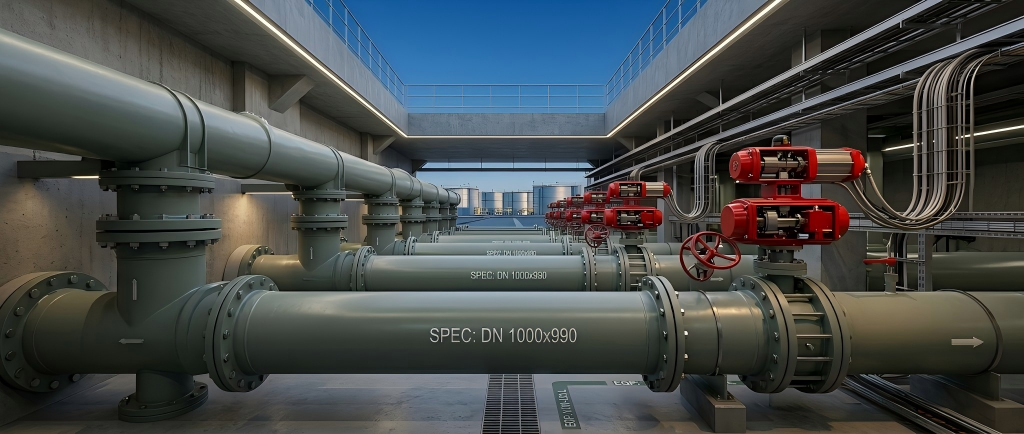
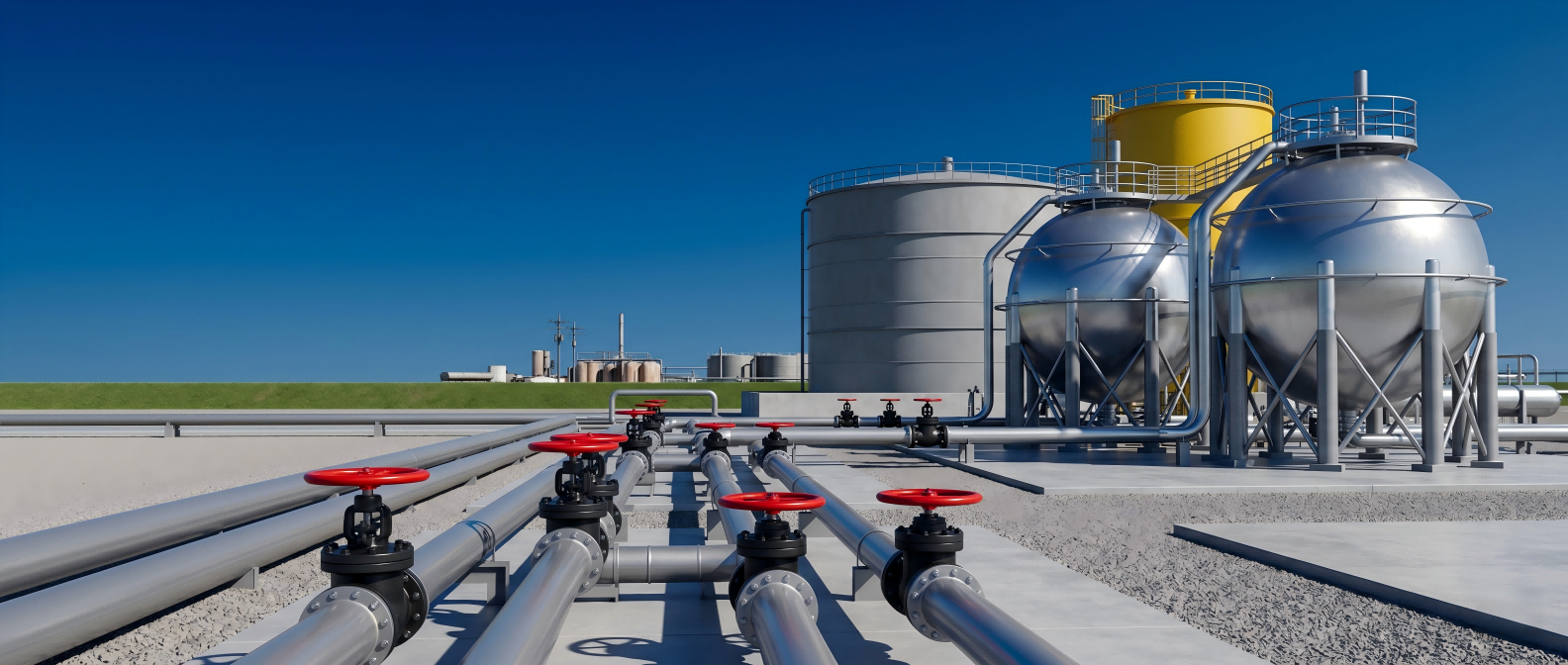
Zhejiang Juhua Chlor-Alkali Project: Engineering Application of Reinforced MC Nylon Pipe in High-Chloride Brine Systems

Reinforced MC Nylon Pipe Application in Chlor-Alkali Brine Systems
In chlor-alkali production, salt dissolution and brine purification systems are continuously exposed to high concentrations of chloride ions. Piping systems must therefore withstand not only long-term corrosion, but also scaling, leakage, maintenance challenges, and the complexity associated with operating multiple pipe materials within the same plant.
At the ion-exchange membrane caustic soda workshop of Zhejiang Juhua Co., Ltd. Electrochemical Plant, various conventional materials had previously been used, including steel-lined PO pipe, steel skeleton PE pipe, stainless steel pipe, and PVC pipe.
Beginning in 2013, DN100–DN400 reinforced MC nylon pipes were introduced into the salt dissolution process. Following satisfactory field performance, their application was expanded to the brine purification process from the second half of 2015 onward, gradually replacing several of the original pipe materials.
This project represents a practical industrial application of reinforced MC nylon piping in high-chloride corrosive environments and chlor-alkali brine transportation systems.
Project Overview
| Item | Details |
|---|---|
| End User | Zhejiang Juhua Co., Ltd. Electrochemical Plant |
| Application | Ion-Exchange Membrane Caustic Soda Workshop |
| Process | Salt Dissolution and Brine Purification |
| Pipe Material | Reinforced MC Nylon Pipe |
| Pipe Size | DN100–DN400 |
| Initial Application | 2013 |
| Expanded Application | Second Half of 2015 |
| Customer Confirmation | June 25, 2016 |
| Replaced Materials | Steel-Lined PO Pipe, Steel Skeleton PE Pipe, Stainless Steel Pipe, PVC Pipe |
| Key Challenges | Chloride Corrosion, Scaling, Leakage, and High Maintenance Costs |
1. The Challenge
Pipeline Challenges in High-Chloride Environments
Salt dissolution and brine purification are among the most demanding piping applications in ion-exchange membrane chlor-alkali production.
Chloride Corrosion
Brine contains high concentrations of chloride ions, placing significant demands on the corrosion resistance of piping materials.
If the selected piping system cannot withstand the operating medium over the long term, potential consequences may include:
-
Accelerated corrosion
-
Localized leakage
-
Increased maintenance frequency
-
Greater risk of unplanned shutdowns
For this reason, resistance to chloride-ion corrosion was one of the primary material-selection considerations in the project.
Scaling and Flow Efficiency
During long-term operation of salt dissolution and brine treatment pipelines, scaling and deposits can increase maintenance requirements and gradually reduce the effective flow area of the pipeline.
Pipeline selection therefore needs to consider not only corrosion resistance but also the long-term condition of the internal pipe surface.
Multiple Pipe Materials
The original piping system used several different materials, including:
-
Steel-lined PO pipe
-
Steel skeleton PE pipe
-
Stainless steel pipe
-
PVC pipe
Maintaining several materials within the same system means different fittings, installation methods, spare parts, maintenance procedures, and management requirements.
This increases the complexity of long-term plant operation and maintenance.
Leakage Control
In chlor-alkali plants, the reliability of pipeline joints directly affects production continuity, workplace conditions, and plant safety.
Controlling leakage at pipe connections was therefore another important requirement of the project.
2. The Solution
Gradual Replacement with Reinforced MC Nylon Pipe
To address these operating challenges, reinforced MC nylon pipe was selected for several critical process pipelines.
The installed pipe sizes ranged from:
DN100 to DN400
The primary applications included:
Salt Dissolution Systems
and
Brine Purification Systems
The first reinforced MC nylon pipelines were installed in the salt dissolution process in 2013.
After satisfactory field performance, the brine purification process began using the material on a larger scale in the second half of 2015.
The reinforced MC nylon pipes gradually replaced:
-
Steel-lined PO pipes
-
Steel skeleton PE pipes
-
Stainless steel pipes
-
PVC pipes
This implementation strategy also provides an important reference for industrial pipeline renovation projects.
Instead of replacing an entire piping system at once, plants can begin with:
high-corrosion sections, leakage-prone sections, and high-maintenance sections, verify performance under actual operating conditions, and then expand the application gradually.
3. Why Reinforced MC Nylon Pipe?
According to the customer’s formal application statement, the reinforced MC nylon piping system demonstrated several important advantages during actual operation.
01. Resistance to Chloride Corrosion
Strong Corrosion Resistance, Especially Against Chloride Ions
For salt dissolution and brine purification systems, chloride resistance is one of the most important material-selection parameters.
The corrosion-resistant characteristics of reinforced MC nylon allow the pipe material itself to resist the conveyed medium rather than relying solely on conventional metallic pipe walls or secondary corrosion-protection systems.
This provides an important advantage in chloride-rich process environments.
02. Smooth Internal Surface
High Wear Resistance with Low Scaling Tendency
The smooth internal surface of the reinforced MC nylon pipe helps reduce the accumulation of deposits and scaling during long-term brine transportation.
Maintaining a relatively smooth flow passage can help:
-
Preserve hydraulic performance
-
Reduce deposit accumulation
-
Lower cleaning requirements
-
Reduce maintenance frequency
The customer specifically identified the smooth internal surface and resistance to scaling and deposits as practical advantages observed during operation.
03. Reliable Pipe Connections
Improved Sealing Performance
One of the most valuable observations in the customer feedback concerned the reliability of pipe connections.
The reinforced MC nylon piping system demonstrated reliable sealing performance during operation, helping reduce leakage-related problems and improve the working environment around the process pipelines.
For chlor-alkali plants requiring continuous operation, joint reliability can be just as important as corrosion resistance.
04. Outdoor Durability
Aging and UV Resistance
Some chemical process pipelines are installed outdoors or in semi-outdoor environments.
Pipeline materials may therefore need to withstand not only chemical exposure, but also sunlight, weathering, temperature variation, and long-term aging.
The customer also identified aging resistance and ultraviolet resistance among the practical advantages of the reinforced MC nylon pipe.
05. Lower Lifecycle Maintenance Cost
Industrial pipeline selection should not be based solely on the purchase price per meter.
For corrosive chemical piping systems, more important questions include:
How many repairs will be required over 10 years or longer?
Does the pipeline require additional corrosion protection?
How frequently will scaling need to be removed?
How often must the system be shut down for maintenance?
What are the indirect costs associated with pipeline leakage?
According to the customer feedback, the use of reinforced MC nylon piping helped reduce costs associated with corrosion protection, insulation, and maintenance.
The real value of this project is therefore not simply that one pipe material may have a lower initial cost.
It demonstrates a broader change in industrial pipeline procurement:
Chemical pipeline selection is increasingly shifting from initial purchase price toward lifecycle cost and long-term reliability.
4. Project Implementation Timeline
2013 — Initial Application
Reinforced MC nylon pipe was first introduced into the salt dissolution process at the ion-exchange membrane caustic soda workshop of Zhejiang Juhua Electrochemical Plant.
Pipe sizes:
DN100–DN400
The initial installation achieved satisfactory operating results.
2015 — Expanded Application
Following the successful application in the salt dissolution process, the plant began using reinforced MC nylon pipe on a larger scale in the brine purification process from the second half of 2015.
The material gradually replaced the previously used:
-
Steel-lined PO pipe
-
Steel skeleton PE pipe
-
Stainless steel pipe
-
PVC pipe
June 25, 2016 — Formal Customer Confirmation
On June 25, 2016, the ion-exchange membrane workshop of Zhejiang Juhua Co., Ltd. Electrochemical Plant formally issued a:
Statement on the Application of Reinforced MC Nylon Pipe
The document confirmed the positive performance of the piping system under actual industrial operating conditions.
5. Verified Customer Feedback
Real-World Validation from an Industrial End User
One of the strongest aspects of this project is that it is supported by a formal written statement from the end user rather than relying only on manufacturer-generated marketing claims.
The customer identified six major advantages of reinforced MC nylon pipe:
-
Strong corrosion resistance, particularly against chloride-ion corrosion
-
Good aging and ultraviolet resistance
-
High wear resistance with a smooth internal surface and low tendency to scale or form deposits
-
Reliable sealing at pipe connections
-
Reduced corrosion-protection, insulation, and maintenance costs
-
Simple installation, fast construction, and satisfactory after-sales service
These observations provide valuable field evidence for evaluating reinforced nylon piping in chloride-rich chemical process systems.
6. Engineering Value
What Does This Case Mean for the Chlor-Alkali Industry?
The Zhejiang Juhua project is more than a simple product application case.
It illustrates a broader and more practical approach to chemical pipeline material selection.
From Material Comparison to Operating-Condition Matching
Pipeline selection should not simply be approached as:
Nylon vs. Stainless Steel
A more useful engineering question is:
Which piping material can provide reliable long-term performance under chloride-rich brine service conditions?
The answer depends on the actual medium, temperature, pressure, pipe diameter, installation environment, maintenance requirements, and expected service life.
From Purchase Cost to Lifecycle Cost
For corrosive chemical process piping, initial procurement cost represents only one part of total lifecycle expenditure.
A more complete evaluation should also consider:
-
Corrosion protection
-
Pipeline cleaning
-
Scaling removal
-
Leakage repairs
-
Spare parts
-
Installation time
-
Planned maintenance
-
Unplanned shutdowns
-
Production losses
A material with a higher initial price may sometimes produce a lower overall lifecycle cost if it significantly reduces maintenance and replacement requirements.
From Multiple Materials to Pipeline Standardization
Another important feature of the Zhejiang Juhua project was the gradual replacement of several different piping materials with reinforced MC nylon pipe.
Increasing material standardization can help industrial plants reduce:
-
Spare-part varieties
-
Connection standards
-
Maintenance procedures
-
Installation methods
-
Inventory requirements
-
Operational management complexity
For large continuous-process chemical plants, these benefits can become increasingly important over the service life of the plant.
7. Typical Applications
Based on the operating conditions demonstrated in this project, reinforced MC nylon pipe may be considered for engineering evaluation in applications such as:
-
Chlor-Alkali Plants
-
Brine Transportation
-
Salt Dissolution Systems
-
Brine Purification Systems
-
High-Chloride Process Water
-
Corrosive Chemical Pipelines
-
Chemical Plant Utility Pipelines
-
Pipeline Replacement and Retrofit Projects
However, pipeline material selection should always be based on the actual operating conditions of each project, including:
Medium Composition + Concentration + Temperature + Pressure + Diameter + Installation Environment
A single project case should therefore be used as an engineering reference rather than as a universal material-selection rule.
8. Conclusion
A Proven Pipeline Solution for Chloride-Rich Chemical Service
The Zhejiang Juhua ion-exchange membrane caustic soda project demonstrates a practical step-by-step application path for reinforced MC nylon pipe in the chlor-alkali industry:
2013: Initial application in the salt dissolution process
↓
2015: Expanded application in the brine purification process
↓
2016: Formal written confirmation from the customer
The key engineering benefits demonstrated by the project include:
Chloride Corrosion Resistance
Smooth, Low-Scaling Internal Surface
Reliable Sealing
Wear Resistance
Lower Maintenance Requirements
Lifecycle Cost Optimization
For chlor-alkali, salt chemical, and other high-chloride process applications currently evaluating alternatives to stainless steel, lined steel, PE, PVC, or other conventional piping materials, this project provides valuable real-world engineering reference.
Appendix
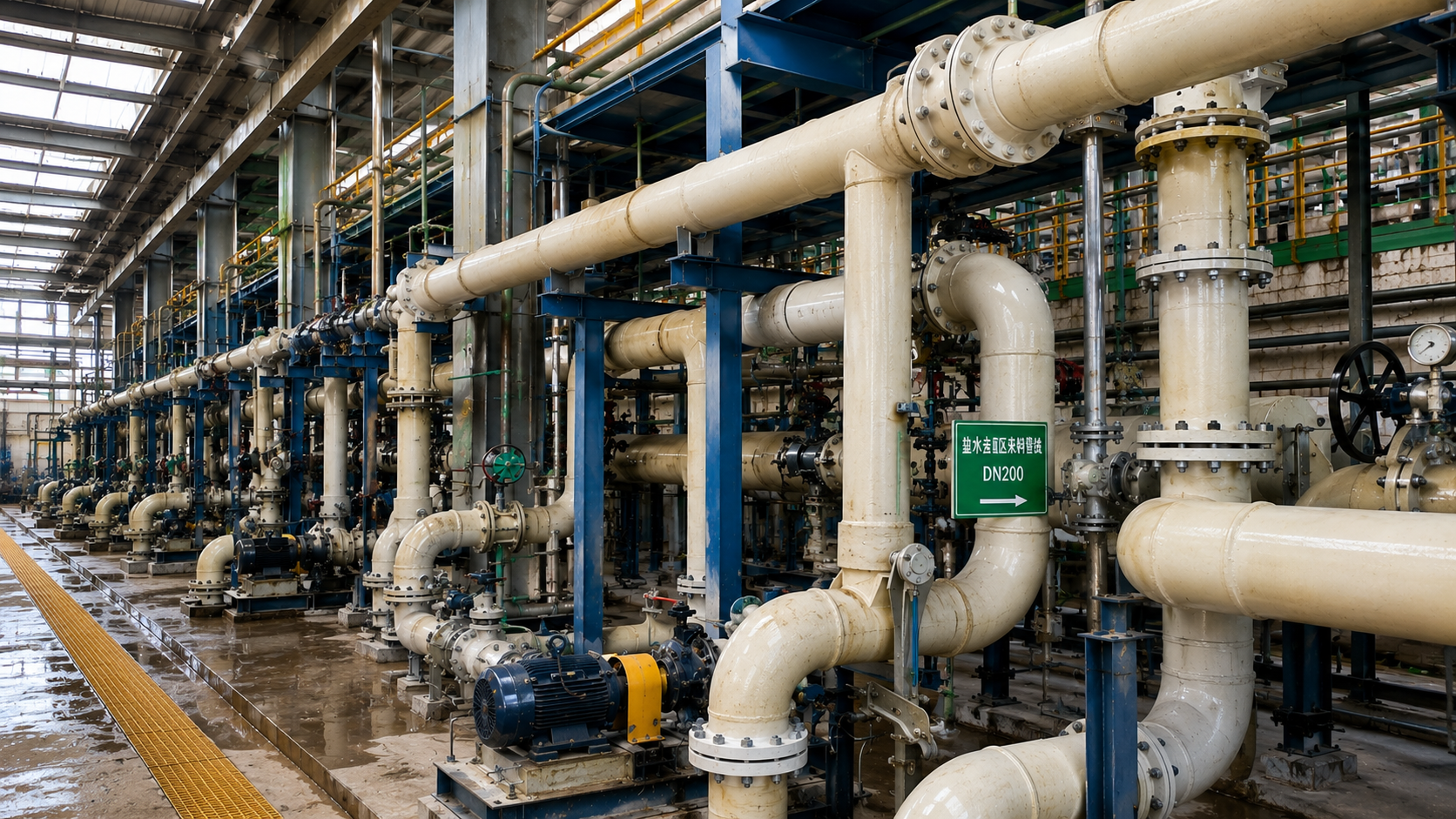
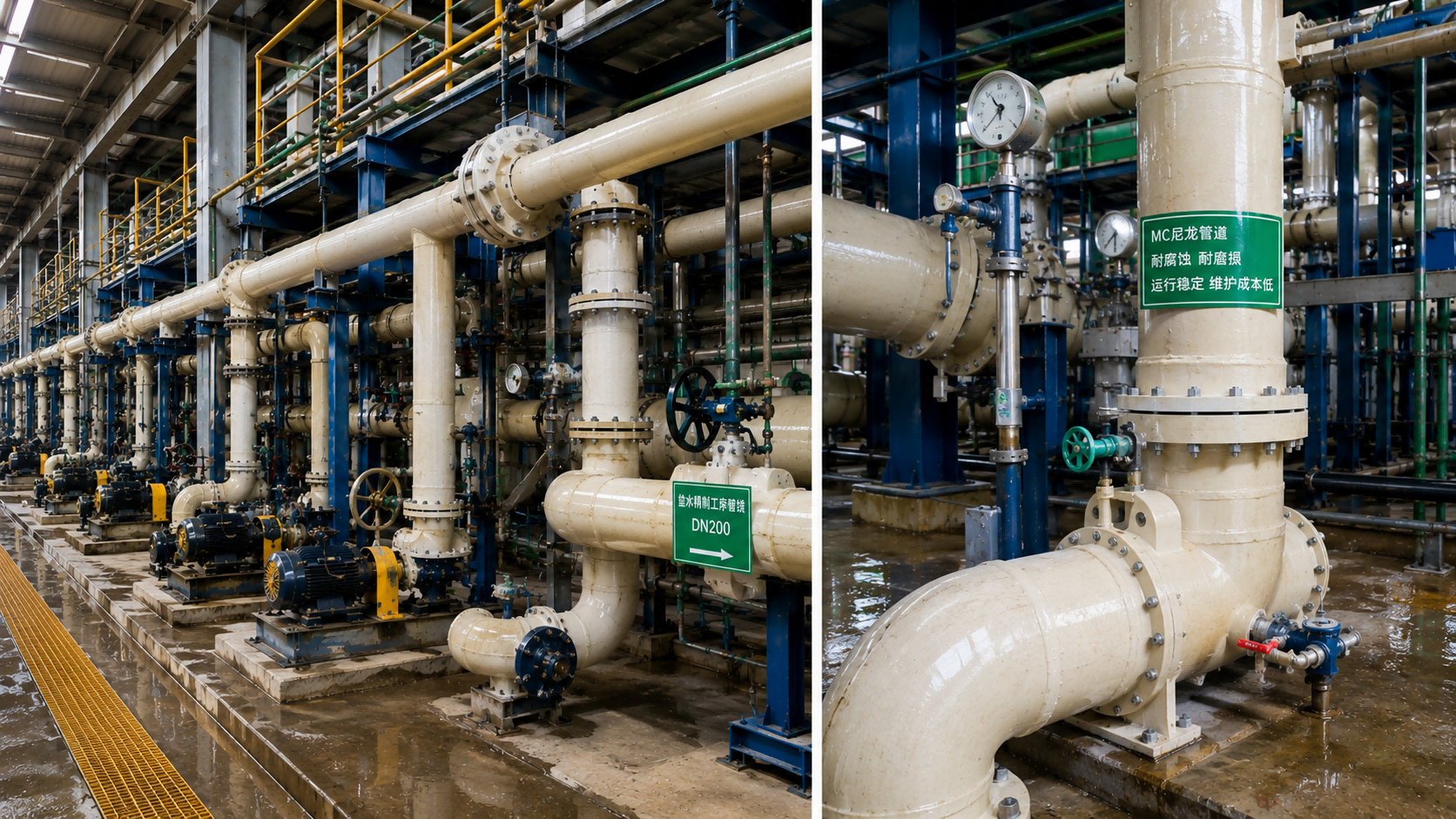
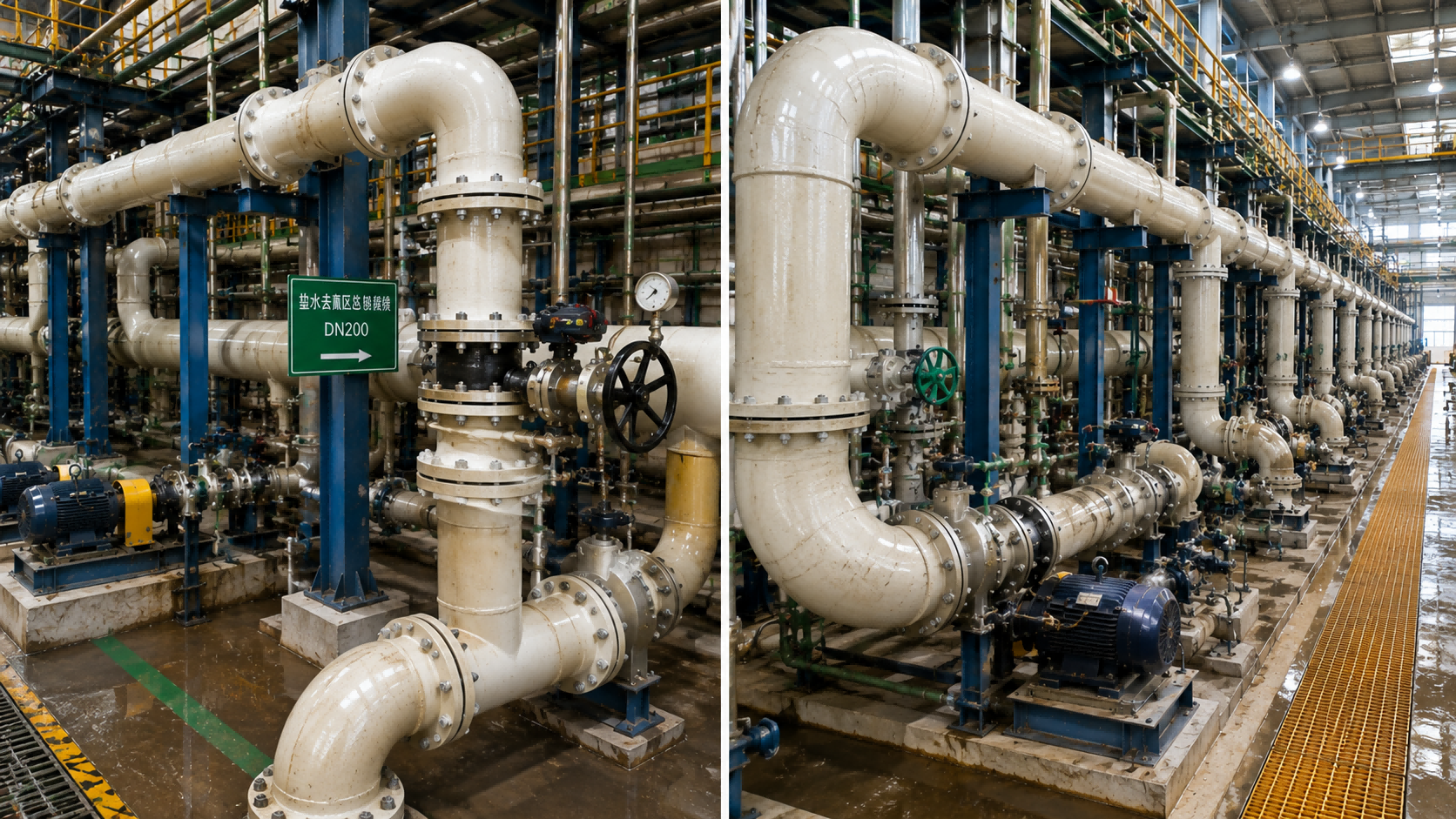
1.On-site photos
2.User feedback

Engineering Application of Reinforced MC Nylon Pipe and Steel–Nylon Composite Pipe at Shandong Haihua Soda Ash Plant
Reinforced MC Nylon Pipe Successfully Operates for Over 18 Years in Zinc Smelter Wastewater System
Related Article