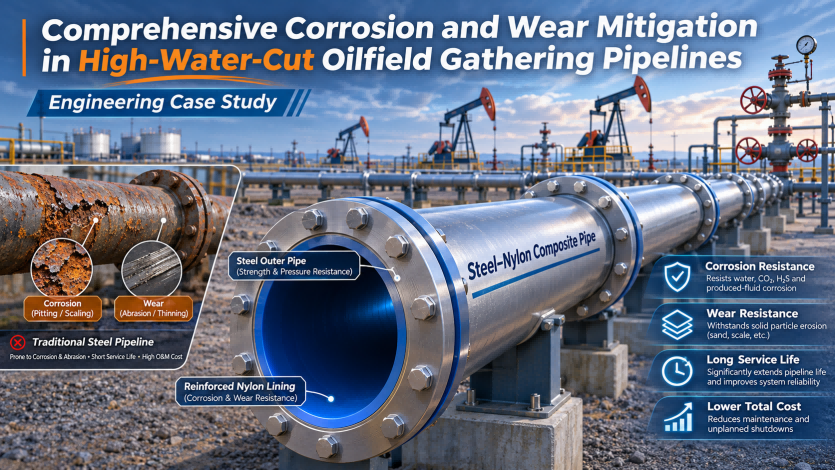
Oilfield Well Manifold Upgrade: Steel-Nylon Pipes Case Study
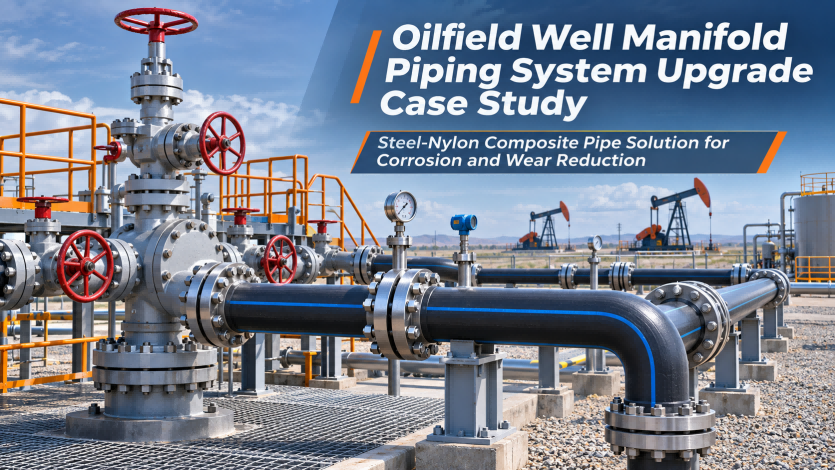
Oilfield Well Manifold Piping System Upgrade: A Comprehensive Case Study
How Steel-Nylon Composite Pipes Help Address Corrosion, Erosion, Leakage, and Maintenance Challenges in Oilfield Gathering Systems
1. Project Background: Why Do Oilfield Well Manifold Piping Systems Need Upgrading?
In modern oilfield surface gathering systems, well manifolds play a critical role in connecting multiple production wells to the gathering network. These systems are responsible for collecting produced fluids, controlling flow direction, isolating individual wells, supporting production measurement, and maintaining operational flexibility.
As oilfields enter the middle and later stages of production, operators increasingly face challenges associated with rising water cuts, higher produced-water salinity, complex multiphase flow, and aging pipeline infrastructure.
These conditions can accelerate the deterioration of conventional carbon steel piping, especially in environments containing corrosive components such as CO₂ and H₂S, high concentrations of dissolved salts, and abrasive solid particles.
Typical problems include:
1. Accelerated Internal Corrosion
High-water-cut production fluids can expose carbon steel surfaces to corrosive aqueous phases. Dissolved gases, chlorides, and other chemical components may contribute to localized corrosion, pitting, and eventual pipeline perforation.
2. Severe Localized Erosion
Sand particles transported by oil, gas, and water can cause erosion at elbows, tees, reducers, and valve connections, particularly where fluid velocity and flow direction change rapidly.
3. Increased Leakage Risk
Pipeline vibration, flange deterioration, sealing failures, and localized corrosion can compromise the integrity of manifold connections.
4. Frequent Maintenance and Replacement
Repeated repairs, welding operations, and pipe section replacements increase maintenance requirements without necessarily addressing the underlying material degradation mechanisms.
5. Production Interruptions and Higher Operating Costs
A single manifold piping failure may affect several connected production wells, resulting in production losses, additional labor costs, and potential environmental risks.
For these reasons, upgrading individual damaged pipe sections may no longer be sufficient.
A comprehensive manifold piping rehabilitation strategy should address materials, pipeline configuration, connections, installation methods, and long-term maintenance requirements.
Steel-nylon composite piping offers an alternative worth evaluating for selected oilfield applications.
2. Engineering Case Analysis: Upgrading a High-Water-Cut Oilfield Well Manifold
2.1 Existing System Conditions
This engineering case analysis considers a representative onshore oilfield well manifold operating under conditions commonly encountered in mature oilfields.
The case describes a typical engineering upgrade scenario rather than a verified project with disclosed customer-specific operating data.
The original system consists of multiple well flowlines, gathering headers, branch connections, valves, flanges, and production measurement interfaces.
Most of the existing piping uses conventional carbon steel, with welded connections and selected flanged joints.
After prolonged operation, several potential reliability challenges become increasingly important.
Challenge 1: Internal Corrosion Caused by High-Water-Cut Production
As the water cut increases, a larger proportion of the pipeline's internal surface may come into contact with produced water.
If the produced water contains dissolved CO₂, H₂S, and high concentrations of salts, electrochemical corrosion of carbon steel may occur.
Localized corrosion can become more severe in low-flow sections, liquid accumulation zones, and intermittently operated pipelines.
Challenge 2: Erosion at Complex Manifold Connections
Well manifolds typically contain numerous elbows, tees, valves, reducers, and branch connections.
When solid particles are present in the produced fluids, changes in flow velocity and direction can create localized erosion.
High-risk locations include:
-
Well flowline connections to gathering headers
-
Tee intersections and branch connections
-
High-velocity regions downstream of valves
-
Pipe reducers and sudden cross-sectional changes
-
Areas where solids accumulate or repeatedly impact the pipe wall
Over time, localized wall thinning may reduce the structural integrity of affected sections.
Challenge 3: Frequent Repairs and Production Disruptions
When corrosion or erosion causes leakage, conventional repairs may require pipeline isolation, depressurization, fluid removal, cutting, welding, and replacement.
In operating oilfields, welding activities may involve additional hot-work permits, gas testing, and strict safety procedures.
These requirements can make maintenance particularly challenging in densely arranged well manifold systems.
2.2 Main Objectives of the Upgrade
The proposed rehabilitation strategy focuses on five engineering objectives:
-
Improve resistance to internal corrosion caused by aggressive produced fluids.
-
Enhance erosion resistance in sand-containing multiphase flow conditions.
-
Optimize pipe connections and reduce potential leakage points.
-
Minimize field welding through prefabricated flanged piping.
-
Reduce long-term maintenance requirements and total lifecycle costs.
The objective is not simply to replace damaged pipes, but to improve the reliability of the entire piping system.
3. Technical Solution: Upgrading the Manifold with Steel-Nylon Composite Pipes
3.1 Why Consider Steel-Nylon Composite Pipes?
Conventional carbon steel pipes provide structural strength and are widely used in oilfield gathering systems.
However, when carbon steel is directly exposed to corrosive produced fluids, internal corrosion can become a major limitation.
Certain non-metallic piping materials offer corrosion resistance, but their suitability for demanding manifold installations must be assessed against pressure, temperature, external loading, support conditions, and mechanical integrity requirements.
Steel-nylon composite pipes combine metallic structural support with an engineered nylon protective layer.
This configuration allows different materials to perform complementary functions.
External Steel Structure
The steel component is designed to provide structural reinforcement and mechanical support.
Its functions include:
-
Supporting pressure loads within the validated design envelope
-
Providing mechanical strength and stiffness
-
Supporting integration with manifold structures and pipeline supports
-
Accommodating industrial piping installation requirements
Internal Reinforced Nylon Layer
The reinforced nylon layer acts as a protective barrier between the transported fluids and the steel substrate.
Its potential benefits include:
-
Reducing direct exposure of steel to corrosive fluids
-
Providing resistance to certain abrasive flow conditions
-
Reducing the generation of internal iron corrosion products
-
Supporting corrosion and erosion management in selected applications
By combining these functions, steel-nylon composite pipes offer a technically attractive option for certain oilfield gathering environments.
However, suitability must always be confirmed using actual operating conditions and relevant engineering verification.
3.2 Engineering Benefits of Reinforced MC Nylon
Our steel-nylon composite piping technology uses reinforced MC nylon, primarily based on Nylon 6 (PA6).
The purpose of the nylon layer is not simply to provide a protective coating. It introduces an engineered non-metallic contact surface that may improve performance in environments where both corrosion and abrasion are concerns.
Benefit 1: Reducing Internal Corrosion Exposure
When the nylon layer remains continuous, intact, and chemically compatible with the transported medium, it separates the steel substrate from the fluid.
This approach can help manage corrosion risks associated with high-salinity produced water and certain CO₂- or H₂S-containing environments.
However, the actual performance depends on chemical compatibility, permeation behavior, long-term aging, and the integrity of the composite structure.
Benefit 2: Improving Resistance to Abrasive Wear
Reinforced nylon materials have useful toughness and tribological characteristics.
Under suitable operating conditions, these properties may improve resistance to certain particle-induced wear mechanisms compared with unprotected carbon steel surfaces.
The magnitude of the benefit depends on particle concentration, particle size, flow velocity, impact angle, and temperature.
Therefore, erosion resistance should be verified using tests representative of the actual service conditions.
Benefit 3: Reducing Internal Rust Formation
In conventional carbon steel pipelines, internal corrosion can generate rust and other corrosion products.
These deposits may accumulate near valves, filters, and flow restrictions, increasing maintenance requirements.
A properly designed non-metallic internal layer can reduce direct corrosion of the underlying steel.
Nevertheless, paraffin deposition, scaling, and solids accumulation may still occur and must be addressed through appropriate pipeline operation and maintenance.
3.3 Integrally Molded Flanges: Optimizing Manifold Connections
Well manifold piping systems contain numerous connections and require convenient access for maintenance and component replacement.
Connection design therefore plays an important role in system reliability.
Our steel-nylon composite pipes incorporate an integrally formed flange design concept, emphasizing structural continuity and factory-controlled connection manufacturing.
The main advantages include:
Reduced Field Fabrication
Manufacturing flanged components under controlled factory conditions can reduce the need for additional field fabrication and welded connection work.
Compatibility with Modular Installation
Properly designed flanged connections allow composite piping sections to be assembled with compatible valves, equipment, and other piping components.
Convenient Maintenance and Replacement
Flanged sections can facilitate pipe removal and replacement during scheduled maintenance activities.
Reduced Field Hot-Work Requirements
Prefabricated flanged piping can reduce the amount of field welding required for new pipeline connections.
However, integral flange construction does not guarantee leak-free performance.
Reliable sealing still depends on flange geometry, gasket selection, bolt preload, installation accuracy, and operating conditions.
4. Comprehensive Rehabilitation: More Than Replacing Pipe Materials
Successful manifold rehabilitation requires coordinated improvements in materials, piping design, connections, and installation procedures.
4.1 Comprehensive Assessment of the Existing System
Before upgrading the piping, engineers should perform a detailed assessment of the existing manifold.
Important parameters include:
-
Production flow rate from each well
-
Normal operating pressure and maximum design pressure
-
Maximum, minimum, and continuous operating temperatures
-
Water cut, salinity, pH, CO₂, and H₂S concentration
-
Sand production rate and particle size distribution
-
Pipeline dimensions and wall thickness
-
Historical corrosion and leakage records
-
Valve, flange, and pipe support conditions
Where failures have already occurred, wall-thickness measurements, corrosion product analysis, and fluid-flow evaluation can help identify the underlying failure mechanisms.
4.2 Upgrading Different Manifold Sections
Rather than replacing every component without evaluation, engineers can classify pipeline sections according to corrosion, erosion, and leakage risk.
| Pipeline Section | Main Risks | Recommended Upgrade Approach |
|---|---|---|
| Individual well flowlines | Corrosion and sand erosion | Evaluate steel-nylon composite pipe replacement |
| Gathering headers | Multiphase corrosion and pressure loading | Reassess material and pressure design |
| Elbows and tees | Localized flow erosion | Optimize geometry and erosion protection |
| Valve connection spools | Leakage and frequent maintenance | Use compatible prefabricated flanged sections |
| Instrument connections | Sealing reliability and measurement accuracy | Retain appropriately rated specialized fittings |
| Drain and low-point sections | Liquid accumulation and localized corrosion | Improve drainage and maintenance access |
This risk-based strategy helps concentrate investment on the most critical sections.
4.3 Optimizing Flow Geometry to Reduce Erosion
Material selection alone cannot eliminate erosion risks.
In sand-producing oilfields, pipeline geometry should be evaluated carefully.
Important considerations include:
-
Appropriate elbow bend radius
-
Smooth flow transitions
-
Reduced abrupt cross-sectional changes
-
Optimized branch connection geometry
-
Control of excessive local fluid velocity
-
Proper pipe supports and vibration management
Improving flow distribution can complement the performance of corrosion- and erosion-resistant piping materials.
4.4 Reviewing Valves and Other Components
Steel-nylon composite pipes are primarily a piping solution.
Their application does not automatically eliminate the need for corrosion-resistant valves, seals, bolts, instruments, or other components.
Valve bodies, seats, gaskets, metallic fittings, and instrumentation connections should be selected independently according to their service requirements.
For sour-service applications containing H₂S, the suitability of exposed metallic components must be assessed against applicable material requirements and safety standards.
5. Installation Strategy: Reducing Field Welding with Flanged Piping
One of the major challenges in oilfield rehabilitation projects is minimizing production interruptions.
Conventional welded piping replacement may require cutting, edge preparation, welding, inspection, and field coating operations.
Prefabricated steel-nylon composite piping can simplify selected installation activities.
Stage 1: Site Survey and Engineering Confirmation
Before shutdown, engineers verify:
-
Existing manifold dimensions
-
Flange sizes and ratings
-
Pipe support positions
-
Equipment connection requirements
-
Pipeline routing and installation clearances
Based on this information, prefabricated piping sections can be designed for the installation.
Stage 2: Factory Prefabrication and Quality Inspection
Steel-nylon composite pipes, elbows, tees, and flanged components are manufactured according to the approved design.
Key quality-control activities include:
-
Composite structure inspection
-
Internal protective layer integrity checks
-
Dimensional verification
-
Flange surface and geometry inspection
-
Required pressure and sealing tests
-
Product identification and traceability
Factory prefabrication helps reduce complex processing at the installation site.
Stage 3: Shutdown, Isolation, and Removal
The existing system is isolated, depressurized, drained, cleaned, and verified safe before removal work begins.
All activities must follow applicable oilfield safety procedures, particularly where flammable gases or H₂S may be present.
Stage 4: Installation of Composite Piping
Prefabricated steel-nylon composite pipe sections are installed using appropriately designed flanged connections.
This approach can reduce the field welding required for the new piping installation.
Correct gasket selection, bolt tightening procedures, alignment, and support positioning remain essential.
Stage 5: Testing and Commissioning
After installation, the system undergoes required pressure testing, leakage inspection, and functional verification in accordance with the project specification and applicable codes.
Baseline operating parameters should be documented during commissioning to support future reliability monitoring.
6. Expected Engineering Benefits of the Upgrade
The value of a manifold rehabilitation project should not be measured solely by the purchase price of the replacement pipes.
Long-term performance, maintenance requirements, and operating reliability are equally important.
| Evaluation Factor | Conventional Carbon Steel Piping | Potential Value of Steel-Nylon Composite Piping |
|---|---|---|
| Internal corrosion | Direct exposure to corrosive fluids | Compatible nylon barrier reduces steel exposure |
| Abrasive wear | Localized metal loss from particle impact | Potential improvement under verified conditions |
| Connections | Corrosion and maintenance-related sealing problems | Engineered flanged connections support modular assembly |
| Installation | May require extensive field welding | Prefabrication reduces connection welding requirements |
| Maintenance | Reactive repairs after failures | Potential transition to planned maintenance |
| Lifecycle cost | Accumulated repair and downtime expenses | Opportunity to reduce long-term ownership costs |
These are expected engineering benefits rather than measured outcomes from a specific field installation.
Actual improvements should be verified using operating records, inspection results, maintenance histories, and long-term field performance data.
7. Technical Considerations: Are Steel-Nylon Composite Pipes Suitable for Every Oilfield?
No single pipeline material is suitable for every operating condition.
Steel-nylon composite pipes should be selected according to a validated engineering design envelope.
7.1 Pressure Ratings
Our steel-nylon composite pipe product range includes designs intended for pressure classes such as 1.0–4.0 MPa.
However, the suitability of each product depends on its diameter, temperature, connection design, mechanical loads, and verified pressure rating.
Well manifold systems may experience operating pressure fluctuations and abnormal pressure conditions.
The selected pipe must therefore satisfy the applicable design requirements, including credible maximum-pressure scenarios.
Applications exceeding the validated product rating require an alternative design.
7.2 Operating Temperature and Long-Term Durability
Reinforced nylon materials can be engineered for a range of operating temperatures.
However, short-term thermal resistance is not the same as long-term pressure-bearing capability.
Nylon 6 absorbs moisture, and prolonged exposure to hot water or chemically aggressive conditions may influence its mechanical properties and hydrolytic aging behavior.
Therefore, material evaluation should consider:
-
Continuous operating temperature
-
Pressure retention over time
-
Moisture absorption
-
Chemical exposure
-
Long-term aging and degradation
-
Thermal cycling and dimensional stability
7.3 CO₂, H₂S, and Complex Produced Fluids
A non-metallic internal layer can reduce direct contact between corrosive fluids and the steel substrate.
However, this does not establish universal compatibility with all sour-service or chemically aggressive environments.
Important verification areas include:
-
Long-term chemical compatibility
-
Gas permeation through the polymer
-
Rapid gas decompression effects
-
Integrity of the composite interface
-
Corrosion exposure at metallic connections
-
Gasket and sealing material performance
Representative laboratory testing and proven field performance should support material qualification.
7.4 Large-Diameter and Customized Piping
In addition to conventional oilfield manifold piping, our manufacturing capabilities include large-diameter reinforced nylon and steel-nylon composite piping technologies.
Customized solutions may be evaluated for gathering headers, industrial water pipelines, and other larger-diameter applications.
However, manufacturing capability alone does not establish pressure or temperature suitability for every diameter.
Each design must be independently assessed and validated.
8. Economic Analysis: Evaluating Total Cost of Ownership
Industrial piping procurement decisions often focus heavily on the initial purchase price.
For oilfield gathering systems, however, the total cost of ownership can be significantly influenced by maintenance requirements, unplanned downtime, and the frequency of pipeline replacement.
A simplified lifecycle cost model is:
TCO = Initial Procurement Cost + Installation Cost + Maintenance Cost + Failure Repair Cost + Production Downtime Cost + End-of-Life Cost
When comparing conventional carbon steel pipes with steel-nylon composite pipes, engineers should consider:
-
Initial material and fabrication costs
-
Installation labor and shutdown requirements
-
Inspection and routine maintenance costs
-
Repair frequency and replacement intervals
-
Production losses associated with pipeline failures
-
Environmental and leakage response costs
-
Long-term lifecycle cost expressed in present-value terms
Steel-nylon composite piping may require a higher initial investment than conventional carbon steel.
However, if improved material performance is demonstrated through operating experience, reductions in maintenance and downtime may offset part or all of that initial difference.
The appropriate selection should be based on a transparent engineering and economic comparison rather than material price alone.
9. Lessons for Future Oilfield Manifold Rehabilitation Projects
This engineering case analysis highlights the importance of moving beyond isolated pipe repairs toward comprehensive system rehabilitation.
For oilfields operating under high-water-cut, high-salinity, sand-producing, and complex multiphase-flow conditions, three principles are particularly important.
9.1 Upgrade the Material System
Selecting piping materials with verified corrosion and erosion performance can help address the limitations of unprotected carbon steel in certain applications.
Steel-nylon composite piping provides an option for consideration where a reinforced polymer barrier and metallic structural support are both desirable.
9.2 Upgrade Connections and Installation Methods
Integrally formed flanges, factory prefabrication, and modular installation can reduce field fabrication requirements and simplify maintenance activities.
A properly engineered flange system can also improve consistency during installation and component replacement.
9.3 Upgrade the Economic Evaluation Model
Pipeline selection should consider the complete operating lifecycle rather than initial procurement cost alone.
Reliability, inspection requirements, maintenance frequency, production interruptions, and repair costs should all contribute to the final engineering decision.
This approach supports the transition from purchasing individual piping products toward developing integrated, long-term industrial piping solutions.
10. Conclusion: A New Approach to Oilfield Well Manifold Piping Rehabilitation
As oilfields mature, gathering systems increasingly encounter challenging combinations of water-induced corrosion, particle erosion, pressure fluctuations, and rising maintenance demands.
Traditional approaches based on repeated local repairs and replacement of damaged carbon steel sections may not adequately address these long-term challenges.
A comprehensive rehabilitation strategy should combine material selection, improved pipeline geometry, reliable connections, factory prefabrication, and appropriate inspection procedures.
Steel-nylon composite pipes offer a potential solution for selected operating conditions by combining metallic structural support with the protective characteristics of reinforced nylon.
When properly designed and validated, these systems can support:
-
Improved management of internal corrosion
-
Better performance in certain abrasive service conditions
-
Reduced field welding requirements
-
More convenient modular installation
-
Simplified maintenance and pipe replacement
-
Improved long-term lifecycle cost potential
The primary value of steel-nylon composite piping is not simply replacing conventional steel pipes. It is helping oilfield operators develop more reliable, maintainable, and cost-effective piping infrastructure.
For operators planning well manifold upgrades, gathering pipeline rehabilitation, or high-water-cut oilfield infrastructure modernization, steel-nylon composite piping deserves consideration as part of a comprehensive technical and economic evaluation.
About Us: Steel-Nylon Composite Pipe Manufacturer
We specialize in the development and manufacturing of reinforced MC nylon pipes and steel-nylon composite pipes for demanding industrial applications.
Our product portfolio includes:
-
Reinforced MC Nylon Pipes
-
Steel-Nylon Composite Pipes
-
Integrally Formed Flanged Piping Systems
-
Customized Industrial Pressure Pipes
-
Large-Diameter Industrial Piping Solutions
-
Corrosion- and Wear-Resistant Piping for Oil & Gas, Chemical Processing, Mining, and Industrial Infrastructure
Our manufacturing approach focuses on combining material engineering, structural design, factory-controlled production, and application-specific technical evaluation.
We aim to help industrial customers reduce maintenance requirements, improve pipeline reliability, and optimize long-term operating costs.
Planning an Oilfield Well Manifold Piping Upgrade?
If your oilfield project faces challenges involving corrosion, sand erosion, frequent leakage, or high maintenance costs, our technical team can help evaluate suitable piping solutions.
Share your pipeline dimensions, design pressure, operating temperature, fluid composition, and engineering drawings with us to begin a preliminary technical assessment.
Visit our website: //www.nylonpipeline.com
Steel-Nylon Composite Pipes — Engineered for Corrosion Resistance, Wear Performance, and Long-Term Industrial Reliability.
High-Water-Cut Oilfield Pipeline Corrosion & Wear Case Study