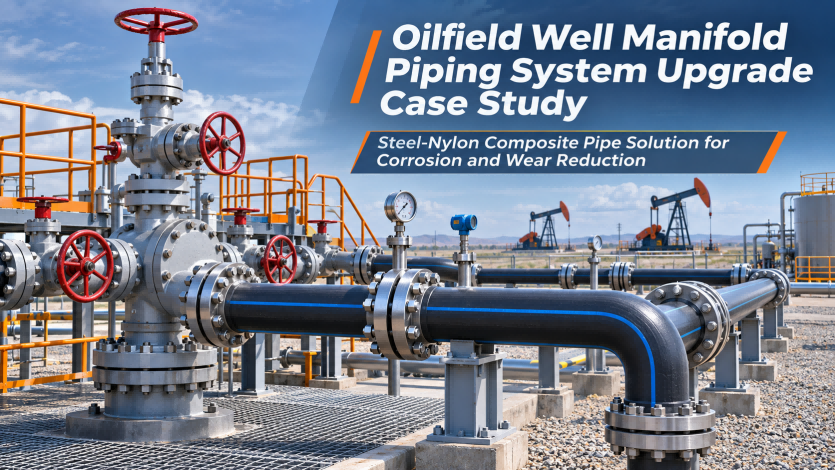
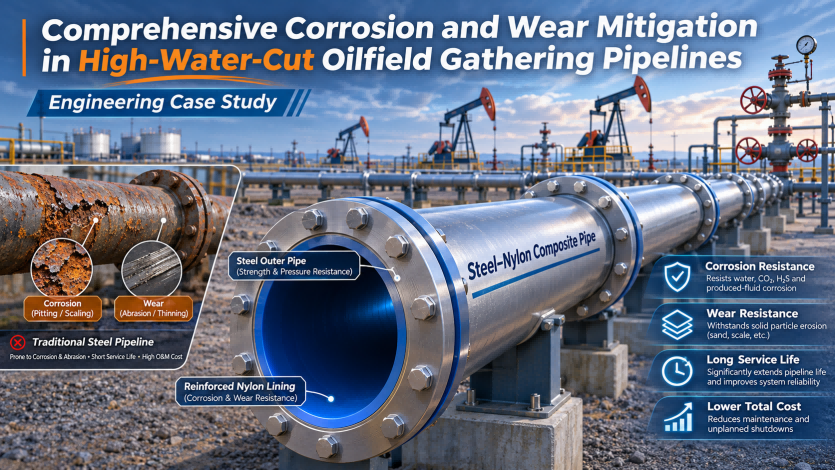
High-Salinity Produced Water Pipelines: Long-Term Case Study
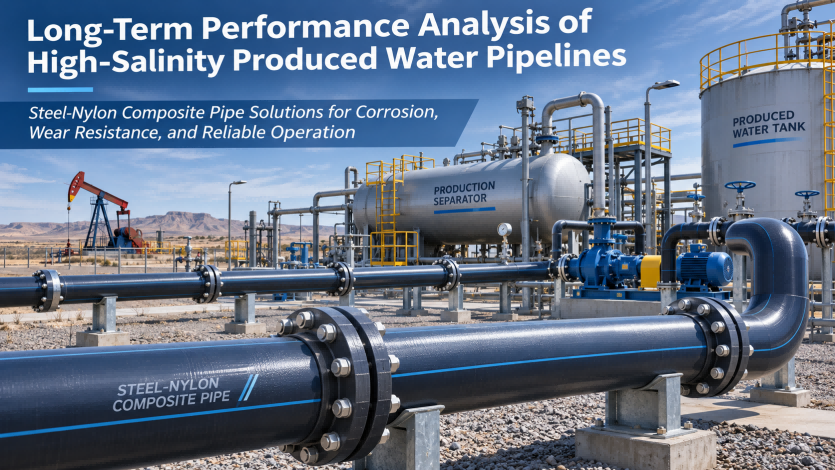
Long-Term Performance Analysis of High-Salinity Produced Water Pipelines: An Oilfield Case Study
Introduction: Why High-Salinity Produced Water Is Changing Pipeline Material Selection
As oil and gas fields enter the middle and late stages of production, increasing water cuts are creating significant challenges for pipeline infrastructure. The collection, transportation, treatment, and reinjection of produced water have become essential components of modern oilfield operations.
In mature oilfields, pipelines no longer transport relatively simple fluids such as crude oil or natural gas alone. Instead, they frequently handle complex mixtures of high-salinity produced water, residual hydrocarbons, dissolved gases, mineral salts, and suspended solids.
Under these demanding conditions, conventional carbon steel pipelines may experience internal corrosion, mineral scaling, localized erosion, leakage, and frequent maintenance.
The combination of high chloride concentrations, dissolved CO₂ and H₂S, pressure fluctuations, and abrasive particles can further accelerate pipeline deterioration.
Consequently, pipeline reliability is no longer determined solely by initial material strength. Long-term performance depends on corrosion resistance, wear resistance, structural integrity, hydraulic efficiency, and connection reliability.
This raises an important engineering question:
Can advanced composite pipeline materials reduce corrosion-related failures at the source rather than relying primarily on chemical inhibitors, repeated repairs, and periodic replacement?
Steel-nylon composite pipes offer a promising engineering approach.
By combining the mechanical strength of steel with the corrosion-resistant and wear-resistant characteristics of reinforced MC nylon, these pipes are designed to address multiple operational challenges simultaneously.
This article examines the long-term operating considerations of high-salinity produced water pipelines, explores an actual oilfield application, and analyzes the engineering advantages and limitations of steel-nylon composite piping systems.
1. Why Is High-Salinity Produced Water So Challenging for Oilfield Pipelines?
1.1 High Salinity Creates Complex Corrosion Conditions
The chemical composition of produced water varies significantly among oilfields.
Depending on reservoir geology and production history, produced water may contain much higher concentrations of dissolved salts than freshwater or seawater.
In some highly mineralized reservoirs, total dissolved solids (TDS) concentrations may exceed 200,000 mg/L.
Common dissolved constituents include:
-
Chloride ions (Cl⁻)
-
Sodium ions (Na⁺)
-
Calcium ions (Ca²⁺)
-
Magnesium ions (Mg²⁺)
-
Barium ions (Ba²⁺)
-
Strontium ions (Sr²⁺)
-
Sulfate ions (SO₄²⁻)
-
Bicarbonate ions (HCO₃⁻)
These substances influence pipeline performance in different ways.
High chloride concentrations may increase localized corrosion risks for certain metallic materials, while calcium, barium, strontium, and other dissolved minerals can contribute to scale formation under specific operating conditions.
However, salinity alone does not determine the corrosiveness of produced water.
Temperature, pH, dissolved oxygen, CO₂ partial pressure, H₂S concentration, fluid velocity, and other factors must also be considered.
1.2 CO₂ and H₂S Introduce Additional Corrosion Risks
Carbon dioxide dissolves in produced water and participates in carbonic acid equilibria, potentially causing corrosion of carbon steel.
The severity of CO₂ corrosion depends on several factors, including:
-
CO₂ partial pressure
-
Operating temperature
-
Water chemistry and pH
-
Flow velocity
-
Stability of corrosion-product films
In sour oilfields, hydrogen sulfide introduces additional material integrity concerns.
Depending on the operating environment, H₂S exposure may contribute to corrosion and sulfide stress cracking risks in susceptible metallic components.
When high salinity, dissolved gases, and suspended particles occur together, conventional pipeline systems may experience several deterioration mechanisms simultaneously.
1.3 Scale Formation Can Reduce Pipeline Efficiency
During produced water transportation, changes in pressure, temperature, and water composition may alter mineral solubility.
Common scales include:
| Scale Type | Typical Formation Conditions | Potential Pipeline Problems |
|---|---|---|
| Calcium carbonate (CaCO₃) | Changes in pressure, temperature, or pH | Reduced flow area and increased pressure drop |
| Barium sulfate (BaSO₄) | Mixing incompatible waters containing barium and sulfate | Hard deposits and difficult cleaning |
| Strontium sulfate (SrSO₄) | Changes in water chemistry or mixing conditions | Deposits and flow restrictions |
| Iron sulfide (FeS) | Reactions involving dissolved sulfides and iron | Deposits, localized blockage, and fouling |
Accumulated deposits can restrict flow, increase pumping requirements, and contribute to localized under-deposit corrosion on susceptible metal surfaces.
Therefore, pipeline material selection must consider both corrosion resistance and long-term hydraulic performance.
1.4 Suspended Solids Cause Abrasive Wear
Produced water may contain formation sand, corrosion products, and suspended particles.
At elbows, reducers, valves, tees, and pump outlets, changes in flow direction and velocity can cause particles to strike pipeline surfaces.
When abrasive wear and corrosion occur together, localized wall loss may become more severe.
An effective produced water pipeline must therefore provide an appropriate combination of:
Corrosion resistance, abrasion resistance, mechanical strength, pressure capability, and reliable connections.
2. Oilfield Case Study: Pipeline Upgrading in the Shengli Oilfield
2.1 Project Background
The Shengli Oilfield in China includes mature production areas operating under challenging high-water-cut conditions.
According to published application information from Guangdong Kejin New Materials Co., Ltd., the Gudong Oil Production Plant has experienced an overall water cut of approximately 97.2%, with certain production areas exceeding 98%.
Under these conditions, pipeline systems must transport complex mixtures of water, oil, gas, and potentially abrasive particles.
Conventional metallic pipelines may face challenges involving internal corrosion, localized wear, and maintenance requirements.
These operating conditions create a strong engineering incentive to evaluate alternative pipeline materials.
2.2 Application of Steel-Nylon Composite Pipes
To address corrosion and wear-related concerns, reinforced MC nylon-steel composite pipes were introduced into selected gathering and transportation pipelines.
Published project information provides the following details:
| Project Parameter | Reported Information |
|---|---|
| Project location | Gudong Oil Production Plant, Shengli Oilfield, China |
| Application | Oilfield gathering and transportation pipeline upgrading |
| Pipeline material | PAMC reinforced MC nylon-steel composite pipe |
| Initial installation | 2015 |
| Reported cumulative installation | Approximately 2.6 km |
| Transported media | Heavy crude oil, produced water, and oil-water-gas mixtures |
| Connection method | Flanged connections |
| Application components | Wellhead manifold systems, gathering lines, elbows, reducers, manifolds, and station piping |
Important qualification: This is a documented high-water-cut oilfield application. The publicly available project information does not establish a complete produced-water salinity profile, chloride concentration, corrosion rate, or verified long-term failure statistics.
Therefore, it should not be interpreted as proof of performance at a particular TDS concentration.
Nevertheless, the application provides a useful engineering reference for evaluating steel-nylon composite pipes in complex produced-fluid transportation systems.
2.3 Why Was a Phased Pipeline Replacement Strategy Used?
Replacing an entire pipeline network in an operating oilfield may involve substantial investment, construction complexity, and production interruptions.
A more practical strategy is to prioritize high-risk pipeline sections.
These may include:
-
Pipeline segments with repeated corrosion-related leakage
-
Elbows subjected to particle impingement
-
Wellhead manifold systems with multiple connections
-
Pump discharge pipelines
-
High-maintenance valves and fittings
-
Sections requiring frequent shutdowns or replacement
A phased replacement program allows operators to manage capital expenditure while gradually obtaining operating experience with alternative materials.
This approach can also be applied to high-salinity produced water transportation systems.
3. Why Steel-Nylon Composite Pipes Are Suitable Candidates for High-Salinity Produced Water Transportation
3.1 Combining Steel Strength with Nylon Corrosion Protection
Steel-nylon composite pipes are engineered to combine different material functions within a single pipeline structure.
The steel component provides mechanical strength and structural support.
The reinforced nylon inner layer forms the primary surface in contact with the transported medium.
The nylon material used in reinforced MC nylon systems is primarily based on Polyamide 6 (PA6), commonly known as Nylon 6.
When appropriately formulated, manufactured, and qualified for the intended service, the nylon layer can act as a protective barrier between corrosive produced water and the steel pressure-bearing structure.
This design can help reduce the risk of internal electrochemical corrosion affecting the steel.
The effectiveness of this protection depends on the integrity of the inner layer and the design of pipe ends, flanges, transitions, and other connections.
3.2 Corrosion Resistance and Abrasion Resistance in One Structure
High-salinity produced water may contain abrasive particles, especially in mature oilfields experiencing sand production.
At locations where flow direction changes, suspended particles can repeatedly strike the internal pipeline surface.
Reinforced MC nylon offers useful toughness and wear-resistance characteristics, making it a candidate material for certain abrasive fluid transportation applications.
Potential advantages include:
-
Reduced direct exposure of steel to corrosive fluids
-
Improved resistance to selected abrasive wear mechanisms
-
Protection of the steel structure against internal fluid contact
-
Application flexibility for elbows, reducers, and other fabricated fittings
However, abrasion performance must be verified under actual operating conditions.
Particle size, solids concentration, fluid velocity, impact angle, and temperature all influence wear behavior.
No pipeline material should be assumed to provide unlimited abrasion resistance.
3.3 Smooth Internal Surfaces Support Hydraulic Performance
One of the long-term operational challenges of produced water transportation is the gradual reduction of flow capacity.
In conventional steel pipelines, internal corrosion products and accumulated deposits may increase surface roughness and reduce the effective internal diameter.
Steel-nylon composite pipes feature a relatively smooth nylon inner surface.
This design can help reduce roughness increases caused by steel corrosion and may limit the adhesion of certain deposits.
Potential operational benefits include:
-
More stable internal surface conditions
-
Reduced corrosion-product accumulation
-
Improved hydraulic efficiency under suitable operating conditions
-
Easier maintenance in selected applications
Nevertheless, a smooth nylon surface cannot prevent all forms of mineral scale.
Barium sulfate, calcium carbonate, and other deposits may still form when water chemistry favors precipitation.
Chemical treatment and scale-management strategies remain necessary where appropriate.
3.4 Integrated Flange Connections Reduce On-Site Welding
Pipeline installation and maintenance are particularly challenging in operating oilfields.
Conventional welded steel pipeline construction may require:
-
Pipe cutting and alignment
-
Welding
-
Weld inspection
-
Corrosion protection of welded joints
-
Hot-work permits and associated safety procedures
Guangdong Kejin New Materials Co., Ltd. manufactures steel-nylon composite pipes with integrated molded flange connection designs.
These systems can be installed using prefabricated pipe sections, flanges, and compatible fittings.
Potential advantages include reduced field welding, fewer hot-work activities, improved installation efficiency, and easier removal of individual sections during maintenance.
Flanged connections also offer practical benefits for wellhead manifolds, gathering stations, and other installations requiring periodic access.
However, long-term leak tightness depends on correct flange design, gasket selection, bolt preload, assembly procedures, and maintenance.
Integrated flange technology reduces certain installation challenges but does not eliminate the need for proper joint engineering.
3.5 Mechanical Strength and Industrial Pressure Capability
Unlike pipes that rely entirely on polymer materials for structural resistance, steel-nylon composite pipes utilize a steel structure for mechanical support.
Guangdong Kejin New Materials Co., Ltd. offers product configurations with nominal pressure classes in the approximate range of 1.0–4.0 MPa, subject to specific product designs.
Large-diameter configurations are also available for industrial applications.
These characteristics make steel-nylon composite pipes worth evaluating for produced water transfer, oilfield gathering lines, station piping, and certain industrial water transportation systems.
The allowable operating pressure must be determined using the actual pipe configuration, diameter, design temperature, connection rating, material qualification, and applicable engineering requirements.
4. How Should Long-Term Pipeline Performance Be Evaluated?
A pipeline should not be considered suitable for long-term high-salinity service solely because it passes its initial hydrostatic pressure test.
Reliable performance requires ongoing monitoring and documented operating experience.
4.1 Structural Integrity
Regular inspection should evaluate the condition of the nylon inner layer and the overall composite structure.
Potential concerns include:
-
Excessive abrasion
-
Cracking or deformation
-
Liner separation
-
Localized structural damage
-
Damage at pipe ends or connections
Depending on accessibility and the inspection program, borescope examinations, representative sampling, or validated nondestructive techniques may be used.
4.2 Hydraulic Performance
Operators should compare operating pressure drops at similar flow rates, temperatures, and fluid conditions.
An increasing pressure drop may indicate:
-
Scale formation
-
Sediment accumulation
-
Partial blockage
-
Changes in fluid properties
-
Localized restrictions
These factors should be investigated before attributing hydraulic changes to pipeline material performance.
4.3 Leakage and Maintenance Frequency
A long-term operating assessment should document:
-
Number of unplanned leaks
-
Flange and gasket replacements
-
Repair frequency
-
Annual maintenance expenditure
-
Unplanned shutdown duration
These indicators provide more meaningful evidence of lifecycle reliability than a single installation inspection.
4.4 Corrosion and Wear Monitoring
Although a nylon inner layer does not corrode through the same electrochemical mechanism as carbon steel, the entire pipeline system may still contain exposed metallic components.
External steel surfaces, connectors, valves, transition pieces, and adjacent equipment require appropriate corrosion protection and inspection.
4.5 Recommended Long-Term Monitoring Indicators
| Performance Indicator | Monitoring Method | Objective |
|---|---|---|
| Leakage frequency | Failure and repair records | Reduce unplanned leaks |
| Inner-layer wear | Borescope or sample inspections | Detect abnormal wear |
| Scaling tendency | Water chemistry and pressure-drop analysis | Control mineral deposits |
| Hydraulic efficiency | Flow rate and pressure monitoring | Maintain transportation performance |
| Flange integrity | Joint inspection and leak detection | Maintain connection reliability |
| Shutdown duration | Annual operating records | Minimize unplanned downtime |
| Maintenance cost | Annual cost analysis | Reduce lifecycle expenditure |
Monitoring should begin with baseline measurements after commissioning.
Follow-up assessments may be scheduled at 6, 12, and 24 months, followed by periodic evaluations based on operating risk.
5. Comparing Pipeline Materials for High-Salinity Produced Water Service
Oilfield operators commonly evaluate several material options for produced water transportation.
These may include carbon steel, stainless steel, HDPE, fiberglass-reinforced plastic (FRP), and composite piping systems.
Each material offers different advantages and limitations.
| Pipeline Material | Main Advantages | Key Considerations in High-Salinity Service |
|---|---|---|
| Carbon steel | High mechanical strength, established design practices, often lower initial material cost | Internal corrosion, corrosion mitigation expenses, scaling |
| Stainless steel | Good performance in appropriately selected environments | Chloride-induced localized corrosion, alloy selection, material cost |
| HDPE | Resistance to metallic electrochemical corrosion, established installation methods | Temperature limits, pressure derating, long-term creep |
| FRP | Corrosion resistance and relatively low weight | Joint quality, impact resistance, abrasion, design limitations |
| Steel-nylon composite pipe | Steel structural strength, corrosion-resistant inner layer, wear protection, flanged assembly | Material compatibility, pressure-temperature qualification, liner and joint integrity |
The main advantage of steel-nylon composite piping is not that it outperforms every alternative in every individual property.
Instead, it offers a combination of characteristics that can be valuable in applications involving multiple challenges:
Corrosive fluids + abrasive particles + structural requirements + complex connections + lifecycle cost control.
This combination provides an important basis for engineering evaluation.
6. How Steel-Nylon Composite Pipes Can Reduce Total Cost of Ownership
A common mistake in industrial pipeline procurement is to compare materials solely by their purchase price per meter.
For high-salinity produced water systems, the initial material cost may represent only part of the total expenditure.
A more comprehensive evaluation considers Total Cost of Ownership (TCO).
A simplified calculation is:
TCO = Material Cost + Installation Cost + Inspection and Maintenance Cost + Chemical Treatment and Cleaning Cost + Replacement Cost + Downtime Losses + Risk-Related Costs
Where appropriate, future costs should be discounted to their present value.
6.1 Potentially Lower Corrosion-Related Maintenance
When the nylon inner layer remains intact throughout the intended service period, it can prevent direct contact between produced water and the steel pressure-bearing component.
This may reduce certain internal corrosion-related repair requirements.
Potential benefits include fewer corrosion-related replacements, less localized repair work, and lower associated maintenance expenditure.
6.2 Longer Maintenance Intervals in Selected Abrasive Applications
Where abrasive wear is a major concern, an appropriately qualified reinforced nylon lining may improve maintenance intervals.
The effectiveness depends on the actual solids loading, fluid velocity, component geometry, and wear mechanism.
6.3 Reduced Installation Complexity
Integrated molded flanges and prefabricated fittings reduce the need for welding during field assembly.
In operating oilfield facilities where hot-work activities require strict controls, this can provide additional construction and safety-management advantages.
6.4 Reduced Exposure to Production Downtime
An unexpected pipeline failure may create costs beyond the physical repair.
These can include:
-
Production interruption
-
Emergency maintenance
-
Equipment shutdown
-
Environmental response
-
Additional operational coordination
For critical gathering and produced water transportation lines, improved reliability may have substantial economic value.
However, actual savings must be established through project-specific calculations using realistic failure rates, repair expenses, and production losses.
The most economical pipeline is not necessarily the one with the lowest purchase price, but the one providing the lowest justified lifecycle cost while meeting safety and performance requirements.
7. Five Critical Engineering Considerations for Long-Term Service
Although steel-nylon composite pipes offer attractive characteristics, proper engineering qualification remains essential.
7.1 Operating Temperature and Pressure
The short-term temperature resistance of a polymer should not be confused with its continuous pressure-bearing service temperature.
Long-term exposure to elevated temperatures may affect nylon mechanical properties, dimensions, and aging behavior.
The selected pipe must therefore be qualified against the actual operating temperature and pressure profile.
7.2 Water Absorption and Dimensional Stability
PA6 is a moisture-absorbing polymer.
Long-term water exposure may influence dimensional stability and certain mechanical properties.
Engineers should evaluate the effects of moisture absorption on the inner layer, interface, and connection design.
7.3 Chemical Compatibility
Produced water treatment systems may introduce various chemicals, including:
-
Biocides
-
Corrosion inhibitors
-
Scale inhibitors
-
Oxygen scavengers
-
Cleaning chemicals
Compatibility must be established based on actual chemical concentrations, operating temperatures, and exposure durations.
Particular attention should be given to aggressive acid cleaning procedures and strong oxidizing agents.
7.4 Sour-Service and Gas Permeation Considerations
If the transported medium contains H₂S or other permeating gases, additional evaluation may be required.
Potential concerns include gas permeation through the polymer layer, accumulation behind the liner, decompression effects, and protection of metallic components.
The presence of a polymer liner does not automatically exempt metallic pressure-containing components from applicable sour-service requirements.
7.5 Flange Integrity and External Corrosion
External steel structures may remain exposed to atmospheric, soil, or marine corrosion.
Appropriate external protective systems and inspection practices are necessary.
Flange assemblies must also be designed for the expected pressure, temperature, fluid compatibility, and maintenance conditions.
Long-term pipeline reliability depends on the entire system rather than the inner lining alone.
8. Why High-Risk Pipeline Sections Should Be Upgraded First
For mature oilfields operating extensive steel pipeline networks, full replacement may not be practical or economically justified.
A risk-based upgrading strategy offers a more manageable approach.
Step 1: Analyze the Operating Environment
Collect relevant data, including:
-
Produced water TDS and ionic composition
-
Chloride concentration
-
Operating pressure and temperature
-
CO₂ and H₂S content
-
pH
-
Suspended solids concentration
-
Flow rate and velocity
-
Historical failure records
Step 2: Identify High-Risk Sections
Prioritize pipelines experiencing recurring corrosion leaks, high wear rates, significant maintenance costs, or major consequences from unplanned shutdowns.
Step 3: Verify Material Compatibility
Conduct appropriate corrosion, abrasion, immersion, pressure-temperature, and connection performance evaluations.
Particular attention should be given to the integrity of the nylon layer and pipe-end transitions.
Step 4: Install Representative Trial Sections
Introduce steel-nylon composite pipes into selected pipeline sections under representative conditions.
Whenever practical, compare their performance with existing materials operating under similar conditions.
Step 5: Expand Deployment Based on Evidence
If trial installations demonstrate acceptable structural integrity, hydraulic performance, leakage control, and maintenance economics, the technology can be considered for broader deployment.
This step-by-step method helps operators manage technical uncertainty while generating valuable operating data.
9. What This Oilfield Application Reveals About the Future of Pipeline Technology
The challenges associated with high-salinity produced water transportation reflect a broader shift in industrial pipeline engineering.
Historically, many pipeline systems relied on increased steel wall thickness, corrosion-resistant coatings, chemical inhibition, and periodic replacement to manage deterioration.
These methods remain important and effective in appropriately designed systems.
However, as oilfields experience increasing water cuts, aggressive brines, abrasive particles, and rising maintenance demands, operators may need to consider alternative approaches.
Steel-nylon composite pipes represent a different design philosophy:
Use a multifunctional composite structure to separate corrosive fluids from the metallic pressure-bearing component while addressing mechanical strength and wear requirements.
In this arrangement:
-
Steel provides structural support and pressure resistance.
-
Reinforced MC nylon forms the corrosion-resistant internal contact surface.
-
The inner layer offers potential abrasion protection.
-
Integrated molded flanges support prefabrication and installation without field welding of pipe joints.
Published application information from the Gudong Oil Production Plant demonstrates that steel-nylon composite pipes have been deployed in complex high-water-cut oilfield gathering systems.
For applications involving higher salinity, more aggressive chemicals, or extended design lives, additional qualification and documented long-term monitoring remain necessary.
The future of industrial piping is unlikely to depend on a single material replacing all others.
Instead, engineering progress will increasingly involve selecting complementary material properties and structural designs for specific operating challenges.
Conclusion: Long-Term Pipeline Value Depends on Materials, Design, and Operational Management
High-salinity produced water transportation is one of the more demanding applications in oilfield surface engineering.
Pipeline deterioration often results from the combined effects of corrosion, scaling, abrasive particles, pressure fluctuations, and connection-related vulnerabilities.
Steel-nylon composite pipes provide a practical material option for engineering evaluation by combining steel strength with reinforced MC nylon corrosion and wear protection.
Their potential advantages include:
-
Steel-based structural strength and pressure capability
-
A nylon inner layer that separates corrosive fluids from the steel structure
-
Wear-resistance characteristics for selected abrasive applications
-
Integrated molded flange connections that reduce field welding
-
Potential reductions in maintenance and lifecycle costs
-
Flexible application in pipeline upgrades and complex industrial layouts
For oilfield operators, the most important question is not simply how many years a particular pipe is expected to last.
The real issue is whether it can maintain structural integrity, hydraulic performance, operational safety, and predictable maintenance costs throughout its intended service life.
By addressing several critical pipeline challenges within a single composite structure, steel-nylon composite pipes deserve consideration in the material selection process for high-salinity produced water transportation and mature oilfield pipeline modernization.
About Guangdong Kejin New Materials Co., Ltd.
Guangdong Kejin New Materials Co., Ltd. specializes in the manufacturing of reinforced MC nylon pipes, steel-nylon composite pipes, and related industrial piping components.
Our products are designed for demanding applications across industries such as:
-
Oil and gas production
-
Oilfield gathering and produced water transportation
-
Water injection systems
-
Chlor-alkali and chemical processing
-
Soda ash and salt chemical industries
-
Mining and slurry transportation
-
Power generation
-
Industrial water treatment
By combining advanced material technology, composite structural design, and integrated molded flange connections, we strive to provide industrial pipeline solutions that support lower maintenance requirements and longer service life.
If your project is experiencing high-salinity corrosion, repeated pipeline leakage, abrasive wear, or rising maintenance costs, our technical team can assist with preliminary material selection and application assessment.
We evaluate projects based on actual fluid chemistry, salinity, pressure, temperature, pipe diameter, and installation conditions.
Visit our website: //www.nylonpipeline.com
Steel Strength. Nylon Protection. Long-Term Pipeline Reliability.
Oilfield Well Manifold Upgrade: Steel-Nylon Pipes Case Study