
Long-Distance Gathering and Transportation Pipeline Solutions: How to Solve Corrosion, Wear, and Long-Term Maintenance Challenges
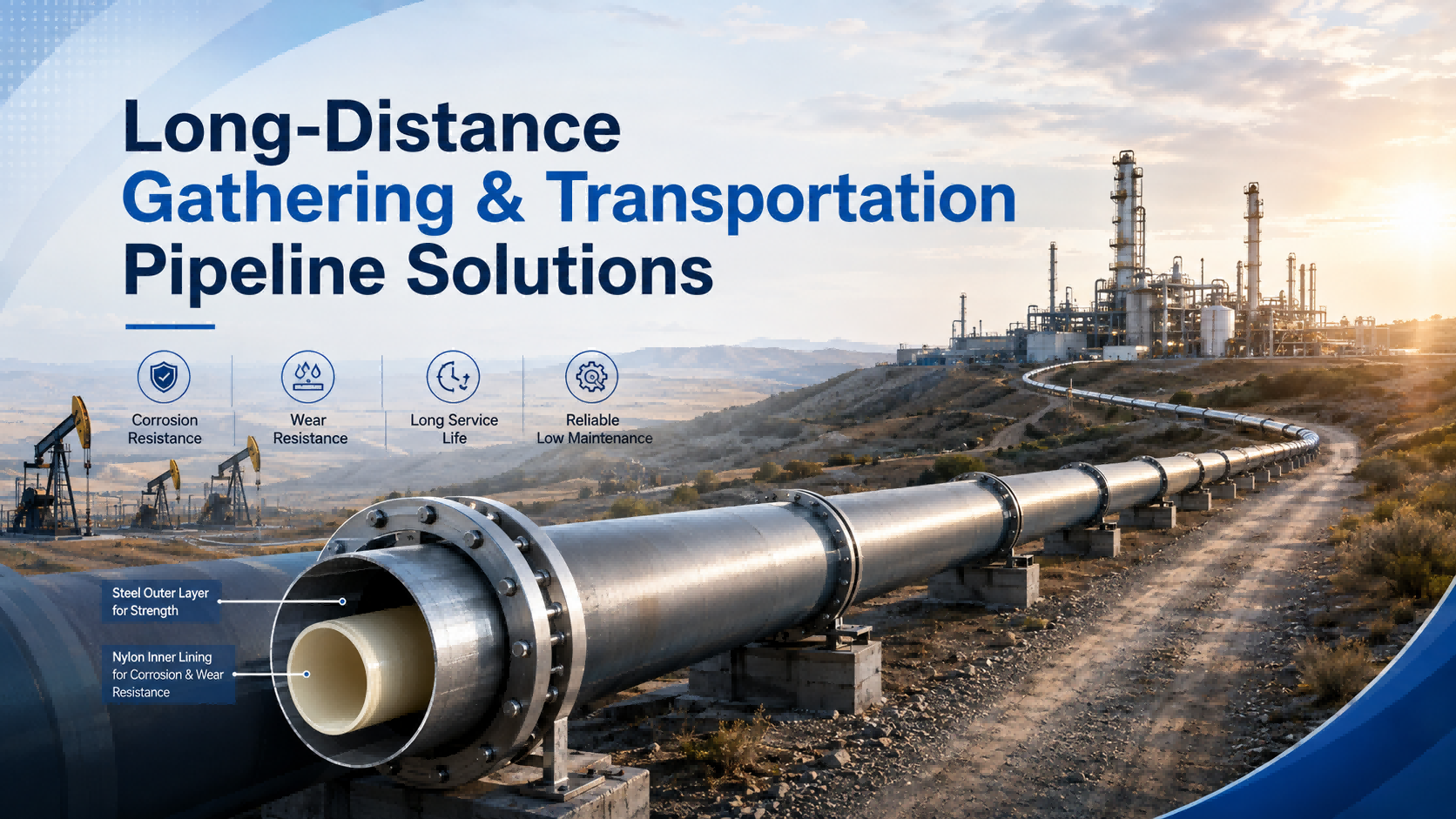
In oil and gas fields, chemical plants, mining operations, and other industrial fluid transportation systems, the longer the pipeline, the less important the question of “how much does each meter of pipe cost?” becomes.
The more important question is:
How many years can the pipeline operate reliably?
For oil and gas gathering pipelines, produced water pipelines, water injection lines, and long-distance industrial fluid transportation systems, corrosion, erosion, scaling, pressure loss, and repeated leakage often become major reliability problems after several years of operation.
Once a pipeline extends for tens of kilometers or even farther, a single corrosion point, failed connection, or perforated pipe section can potentially result in production shutdowns, emergency repairs, fluid leakage, environmental risks, and significant economic losses.
As a result, the design philosophy of modern long-distance gathering and transportation pipelines is changing.
Pipeline selection is gradually moving away from simply meeting initial transportation requirements toward achieving long-term system reliability and lower lifecycle costs.
For this new requirement, steel–nylon composite pipe provides an alternative engineering solution.
Rather than simply replacing steel with another material, steel–nylon composite pipe combines the structural strength of steel with the corrosion resistance and wear resistance of nylon, helping address the long-term failure mechanisms found in conventional industrial pipeline systems.
1. Why Are Long-Distance Gathering Pipelines More Difficult to Design?
Many pipelines perform well when they are first commissioned.
Problems often begin to appear only after years of continuous operation.
The reason is simple:
A long-distance pipeline operates under a continuous, dynamic, and often highly complex service environment.
For example, oilfield gathering systems may transport fluids containing:
-
Crude oil
-
Natural gas
-
High-salinity produced water
-
CO₂
-
H₂S
-
Chloride ions
-
Sand
-
Suspended solids
-
Chemical treatment agents
When these factors interact, pipeline deterioration becomes far more complicated than simple chemical corrosion.
In many applications, the actual failure mechanism is a combination of:
Corrosion + erosion + abrasion + scaling + temperature fluctuations + pressure fluctuations.
This explains why some materials perform well in laboratory corrosion tests but fail to achieve the same service life under real oilfield or chemical processing conditions.
2. Five Common Failure Modes in Long-Distance Gathering Pipelines
2.1 Internal Corrosion
For conventional carbon steel pipelines, internal corrosion is one of the most common causes of failure.
This is especially important in oil and gas systems containing water.
The water phase can create the conditions required for electrochemical corrosion.
When the transported fluid contains substances such as:
-
CO₂
-
H₂S
-
Cl⁻
-
O₂
-
Highly mineralized water
the corrosion environment can become significantly more aggressive.
More importantly, corrosion does not necessarily occur uniformly.
Localized corrosion and pitting are often far more dangerous.
A DN300 steel pipeline does not need to lose its entire wall thickness before failure occurs.
A single deep corrosion pit can eventually penetrate the pipe wall and cause leakage.
2.2 Erosion and Abrasive Wear
When the transported medium contains:
-
Sand
-
Mineral particles
-
Crystals
-
Catalyst particles
-
Suspended solids
the pipeline must resist not only corrosion but also mechanical wear.
High-risk areas typically include:
-
Elbows
-
Tees
-
Reducers
-
Upstream and downstream sections of valves
-
Pump discharge sections
-
Areas where flow velocity changes rapidly
At these locations, changes in fluid direction and velocity can significantly increase localized erosion.
This explains a common phenomenon in industrial pipelines:
Straight pipe sections may remain in good condition while elbows and valve-adjacent sections have already suffered severe wall thinning.
2.3 Scaling and Declining Transportation Efficiency
Pipeline failure is not limited to leakage.
Another frequently underestimated problem is:
Gradual reduction of the effective internal diameter.
Produced water, highly mineralized water, chemical mother liquor, and other industrial fluids may generate deposits such as:
-
Carbonate scale
-
Salt crystallization
-
Corrosion products
-
Suspended solid deposits
As internal surface roughness increases and the effective flow area decreases:
Pressure loss increases → pumping energy consumption increases → transportation capacity decreases.
For a pipeline extending tens of kilometers, even a relatively small increase in friction loss per meter can create a substantial difference in total energy consumption.
2.4 Connection Failure
Another underestimated challenge in long-distance pipelines is the number of connection points.
The more connections a pipeline contains, the more potential failure points the system may have.
Traditional pipeline installation may involve:
-
Welding
-
Lining connections
-
Heat fusion
-
Adhesive bonding
-
Mechanical joints
Variations in field installation quality can directly affect the reliability of the entire pipeline.
Therefore, in long-distance industrial pipeline projects, reducing uncertainty during field installation should be considered part of the material selection process.
2.5 External Environmental Corrosion
Long-distance pipelines are exposed not only to internal fluids but also to external environments.
Pipelines installed in:
-
Coastal areas
-
High-salinity soil
-
Desert regions
-
High-humidity environments
-
Chemical industrial parks
-
Saline-alkali soils
may also face significant external corrosion risks.
A reliable long-distance pipeline solution therefore needs to consider:
Internal fluid conditions + external environment + mechanical loads + installation conditions.
3. Why Do Conventional Pipelines Often Enter a Continuous Maintenance Cycle?
Many industrial pipeline systems follow a similar lifecycle.
Stage 1: Construction
Initial decisions focus primarily on:
-
Pipe price
-
Procurement cost
-
Installation cost
-
Construction schedule
Stage 2: Operation
After years of service, problems begin to develop:
-
Corrosion
-
Scaling
-
Increased pressure loss
Stage 3: Maintenance
The operator gradually begins to perform:
-
Repair welding
-
Partial pipe replacement
-
Additional corrosion protection
-
Elbow replacement
-
Leakage repairs
Stage 4: Repeated Maintenance
Eventually, the pipeline may enter a cycle of:
Repair → Restart → Leakage → Repair Again
At this stage, operators often realize that:
The pipe with the lowest initial purchase price is not necessarily the pipeline solution with the lowest long-term cost.
4. Long-Distance Pipelines Should Be Evaluated by Total Cost of Ownership
Modern industrial projects are increasingly focused on:
Total Cost of Ownership (TCO)
For a long-distance pipeline:
TCO ≠ Initial Pipe Purchase Price
The actual cost should include multiple factors.
Initial Investment
-
Pipes
-
Fittings
-
Flanges
-
Installation
-
Welding
-
Corrosion protection
Operating Costs
-
Pumping energy
-
Pigging
-
Descaling
-
Corrosion control
-
Inspection
Maintenance Costs
-
Emergency leakage repairs
-
Pipe section replacement
-
Labor
-
Equipment
Production Shutdown Losses
In many industrial projects, downtime can become the largest cost of all.
When a critical transportation pipeline is shut down:
The production loss may be far greater than the cost of replacing several meters of pipe.
For this reason, long-distance industrial pipeline materials should increasingly be evaluated based on questions such as:
What is the total cost per kilometer, per operating year, and per ton of transported fluid?
rather than simply:
Which pipe has the lowest price per meter?
5. Why Are Steel–Nylon Composite Pipes Suitable for Long-Distance Gathering Systems?
The engineering concept behind steel–nylon composite pipe is straightforward:
Steel provides structural strength and pressure resistance, while nylon provides corrosion resistance and wear resistance on the medium-contacting surface.
This is a typical functional composite-material design.
Instead of requiring one material to provide every performance characteristic, the system combines the advantages of two different materials.
6. Advantage 1: Steel Structure Provides the Mechanical Strength Required for Long-Distance Pipelines
One of the challenges with some non-metallic pipeline materials is achieving both:
corrosion resistance and sufficient structural rigidity.
This becomes particularly important in:
-
Large-diameter pipelines
-
Higher-pressure systems
-
Long unsupported spans
-
Above-ground installations
-
Long-distance transportation systems
where pipe stiffness and structural stability are critical.
Steel–nylon composite pipes retain a steel structural layer, providing strong mechanical support while the nylon layer performs the corrosion-resistant function.
This combination is particularly valuable for large industrial pipeline systems.
7. Advantage 2: Nylon Isolates Corrosive Media from the Steel Structure
One fundamental weakness of conventional carbon steel pipe is that:
the transported fluid directly contacts the metal surface.
Steel–nylon composite pipe changes this interface.
The nylon working layer helps isolate corrosive media from the steel structural layer.
This can provide significant advantages when transporting:
-
High-salinity water
-
Industrial wastewater
-
Oilfield produced water
-
Salt chemical fluids
-
Alkaline media
-
Certain weak acidic media
-
Industrial fluids containing aggressive ions
As a result, the steel layer can primarily perform its structural function instead of being directly exposed to the aggressive process fluid.
8. Advantage 3: High Wear Resistance for Particle-Containing Fluids
In oilfields, mining, and chemical industries, corrosion and abrasion frequently occur simultaneously.
Solving corrosion alone is therefore not enough.
If the material has insufficient wear resistance, pipeline service life may still be limited.
Nylon offers excellent abrasion resistance, making steel–nylon composite pipe suitable for transporting fluids such as:
-
Sand-containing crude oil
-
Produced water
-
Mineral slurry
-
Industrial slurry
-
Crystal-containing media
-
Solid-liquid two-phase flows
This is also an important distinction between steel–nylon composite pipe and conventional anti-corrosion coatings.
The objective is not simply:
corrosion protection
but:
corrosion resistance + wear resistance.
9. Advantage 4: Smooth Inner Surface Helps Reduce Scaling and Flow Resistance
One critical but often overlooked parameter in long-distance pipeline engineering is:
Internal Surface Roughness
The rougher the internal surface:
-
The higher the friction loss
-
The greater the pressure drop
-
The easier deposits can accumulate
-
The higher the pumping energy consumption
In conventional steel pipelines, corrosion products can progressively increase internal roughness during operation.
The relatively smooth nylon inner surface of steel–nylon composite pipe can help reduce:
-
Scale adhesion
-
Corrosion-product accumulation
-
Increasing hydraulic resistance
For transportation systems extending tens of kilometers, this hydraulic advantage can become increasingly important as pipeline length increases.
10. Advantage 5: Integral Flange Connections Simplify Field Installation
Field installation quality is particularly important for long-distance industrial pipeline systems.
Extensive welding can increase:
-
Construction time
-
Labor requirements
-
Non-destructive testing requirements
-
Variability in field installation quality
Our steel–nylon composite pipes can be manufactured with integrally formed flange connections.
The connection structure is formed directly with the pipe body, eliminating the need for conventional field welding or heat-fusion joining.
This approach can help:
-
Simplify installation
-
Shorten construction schedules
-
Improve connection standardization
-
Reduce field construction uncertainty
-
Facilitate future pipe-section removal and maintenance
For oilfields, chemical industrial parks, and remote long-distance pipeline projects, installation efficiency itself can generate significant economic value.
11. Advantage 6: Suitable for Complex Temperature and Pressure Conditions
Long-distance industrial transportation systems rarely operate under a single standardized condition.
Different projects may involve:
-
Low winter temperatures
-
High-temperature industrial fluids
-
Pressurized transportation
-
Pressure fluctuations
Our steel–nylon composite pipe products can cover operating temperatures of approximately:
–36°C to 160°C
with pressure classes ranging from:
1.0 to 4.0 MPa
Different diameters and structural configurations can be designed according to project requirements.
This enables applications in:
-
Oil and gas gathering
-
Water injection
-
Produced water transportation
-
Chemical fluid transportation
-
Salt chemical processing
-
Mining
-
Power plants
-
Industrial water systems
and many other industrial applications.
12. Large-Diameter Long-Distance Pipelines Require Both Material and Structural Engineering
As pipeline diameter increases, design requirements change significantly.
A DN100 pipeline and a DN1000 pipeline cannot simply be treated as the same design scaled to a larger diameter.
Large-diameter industrial pipelines need careful consideration of:
-
Ring stiffness
-
Support spacing
-
Vacuum conditions
-
Water hammer
-
Thermal deformation
-
Flange strength
-
Lifting and installation
-
Foundation settlement
Therefore, reliable large-diameter industrial pipelines require systematic engineering rather than simple material selection.
Our steel–nylon composite pipe manufacturing capability can cover large-diameter industrial transportation requirements, including DN2000 and above, providing additional options for large-scale gathering, transmission, and industrial fluid transportation projects.
13. Oil and Gas Gathering Systems Are a Typical Application
Oil and gas fields represent one of the most important application areas for steel–nylon composite pipes.
Typical applications include:
Oil and Gas Gathering Pipelines
Wellhead → Metering Station → Gathering Station → Central Processing Facility
Produced Water Transportation
Produced Water → Treatment Facility → Reinjection System
Water Injection Pipelines
Injection Station → Water Distribution Station → Injection Well
Oilfield Wastewater Pipelines
Treatment System → Transportation System → Reinjection System
These systems share several characteristics:
Long transportation distances, complex fluids, aggressive corrosion conditions, and high maintenance costs.
In mature oilfields with high water cut, corrosion problems can become increasingly severe as the proportion of produced water increases.
Pipeline corrosion therefore gradually evolves from a simple maintenance issue into:
a reliability issue affecting the entire oilfield production system.
14. Chemical Industry Long-Distance Transportation Also Requires High-Reliability Pipelines
Steel–nylon composite pipe is not limited to oilfield applications.
It can also provide significant value in chemical industries.
Soda Ash Industry
Typical media include:
-
Mother liquor
-
Brine
-
Alkaline process fluids
These systems can suffer from long-term corrosion, crystallization, and scaling.
Chlor-Alkali Industry
Brine and alkaline fluids place high demands on the long-term corrosion resistance of conventional metallic materials.
Salt Chemical Industry
High chloride concentrations can significantly increase corrosion risks for many metal pipelines.
Phosphate Chemical Industry
Some process media present both corrosive and abrasive characteristics due to suspended solids.
These applications increasingly require pipeline materials capable of combining:
corrosion resistance + wear resistance + structural strength.
15. Long-Distance Pipeline Engineering Should Not Be Limited to “Material Selection”
One important trend in industrial pipeline engineering is the transition from:
Material Selection
to:
Pipeline System Engineering
Instead of asking only:
Which material should we use?
projects should increasingly ask:
How can we keep the entire transportation system operating reliably over the long term?
A complete long-distance pipeline solution should include several engineering considerations.
1. Fluid Analysis
Including:
-
pH
-
Chloride concentration
-
CO₂
-
H₂S
-
Solid content
-
Temperature
2. Hydraulic Calculation
Determining:
-
Flow rate
-
Flow velocity
-
Pressure drop
-
Pipe diameter
3. Pressure Design
Considering:
-
Normal operating pressure
-
Maximum operating pressure
-
Water hammer
-
Transient pressure
4. Wear Analysis
Particular attention should be paid to:
-
Elbows
-
Tees
-
Pump outlets
-
Valve-adjacent sections
5. Connection Design
Including:
-
Flanges
-
Valves
-
Expansion compensation
-
Pipe supports
6. Lifecycle Analysis
Comparing:
-
Initial investment
-
Maintenance
-
Downtime
-
Energy consumption
-
Replacement intervals
Only by considering these factors together can engineers determine which pipeline solution provides the best long-term value.
16. Why Can Partial Replacement Be the First Step in Upgrading a Long-Distance Pipeline?
Not every project needs to replace an entire pipeline at once.
For an existing system that has already been operating for many years, a more practical strategy can be to identify:
high-risk pipeline sections first.
These may include:
-
Pump discharge sections
-
Upstream and downstream sections of valves
-
Elbows
-
Tees
-
High-velocity areas
-
Severely corroded sections
-
Sections requiring frequent maintenance
These locations can then be replaced first with corrosion-resistant and wear-resistant composite pipe.
Another practical approach is to install:
A 100–500 Meter Trial Section
The operator can then evaluate actual performance in terms of:
-
Corrosion resistance
-
Wear resistance
-
Transportation capacity
-
Installation efficiency
-
Maintenance requirements
If the trial section performs as expected, the application can gradually be expanded to a larger part of the system.
This approach can significantly reduce the technical and investment risks associated with introducing a new pipeline material into a large industrial project.
17. The Future of Long-Distance Pipelines Is Lower Maintenance
The future competitive advantage of industrial pipelines is unlikely to remain focused on:
Which pipe is cheaper per meter?
Instead, the industry will increasingly ask:
-
Which pipeline lasts longer?
-
Which system experiences fewer leaks?
-
Which requires less maintenance?
-
Which creates less production downtime?
-
Which maintains lower hydraulic resistance?
-
Which provides the lowest lifecycle cost?
This is why more industrial projects are beginning to focus on:
Low-Maintenance Pipeline Systems
For a long-distance transportation network, eliminating even one major maintenance shutdown can significantly improve the economics of the entire pipeline.
18. Steel–Nylon Composite Pipe Is Not Only About Corrosion Resistance — It Is About Pipeline Reliability
If steel–nylon composite pipe is evaluated only from the perspective of material properties, its broader engineering value may be underestimated.
The composite structure is designed to address several limitations found in conventional pipeline materials.
Conventional Steel Pipe
Common challenges include:
Corrosion and scaling.
Some Plastic Pipes
Potential limitations may include:
Structural rigidity, pressure capability, and high-temperature performance.
Some Lined Pipes
Potential risks may include:
Layer separation and interface failure.
Some Composite Pipes
Long-term structural reliability may become an important consideration depending on operating conditions.
The design concept behind steel–nylon composite pipe is therefore:
Use steel to provide strength and use nylon to manage contact with the transported medium.
This allows the pipeline system to achieve a more balanced combination of:
mechanical strength, corrosion resistance, wear resistance, hydraulic performance, and long-term operational reliability.
19. Recommendations for Long-Distance Gathering Pipeline Selection
If your project involves any of the following conditions:
-
Long transportation distance
-
Frequent corrosion
-
Pipeline replacement every few years
-
High-salinity fluids
-
CO₂ or H₂S
-
Sand or solid particles
-
Serious internal scaling
-
High maintenance costs
-
Significant production losses during shutdowns
-
Large-diameter pipelines
-
Pressure requirements between 1.0 and 4.0 MPa
-
A requirement to reduce maintenance costs over the next 10–20 years
then pipeline material selection should not be limited to comparing:
Carbon Steel vs. Stainless Steel vs. FRP vs. HDPE.
It may also be valuable to include:
Steel–Nylon Composite Pipe
in the technical and lifecycle cost evaluation.
Conclusion: The Best Long-Distance Pipeline Is Not the Cheapest Pipe — It Is the Pipeline That Requires the Least Maintenance
For a short conventional pipeline, a leak may simply be a maintenance issue.
But for an industrial pipeline extending tens of kilometers or more, a single leak can result in:
production shutdowns, emergency repairs, environmental risks, and significant economic losses.
This is why the design philosophy of long-distance gathering and transportation pipelines is changing.
Future high-performance pipeline systems should provide:
Higher reliability
Lower corrosion risk
Better wear resistance
Less scaling
Lower pressure loss
Less maintenance
Longer service life
Steel–nylon composite pipe has been developed around these objectives.
By combining the mechanical strength of steel with the corrosion and wear resistance of nylon, together with integral flange connections, large-diameter manufacturing capability, and adaptability to demanding industrial operating conditions, it provides an alternative to traditional single-material pipeline solutions for oil and gas fields, chemical plants, and other long-distance industrial transportation projects.
For the industrial pipeline market of the future, the most important question may no longer be:
“How much does this pipe cost?”
Instead, the more important question will be:
“How many times will this pipeline need to be repaired over the next 20 years?”
That is becoming one of the most important criteria for selecting materials for long-distance gathering and transportation pipeline systems.
New Corrosion Protection Technologies for Oilfields: From Corrosion Control to Long-Term Corrosion-Resistant Pipeline Systems
Recommended Pipeline Solutions for Shale Gas Projects: How to Select Pipe Materials for Complex Corrosive and Abrasive Conditions


