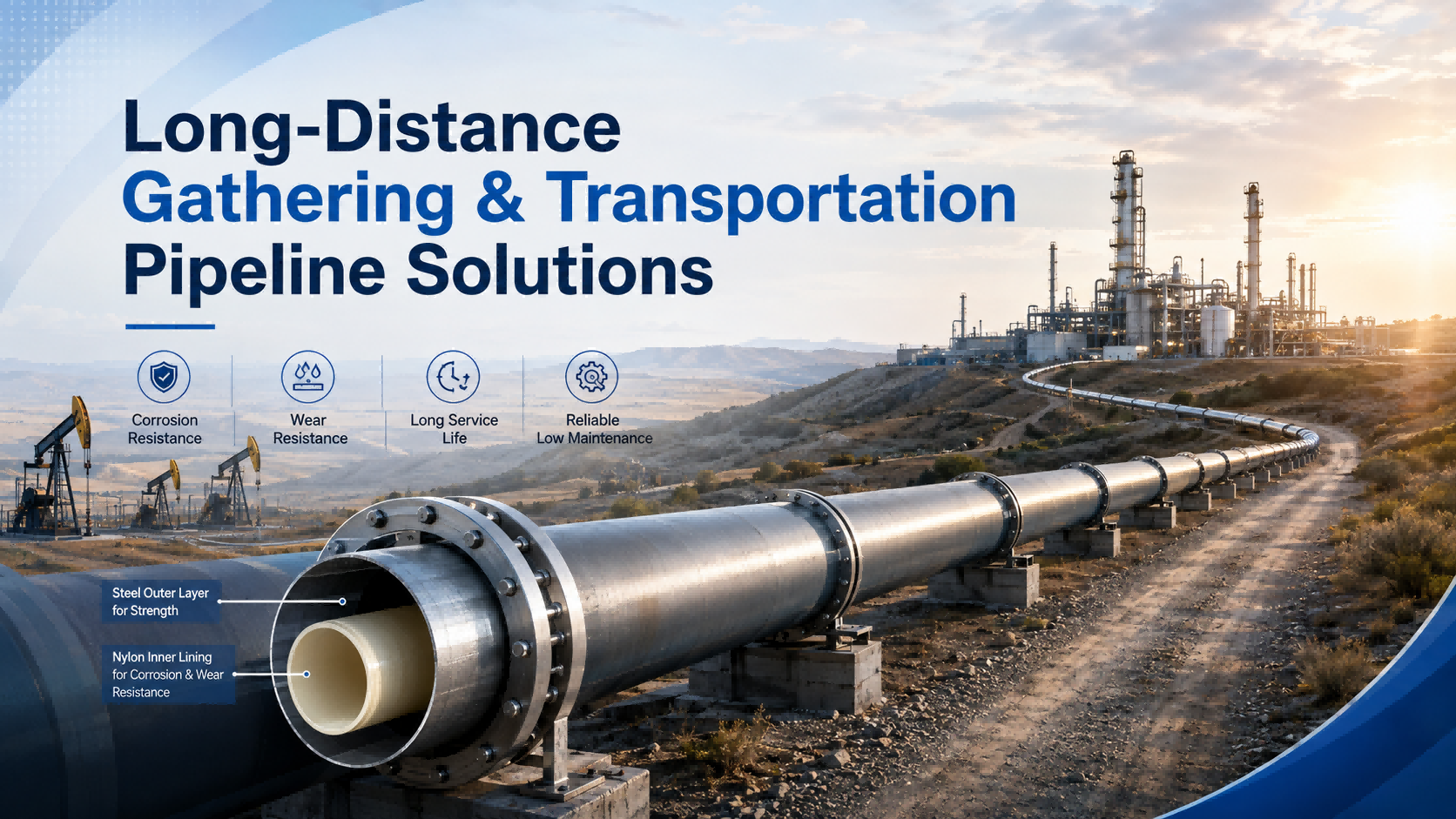
New Corrosion Protection Technologies for Oilfields: From Corrosion Control to Long-Term Corrosion-Resistant Pipeline Systems

Corrosion in oil and gas fields has never been simply a material problem.
From wellhead production fluids and oil & gas gathering systems to produced water treatment, water injection pipelines, process piping, and long-distance transportation lines, operating conditions vary significantly in terms of fluid composition, temperature, pressure, flow velocity, and solids content.
CO₂, H₂S, chloride ions, highly mineralized produced water, dissolved oxygen, sand, and other solid particles may exist simultaneously. As a result, oilfield pipelines often face a combination of corrosion, erosion, scaling, and mechanical wear rather than a single degradation mechanism.
Traditional oilfield corrosion protection has largely focused on one question:
How can we slow down the corrosion of steel pipelines?
However, a new generation of oilfield corrosion protection technologies is beginning to change this approach.
More engineers are asking a different question:
Instead of continuously improving the corrosion resistance of steel itself, can we redesign the pipeline structure so that corrosive fluids no longer come into direct contact with the metallic pressure-bearing layer?
This is one of the fundamental principles behind the development of advanced composite pipeline technologies.
For oilfield pipelines exposed to high water cut, high salinity, aggressive corrosion, and high maintenance costs, steel–nylon composite pipe is emerging as a promising long-term corrosion-resistant pipeline solution.
1. Why Is Oilfield Pipeline Corrosion Becoming More Difficult to Control?
The challenge of oilfield pipeline corrosion lies in the fact that it is rarely caused by a single factor.
As many oilfields enter the middle and late stages of development, water cut continues to rise. The transported medium gradually changes from primarily crude oil to a much more complex mixture of oil, water, gas, salts, and solid particles.
Typical corrosion mechanisms include the following.
1.1 Corrosion Caused by Highly Mineralized Produced Water
Oilfield produced water often contains significant concentrations of:
-
Cl⁻
-
Na⁺
-
Ca²⁺
-
Mg²⁺
-
Other dissolved salts
High salinity increases the electrical conductivity of the fluid and can accelerate electrochemical corrosion.
When local defects, deposits, weld areas, or other non-uniform conditions exist on the internal surface of a pipeline, localized corrosion can become even more severe, increasing the risk of premature perforation and leakage.
1.2 CO₂ Corrosion
When carbon dioxide dissolves in water, it forms a carbonic acid system.
In oil and gas pipelines containing free water, CO₂ corrosion is one of the most common internal corrosion mechanisms affecting carbon steel.
Its severity can be influenced by:
-
CO₂ partial pressure
-
Temperature
-
pH
-
Flow velocity
-
Water content
-
Stability of FeCO₃ corrosion product films
At higher flow velocities, protective corrosion product films may also be disturbed or removed, exposing fresh metal surfaces and accelerating corrosion.
1.3 H₂S Corrosion
Pipeline conditions in sour oil and gas fields are even more complex.
H₂S may contribute not only to general corrosion but also to material integrity issues associated with sulfide stress cracking and hydrogen-related damage.
For this reason, material selection in high-H₂S environments cannot simply rely on increasing steel wall thickness.
Instead, engineers need to consider the complete system, including:
-
Material compatibility
-
Fluid isolation
-
Mechanical properties
-
Pressure requirements
-
Long-term structural reliability
1.4 Localized Corrosion Associated with Chlorides
Even certain stainless steels must be carefully evaluated when exposed to high chloride concentrations, elevated temperatures, deposits, or stagnant areas.
Under unfavorable conditions, localized corrosion mechanisms such as pitting corrosion and crevice corrosion may still occur.
This is why, in some highly mineralized produced-water systems:
Using a more expensive metal does not necessarily mean corrosion has been completely eliminated.
1.5 Corrosion and Erosion Often Occur Simultaneously
Oilfield fluids may also carry:
-
Sand
-
Corrosion products
-
Scale particles
-
Other suspended solids
At higher velocities, these particles continuously impact the internal pipe wall.
The effect becomes particularly severe at:
-
Elbows
-
Tees
-
Reducers
-
Valve sections
-
Pump outlets
-
Manifolds
Under such conditions, the problem is no longer purely chemical corrosion.
It becomes:
Corrosion + Erosion
Some materials may demonstrate excellent chemical corrosion resistance in static laboratory conditions but fail to withstand long-term particle erosion under actual operating conditions.
Therefore, oilfield pipeline material selection must consider both chemical and mechanical degradation.
2. Why Are Traditional Oilfield Corrosion Protection Technologies Reaching Their Limits?
For decades, oilfield operators have relied on several established corrosion mitigation methods.
These technologies remain valuable, but their limitations become more apparent as operating environments become increasingly demanding.
2.1 Corrosion Allowance: Simply Making the Steel Pipe Thicker
One of the most straightforward strategies is to increase pipe wall thickness.
The principle is simple:
If a certain amount of corrosion loss is expected every year, additional wall thickness is incorporated into the original design.
This method is easy to understand, but fundamentally it still accepts that corrosion will continue.
A pipeline designed for a 20-year service life does not necessarily mean the pipe will remain corrosion-free for 20 years.
Instead, it means that engineers expect the remaining wall thickness to stay above the minimum required for safe pressure containment during that period.
For highly corrosive environments, increasing wall thickness results in:
-
Higher steel consumption
-
Greater pipeline weight
-
Higher transportation costs
-
Higher installation costs
-
Continued wall-thickness inspection requirements
-
Risk of premature failure caused by localized corrosion
Increasing wall thickness therefore does not eliminate the underlying corrosion mechanism.
2.2 Corrosion Inhibitors: Continuously Reducing the Corrosion Rate
Corrosion inhibitors remain an important internal corrosion control technology in oilfields.
Through continuous or intermittent chemical injection, inhibitors can form protective films on metal surfaces and reduce corrosion rates.
However, inhibitor-based corrosion management requires continuous operation and monitoring.
Over the lifecycle of the pipeline, operators must consider:
-
Chemical purchasing
-
Injection equipment
-
Injection concentration
-
Fluid compatibility
-
Online monitoring
-
Corrosion coupons
-
Maintenance labor
-
Operational management
If chemical injection becomes unstable or certain sections of the pipeline receive inadequate inhibitor coverage, corrosion rates may increase again.
From a lifecycle perspective:
Corrosion inhibitors reduce the corrosion rate, but they do not eliminate direct contact between the corrosive fluid and the steel substrate.
2.3 Internal Coatings: Creating a Protective Barrier
Internal epoxy coatings and similar systems take corrosion protection one step further by physically separating the fluid from the steel surface.
When properly designed and applied, internal coatings can significantly reduce corrosion.
However, their long-term performance depends heavily on coating integrity.
Critical factors include:
-
Coating thickness
-
Surface preparation
-
Pinholes
-
Installation damage
-
Joint areas
-
Thermal cycling
-
Particle erosion
-
Localized coating detachment
Once the coating is damaged locally, corrosion may become concentrated at the exposed area.
For high-erosion pipelines, relying on a relatively thin coating layer therefore requires very strict manufacturing, installation, and inspection control.
2.4 Stainless Steel and Corrosion-Resistant Alloys
Upgrading the metallic material itself is another established approach.
Replacing conventional carbon steel with:
-
304 stainless steel
-
316L stainless steel
-
Duplex stainless steel
-
Higher-grade corrosion-resistant alloys
can significantly improve resistance to certain corrosive environments.
However, one major challenge remains:
Material cost rises rapidly as alloy grade increases.
For DN300, DN500, and even larger-diameter gathering or produced-water pipelines, using high-grade corrosion-resistant alloys throughout the entire system can lead to very high initial capital costs.
At the same time, metallic material selection must still consider actual operating conditions such as:
-
Chloride concentration
-
Temperature
-
H₂S exposure
-
Fluid composition
-
Localized corrosion risk
This has encouraged the development of another engineering philosophy:
Instead of requiring one material to provide both mechanical strength and corrosion resistance, use different materials for different functions.
This is one of the fundamental principles behind composite pipeline technology.
3. A New Generation of Oilfield Corrosion Protection: From Single Materials to Functional Layering
Conventional pipelines often require one material to simultaneously provide:
-
Mechanical strength
-
Pressure resistance
-
Corrosion resistance
-
Wear resistance
-
Temperature resistance
-
Installation performance
Achieving all these properties with a single material can be extremely difficult.
Modern composite pipeline systems take a different approach.
Different materials are assigned different engineering functions.
External Structural Layer
Responsible for:
-
Mechanical strength
-
Rigidity
-
Pressure containment
-
Resistance to mechanical impact
-
Overall structural stability
Internal Functional Layer
Responsible for:
-
Direct contact with the transported medium
-
Corrosion resistance
-
Wear resistance
-
Reduced scaling
-
Lower hydraulic resistance
For steel–nylon composite pipe, the concept can be summarized very simply:
Steel provides strength. Nylon handles the process medium.
This combination allows pipeline performance to move beyond the limitations of a conventional single-material system.
4. How Does Steel–Nylon Composite Pipe Change Oilfield Corrosion Protection?
Steel–nylon composite pipe is not simply a conventional steel pipe with a thin plastic coating.
Its core concept is to combine a steel structural component with an engineering nylon functional layer to create an integrated composite pipeline system.
When properly engineered and manufactured, the structure can provide a combination of:
-
Pressure resistance
-
Corrosion resistance
-
Wear resistance
-
Mechanical strength
-
Industrial-service reliability
4.1 From “Slowing Steel Corrosion” to “Isolating Steel from Corrosive Media”
For conventional carbon steel pipelines, one of the basic conditions required for internal corrosion is:
Direct contact between the corrosive fluid and the steel surface.
Steel–nylon composite pipe changes this relationship.
Under normal operating conditions, the transported medium primarily contacts the nylon functional layer instead of directly contacting the steel pressure-bearing structure.
The corrosion protection philosophy therefore changes fundamentally.
Traditional Approach
Steel → Corrosive Fluid Contact → Coatings/Chemicals → Reduced Corrosion Rate
Composite Approach
Process Fluid → Nylon Functional Layer → Steel Pressure-Bearing Structure
The engineering question changes from:
“How many millimeters of steel will be lost to corrosion every year?”
to:
“Can the functional lining remain compatible with this process medium over the required service period?”
These are two fundamentally different pipeline design philosophies.
4.2 Particularly Valuable for Highly Mineralized Produced Water
Produced-water pipelines represent one of the most challenging corrosion environments in oilfields.
As oilfields mature and water cut increases, produced-water volumes may rise significantly.
Produced-water systems commonly contain:
-
High chloride concentrations
-
High total dissolved solids
-
CO₂
-
H₂S
-
Solid particles
-
Scale-forming ions
Conventional carbon steel pipelines can experience a degradation cycle such as:
Corrosion → Iron Release → Corrosion Product Formation → Deposition → Under-Deposit Corrosion → Localized Perforation
By introducing a non-metallic functional layer between the fluid and carbon steel, the direct internal corrosion mechanism can be substantially reduced.
This makes composite pipeline systems particularly attractive for:
-
Produced-water transportation
-
Oilfield wastewater systems
-
Certain water-injection applications
5. Oilfield Pipelines Must Be Wear-Resistant as Well as Corrosion-Resistant
This is often overlooked during corrosion-resistant material selection.
In static immersion tests, many materials can demonstrate excellent corrosion resistance.
Real oilfield pipelines, however, operate under dynamic flow conditions.
The transported medium may move at significant velocity while carrying sand and other suspended solids.
Severe local turbulence and particle impact may occur around:
-
Elbows
-
Tees
-
Reducers
-
Pump outlets
-
Upstream and downstream valve sections
-
Manifolds
Therefore, a pipeline intended for long-term oilfield service should ideally address:
Corrosion Resistance + Erosion Resistance + Wear Resistance
Engineering nylon provides good wear-resistant characteristics, giving steel–nylon composite pipe advantages in applications where corrosive fluids also contain abrasive particles.
This is one important distinction between a structural composite lining and a conventional thin corrosion-resistant coating.
6. Reducing Scaling Is Becoming an Important Performance Requirement
Pipeline maintenance costs in oilfields do not come from corrosion alone.
Scaling can also create substantial hidden operating costs.
Common oilfield deposits include:
-
CaCO₃
-
CaSO₄
-
BaSO₄
-
SrSO₄
-
Iron corrosion products
-
Oil sludge deposits
As conventional steel pipelines age, their internal surfaces may gradually become rougher due to corrosion.
Rough surfaces encourage additional deposition.
This can create a self-reinforcing cycle:
Corrosion → Increased Surface Roughness → Deposition → Scaling → Under-Deposit Corrosion → Reduced Internal Diameter
The relatively smooth surface of a nylon functional layer can help reduce conditions favorable to adhesion and deposition.
Over long-term operation, this can influence more than corrosion resistance.
It may also affect:
-
Pipeline transportation capacity
-
Pumping energy consumption
-
Pigging intervals
-
Chemical cleaning frequency
-
Shutdown frequency
For this reason, maintaining a smooth internal surface over extended service periods is becoming an increasingly important criterion in oilfield pipeline lifecycle evaluation.
7. Why Combine Nylon with Steel Instead of Using a Fully Non-Metallic Pipe?
If nylon provides corrosion resistance, why use steel at all?
Because an oilfield pipeline is first and foremost a pressure transportation system.
Corrosion resistance is only one of many engineering requirements.
Oilfield pipeline design must also consider:
-
Working pressure
-
Pipe diameter
-
Support span
-
External loading
-
Installation requirements
-
Temperature fluctuations
-
Mechanical impact
-
Flange loads
-
Pipe support systems
For larger-diameter or higher-pressure applications, fully non-metallic piping may face additional structural and stiffness considerations.
The advantage of a steel–nylon composite structure lies in combining the strengths of two different materials.
Steel Structure
Provides:
Strength + Rigidity + Pressure-Bearing Capability
Nylon Functional Layer
Provides:
Corrosion Resistance + Wear Resistance + Smooth Internal Surface
The two materials complement each other.
This functional combination represents an important development direction for advanced industrial composite piping systems.
8. Why Are Integrated Flange Connections Important in Oilfield Applications?
Pipeline material performance is critical, but installation method also has a major influence on project cost and reliability.
Our steel–nylon composite pipes use an integrated flange connection design and can be connected with valves, pumps, tees, elbows, reducers, and other process equipment according to system requirements.
Compared with piping systems that require extensive onsite:
-
Welding
-
Heat fusion
-
Specialized bonding
flanged installation can significantly simplify field construction.
This is particularly valuable for oilfield rehabilitation projects.
Many oilfield piping projects are not complete greenfield installations.
Instead, they involve:
Localized Corrosion → Partial Replacement → Valve Group Upgrading → Replacement of High-Failure Sections
New piping therefore needs to integrate efficiently with the existing pipeline network.
Steel–nylon composite piping can be introduced first at critical high-risk locations such as:
-
Pump outlets
-
Upstream and downstream valve sections
-
Well-drain valve groups
-
Elbows
-
Tees
-
Reducers
-
Manifolds
-
Highly corrosive straight pipeline sections
This means operators do not necessarily need to replace the entire pipeline network at once.
A high-risk-section-first upgrade strategy can significantly reduce the barrier to adopting new corrosion-resistant pipeline technology.
9. Oilfield Pipeline Cost Evaluation Needs to Change
Traditional pipeline procurement often focuses heavily on one number:
$/m
The purchase price per meter.
However, the more important number for oilfield operators should often be:
$/year
or, more comprehensively:
Total Lifecycle Cost
A complete oilfield pipeline cost assessment should consider several categories.
Initial Investment
-
Pipe
-
Fittings
-
Transportation
-
Installation
-
Supports
-
Construction
Operating Costs
-
Corrosion inhibitors
-
Inspection
-
Cleaning
-
Pigging
-
Corrosion management
Maintenance Costs
-
Leak repair
-
Pipeline replacement
-
Valve replacement
-
Excavation and site restoration
Production Losses
These are frequently among the most underestimated costs.
A pipeline may be 20% cheaper to purchase initially.
But if leakage occurs after several years and the operator must:
Shut Down Production → Depressurize → Clean the Line → Excavate → Cut the Pipe → Replace the Section → Inspect → Restart Production
the real financial impact may greatly exceed the original material savings.
For this reason, more oilfield projects are gradually shifting from:
Lowest Purchase Price
to:
Lowest Lifecycle Cost
10. Where Can Steel–Nylon Composite Pipes Be Used in Oilfields?
Based on their structural characteristics and material properties, steel–nylon composite pipes can be considered for technical evaluation in several oilfield applications.
Oil & Gas Gathering Pipelines
For high-water-cut multiphase fluids containing CO₂, salts, and solids, the functional internal layer can help reduce direct contact between the corrosive medium and the steel structure.
Produced-Water Pipelines
Highly mineralized produced water and high-chloride environments represent important potential applications for composite piping.
Oilfield Wastewater Treatment Systems
Suitable for transporting corrosive oilfield wastewater where conventional metallic pipelines may experience frequent internal corrosion.
Water Injection Pipelines
Composite piping can help reduce internal corrosion and the formation of deposits associated with metallic corrosion products.
Well-Drain and Valve Group Piping
Valves, elbows, tees, and similar locations frequently experience combined corrosion and erosion and may therefore be suitable candidates for priority upgrading.
Central Processing Facility Piping
Large oilfield stations contain extensive process piping networks transporting corrosive water-based media.
Composite piping can be selected according to actual pressure, temperature, flow conditions, and chemical composition.
Localized High-Corrosion and High-Wear Pipeline Sections
Where complete pipeline replacement is not currently feasible, high-failure sections can be upgraded first.
11. Our Steel–Nylon Composite Pipeline Solution
We focus on corrosion-resistant and wear-resistant industrial pipeline technologies and manufacture both steel–nylon composite pipes and reinforced nylon pipes.
Our product development philosophy is not simply to replace one conventional pipeline material with another.
Instead, we aim to address several recurring challenges in demanding industrial fluid transportation systems.
Corrosion Resistance
The nylon functional layer helps isolate corrosive process fluids from the steel pressure-bearing structure.
Wear Resistance
Suitable for applications where both corrosion and a certain degree of particle erosion must be considered.
High Mechanical Strength
The steel structural layer provides mechanical strength, rigidity, and pressure-bearing capability.
Smooth Internal Surface
A smooth nylon internal surface helps reduce scaling, deposition, and long-term increases in hydraulic resistance.
Integrated Flange Connection
Integrated flange connections reduce the need for onsite welding and heat fusion, making installation and existing-pipeline upgrades more convenient.
Large-Diameter Manufacturing Capability
Our production capability can support large industrial transportation systems, including DN2000-class and larger-diameter pipelines.
Depending on specific product design and operating conditions, pressure classes of approximately 1.0–4.0 MPa can be supported, together with a broad industrial operating temperature range.
Actual project selection should always be based on detailed operating parameters, including:
-
Fluid composition
-
Chemical concentration
-
Temperature
-
Pressure
-
Flow velocity
-
Solids content
-
Installation environment
12. What Is the Future of Oilfield Corrosion Protection Technology?
The future of oilfield corrosion protection will not be dominated by a single material or one universal solution.
Technologies such as:
-
Corrosion inhibitors
-
Cathodic protection
-
Corrosion-resistant alloys
-
Non-metallic piping
-
Lining systems
-
Composite pipelines
will continue to coexist.
However, one important trend is becoming increasingly clear.
In the past, the key question was:
How do we protect the steel pipe?
In the future, the more important question may become:
How do we build a transportation system that is inherently more resistant to corrosion?
This shift is driving several important changes.
From Protective Coatings to Structural Material Design
Corrosion protection is no longer treated only as an additional surface treatment after pipe manufacturing.
Instead, corrosion resistance can be incorporated into the pipeline structure from the design stage.
From Single Materials to Multi-Material Collaboration
Rather than looking for one material that solves every engineering problem, different materials can be assigned the functions they perform best.
From Purchase Price to Lifecycle Cost
Project owners are increasingly evaluating:
20 years of operating cost rather than only the first-year purchase price.
From Regular Maintenance to Low-Maintenance Systems
The goal of advanced industrial piping should not simply be to make maintenance easier.
The more valuable goal is to reduce the need for maintenance itself.
Conclusion: The Next Generation of Oilfield Corrosion Protection Is About More Than Slowing Corrosion
Oilfield pipeline corrosion technology is gradually moving from:
Corrosion Control
toward:
Corrosion-Resistant Pipeline Systems
This represents an important change in engineering philosophy.
The future competition among oilfield pipeline technologies may no longer be determined simply by who can manufacture the lowest-cost steel pipe.
Instead, the real value will come from building transportation systems that deliver:
-
Better corrosion resistance
-
Better wear resistance
-
Less scaling
-
Lower maintenance requirements
-
Longer service life
-
Lower total lifecycle cost
This is where steel–nylon composite pipe offers a different approach.
Through the combination of a steel pressure-bearing structure, nylon functional layer, and integrated flange connection system, mechanical performance and fluid compatibility can be assigned to different materials according to their respective strengths.
This provides an alternative pipeline solution for applications such as:
-
Highly mineralized produced water
-
Oil & gas gathering
-
Oilfield wastewater treatment
-
Water injection
-
High-corrosion pipeline systems
For oilfields that repeatedly face corrosion perforation, leaks, repairs, and frequent pipeline replacement, the most important question may no longer be:
“How much does this pipe cost?”
Instead, the better question is:
“How much will it cost to keep this pipeline operating reliably over the next 10 or 20 years?”
When the evaluation standard changes, the way oilfield pipeline materials are selected will change as well.
Long-Distance Gathering and Transportation Pipeline Solutions: How to Solve Corrosion, Wear, and Long-Term Maintenance Challenges