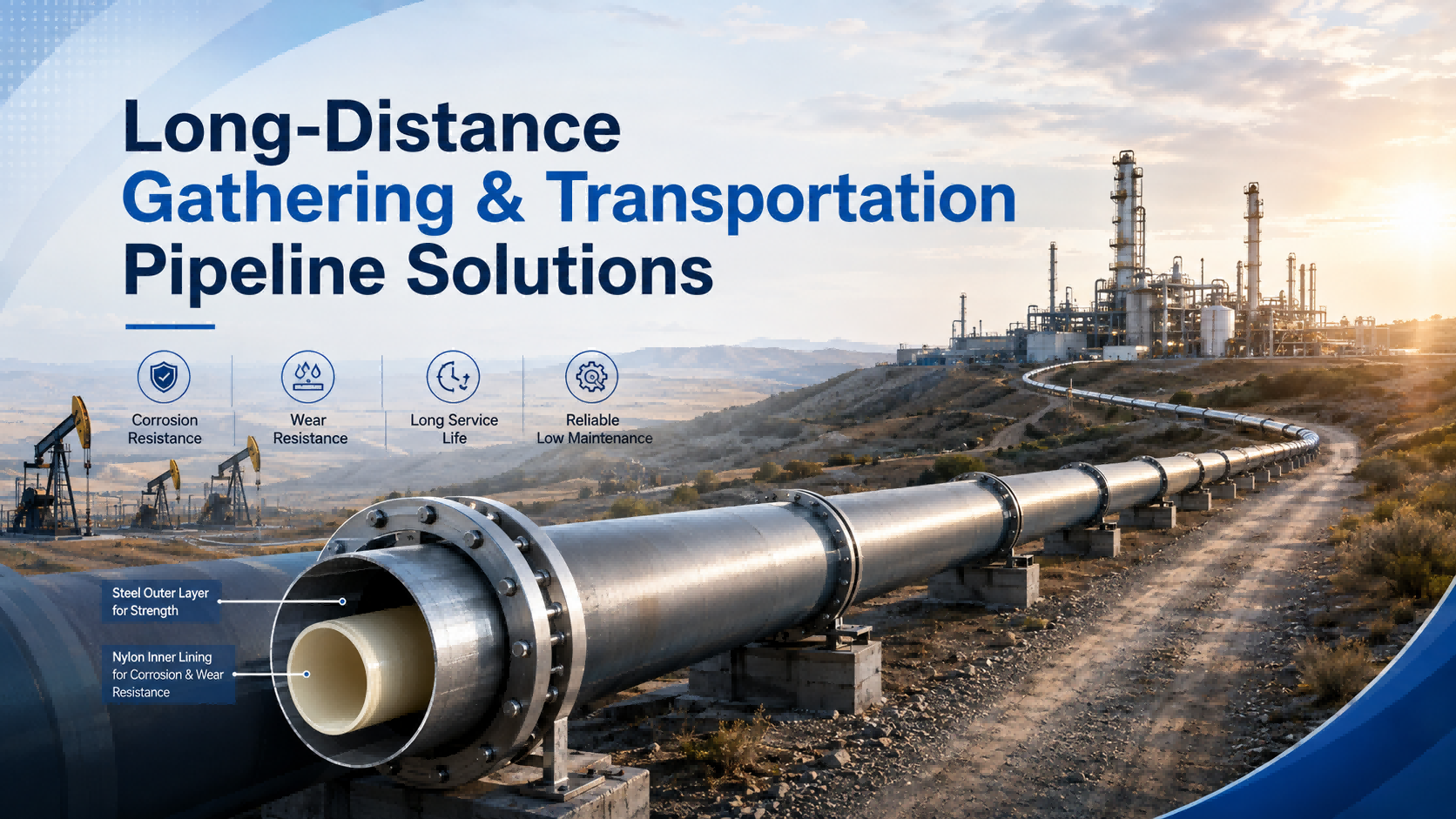
Recommended Pipeline Solutions for Shale Gas Projects: How to Select Pipe Materials for Complex Corrosive and Abrasive Conditions

Shale gas development has become an increasingly important part of the global natural gas supply system.
Compared with conventional natural gas projects, shale gas surface facilities often operate under more demanding conditions. High-salinity water, fracturing flowback fluid, suspended solids, CO₂, H₂S, chlorides, and constantly changing pressures and flow rates can accelerate pipeline corrosion, erosion, scaling, and ultimately leakage.
Therefore, pipeline selection for shale gas projects should not be reduced to a simple question:
“Which pipe has the lowest purchase price?”
A more important question is:
Which pipeline material can minimize corrosion, erosion, scaling, maintenance, leakage, and production interruption throughout the intended operating life under the actual medium, pressure, and temperature conditions?
From this perspective, conventional carbon steel, stainless steel, HDPE, FRP, and various lined pipe systems all have their own application ranges.
At the same time, steel–nylon composite pipe is emerging as a pipeline solution worth evaluating for certain shale gas gathering systems, produced-water systems, flowback-water systems, wastewater treatment systems, and other corrosive fluid transportation applications.
1. Why Do Shale Gas Projects Place Higher Demands on Pipeline Materials?
Shale gas production involves far more than simply transporting gas from the wellhead to a processing facility.
From hydraulic fracturing and flowback to gas-liquid separation, produced-water treatment, gathering, wastewater treatment, and reinjection, a complete shale gas project may involve many different types of fluids.
Typical transported media may include:
-
Natural gas and gas-liquid mixtures
-
Hydraulic fracturing flowback water
-
High-salinity produced water
-
Saline wastewater
-
Sand-containing fluids
-
Chemical treatment fluids
-
Injection water
-
Reinjection water
-
CO₂-containing media
-
H₂S-containing media in certain fields
-
Water containing chlorides, carbonates, and other corrosive ions
These fluids create several common pipeline challenges.
High-Salinity Water Can Accelerate Internal Corrosion
Produced water and flowback water from shale gas operations cannot be treated as ordinary industrial water.
As formation water enters the production system, dissolved salts and corrosive ions such as Cl⁻ can significantly increase the risk of internal pipeline corrosion.
For conventional carbon steel pipe, once the internal corrosion protection system deteriorates, the failure process may develop as follows:
Localized corrosion → Pitting → Wall thinning → Perforation → Leakage
When pipelines are buried underground or installed inside complex processing facilities, replacement costs may be many times higher than the original pipe purchase cost.
2. CO₂ Corrosion Is a Critical Issue in Shale Gas Pipeline Systems
CO₂ in a natural gas production system is not simply another gas component.
When CO₂, water, and carbon steel coexist, dissolved CO₂ can create an acidic aqueous environment that accelerates internal corrosion of steel pipelines.
CO₂ corrosion deserves particular attention in:
-
Gas-liquid two-phase pipelines
-
Produced-water pipelines
-
Liquid pipelines downstream of separators
-
Wastewater treatment systems
-
Low points where liquids can accumulate
This is one reason shale gas pipeline materials should never be selected solely according to design pressure.
The chemical characteristics of the transported medium can be equally important in determining pipeline service life.
3. H₂S Makes Pipeline Material Selection Even More Complex
Some shale gas reservoirs may contain varying concentrations of H₂S.
H₂S can not only increase corrosion risk but may also introduce more serious material integrity and safety concerns.
Therefore, high-pressure sour-gas pipelines, wellhead pipelines, and other critical pressure-containing systems exposed to significant H₂S should be designed strictly according to applicable engineering standards, material specifications, and sour-service requirements.
Steel–nylon composite pipe is more appropriately evaluated for applications such as:
low- to medium-pressure corrosive liquid transportation, produced water, flowback water, wastewater treatment, injection systems, and selected gathering applications that fall within its approved design conditions.
It should not simply be considered a replacement for every high-pressure wellhead or sour-gas pipeline.
This application-specific approach is more technically responsible than claiming that any single material can solve every shale gas pipeline problem.
4. Why Can Flowback Water Cause Severe Pipeline Erosion?
After hydraulic fracturing, shale gas wells can generate significant volumes of flowback water.
In addition to water and dissolved salts, these fluids may contain:
-
Sand
-
Rock fragments
-
Fracturing proppant particles
-
Corrosion products
-
Suspended solids
When solid particles travel at high velocity through:
-
Elbows
-
Tees
-
Reducers
-
Upstream and downstream sections of valves
-
Pump discharge sections
-
Areas where flow direction changes
localized erosion can become significantly more severe.
Therefore, when selecting liquid transportation pipelines for shale gas projects, engineers should not consider only:
Corrosion Resistance
They should also evaluate:
Wear and Erosion Resistance
This is one of the reasons steel–nylon composite piping can be valuable in certain shale gas applications.
5. Why Can Conventional Carbon Steel Lead to Higher Maintenance Costs?
The advantages of carbon steel are well established:
-
High mechanical strength
-
Mature manufacturing technology
-
Extensive supply chains
-
High degree of standardization
-
Relatively competitive initial cost
For these reasons, carbon steel remains one of the most important pipeline materials in the oil and gas industry.
However, when carbon steel is continuously exposed to corrosive produced water, flowback fluids, or high-salinity wastewater, several disadvantages may become increasingly significant.
Internal Corrosion
The steel surface is directly exposed to corrosive fluids.
Scaling
Corrosion products and inorganic salts in the transported water may accumulate inside the pipe.
Wall-Thinning
Long-term corrosion gradually reduces the effective pressure-bearing wall thickness.
Localized Perforation
Pitting corrosion may eventually penetrate the pipe wall and cause leakage.
Increasing Maintenance Frequency
Repair welding, replacement of damaged pipe sections, shutdowns, and emergency maintenance all increase lifecycle costs.
Therefore, in highly corrosive liquid transportation systems:
Low initial purchase cost does not necessarily mean low long-term operating cost.
6. Is Stainless Steel Always the Best Choice for Shale Gas Pipelines?
Not necessarily.
304, 316L, and higher-alloy stainless steels offer good corrosion resistance and therefore play an important role in many oil and gas projects.
However, stainless steel selection must still be carefully evaluated in high-chloride and high-salinity environments.
Potential concerns include:
-
Pitting corrosion
-
Crevice corrosion
-
Chloride-related corrosion
-
Proper alloy-grade selection
-
Corrosion around welded areas
-
High material cost
If engineers continuously increase alloy content to achieve better corrosion resistance, the cost of the pipeline system can rise rapidly.
For large low- and medium-pressure corrosive water systems, project owners increasingly need to ask:
Is upgrading to a more expensive metallic alloy always the only way to solve corrosion problems?
There is another engineering approach:
Use steel to provide structural strength and pressure resistance, while using corrosion-resistant non-metallic material to isolate the transported fluid from the steel structure.
This is the fundamental concept behind steel–nylon composite pipe.
7. Why Is Steel–Nylon Composite Pipe Suitable for Certain Shale Gas Applications?
Steel–nylon composite pipe is not simply a steel pipe with a thin plastic coating.
Its engineering concept is based on combining:
Steel Structure + Engineering Nylon
into an integrated composite piping system.
The steel structure provides:
-
Mechanical strength
-
Pipe rigidity
-
External structural performance
-
Pressure-bearing support
The nylon layer primarily addresses:
-
Corrosion
-
Wear and erosion
-
Scaling
-
Direct contact between corrosive fluids and steel
Instead of requiring a single material to perform every function, the composite structure allows different materials to perform the functions for which they are best suited.
For shale gas surface facilities, this composite-material strategy can offer significant engineering value.
8. Advantage 1: Reducing Direct Corrosion of Steel by High-Salinity Water
In a conventional carbon steel pipe, the relationship is essentially:
Fluid → Steel
The corrosive medium directly contacts the metal surface.
In a steel–nylon composite structure, the relationship becomes:
Fluid → Nylon Layer → Steel Structural Layer
The internal nylon layer separates the transported medium from the main steel structure.
This approach can be particularly valuable for transporting:
-
High-salinity produced water
-
Hydraulic fracturing flowback water
-
Wastewater
-
Injection water
-
Reinjection water
-
Certain saline chemical media
Rather than solving corrosion exclusively by increasing the alloy content of the metal, the composite structure reduces direct exposure of the steel to the corrosive medium.
9. Advantage 2: Combining Corrosion Resistance and Wear Resistance
Produced-water systems in shale gas fields rarely face corrosion alone.
In many cases, the actual operating environment involves:
Corrosion + Erosion + Scaling
If a pipeline material provides good corrosion resistance but inadequate wear resistance, it may still experience rapid deterioration when transporting fluids containing solid particles.
Reinforced engineering nylon offers strong wear-resistant characteristics.
Therefore, steel–nylon composite pipe can be particularly suitable for evaluation in:
-
Sand-containing wastewater
-
Flowback water
-
Produced water
-
Solid-liquid mixtures
-
High-erosion pipeline sections
Special attention should be given to high-wear areas such as:
-
Elbows
-
Reducers
-
Pump discharge sections
-
Pipe sections upstream and downstream of valves
These locations often experience the highest combination of turbulence, particle impact, corrosion, and erosion.
10. Advantage 3: Smooth Internal Surfaces Help Reduce Deposits and Scaling
Another long-term operating challenge in shale gas water systems is:
Scaling
As scale accumulates inside a pipeline, its effective internal diameter gradually decreases.
The result may be:
Reduced Flow Area
↓
Higher Hydraulic Resistance
↓
Lower Transportation Efficiency
↓
Higher Pumping Energy Consumption
↓
More Frequent Cleaning and Maintenance
Steel–nylon composite pipe has a relatively smooth internal surface.
Compared with corroded steel surfaces that progressively become rougher, a smooth nylon inner wall can help reduce adhesion and deposition and support long-term hydraulic efficiency.
It is important to recognize that:
No pipeline material can guarantee zero scaling under every water chemistry condition.
However, reducing internal roughness and minimizing corrosion-product formation are important engineering measures for controlling deposit accumulation.
11. Advantage 4: Integral Flange Connections Can Simplify Field Installation
Many shale gas developments are located in:
-
Mountainous regions
-
Hilly terrain
-
Desert areas
-
Remote well pads
-
Decentralized production facilities
Field construction conditions are often much more challenging than those inside a large chemical plant.
If a pipeline system relies heavily on:
-
Field welding
-
Heat fusion
-
Specialized bonding processes
-
Complex installation equipment
construction efficiency and quality control can become more difficult.
Our steel–nylon composite pipes use an integrally formed flange connection structure.
The pipe is manufactured with integrated flange connections and can be mechanically connected through bolted flange joints.
This can reduce the need for:
Welding
and:
Hot-Melt Fusion
during certain installation stages.
For dispersed shale gas facilities, this design can help:
-
Improve installation efficiency
-
Reduce field-connection complexity
-
Simplify pipe-section replacement
-
Facilitate valve connections
-
Facilitate equipment connections
-
Reduce maintenance complexity
12. Advantage 5: Particularly Suitable for High-Wear Fittings and Critical Short Pipe Sections
When discussing pipeline material upgrades, project owners often assume that the entire pipeline must be replaced at once.
That is not always necessary.
A more practical approach is to identify the locations with the highest failure frequency.
Typical examples include:
Pump Outlet Pipe Sections
Elbows
Tees
Reducers
Valve Inlet and Outlet Sections
Separator Outlet Sections
These areas frequently experience a combination of:
-
Changes in flow velocity
-
Local turbulence
-
Solid-particle erosion
-
Corrosion
-
Pressure fluctuations
They can therefore be suitable locations for introducing steel–nylon composite pipe.
Projects can begin with:
100–500 Meter Trial Sections
or targeted replacement of high-wear components.
After operating performance has been verified, the application can gradually be expanded.
Compared with replacing an entire pipeline system immediately, this approach can significantly reduce the technical risk associated with adopting a new material.
13. Which Shale Gas Pipelines Should Consider Steel–Nylon Composite Pipe?
Based on the operating characteristics of shale gas surface facilities, the following systems are particularly worth evaluating.
13.1 Hydraulic Fracturing Flowback Water Pipelines
Typical challenges include:
-
High salinity
-
Sand and suspended solids
-
Corrosion
-
Erosion
The key material requirements are:
Corrosion Resistance + Wear Resistance
13.2 Shale Gas Produced-Water Pipelines
Typical challenges include:
-
High mineralization
-
Chlorides
-
CO₂
-
Scaling
-
Corrosion
This may be one of the most promising application areas for steel–nylon composite pipe.
13.3 Wastewater Treatment Pipelines
From separation and sedimentation to treatment and reinjection, wastewater systems are often among the most corrosion-prone areas in an oil and gas facility.
Compared with high-pressure natural gas transmission lines, these liquid pipelines often operate within pressure conditions that are more compatible with composite piping systems.
13.4 Water Injection and Reinjection Systems
Treated produced water may be reinjected underground.
When the water remains corrosive, long-term pipeline reliability directly affects the stability of the entire water-handling system.
13.5 Process Liquid Pipelines Inside Gathering and Treatment Stations
Typical applications may include:
-
Separator drainage lines
-
Wastewater pipelines
-
Storage tank connections
-
Pump suction and discharge lines
-
Valve manifold pipelines
-
Process equipment connection pipelines
These areas generally contain many fittings and directional changes and are therefore often maintenance-intensive.
14. Which Shale Gas Pipelines Should Not Simply Be Replaced with Steel–Nylon Composite Pipe?
A professional pipeline recommendation must clearly define application boundaries.
Our steel–nylon composite pipes typically cover pressure ratings of:
1.0–4.0 MPa
with an applicable temperature range of approximately:
–36°C to 160°C
Large-diameter configurations are also available depending on project requirements.
Therefore, when design pressure, operating temperature, medium compatibility, and relevant engineering standards are satisfied, steel–nylon composite pipe is particularly suitable for low- and medium-pressure industrial transportation systems.
However, shale gas applications such as:
-
High-pressure fracturing lines
-
High-pressure wellhead pipelines
-
High-pressure natural gas transmission lines
-
Extremely high-pressure gathering systems
may operate at pressures significantly higher than this range.
These systems should use specialized high-pressure piping materials designed and certified according to the corresponding oil and gas industry standards.
Steel–nylon composite pipe should therefore not be positioned as:
“One material that replaces every pipeline in a shale gas project.”
Its more appropriate role is:
A specialized solution for pipeline systems where corrosion, erosion, scaling, and maintenance are major operational challenges.
15. Basic Comparison of Pipeline Materials for Shale Gas Projects
| Pipeline Material | Corrosion Resistance | Wear Resistance | Pressure Capability | High-Temperature Capability | Key Considerations |
|---|---|---|---|---|---|
| Carbon Steel | Moderate | Good | High | High | Internal corrosion |
| 304 Stainless Steel | Good | Good | High | High | Pitting should be evaluated in high-salinity environments |
| 316L Stainless Steel | Very Good | Good | High | High | Higher material cost |
| HDPE | Very Good | Good | Low to Medium | Limited | Temperature, rigidity, and pressure limitations |
| FRP | Very Good | Moderate | Medium | Good | Connections, impact resistance, and long-term structural reliability |
| Rubber-Lined Steel Pipe | Very Good | Good | Relatively High | Medium | Liner bonding and long-term wear |
| Steel–Nylon Composite Pipe | Very Good | Very Good | 1.0–4.0 MPa Application Range | –36°C to 160°C | Suitable for combined corrosion, erosion, and scaling conditions |
A final material decision should never be based on a comparison table alone.
Engineers should evaluate:
Medium + Temperature + Pressure + Flow Velocity + Solid Content + Diameter + Installation Conditions + Required Service Life
as an integrated system.
16. Large-Diameter Shale Gas Water Systems Represent Another Important Opportunity
As shale gas development expands, the required capacity of surface water-management systems also increases.
Large:
-
Flowback-water treatment facilities
-
Produced-water treatment plants
-
Centralized wastewater systems
-
Recycled-water systems
may require DN500, DN800, or even larger pipelines.
Our steel–nylon composite pipe manufacturing capability covers large industrial diameters, including DN2000 and above.
For industrial water systems that must simultaneously address:
Large Diameter + Corrosion + Pressure + Structural Rigidity
steel–nylon composite construction can offer different engineering advantages compared with purely flexible thermoplastic pipeline systems.
17. Cold-Climate Shale Gas Projects Must Also Consider Low-Temperature Performance
Shale gas developments in Canada, parts of the United States, western China, and other cold regions may experience severe winter temperatures.
Under low-temperature conditions, pipeline systems need to consider:
-
Material low-temperature performance
-
Thermal expansion and contraction
-
Ground movement
-
Frozen soil
-
Fluid freezing
-
Start-stop pressure fluctuations
Our steel–nylon composite pipe can operate across an approximate temperature range of:
–36°C to 160°C
This makes it a potential candidate for surface industrial fluid transportation systems operating under significant seasonal temperature variations, subject to detailed engineering verification.
18. The Real Comparison Should Be Based on 10-Year Lifecycle Cost
Consider two hypothetical pipeline solutions.
Solution A
Initial investment:
100
During operation, however, the system requires:
-
Repeated corrosion repairs
-
Two major pipe-section replacements
-
Scale cleaning
-
Emergency leak repairs
-
Production shutdowns
The total 10-year cost may eventually reach:
300
Solution B
Initial investment:
130
However:
-
Replacement frequency is reduced
-
Corrosion maintenance is reduced
-
Cleaning frequency decreases
-
Unplanned shutdowns are minimized
The total 10-year cost may be only:
190
Which solution is actually cheaper?
Clearly, it is not necessarily the one with the lowest initial purchase price.
This is why shale gas pipeline procurement should gradually shift from focusing primarily on:
Purchase Price
toward:
Total Cost of Ownership (TCO)
or total lifecycle cost.
19. Ten Parameters to Provide Before Selecting a Pipeline for a Shale Gas Project
When evaluating whether steel–nylon composite pipe is suitable for a shale gas project, we recommend providing the following information.
1. Transported Medium
Natural gas, produced water, flowback water, wastewater, or a multiphase mixture?
2. Chemical Composition
Including Cl⁻, CO₂, H₂S, pH, and major dissolved ions.
3. Solid Content
Does the fluid contain sand, rock fragments, proppant, or other particles?
4. Operating Pressure
Normal Operating Pressure
5. Design Pressure
Design Pressure
6. Operating Temperature
Operating Temperature
7. Pipe Diameter
DN
8. Flow Velocity
Flow Velocity
9. Installation Method
Buried, above ground, indoor, or installed on a pipe rack?
10. Existing Pipeline Failure Mode
Is the problem primarily:
-
Corrosion?
-
Perforation?
-
Erosion?
-
Scaling?
-
Liner delamination?
-
Joint leakage?
This information is far more important than simply asking:
“What is the price per meter for DN300 pipe?”
20. We Recommend a Trial-Section Strategy for Shale Gas Projects
For shale gas projects that have not previously used steel–nylon composite pipe, a controlled field trial is often the most practical approach.
Step 1: Analyze Existing Pipeline Failures
Identify the pipelines with the highest maintenance or failure frequency.
Step 2: Select Representative Locations
For example:
-
Pump discharge sections
-
Wastewater pipelines
-
Flowback-water pipelines
-
Elbows
-
Highly corrosive pipe sections
Step 3: Install a 100–500 Meter Trial Section
Operate it under actual field conditions alongside the existing pipeline system.
Step 4: Record Operating Performance
Compare:
-
Corrosion
-
Wear
-
Scaling
-
Pressure drop
-
Maintenance frequency
Step 5: Calculate Lifecycle ROI
Once technical and economic value has been verified, expand the application gradually.
This approach can significantly reduce the technical decision-making risk associated with introducing new pipeline materials into major oil and gas projects.
21. Moving from “Buying Pipe” to “Solving Pipeline Failure”
The procurement logic for shale gas pipeline systems is changing.
Traditionally, the key question was:
What pipe should we buy?
A more important question for future projects may be:
Why does our pipeline keep failing?
If the primary problem is high pressure, a higher-pressure-rated material is required.
If the main challenge is temperature, high-temperature capability should be prioritized.
If strong acids are involved, chemical compatibility must be verified first.
However, when pipeline problems are mainly caused by:
Corrosion + Erosion + High Salinity + Scaling + Frequent Maintenance
simply increasing the grade of the metallic material may not be the only engineering solution.
Conclusion: Which Pipeline Is Recommended for Shale Gas Projects?
There is no single “universal pipeline” suitable for every shale gas application.
High-pressure wellheads, fracturing systems, natural gas trunk lines, and produced-water systems have fundamentally different operating requirements.
Professional shale gas pipeline selection should therefore follow one basic principle:
Different Pipeline, Different Material Strategy.
High-pressure gas and wellhead systems should use specialized high-pressure piping materials selected strictly according to applicable oil and gas standards.
However, for applications such as:
-
Shale gas produced-water pipelines
-
Hydraulic fracturing flowback-water pipelines
-
High-salinity wastewater pipelines
-
Water injection and reinjection systems
-
Process liquid pipelines within gathering stations
-
Sand-containing corrosive fluid transportation
-
Industrial water pipelines susceptible to scaling
-
Elbows and short pipe sections exposed to severe corrosion and erosion
steel–nylon composite pipe deserves serious engineering evaluation as a candidate material.
Its value does not come from expecting one material to solve every problem.
Instead:
Steel provides structural strength and rigidity, while engineering nylon provides corrosion resistance, wear resistance, and a smooth medium-contacting surface.
For shale gas projects seeking:
Longer Service Life
Lower Maintenance
Better Corrosion Resistance
Better Wear Resistance
Lower Lifecycle Cost
steel–nylon composite piping provides an alternative to traditional single-material pipeline systems.
The most important question for a shale gas project is no longer simply:
“How much does this pipe cost?”
It should be:
“How much maintenance, leakage, replacement, and production-loss cost will this pipeline system create over the next 10 years?”
When pipeline selection moves beyond initial purchase price and begins to focus on lifecycle reliability, the engineering value of steel–nylon composite pipe becomes much clearer.
Long-Distance Gathering and Transportation Pipeline Solutions: How to Solve Corrosion, Wear, and Long-Term Maintenance Challenges
Desert Oilfield Pipeline Selection: How to Choose Reliable Pipelines for High Temperatures, Corrosion, Abrasion, and Extreme Day–Night Temperature Swings