Unveiling the Total Cost of Ownership (TCO) of Industrial Piping: FRP, 316 Stainless Steel, and Nylon-Steel Composite Pipe – Which One Reigns Supreme?
When selecting materials for industrial piping systems, we often over-focus on the upfront procurement price while ignoring the core financial logic of **Total Cost of Ownership (TCO)**. In fact, in many chemical and municipal projects, maintenance and replacement costs frequently exceed the initial investment by dozens of times. This article will deeply deconstruct the TCO of FRP (Fiber-Reinforced Plastic) pipes, 316 stainless steel pipes, and the emerging nylon-steel composite pipe, revealing how seemingly "more expensive" materials can shatter traditional unit-price thinking over the long-term operation, thereby achieving ultimate cost reduction and efficiency gains.
1. TCO Methodology: Rejecting the Purchase-Price-Only Mindset
Before making specific comparisons, we must establish a scientific TCO evaluation framework. TCO stands for Total Cost of Ownership, and its core formula can be summarized as:
**TCO = Purchase Cost + Installation Cost + Operations & Maintenance Cost + Downtime Loss Cost + Replacement Cost – Residual Value**
It is crucial to break free from the misconception of only looking at the cost per meter. Taking oil and gas field tubulars as an example, the purchase price of ordinary carbon steel pipe seems extremely cheap, but under high-sulfur working conditions, unplanned shutdowns can occur 1 to 3 times per year, with a single shutdown loss exceeding one million yuan. In contrast, although the purchase cost of bimetallic composite pipe is about 1.5 to 2 times that of carbon steel pipe, it can achieve the optimal TCO by significantly reducing maintenance, downtime, and replacement costs, lowering the overall cost by over 70% over the entire life cycle. This fully demonstrates that the core battle of piping economics actually lies in the "hidden costs."
2. FRP Pipe (Glass-Reinforced Plastic): Lightweight Anti-Corrosion, Amortizing Costs Through Longevity
2.1 Purchase and Installation
The density of FRP pipe is only about one-quarter that of steel. This lightweight physical characteristic brings significant optimization in logistics and installation costs. Compared to metal pipes that require heavy lifting and welding, FRP pipes are mainly joined by flanges and adhesive bonding, which can shorten the installation period by nearly half in some projects. Although the initial purchase unit price of high-quality FRP mortar pipes is typically 15% to 30% higher than ordinary carbon steel pipes, it is on par with other anti-corrosion solutions like plastic-lined pipes and far lower than alloy pipes.
The density of FRP pipe is only about one-quarter that of steel. This lightweight physical characteristic brings significant optimization in logistics and installation costs. Compared to metal pipes that require heavy lifting and welding, FRP pipes are mainly joined by flanges and adhesive bonding, which can shorten the installation period by nearly half in some projects. Although the initial purchase unit price of high-quality FRP mortar pipes is typically 15% to 30% higher than ordinary carbon steel pipes, it is on par with other anti-corrosion solutions like plastic-lined pipes and far lower than alloy pipes.
2.2 Core Cost Advantages
**Ultra-long service life**: In highly corrosive media, even 316 stainless steel cannot completely avoid the risks of pitting and stress corrosion cracking, whereas FRP, composed of resin and glass fiber, can survive long-term in extreme environments with pH ranging from 1 to 14, with a design life typically exceeding 50 years. In contrast, steel in harsh environments often lasts only 10 to 15 years.
**Near-zero maintenance**: No electrochemical corrosion, no need for cathodic protection, and no need for regular anti-corrosion coating, drastically reducing high labor and material maintenance costs.
**Ultra-long service life**: In highly corrosive media, even 316 stainless steel cannot completely avoid the risks of pitting and stress corrosion cracking, whereas FRP, composed of resin and glass fiber, can survive long-term in extreme environments with pH ranging from 1 to 14, with a design life typically exceeding 50 years. In contrast, steel in harsh environments often lasts only 10 to 15 years.
**Near-zero maintenance**: No electrochemical corrosion, no need for cathodic protection, and no need for regular anti-corrosion coating, drastically reducing high labor and material maintenance costs.
2.3 Non-negligible Weaknesses
The disadvantages of FRP pipe mainly lie in its material modulus of elasticity and impact resistance. Brittle cracking may occur under extremely high pressure or frequent physical impact, and the joints can easily become weak points in the system. Additionally, high temperature environments are a forbidden zone for FRP, as its long-term high-temperature resistance is limited (most conventional epoxy or polyester FRP has an upper long-term use limit below 120°C), making it unsuitable for high-temperature steam pipelines.
The disadvantages of FRP pipe mainly lie in its material modulus of elasticity and impact resistance. Brittle cracking may occur under extremely high pressure or frequent physical impact, and the joints can easily become weak points in the system. Additionally, high temperature environments are a forbidden zone for FRP, as its long-term high-temperature resistance is limited (most conventional epoxy or polyester FRP has an upper long-term use limit below 120°C), making it unsuitable for high-temperature steam pipelines.
3. 316 Stainless Steel Pipe: The Mechanical Performance King, Valued for Its Stability
3.1 Purchase and Installation
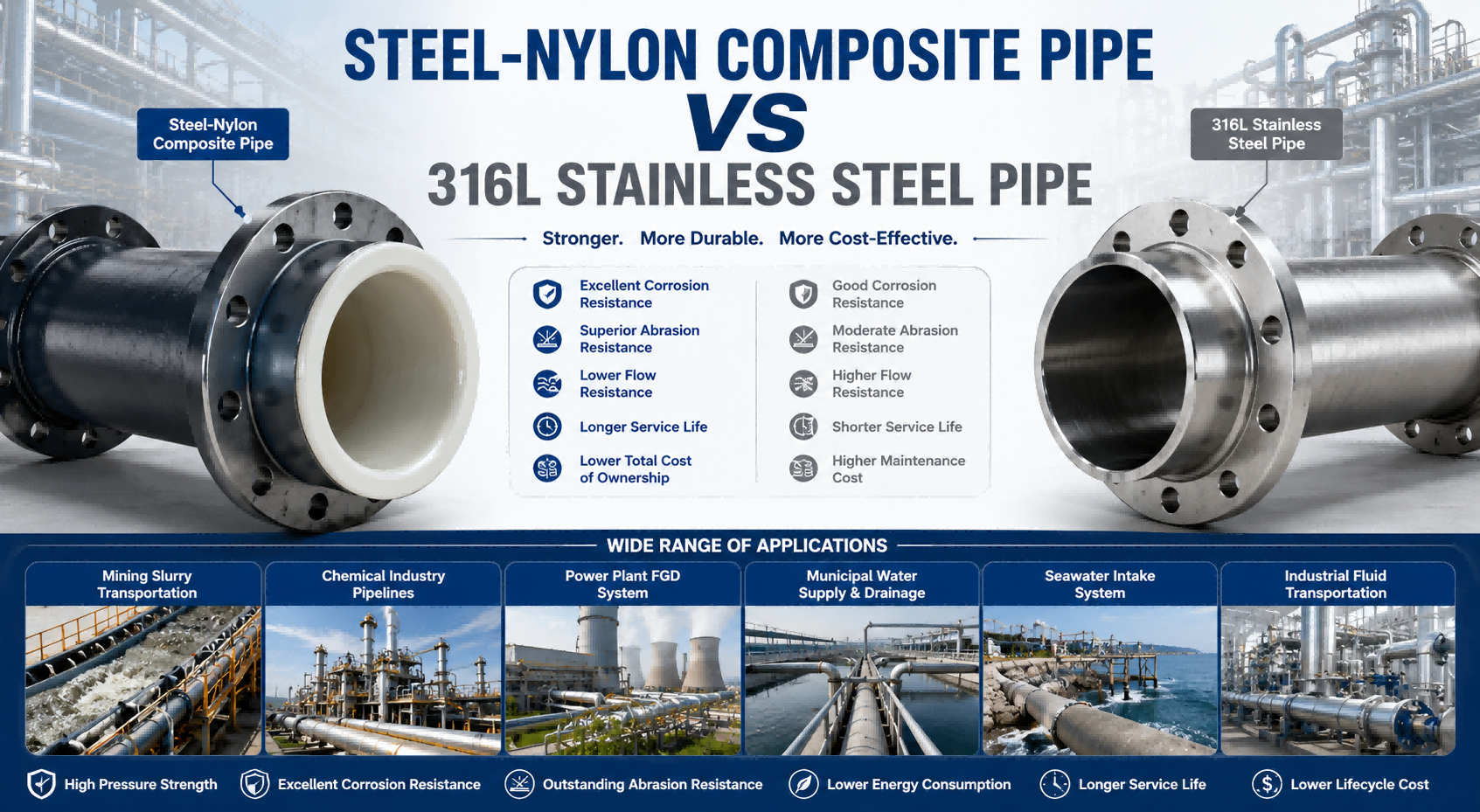
316 stainless steel pipe is a typical representative of the austenitic stainless steel family, relying on alloying (containing 2% to 3% molybdenum and 10% to 14% nickel) to gain resistance to chloride ion pitting. The addition of these precious metals directly makes its unit price several times that of ordinary carbon steel; for example, the price of seamless DN200 pipe can reach 260–375 CNY per meter. In terms of construction, although austenitic stainless steel has good weldability and a high inspection pass rate, the total installation investment remains very high for medium and large-diameter pipelines.
316 stainless steel pipe is a typical representative of the austenitic stainless steel family, relying on alloying (containing 2% to 3% molybdenum and 10% to 14% nickel) to gain resistance to chloride ion pitting. The addition of these precious metals directly makes its unit price several times that of ordinary carbon steel; for example, the price of seamless DN200 pipe can reach 260–375 CNY per meter. In terms of construction, although austenitic stainless steel has good weldability and a high inspection pass rate, the total installation investment remains very high for medium and large-diameter pipelines.
3.2 Core Cost Advantages
**Ultimate mechanical safety**: The tensile and yield strengths of 316 stainless steel far exceed those of conventional plastic pipes, allowing it to withstand extremely high physical loads and fluid impacts, thereby ensuring "zero leakage" in system operation. Data shows that after an airport adopted this material, system stability improved by about 40%, and its service life exceeds 70 years, essentially matching the lifespan of the building itself.
**Comprehensive temperature adaptability**: 316 stainless steel can operate stably in a wide temperature range from -200°C to 400°C, a feat unmatched by any organic non-metallic material, meaning it is virtually the only choice for extreme high and low temperature conditions.
**Ultimate mechanical safety**: The tensile and yield strengths of 316 stainless steel far exceed those of conventional plastic pipes, allowing it to withstand extremely high physical loads and fluid impacts, thereby ensuring "zero leakage" in system operation. Data shows that after an airport adopted this material, system stability improved by about 40%, and its service life exceeds 70 years, essentially matching the lifespan of the building itself.
**Comprehensive temperature adaptability**: 316 stainless steel can operate stably in a wide temperature range from -200°C to 400°C, a feat unmatched by any organic non-metallic material, meaning it is virtually the only choice for extreme high and low temperature conditions.
3.3 Core Cost Weakness
"Corrosion" remains the Achilles' heel of 316 stainless steel. In environments containing high chloride ions, hydrofluoric acid, or high-temperature acids, austenitic stainless steel is highly susceptible to stress corrosion cracking. Once penetration corrosion occurs, production must be halted to cut and replace the entire pipe section, and the resulting downtime losses and replacement costs often cause the TCO to skyrocket to astronomical figures. In the chemical industry, even stainless steel pipes can be completely scrapped within a few months to a year in strong acid environments.
"Corrosion" remains the Achilles' heel of 316 stainless steel. In environments containing high chloride ions, hydrofluoric acid, or high-temperature acids, austenitic stainless steel is highly susceptible to stress corrosion cracking. Once penetration corrosion occurs, production must be halted to cut and replace the entire pipe section, and the resulting downtime losses and replacement costs often cause the TCO to skyrocket to astronomical figures. In the chemical industry, even stainless steel pipes can be completely scrapped within a few months to a year in strong acid environments.
4. Nylon-Steel Composite Pipe: The Emerging Champion of Wear and Corrosion Resistance
4.1 Purchase and Installation
Nylon-steel composite pipe employs a "rigid-flexible" composite structure: the outer steel pipe bears the system pressure, while the inner nylon layer provides a corrosion and wear-resistant barrier. Its unit procurement cost sits between ordinary carbon steel pipe and pure high-alloy pipe, roughly at the same level as FRP. Connection methods typically use flange connections, and the installation operation is similar to ordinary metal pipes, requiring no special training and featuring high workflow efficiency.
Nylon-steel composite pipe employs a "rigid-flexible" composite structure: the outer steel pipe bears the system pressure, while the inner nylon layer provides a corrosion and wear-resistant barrier. Its unit procurement cost sits between ordinary carbon steel pipe and pure high-alloy pipe, roughly at the same level as FRP. Connection methods typically use flange connections, and the installation operation is similar to ordinary metal pipes, requiring no special training and featuring high workflow efficiency.
4.2 Core Cost Advantages
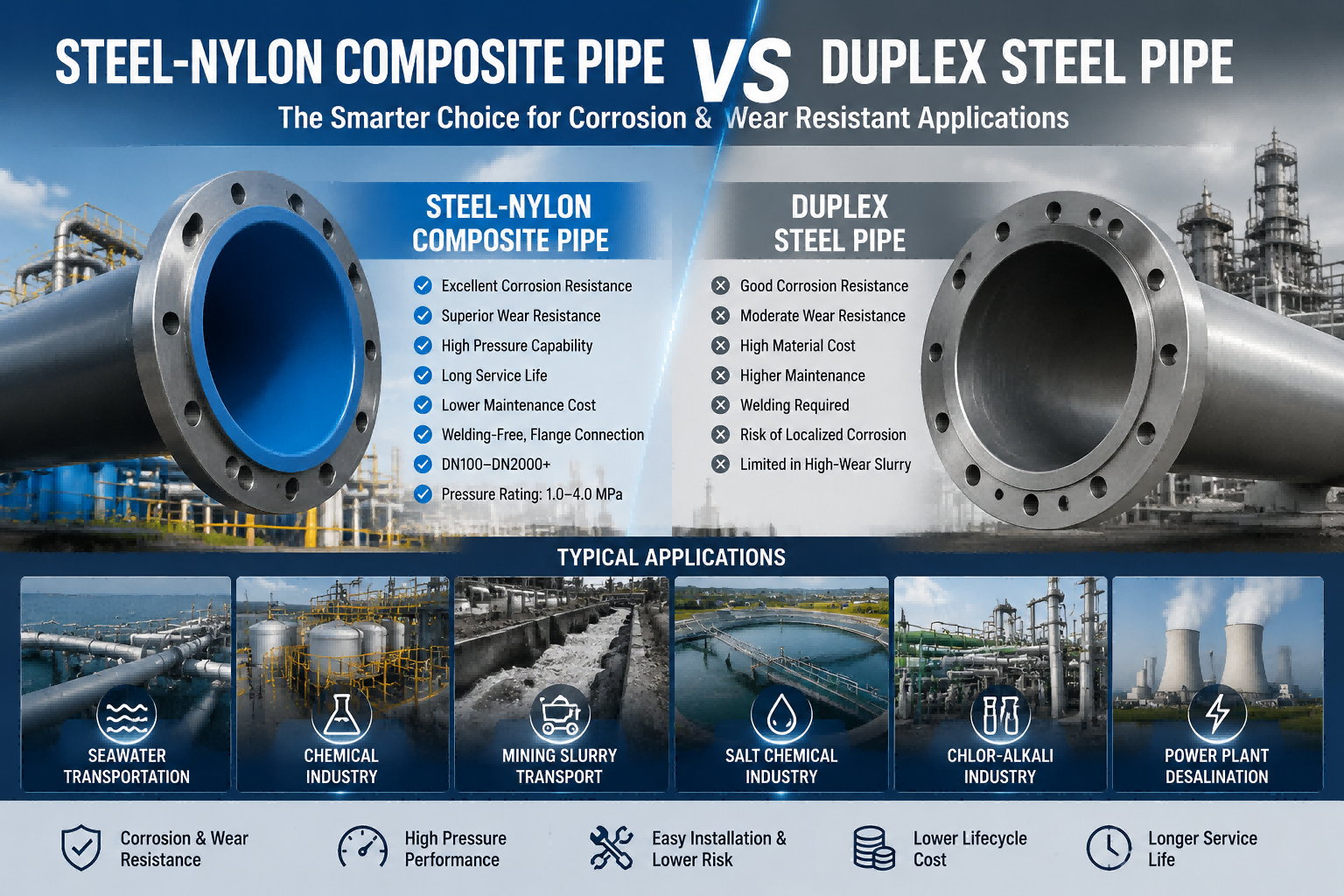
**Top-tier wear resistance**: This is the most commercially impactful strength of nylon composite pipe. When conveying media such as slurries, slag, and industrial wastewater, the wear resistance of steel-reinforced nylon pipe is 8 to 10 times that of carbon steel and stainless steel, and 6 times that of PE100 material, directly extending the replacement cycle caused by pipe wall wear-through significantly.
**Good corrosion resistance and drag reduction**: The nylon material is non-stick and scale-free, with an extremely smooth surface that significantly reduces frictional resistance loss in fluid transport. Oilfield application tests have confirmed that, as an internal anti-corrosion technology for gathering and transportation systems, nylon composite pipe has excellent anti-corrosion performance and overall suitability.
**Wide working window**: The material maintains stable physical properties within a temperature range of -40°C to 120°C, adapting to most medium-temperature conditions.
**Top-tier wear resistance**: This is the most commercially impactful strength of nylon composite pipe. When conveying media such as slurries, slag, and industrial wastewater, the wear resistance of steel-reinforced nylon pipe is 8 to 10 times that of carbon steel and stainless steel, and 6 times that of PE100 material, directly extending the replacement cycle caused by pipe wall wear-through significantly.
**Good corrosion resistance and drag reduction**: The nylon material is non-stick and scale-free, with an extremely smooth surface that significantly reduces frictional resistance loss in fluid transport. Oilfield application tests have confirmed that, as an internal anti-corrosion technology for gathering and transportation systems, nylon composite pipe has excellent anti-corrosion performance and overall suitability.
**Wide working window**: The material maintains stable physical properties within a temperature range of -40°C to 120°C, adapting to most medium-temperature conditions.
4.3 Non-negligible Weaknesses
Nylon-steel composite pipe has clear selection no-go zones. First, the temperature red line is clear: nylon material undergoes physical creep and softening above 120°C and must never be mistakenly used for high-temperature superheated steam networks. Second, the quality of the composite structure is highly dependent on manufacturing: if the steel-plastic interface bonding process is subpar, liner collapse or delamination may occur under negative pressure or temperature cycling. Such hidden quality defects will directly cut off the pipeline's long-life expectation.
Nylon-steel composite pipe has clear selection no-go zones. First, the temperature red line is clear: nylon material undergoes physical creep and softening above 120°C and must never be mistakenly used for high-temperature superheated steam networks. Second, the quality of the composite structure is highly dependent on manufacturing: if the steel-plastic interface bonding process is subpar, liner collapse or delamination may occur under negative pressure or temperature cycling. Such hidden quality defects will directly cut off the pipeline's long-life expectation.
5. TCO Quantitative Showdown: Who Reigns Supreme?
To more intuitively reveal the true economic gap among the three materials, a scenario-based simulation is conducted using typical TCO calculation data:
**Scenario 1: Strong Chemical Corrosion & Atmospheric Pressure Conditions (e.g., Chlor-alkali Industry Brine Purification System)**
In this scenario, high concentrations of chloride ions are a fatal killer for 316 stainless steel, with a very high risk of crevice corrosion failure in austenitic stainless steel. Here, the core variables in the TCO model are "maintenance and replacement costs."
**FRP Pipe**: By virtue of its overall inertness to a wide range of acids and alkalis, it can eliminate expensive cathodic protection and anti-corrosion coating maintenance for the entire life cycle, easily achieving a service life of 30 to 50 years. Calculations show that in the petrochemical sector, the TCO of FRP is over one-third lower than that of steel solutions, making it the cost-optimal choice for this condition.
**Nylon-Steel Composite Pipe**: Its performance is adequate for this corrosive environment, but its **wear resistance advantage cannot be leveraged here**, while its procurement cost is higher than FRP, placing its TCO in the middle.
**316 Stainless Steel**: Requires frequent inspection, shutdowns, cleaning, and even premature replacement. The three hidden costs are extremely high, ranking its TCO at the bottom.
In this scenario, high concentrations of chloride ions are a fatal killer for 316 stainless steel, with a very high risk of crevice corrosion failure in austenitic stainless steel. Here, the core variables in the TCO model are "maintenance and replacement costs."
**FRP Pipe**: By virtue of its overall inertness to a wide range of acids and alkalis, it can eliminate expensive cathodic protection and anti-corrosion coating maintenance for the entire life cycle, easily achieving a service life of 30 to 50 years. Calculations show that in the petrochemical sector, the TCO of FRP is over one-third lower than that of steel solutions, making it the cost-optimal choice for this condition.
**Nylon-Steel Composite Pipe**: Its performance is adequate for this corrosive environment, but its **wear resistance advantage cannot be leveraged here**, while its procurement cost is higher than FRP, placing its TCO in the middle.
**316 Stainless Steel**: Requires frequent inspection, shutdowns, cleaning, and even premature replacement. The three hidden costs are extremely high, ranking its TCO at the bottom.
**Winner: FRP Pipe**
**Scenario 2: High Temperature, High Pressure & Strict Fire Safety Zones (e.g., Reactor Discharge Pipe at the Core of a Chemical Plant)**
In this scenario, the primary TCO weights become "safety risk cost" and "impact strength."
**316 Stainless Steel**: Resistant to high temperature and high pressure, with no creep risk. Although the procurement cost is as high as several hundred yuan per meter, considering the absolute red line of safe production, it becomes the only reasonable choice.
**FRP Pipe**: Has inherent material weaknesses such as high-temperature softening, insufficient pressure rating, and low impact resistance, making it unsuitable for this scenario.
**Nylon-Steel Composite Pipe**: Its 120°C temperature ceiling also prevents it from covering the high-temperature segment, disqualifying it from the candidate list.
In this scenario, the primary TCO weights become "safety risk cost" and "impact strength."
**316 Stainless Steel**: Resistant to high temperature and high pressure, with no creep risk. Although the procurement cost is as high as several hundred yuan per meter, considering the absolute red line of safe production, it becomes the only reasonable choice.
**FRP Pipe**: Has inherent material weaknesses such as high-temperature softening, insufficient pressure rating, and low impact resistance, making it unsuitable for this scenario.
**Nylon-Steel Composite Pipe**: Its 120°C temperature ceiling also prevents it from covering the high-temperature segment, disqualifying it from the candidate list.
**Winner: 316 Stainless Steel Pipe**
**Scenario 3: Medium Corrosion & High Wear Conditions (e.g., Mine Tailings Slurry Pipeline)**
In this scenario, inner wall wear is the primary driver for pipe replacement, and TCO is decided by "the service life difference brought by wear resistance."
**Nylon-Steel Composite Pipe**: Its self-lubricating wear resistance is several times to ten times that of its competitors. In the composite pipe TCO calculation model, its long service cycle significantly amortizes the unit-time cost, with TCO only one-third that of ordinary carbon steel tubing, making it the veritable economic optimum.
**316 Stainless Steel**: Lacking a wear-resistant alloy layer, the pipe wall will thin rapidly under the strong erosion-corrosion of ore slurry, leading to frequent replacement.
**FRP Pipe**: The inner liner is relatively soft and has insufficient erosion resistance. Under long-term scouring by particle-laden fluids, wear will push up replacement costs.
In this scenario, inner wall wear is the primary driver for pipe replacement, and TCO is decided by "the service life difference brought by wear resistance."
**Nylon-Steel Composite Pipe**: Its self-lubricating wear resistance is several times to ten times that of its competitors. In the composite pipe TCO calculation model, its long service cycle significantly amortizes the unit-time cost, with TCO only one-third that of ordinary carbon steel tubing, making it the veritable economic optimum.
**316 Stainless Steel**: Lacking a wear-resistant alloy layer, the pipe wall will thin rapidly under the strong erosion-corrosion of ore slurry, leading to frequent replacement.
**FRP Pipe**: The inner liner is relatively soft and has insufficient erosion resistance. Under long-term scouring by particle-laden fluids, wear will push up replacement costs.
**Winner: Nylon-Steel Composite Pipe**
6. Strategic Selection Guide: The Cost-Optimal Formula Based on Working Conditions
In summary, claiming that a single material is invincible in all scenarios is unscientific. The essence of TCO is the **precise matching of material to working conditions**. Here is a clear choice roadmap for decision-makers:
| Decision Dimension | Recommended Material | Core Rationale |
|---|---|---|
| Extreme corrosion (strong acid, high salt) + ambient temperature & pressure | FRP Pipe | No weakness in corrosion resistance, zero maintenance, 50-year lifecycle amortizing annual TCO |
| High temperature, high pressure, fire protection & load-bearing areas | 316 Stainless Steel Pipe | Outstanding mechanical properties, full-range temperature adaptability, eliminating safety incidents |
| Medium corrosion + heavy wear (tailings, slurry) | Nylon-Steel Composite Pipe | Unmatched wear resistance, ensuring long-term continuous system operation and reducing downtime losses |
| Optimal overall cost-performance (general medium/low-pressure conditions) | Nylon-Steel Composite / FRP | Fine-tune based on the dual characteristics of corrosion and wear in the specific medium |
Industrial pipe material selection is a strategic game of long-termism. Only by stepping out of the "lowest bid wins" procurement framework and establishing a quantifiable TCO mindset can we truly find the pipeline that best fits the project's characteristics for "cost reduction and efficiency gain." As procurement and technical leaders, what you need to do is accurately define the current and future media properties and operating boundaries, and then let the TCO model reveal the final financial answer for you.
A Powerful Tool for Pipeline Construction Efficiency: Why Nylon-Steel Composite Pipes with "Built-in Flanges + Welding-Free" Are Phasing Out Traditional Construction Methods
Tubing Selection for Harsh Oil & Gas Field Conditions: Why Flanged Nylon-Steel Composite Pipe Is Becoming the New Industry Darling
Related blog