
Rubber Hoses Crack and Age Under Scorching Sun in Oilfields, While Reinforced Nylon Pipes Remain Like New After Thirty Years of Rain and Sun
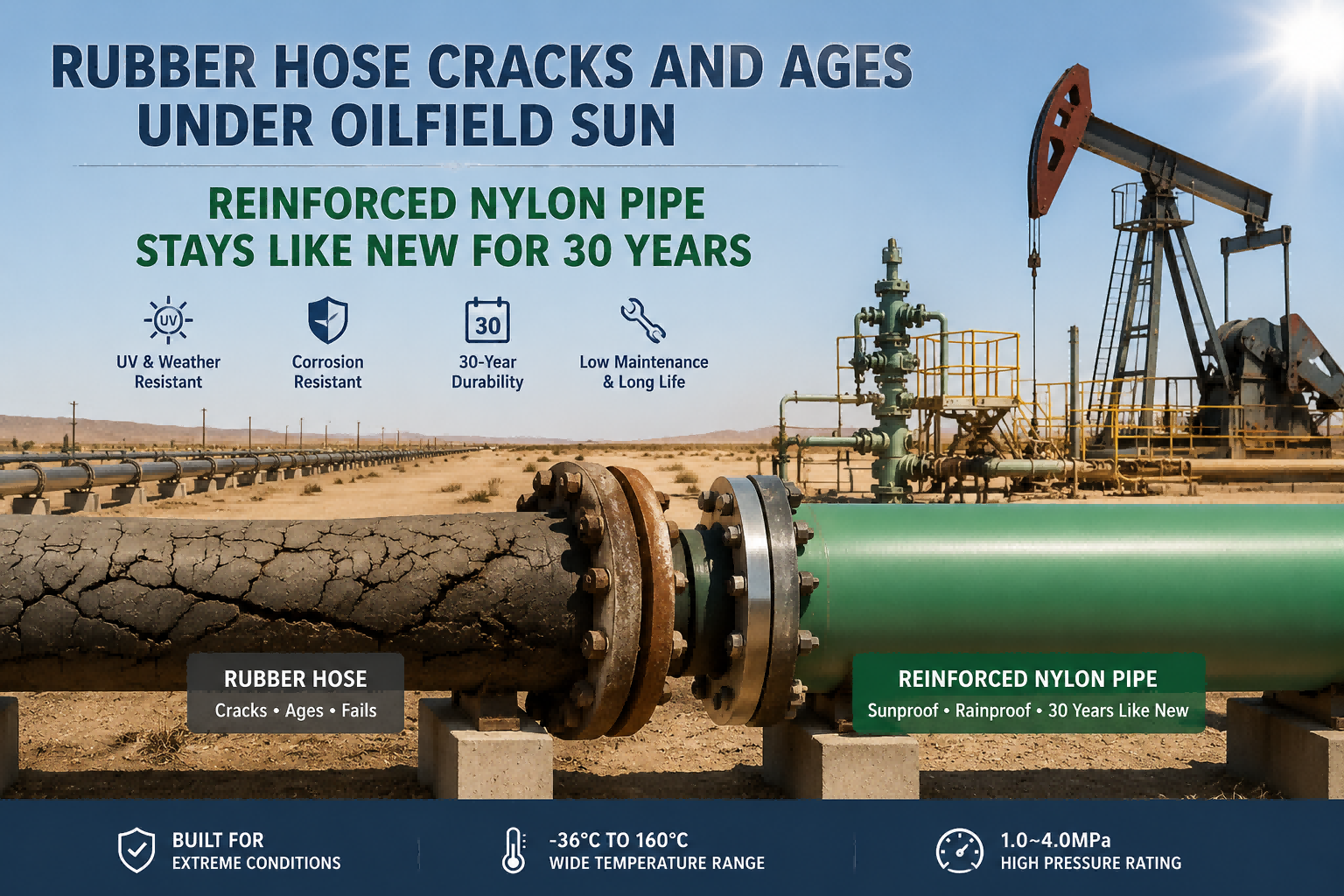
On oilfield job sites, a striking contrast often unfolds: on one side, rubber hoses laid less than two years ago are already covered with a web of fine cracks, hardened and losing elasticity under the relentless sun; on the other, reinforced nylon pipelines that have served for over two decades, having weathered countless cycles of sun and rain, still appear glossy and perform steadily. This is not merely a difference in fate between two piping materials—it is a microcosm of how materials science, when deeply understood, can reshape industrial realities.
The Agony of Rubber Hoses: When Elastomers Meet Sunlight
The widespread use of rubber hoses in oilfields is not without reason. They are flexible, abrasion‑resistant, and capable of withstanding a wide temperature range (from –80°C to 300°C), which makes them adequate for short‑term conveying needs. However, the Achilles’ heel of rubber lies hidden in its molecular architecture.
The molecular chains of rubber are built on carbon‑carbon single bonds—a structure highly sensitive to ultraviolet (UV) energy. The high‑energy UV rays in sunlight do more than simply break or cross‑link these chains; they also generate free radicals upon absorption, which in turn initiate and accelerate oxidative chain reactions. In effect, UV radiation constantly “heats” the rubber molecules from within, driving ageing processes at an accelerated pace on the material’s surface. Because photodegradation occurs primarily on the surface, the outer layer of the hose develops a characteristic network of fine cracks—known as “photo‑oxidative crazing.”
But surface cracking is only the beginning. Once the outer layer is breached, UV radiation, ozone, and moisture penetrate deeper, attacking the reinforcement layer and the inner tube. In the open‑air environment of an oilfield—where solar irradiation, ozone attack, and humid air alternate relentlessly—the ageing of rubber hoses accelerates exponentially. Industry data show that the service life of mud hoses under severe conditions typically ranges from 6 months to 2 years. For oilfield operators seeking long‑term stability, this translates into frequent replacements, unplanned downtime, and escalating maintenance costs.
The Nylon Way: Immunity at the Molecular Level
The reason reinforced nylon pipes can “remain like new after thirty years of sun and rain” lies in their molecular structure, which confers a natural “immunity” to UV degradation.
Nylon (polyamide) chains contain amide groups (–CONH–). These polar groups form stable intermolecular hydrogen bonds, giving nylon a higher degree of crystallinity and more tightly packed molecular chains. Unlike the loose configuration of rubber chains, nylon’s densely ordered structure makes it difficult for UV rays to penetrate the surface and trigger deep‑seated degradation. Even if the outermost layer experiences some photo‑induced effects, the overall mechanical properties degrade at an exceedingly slow rate.
More importantly, the word “reinforced” is key. By incorporating glass fibres, carbon fibres, or adopting a steel‑reinforced composite structure, the strength, stiffness, and weatherability of reinforced nylon pipes are significantly enhanced. For example, reinforced MC nylon pipes exhibit a heat‑deflection temperature exceeding 200°C and a service life of over 30 years. In practical applications, flexible composite pipes with polyester‑reinforced nylon liners have been widely used in high‑pressure methanol‑injection service in gas fields. Steel‑skeleton reinforced nylon pipes demonstrate abrasion and corrosion resistance superior to any other non‑metallic product on the market.
The Numbers Behind the Gap
A set of comparative data highlights the stark differences more concretely:
**Surface roughness**: Rubber hoses have an internal surface roughness of 38 μm, whereas nylon pipes achieve only 2.5 μm. Smoother interiors mean lower flow resistance, less energy loss, and reduced tendency for scaling.
**Weight**: Reinforced nylon pipes weigh about one‑half to one‑third as much as rubber hoses of the same specification, and roughly one‑seventh as much as steel pipes. Lighter weight translates into easier installation, lower transport costs, and reduced support loads.
**Ozone resistance**: Nylon pipes do not suffer from ozone‑induced cracking—a critical advantage in open‑air oilfield environments where ozone and UV coexist.
**Service life**: Rubber hoses are measured in *months* under harsh conditions, while reinforced nylon pipes are measured in *decades*. For instance, buried oil‑production and transmission pipelines in the Shengli Oilfield have been in continuous service since 1994. PAMC nylon‑steel composite pipes have operated reliably for over 23 years in the Sinopec system without corrosion or leakage.
Material Selection as Strategic Decision
In oilfield applications, pipe selection is never a simple arithmetic problem. In the short term, the initial purchase cost of rubber hoses may be lower. However, when the total cost of ownership—including replacement frequency, downtime losses, maintenance labour, and safety risks—is factored in, the overall economic advantage of reinforced nylon pipes becomes undeniable.
This reveals a deeper industrial logic: **in extreme environments, durability itself is a form of efficiency**. Every unscheduled shutdown is a loss of production; every pipe replacement consumes resources; every leak is a safety hazard. Choosing a material that can “remain like new for thirty years” is, in essence, using material certainty to counter environmental uncertainty.
The transition from rubber to reinforced nylon is not simply a substitution of one material for another—it represents an evolution in engineering thinking: from “good enough for now” to “reliable for the long haul”; from “frequent maintenance” to “extended operation cycles.” When sun and rain are the daily norm in oilfields, opting for reinforced nylon pipes means using the wisdom of materials science to build a defence line that withstands the test of time—ensuring the continuity of industrial production, season after season, decade after decade.
Let me know if you need a shorter executive summary, a more technical whitepaper version, or any adjustments for a specific target audience.
From Carbon Steel Lined Plastic to Nylon Composite Pipe: A Three‑Generation Evolution in Chemical Plant Piping Selection
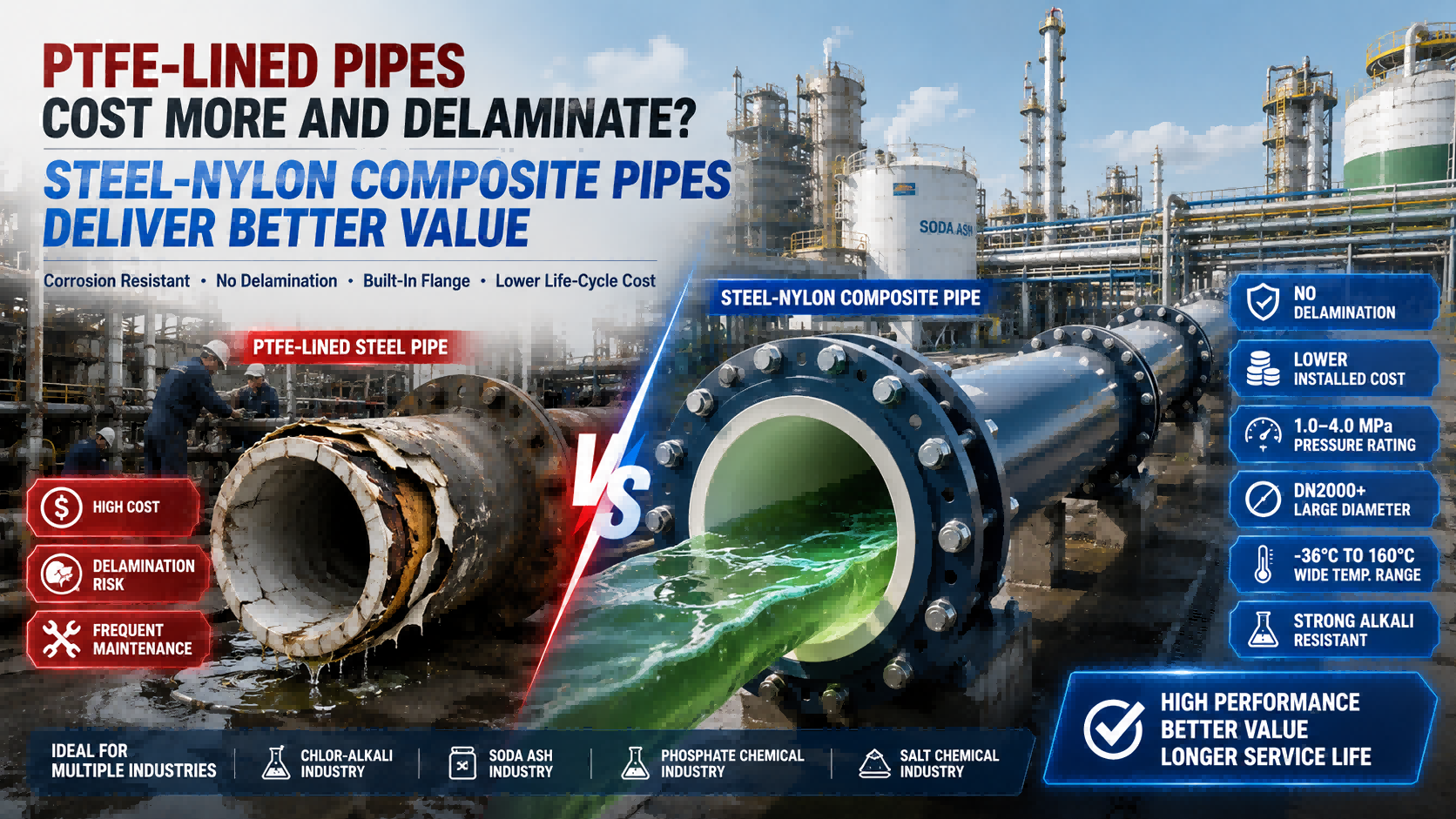
PTFE-Lined Pipes Are Expensive and Prone to Delamination – Steel-Nylon Composite Pipes Offer Overwhelming Cost-Effectiveness
Related blog


SEND MESSAGE