
From Carbon Steel Lined Plastic to Nylon Composite Pipe: A Three‑Generation Evolution in Chemical Plant Piping Selection

The piping system of a chemical plant is often vividly described as its “blood vessels.” The health of the blood determines the lifespan and vitality of the entire organism; likewise, proper pipe selection directly decides the operational efficiency, safety margin, and total life‑cycle cost of a chemical facility. Over the past decades, chemical piping materials have undergone a profound evolution—from single‑metal constructions to composite structures, and from passive corrosion protection to active abrasion resistance. Tracing this technology path, we can clearly identify three generations of pipe materials and their transitions.
First Generation: The “Short‑Life” Dilemma of Pure Metal Pipes
Before the widespread adoption of composite pipes, the conveyance of corrosive media in chemical plants relied primarily on pure metal pipes—carbon steel, stainless steel, and rubber‑lined metal pipes.
The advantages of carbon steel pipes are obvious: high strength, low cost, and ease of fabrication and welding. However, in the presence of corrosive media such as acids, alkalis, and salts, the weaknesses of carbon steel are equally fatal. Taking concentrated sulfuric acid transport as an example, ordinary carbon steel pipes can suffer a flow capacity reduction of over 15% due to corrosion. Corrosion not only leads to frequent leaks and replacements but also creates hidden safety risks from chemical agent leakage.
Stainless steel pipes (e.g., 304 stainless steel) perform reasonably well in oxidizing acids, but under high temperatures or strong oxidising environments, issues such as intergranular corrosion and metal ion precipitation become prominent. In applications demanding ultra‑high purity, such as semiconductor chemical delivery, metal ion leaching can even become an unacceptable quality risk. Rubber‑lined solutions, while alleviating corrosion in the short term, have joint seams that are vulnerable, offer limited advantages in acid‑alkali solutions, and wear extremely fast in slurries containing solid particles.
The statistics are alarming: according to relevant authorities, China’s annual corrosion losses amount to approximately RMB 50 billion, of which piping—the arteries of chemical plants—accounts for RMB 20 billion. The “short‑life” dilemma of pure metal pipes catalysed the first revolution in piping technology.
Second Generation: The “Corrosion‑Resistant” Breakthrough of Carbon Steel Lined Plastic Pipes
The emergence of carbon steel lined plastic pipes marked a shift from “single material” to “composite structure” in chemical piping.
The design logic is simple yet effective: a standard carbon steel pipe serves as the substrate, with an inner lining of PE, PO, PP, or PVDF thermoplastic applied via cold‑draw composite or rotational moulding processes. This structure achieves a “1+1>2” effect—the outer steel layer provides mechanical strength and pressure‑bearing capacity, while the inner plastic layer isolates corrosive media.
Performance data validate the rationality of this technology. Carbon steel lined plastic pipes operate stably in the range of ‑25°C to +105°C, with a positive pressure capacity of up to 1.6 MPa. In concentrated sulfuric acid transport, the inner wall shows less than 3% corrosion attenuation over five years. In one phosphate chemical project, steel‑lined PO pipes conveying 60°C concentrated sulfuric acid operated leak‑free for six years. In applications such as demineralised water stations, steel‑lined plastic composite pipes have been proven to be a preferred solution for acidic corrosive environments.
However, carbon steel lined plastic pipes are not a universal remedy. Their limitations are equally evident:
**First**, the upper temperature limit is approximately 105°C; above 60°C, the risk of accelerated plastic ageing cannot be ignored.
**Second**, they remain vulnerable to strongly oxidising acids such as concentrated nitric acid and fuming sulfuric acid.
**Third**, the pipes are factory‑finished products, making on‑site welding difficult.
**Fourth**, and most critically—in abrasive media containing solid particles, the wear resistance of the plastic lining becomes a new shortcoming.
**First**, the upper temperature limit is approximately 105°C; above 60°C, the risk of accelerated plastic ageing cannot be ignored.
**Second**, they remain vulnerable to strongly oxidising acids such as concentrated nitric acid and fuming sulfuric acid.
**Third**, the pipes are factory‑finished products, making on‑site welding difficult.
**Fourth**, and most critically—in abrasive media containing solid particles, the wear resistance of the plastic lining becomes a new shortcoming.
The complexity of chemical media extends far beyond “corrosion” alone. Acid‑alkali slurries, mineral slurries, and desulphurisation limestone slurries—which are both corrosive and abrasive—place dual demands on piping. Carbon steel lined plastic pipes solved the “corrosion” problem but failed to adequately address the challenge of “abrasion.”
Third Generation: The “Abrasion‑Resistant” Evolution of Nylon Composite Pipes
If carbon steel lined plastic pipes were a breakthrough from the perspective of “corrosion protection,” then nylon composite pipes represent a comprehensive evolution along both “corrosion resistance” and “abrasion resistance” dimensions.
Nylon composite pipes (typically steel‑lined nylon pipes or nylon‑steel composite pipes) consist of an outer steel pipe with an inner nylon layer (or a steel substrate with a nylon lining). This structure preserves the mechanical strength of metal while introducing the outstanding abrasion and corrosion resistance of nylon to the pipe’s inner surface.
The performance advantages of nylon are remarkable. As a specialty engineering plastic that can serve in environments exceeding 180°C, nylon simultaneously offers abrasion resistance more than 20 times that of ceramics, while weighing only one‑seventh as much as steel. In terms of chemical resistance, except for strong oxidising acids such as concentrated nitric acid, fuming sulfuric acid, and chlorosulfonic acid, nylon can withstand most organic and inorganic acids, alkalis, and salts.
Field applications confirm the engineering value of nylon composite pipes. In industries such as mining, metallurgy, and chemicals—where abrasion resistance is paramount—nylon‑steel composite pipes have been widely adopted due to their compact structure and excellent mechanical properties. Projects including Tongling Chemical Group and the Kazakhstan soda ash plant have incorporated steel‑lined nylon piping into their procurement and construction plans. In scenarios such as salt‑chemical liquid transport, thermal power desulphurisation, and petroleum gathering, nylon pipes—with their combined advantages of corrosion resistance, non‑scaling, abrasion resistance, and temperature tolerance—are rapidly replacing traditional materials.
The Transformation Across Three Generations: From “Passive Repair” to “Active Matching”
Looking back at the evolution of these three generations, the essence is a technology path from “passive response” to “active matching”:
**First‑generation pure metal pipes** followed a logic of “brute force”—using the strength of metal to combat corrosion, often ending in mutual damage.
**Second‑generation carbon steel lined plastic pipes** followed a logic of “isolation”—separating corrosive media from the metal substrate with a plastic lining, effectively solving corrosion but falling short in abrasive conditions.
**Third‑generation nylon composite pipes** follow a logic of “matching”—selecting the most suitable lining material based on the specific service conditions of corrosiveness, temperature, and abrasion. The comprehensive performance of nylon pipes under extreme conditions (>180°C, abrasion resistance >20× ceramics, complex media) represents a mature milestone in chemical piping selection—moving from “general‑purpose” to “scenario‑tailored.”
**Second‑generation carbon steel lined plastic pipes** followed a logic of “isolation”—separating corrosive media from the metal substrate with a plastic lining, effectively solving corrosion but falling short in abrasive conditions.
**Third‑generation nylon composite pipes** follow a logic of “matching”—selecting the most suitable lining material based on the specific service conditions of corrosiveness, temperature, and abrasion. The comprehensive performance of nylon pipes under extreme conditions (>180°C, abrasion resistance >20× ceramics, complex media) represents a mature milestone in chemical piping selection—moving from “general‑purpose” to “scenario‑tailored.”
This does not mean that nylon composite pipes will entirely replace all earlier products. In purely corrosive (particle‑free), moderate‑temperature, low‑temperature applications, carbon steel lined plastic pipes remain the most economical and efficient choice. In ultra‑aggressive environments (e.g., high‑temperature strong oxidising acids), steel‑lined PTFE (Teflon) pipes still serve as the “ultimate solution.” The essence of pipe material selection is never “which replaces which,” but rather, amidst a myriad of complex operating parameters, finding the optimal balance between performance and cost.
From carbon steel lined plastic to nylon composite pipes, the “blood vessels” of chemical plants are becoming ever tougher and smarter. And the endpoint of this evolution is far from being reached.
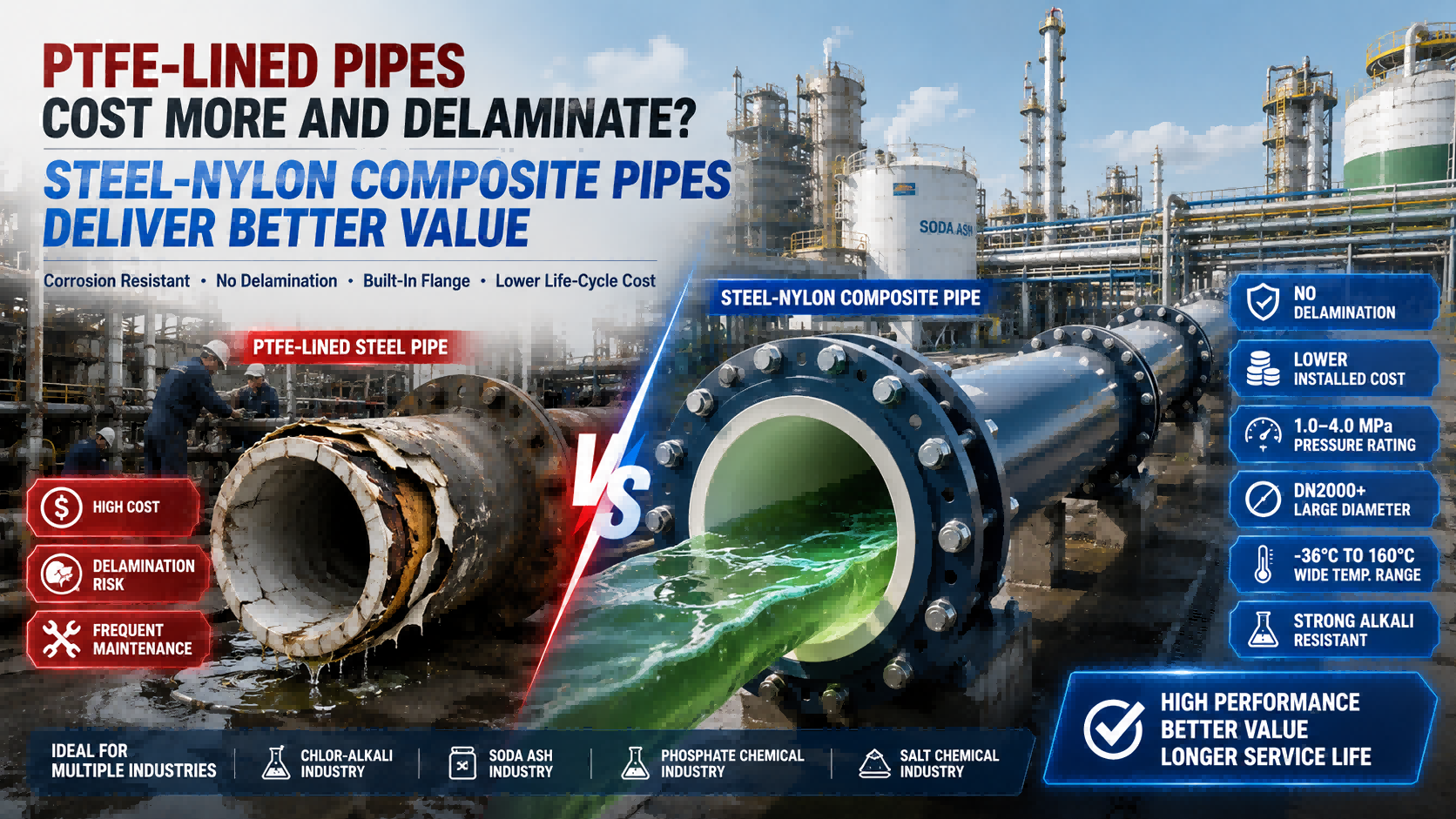
Life Cycle Cost Comparison: The True Cost-Performance Champion Among Anti-Corrosion Pipes in Salt Chemical Applications
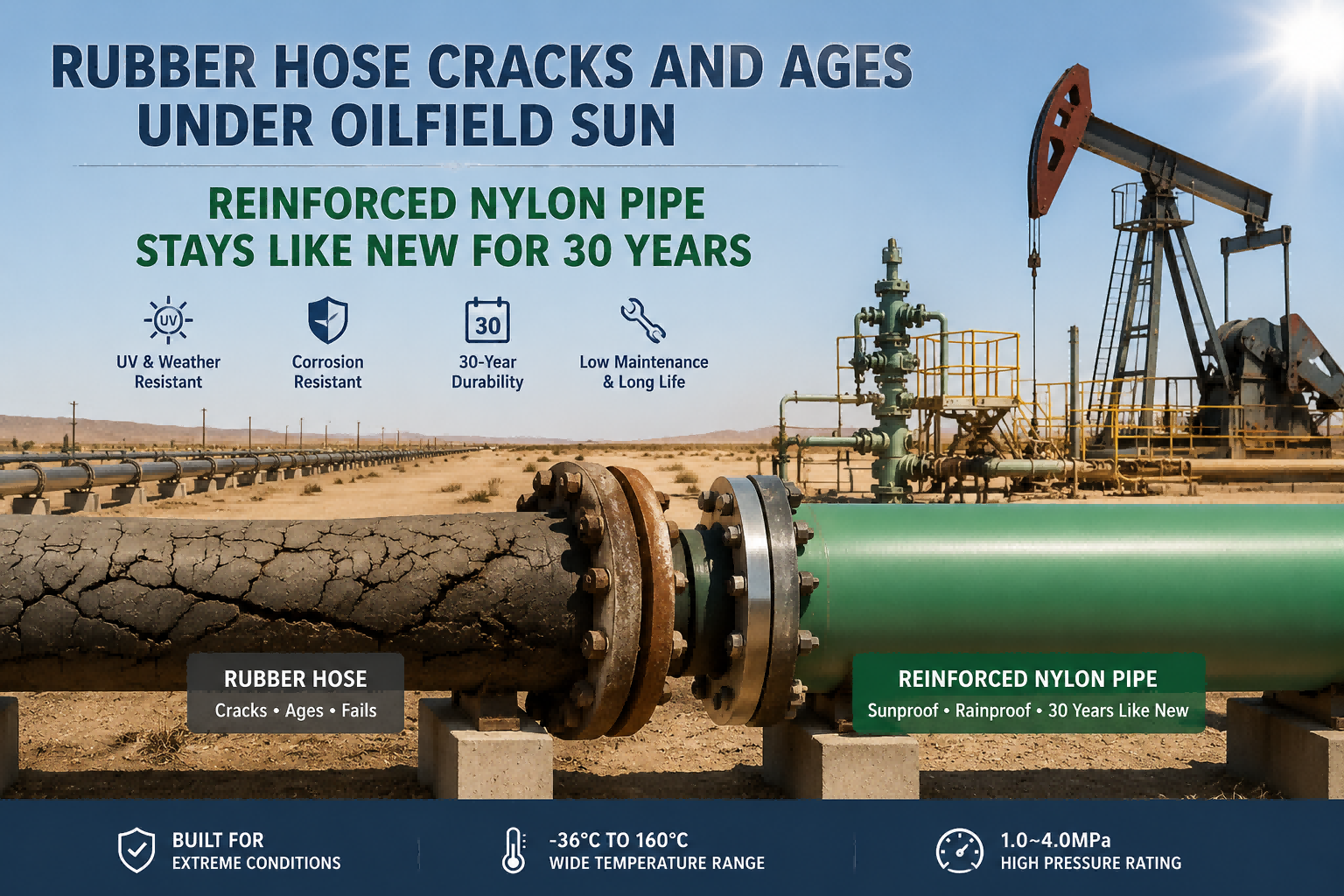
Rubber Hoses Crack and Age Under Scorching Sun in Oilfields, While Reinforced Nylon Pipes Remain Like New After Thirty Years of Rain and Sun
Related blog

SEND MESSAGE