Glass‑Lined Piping Shatters at the First Knock – Reinforced Nylon Pipe Delivers Impact Resistance and Lifetime Peace of Mind
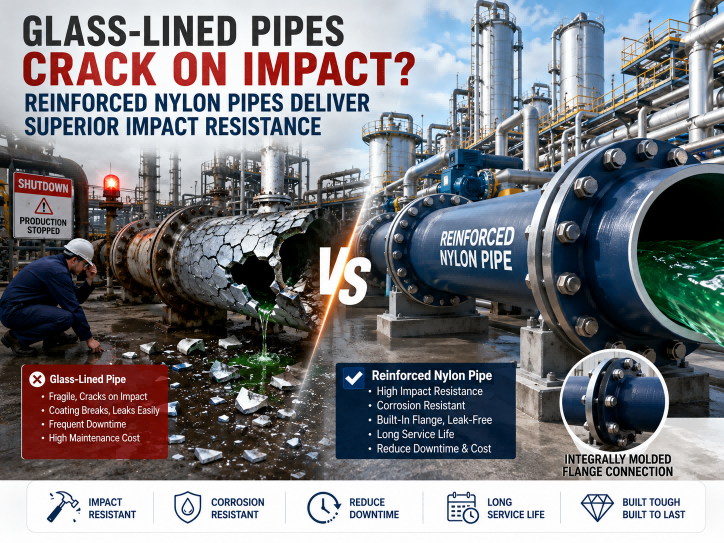
When the “Corrosion‑Resistant Myth” Meets the Brutal Reality of “Shatter‑Prone”
On the front lines of chemical, pharmaceutical, and food processing plants, selecting piping materials is never a mere “nice‑to‑have” upgrade. It is a critical decision that affects production safety, operating costs, and team morale.
Glass‑lined piping—once hailed as the benchmark of corrosion resistance—has dominated corrosive‑media transport for decades, thanks to the chemical stability and non‑stick smoothness of its borosilicate glass inner lining. The combination of metal strength and glass corrosion resistance sounds almost perfect on paper.
But reality is unforgiving. **The brittleness of glass‑lined piping is exacting a heavy toll on countless plants.**
The Achilles’ Heel of Glass‑Lined Piping: Brittleness
The manufacturing process of glass‑lined piping dictates its inherent flaw: a glass enamel layer, only 0.8‑2 mm thick, is fused onto the inner wall of a metal pipe at high temperature. Although this glass layer forms a strong chemical bond with the metal substrate, glass is intrinsically a brittle material—low strength, low toughness—characteristics it cannot escape.
What does this mean in practice? **Any accidental impact, extrusion, or even a minor knock can lead to catastrophic failure.**
Systematic studies on glass‑lined equipment failure show that external impact damage typically presents as star‑shaped cracks—the tensile force from impact fractures the glass, and because the enamel layer is much weaker in tension than in compression, the damage often extends to the underlying steel. Internal impact is equally dangerous: hard objects striking the surface, bubble bursts, violent material surges, or even high‑pressure water jets can directly ruin the glass surface.
Even more troublesome is the insidious and unpredictable nature of the damage. A slight jolt during transport, an inadvertent bump during installation, or even scratches from improper sling binding during hoisting can leave the pipe “wounded” before it ever goes into service.
**Any tiny chip or crack can lead to costly downtime, emergency repairs, or even catastrophic losses for the enterprise.**
The Chain Reaction of “Production Shutdown”: Far More Than Replacing One Pipe
When a glass‑lined pipe fractures, the plant faces much more than the cost of a single replacement.
First, **shutdown is inevitable**. Leaking corrosive media not only endangers equipment but also directly threatens personnel safety. Emergency shutdown, media drainage, repair and replacement—this whole process takes hours at best, days at worst. For continuous chemical processes, the loss from downtime is often tens or even hundreds of times the cost of the pipe itself.
Second, **maintenance costs spiral far beyond expectations**. Installing glass‑lined pipe demands extreme care: separate storage, wooden sleepers underneath, waterproof covers, and safety barriers. Any negligence during installation can cause new damage. Moreover, because glass‑lined pipe is rigid and cannot be cut to length on‑site, any dimensional deviation means a new custom order.
Third, **hidden costs cannot be ignored**. Research indicates that the primary causes of glass‑lined equipment failure are design/manufacturing defects, process installation errors, and improper use. To cut costs, some manufacturers reduce the number of firing cycles or increase single‑coat enamel thickness, leading to “under‑fired” layers and poor inter‑layer adhesion, further heightening the risk of fracture.
**Every fracture is a triple blow to production efficiency, safety margins, and workforce confidence.**
Reinforced Nylon Pipe: The Answer to Breaking the “Fragility” Trap
If glass‑lined piping represents the extreme of “hard but brittle,” then reinforced nylon piping represents the alternative of “strong and tough.”
Reinforced nylon pipe (especially MC nylon and steel‑reinforced nylon piping) is a high‑performance engineering plastic, manufactured by polymerisation extrusion or centrifugal casting. It fundamentally solves the fatal “shatter‑on‑impact” weakness of glass‑lined pipe.
Impact Resistance & Knock Tolerance – Eliminating Risks at the Source
The core advantage of reinforced nylon pipe lies in its outstanding **impact resistance and toughness**. It will not be scrapped by a single accidental knock; it will not develop micro‑cracks from minor transport jolts; it will not force a full production halt because of an inadvertent bump during installation.
Comparative studies on impact resistance of various piping materials show that reinforced nylon pipe outperforms FRP, HDPE, and many composites. Toughened nylon formulations significantly enhance impact strength, flexibility, and fatigue resistance. **This means reinforced nylon can withstand the “everyday abuse” that glass‑lined pipe simply cannot handle.**
Much More Than “Toughness” – A Full Spectrum of Performance
If impact resistance is reinforced nylon’s signature dish, then its comprehensive performance is a full banquet:
**Excellent wear resistance**: In slurry transport, reinforced nylon’s wear resistance is 8‑10 times that of carbon steel and stainless steel, and 6 times that of PE100. In severe abrasive conditions (e.g., soda ash, mining), reinforced MC nylon pipe has successfully replaced cast iron, demonstrating combined advantages in corrosion resistance, erosion resistance, scale retardation, and ageing resistance.
**Self‑lubricating / low friction**: MC nylon has inherent self‑lubricating properties; under identical conditions, its wear resistance is 3‑6 times that of steel. Its non‑stick, non‑scaling surface is comparable to the smoothness of glass lining.
**Corrosion and chemical resistance**: Reinforced nylon pipe resists a wide range of chemicals, with exceptional alkali resistance. It has been widely adopted in petroleum, petrochemical, chemical, soda ash, and thermal power desulphurisation applications.
**Lightweight and easy installation**: Light in weight, it supports socket‑and‑spigot, flanged, and other connection methods, making installation and maintenance convenient. Large‑diameter pipes (150‑2000 mm) can handle working pressures from 1.0 to 10.0 MPa.
From “Passive Protection” to “Active Peace of Mind”
The logic of using glass‑lined pipe is **“handle with kid gloves”** – protection during transport, protection during hoisting, protection during installation, protection during operation. Every step is a tightrope; one misstep means total shutdown.
The logic of reinforced nylon pipe is **“lifetime peace of mind”** – it needs no special “protective measures” because it is inherently tough. It fears no knocks, no impacts, and it won’t cripple your entire production line because of a single accident.
**This is not just “a better pipe”; it is “a different piping philosophy”.**
Data Speaks for Itself – Real‑World Pilot Feedback
In a mid‑scale evaluation of eight internal anti‑corrosion piping technologies, researchers conducted a one‑year follow‑up assessment using macro‑inspection, impact tests, chemical resistance tests, and other methods. The results showed that **steel‑reinforced composite pipe and nylon composite pipe performed excellently in both anti‑corrosion and overall performance**.
In another field evaluation of five piping types, FRP pipe, steel‑reinforced composite pipe, and nylon composite pipe all received a “good” overall rating, whereas glass‑enamelled lined pipe (glass‑lined type) showed signs of ageing and local corrosion.
**Practice is the sole criterion of truth.** In real production environments, reinforced nylon pipe has proven its worth.
Conclusion: Choosing Pipe Means Choosing Peace of Mind
Glass‑lined pipe does have its merits—excellent corrosion resistance and surface smoothness. But these advantages come with the fragile prerequisite of **“must not be knocked”**. For a modern plant that operates 24/7, that very fragility is an unacceptable risk.
Reinforced nylon pipe offers a new paradigm: **excellent corrosion resistance combined with impact toughness that glass‑lined pipe can never match**. It won’t shut you down because of one mishap; it won’t cost you dearly because of one bump.
**Glass‑lined pipe makes you walk on eggshells; reinforced nylon pipe lets you rest easy.**
On the scales of industrial pipe selection, instead of choosing a fragile corrosion‑resistant solution that “shatters at a touch,” choose a tough, all‑round solution that delivers **lifetime peace of mind**.
**Reinforced Nylon Pipe – Impact‑resistant, Knock‑tolerant, Lifetime Peace of Mind. Your production line deserves the better choice.**
*This article is based on publicly available industry data and technical research, intended as a reference for industrial pipe selection. For specific applications, always consult professional engineers and consider actual operating conditions.*
PTFE-Lined Pipes Are Expensive and Prone to Delamination – Steel-Nylon Composite Pipes Offer Overwhelming Cost-Effectiveness
Rubber-Lined Pipes Suffer from Collapse and Bulging Under Negative Pressure? Reinforced Nylon Pipes, Formed as an Integral Structure, Withstand Vacuum Conditions with Ease.
Related blog