Life Cycle Cost Comparison: The True Cost-Performance Champion Among Anti-Corrosion Pipes in Salt Chemical Applications

In salt chemical production, pipelines serve as the critical “blood vessels” for conveying brine, salt solutions, and acidic/alkaline media. However, the high concentrations of chloride ions, salt crystallization, and acidic/alkaline substances in these environments impose extremely severe corrosion challenges on piping systems. Many companies tend to focus solely on the unit purchase price during procurement, while overlooking the total cost over the entire service life of the pipes. This “price-only” mindset often leads to costs far exceeding expectations.
This article provides a systematic life-cycle cost (LCC) comparison of mainstream anti-corrosion pipes used in salt chemical scenarios, with special attention to one type that has gained increasing recognition in the industry—**steel-nylon composite pipe**. We aim to answer a core question: **Who is the true cost-performance champion?**
1. Salt Chemical Environments: The “Hell Mode” of Corrosion for Pipelines
The corrosiveness of salt chemical media manifests in multiple dimensions:
**Chloride ion attack** is the primary killer. Ordinary carbon steel pipes conveying chloride-containing media are highly susceptible to electrochemical corrosion at weld seams. In high-temperature, high-salinity oilfield produced water with mineralization up to tens of thousands or even hundreds of thousands of mg/L and temperatures above 50°C, internal corrosion of pipelines is a prominent problem, and pipeline perforation failures occur frequently.
**The combined effect of temperature and concentration** further accelerates corrosion. Brine transport pipes, due to high NaCl content and other substances such as O₂ and H₂S, are extremely corrosive—they typically begin to leak after three to four years and become severely damaged after six to seven years.
**Salt crystallization and abrasion** cannot be ignored either. During salt slurry transport, crystal particles scour the pipe wall, imposing additional demands on the inner surface.
In such a “hell mode” environment, pipe selection is by no means a simple material substitution; it is a systematic engineering task that requires comprehensive consideration of corrosion resistance, abrasion resistance, temperature resistance, installation convenience, and full life‑cycle costs.
2. Why Replace “Purchase Price” with “Life‑Cycle Cost”?
The frequent replacement of chemical pipelines is essentially the cost of “wrong material selection + poor management.” Life‑cycle cost is not simply “purchase price + installation cost”; it is a comprehensive economic model covering **initial procurement cost, installation and construction cost, operation and maintenance cost, production loss from failures, and eventual replacement cost**.
In salt chemical applications, once a pipeline leaks or suffers corrosion perforation, it not only causes material loss but also triggers a cascade of costs such as production line shutdowns, safety hazard rectification, and pollution compensation—often far exceeding the savings from a lower purchase price. A scientific cost assessment should cover all three phases: procurement, construction, and maintenance. When preparing tender estimates, it is advisable to include shutdown losses, welder man‑hours, anti‑corrosion recoating expenses, and buried pipe removal costs in the comparison to obtain a true LCC picture.
3. Comprehensive Performance and Cost Comparison of Mainstream Anti‑Corrosion Pipes
3.1 Carbon Steel Pipes (with Coating Protection)
Carbon steel represents the “baseline” of piping—lowest cost, good strength, and mature processing technology. The 3PE anti‑corrosion layer has a design life of 30–50 years and, in saline‑alkali soils, provides 300% better microbial resistance than single‑layer coatings.
However, the inherent weakness of carbon steel substrate cannot be avoided—when chloride content exceeds 200 ppm, service life drops by 40%. Conventional anti‑corrosion technologies are easily damaged by sand abrasion and scouring, creating weak points that lead to corrosion leakage. Typical service life is as short as 2–3 years and at most 4–5 years. In the high‑chloride environment of salt chemical plants, once the coating is locally damaged, corrosion spreads rapidly from the damaged point.
**LCC profile**: Very low initial cost, but highly dependent on coating integrity; high failure risk in salt chemical scenarios, with maintenance costs rising sharply over time.
3.2 Stainless Steel Pipes (304/316L/Duplex)
Stainless steel, with its inherent corrosion resistance, has become the “upgrade choice” for many chemical companies. But the common misconception that “stainless steel never rusts” is a major pitfall—316L can still suffer pitting and stress corrosion cracking in chloride‑containing media.
Duplex stainless steel (e.g., 2205) offers better pitting resistance than 316L and often results in lower total project costs in chloride‑rich, seawater, or acidic environments. However, the high cost of stainless steel makes it unsuitable for large‑area applications.
**LCC profile**: High initial cost; low maintenance under normal conditions, but risk of failure in high‑chloride environments; replacement costs are huge if stress corrosion cracking occurs.
3.3 Steel‑Lined Plastic / Steel‑Lined PTFE Pipes
Steel‑lined plastic pipes use ordinary carbon steel as the substrate with a chemically stable plastic liner (PE, PP, PTFE, etc.), combining the mechanical strength of steel with the corrosion resistance of plastics.
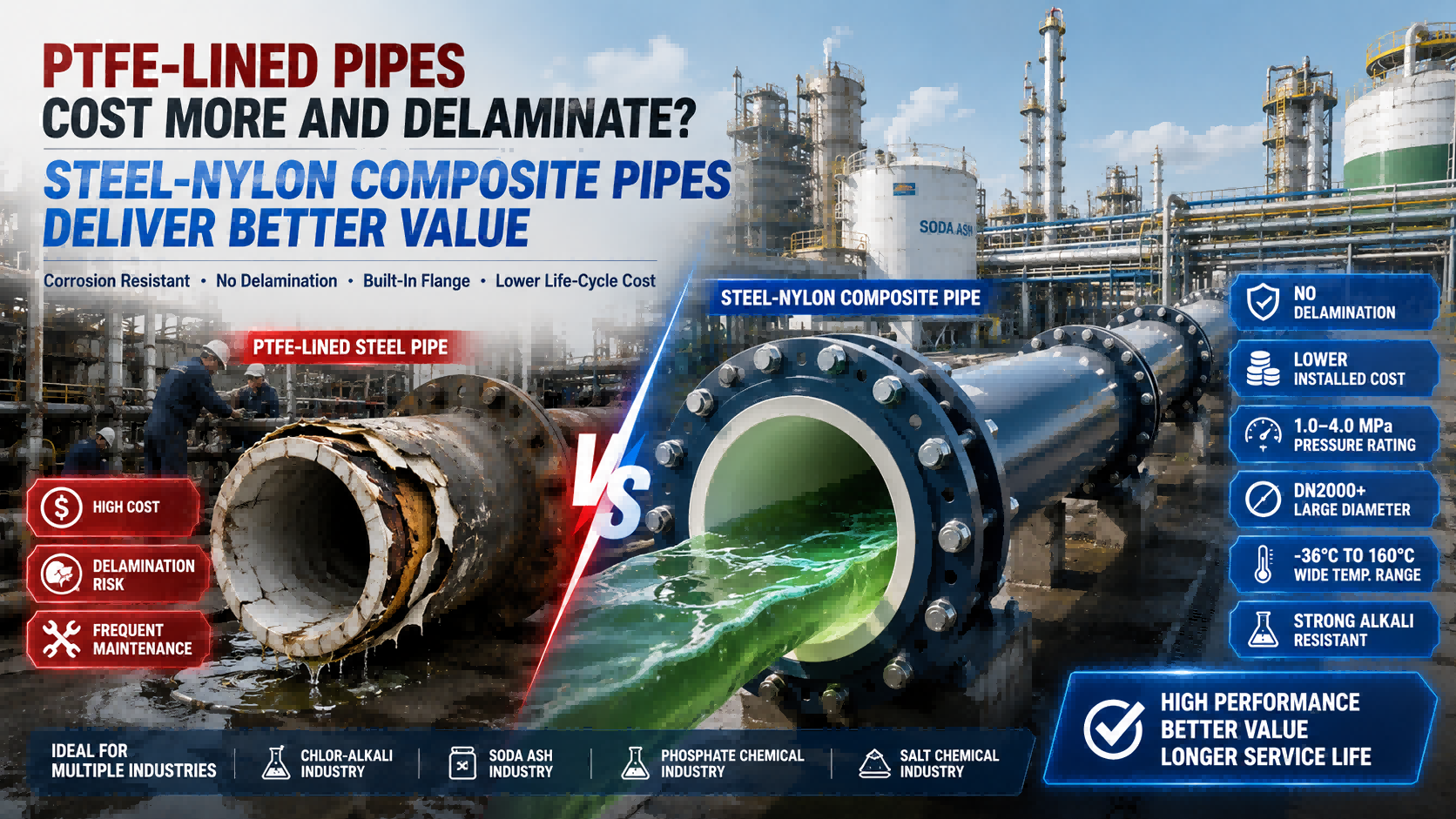
**Steel‑lined PTFE (polytetrafluoroethylene) pipes** are the “ultimate solution” for strong corrosive conditions—they resist nearly all chemical media and can operate continuously for 15–40 years. Steel‑lined PTFE withstands all strong corrosives with a service life of 5–8 years and is virtually maintenance‑free. When including pipe material, replacement, and shutdown losses, steel‑lined PTFE can reduce total LCC by more than 50%.
**LCC profile**: Medium‑high initial cost; excellent corrosion resistance; stable performance in salt chemical acid, alkali, and salt media; outstanding overall cost‑performance.
3.4 FRP/GRP (Glass Reinforced Plastic) Pipes
FRP pipes use glass fibers as reinforcement and resin as the matrix, with a density only one‑quarter that of steel, making them lightweight and easy to install. The internal roughness of steel pipes is about 0.05 mm, while that of FRP filament‑wound pipes is about 0.0084 mm, significantly reducing fluid resistance. The design life is typically over 50 years.
However, in strong acid (pH<2), strong alkali, or oxidizing media, the design life may shorten from 50 years to 15–30 years. Impact and abrasion resistance are relatively low.
**LCC profile**: Medium‑high initial cost; low installation expense; energy‑saving operation; excellent performance in conventional salt chemical media, but careful evaluation is needed in high‑temperature, strong‑oxidizing, or highly abrasive conditions.
3.5 PE Steel‑Wire Skeleton Composite Pipes
This is an emerging non‑metallic composite pipe with a design life of over 50 years and LCC reduced compared with traditional pipes. However, at temperatures above 80°C, other materials must be used.
**LCC profile**: Medium initial cost; easy installation; very high cost‑performance in ambient‑temperature salt chemical media, but not suitable for high‑temperature conditions.
3.6 Steel‑Nylon Composite Pipe: The Perfect Balance of High Strength and Corrosion Resistance
In the material selection map for salt chemical pipelines, there has long been a dilemma: metallic pipes offer high strength but insufficient corrosion resistance, while non‑metallic pipes provide good corrosion resistance but poor mechanical properties and low external pressure resistance. **Steel‑nylon composite pipe** offers a “third path” that combines the advantages of both.
What is Steel‑Nylon Composite Pipe?
Steel‑nylon composite pipe is a new type of composite pipe that uses a steel pipe as the reinforcing skeleton and monomer casting nylon (MC nylon) as the inner lining. Through a special process, it integrates the high strength and toughness of steel pipes with the salt‑resistance, abrasion‑resistance, and anti‑corrosion properties of nylon. This technology overcomes the problems of conventional steel pipe coating processes—such as multiple influencing factors, difficulty in welding joint anti‑corrosion, and vulnerability to construction quality—by producing tightly bonded, integrally formed composite pipes and fittings in a factory‑controlled environment. This effectively shields corrosive media and achieves inherent corrosion resistance and long life.
China has established comprehensive standards for such products: the urban construction industry standard **CJ/T 438‑2013 “Monomer Casting Nylon‑Steel Composite Pipes and Fittings”** and the petroleum and natural gas industry standard, providing a normative basis for quality control and engineering selection.
Performance Advantages in Salt Chemical Scenarios
**(1) Excellent Corrosion Resistance**
Nylon materials inherently possess high chemical stability. Apart from strong oxidizing acids such as concentrated nitric acid, fuming sulfuric acid, and chlorosulfonic acid, nylon resists most organic and inorganic acids, alkalis, and salts. In the most common salt chemical media, it withstands hydrochloric acid below 36%, carbonic acid of various concentrations, alkalis, and the vast majority of salts. Nylon also exhibits good resistance to stress corrosion—a critical advantage in the high‑chloride environment of salt chemical plants, effectively avoiding the risk of stress corrosion cracking that stainless steel faces in chloride‑containing media.
**(2) Outstanding Abrasion Resistance**
Salt chemical production often involves conveying salt slurry, brine, and other solids‑containing media, where abrasion and corrosion combine to form a dual challenge. Steel‑reinforced nylon pipes have a low friction coefficient, excellent wear resistance, self‑lubricating properties, and a non‑stick, non‑scaling surface. Their abrasion resistance when conveying slurries is **8–10 times** that of carbon steel and stainless steel, and **6 times** that of PE100. Other data show that their wear resistance is more than 10 times that of cast iron pipes and more than 12 times that of stainless steel. Under the same conditions, wear resistance is 8 times that of steel.
**(3) Good Temperature and Pressure Resistance**
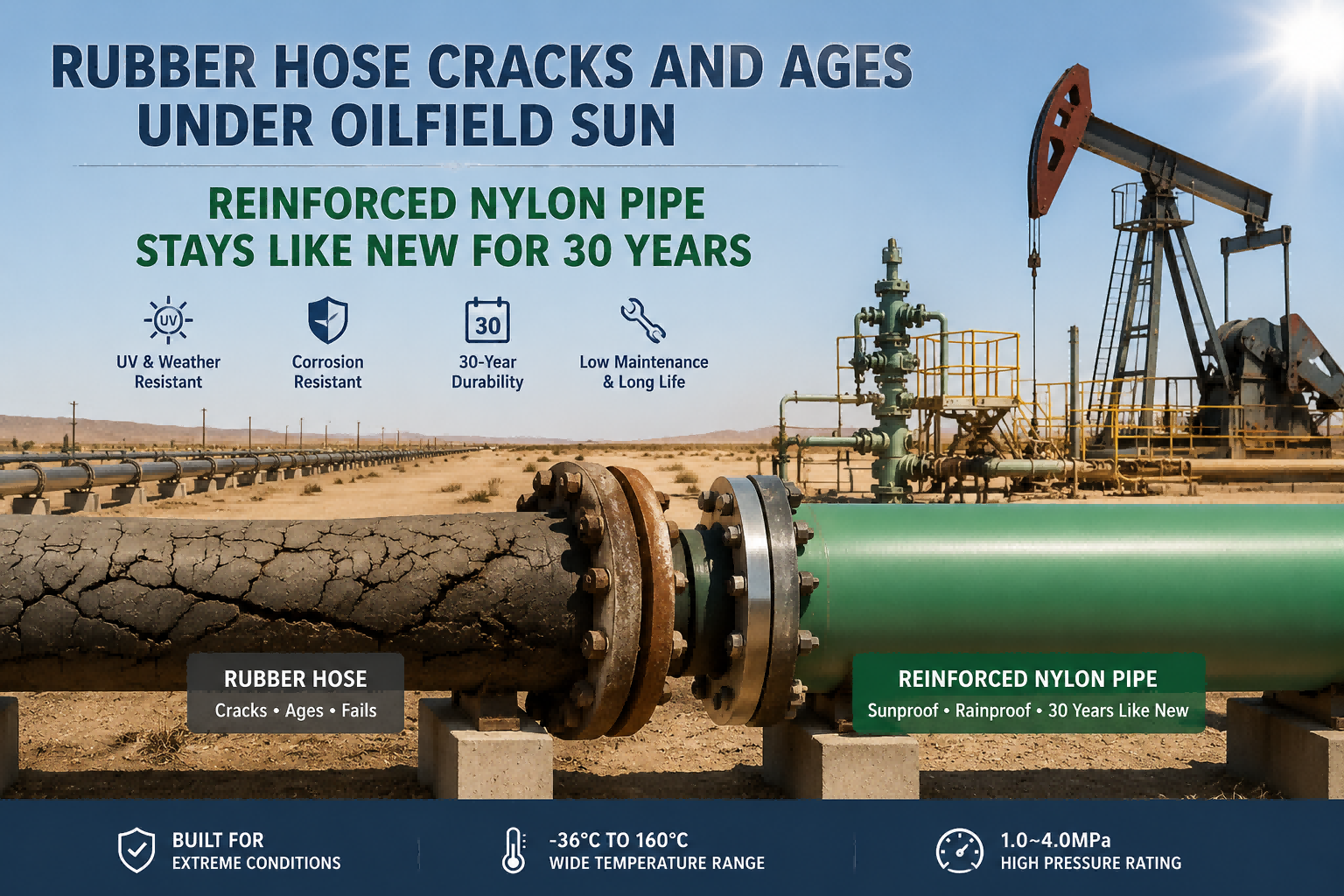
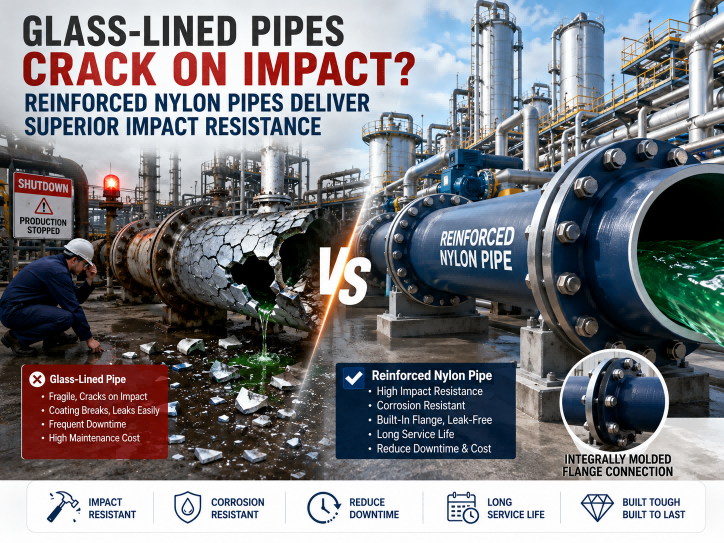
Steel‑nylon composite pipes have a service temperature range of –50°C to 130°C, with some products able to withstand –36°C to 160°C. The working pressure rating can reach 1.0–4.0 MPa, with a burst pressure up to 10.2 MPa. The steel skeleton gives the pipe excellent impact resistance and dimensional stability, enabling it to effectively bear longitudinal loads from soil settlement, surface vehicles, and other sources.
**(4) Inherent Corrosion Resistance, Eliminating “Weak Points”**
Traditional coated steel pipes are affected by construction quality and difficult joint anti‑corrosion. In contrast, steel‑nylon composite pipes are processed and formed in a factory with tight bonding and integral molding, effectively blocking corrosive media and achieving inherent corrosion resistance and long life. The earliest pipes installed by Sinopec Shengli Oilfield and other units have been in continuous operation for **23 years** without corrosion leakage. Under natural conditions, the service life exceeds 50 years.
**(5) Lightweight and Easy Installation**
The unit weight is only **1/6** of that of steel pipes, and the product weight is 1/7 that of steel pipes, with weight in water being 1/45 of steel. This not only reduces transportation and lifting costs but also greatly reduces installation man‑hours and support expenses.
Life‑Cycle Cost Analysis
The comprehensive economic benefit of steel‑nylon composite pipes is more than **6 times** that of steel pipes. Although the initial investment is higher than carbon steel pipes, the ultra‑long service life, extremely low maintenance requirements, and excellent abrasion and corrosion resistance result in a total LCC far below that of traditional metal pipes.
Real‑World Application Verification
Steel‑nylon composite pipes have been widely used in salt chemical and related corrosive service conditions:
**China Salt Inner Mongolia Chemical Co., Ltd.** has repeatedly purchased steel‑composite nylon pipes and fittings for core processes such as its soda ash workshop.
**China Salt Anhui Hongsifang Co., Ltd.** purchased nylon‑steel composite pipes and fittings for its CO₂ emission reduction and combined‑soda energy‑saving renovation project.
**Sinopec Shengli Oilfield and Southwest Oil & Gas Branch** have applied more than 40,000 meters.
**Qingdao Refining & Chemical and Tianjin Refining** have applied more than 10,000 meters.
**China Salt Anhui Hongsifang Co., Ltd.** purchased nylon‑steel composite pipes and fittings for its CO₂ emission reduction and combined‑soda energy‑saving renovation project.
**Sinopec Shengli Oilfield and Southwest Oil & Gas Branch** have applied more than 40,000 meters.
**Qingdao Refining & Chemical and Tianjin Refining** have applied more than 10,000 meters.
In extreme conditions such as chlor‑alkali, salt chemical, and phosphorus chemical industries, traditional metal pipes suffer from rapid corrosion and short life, whereas reinforced PAMC (polyamide‑steel composite) pipes have become an ideal replacement for metal pipes due to their high strength and abrasion resistance.
4. Comprehensive Comparison: Who Is the True Cost‑Performance Champion in Salt Chemical Scenarios?
| Pipe Type | Initial Cost | Corrosion Resistance | Abrasion Resistance | Typical Service Life | Maintenance Cost | LCC Overall Rating |
|---|---|---|---|---|---|---|
| Carbon steel + 3PE coating | ★☆☆☆☆ | ★★☆☆☆ | ★★☆☆☆ | 2–5 years | High | ★★☆☆☆ |
| 316L stainless steel | ★★★★☆ | ★★★☆☆ | ★★★☆☆ | 10–20 years | Medium | ★★★☆☆ |
| Duplex 2205 stainless steel | ★★★★★ | ★★★★☆ | ★★★★☆ | 20–30 years | Low | ★★★★☆ |
| Steel‑lined PE/PP | ★★★☆☆ | ★★★★☆ | ★★★☆☆ | 10–20 years | Low | ★★★★☆ |
| Steel‑lined PTFE | ★★★★☆ | ★★★★★ | ★★★☆☆ | 15–40 years | Very low | ★★★★★ |
| FRP/GRP | ★★★☆☆ | ★★★★☆ | ★★☆☆☆ | 15–50 years | Very low | ★★★★☆ |
| PE steel‑wire skeleton composite | ★★☆☆☆ | ★★★★☆ | ★★★☆☆ | 50 years | Very low | ★★★★☆ |
| Steel‑nylon composite | ★★★☆☆ | ★★★★☆ | ★★★★★ | 50 years | Very low | ★★★★★ |
> ⚠️ The “typical service life” in the table is a reference value for salt chemical scenarios; actual life varies significantly with specific operating conditions (temperature, pressure, medium concentration, solids content, etc.). A project‑specific evaluation is recommended.
**Overall Assessment Conclusion:**
In most conventional salt chemical conditions (ambient temperature, medium‑low pressure, acid/alkali/salt media), **steel‑lined PTFE pipes** excel in pure corrosion scenarios due to their nearly perfect chemical inertness and wide temperature adaptability. However, when the service condition involves the **combined challenge of salt corrosion + salt slurry abrasion**, **steel‑nylon composite pipes**—with their dual advantages of “steel strength + nylon corrosion/abrasion resistance”—emerge as a strong competitor in LCC.
**If your conditions are dominated by strong acids, strong alkalis, and high temperatures**, steel‑lined PTFE is the undisputed first choice.
**If your conditions involve salt slurry transport, solids‑containing media scouring, and salt corrosion**—which are typical of brine purification and brine conveying in salt chemical plants—**steel‑nylon composite pipes**, with 8–10 times the abrasion resistance of steel, a design life of over 50 years, and only 1/6 the weight of steel, offer unparalleled overall value.
**If your conditions involve salt slurry transport, solids‑containing media scouring, and salt corrosion**—which are typical of brine purification and brine conveying in salt chemical plants—**steel‑nylon composite pipes**, with 8–10 times the abrasion resistance of steel, a design life of over 50 years, and only 1/6 the weight of steel, offer unparalleled overall value.
The continued procurement and application by leading companies such as China Salt Group and Sinopec Shengli Oilfield have cast a strong vote of confidence in the reliability of steel‑nylon composite pipes in salt chemical and related corrosive conditions.
5. Selection Recommendations: Tailor to Each Process Section
The temperature, pressure, and medium concentration vary greatly across different sections of a salt chemical plant, so selection strategies should be tailored accordingly:
**Brine purification and brine transport (ambient, solids‑containing, high salt)**: **Steel‑nylon composite pipe** is the ideal choice—offering both excellent salt‑corrosion resistance and outstanding abrasion resistance, with extremely low LCC. The practices of China Salt Group and other industry leaders have fully validated this.
**Strong acid, strong alkali, and high‑temperature sections (e.g., electrolysis, evaporation)**: **Steel‑lined PTFE pipes** remain the top choice due to their near‑perfect chemical inertness and wide temperature range.
**Large‑diameter, long‑distance ambient‑temperature transport**: **FRP pipes** offer very competitive LCC due to their light weight, high strength, easy installation, and low operating energy consumption.
**High‑temperature (>130°C) or ultra‑high‑pressure special conditions**: **Duplex stainless steel** or special alloys are necessary.
**Budget‑constrained conventional conditions**: **Steel‑lined PE/PP pipes** can serve as an economical alternative.
**Strong acid, strong alkali, and high‑temperature sections (e.g., electrolysis, evaporation)**: **Steel‑lined PTFE pipes** remain the top choice due to their near‑perfect chemical inertness and wide temperature range.
**Large‑diameter, long‑distance ambient‑temperature transport**: **FRP pipes** offer very competitive LCC due to their light weight, high strength, easy installation, and low operating energy consumption.
**High‑temperature (>130°C) or ultra‑high‑pressure special conditions**: **Duplex stainless steel** or special alloys are necessary.
**Budget‑constrained conventional conditions**: **Steel‑lined PE/PP pipes** can serve as an economical alternative.
Conclusion
In the corrosive “battlefield” of salt chemical plants, the true cost‑performance of a pipeline is never determined by the number on the purchase contract, but by how much value it creates and how much loss it avoids over its entire service life.
**If your conditions are dominated by strong acids, strong alkalis, and high temperatures, steel‑lined PTFE is the undisputed leader. If your conditions involve salt slurry transport with solids scouring combined with salt corrosion, steel‑nylon composite pipe, with its dual strength and corrosion/abrasion resistance, stands as a powerful contender for LCC leadership.**
The sustained procurement and application by leading salt chemical and related companies, such as China Salt Group and Sinopec Shengli Oilfield, have already cast a strong vote of confidence in the reliability of steel‑nylon composite pipes in salt chemical environments.
However, remember that there is no one‑size‑fits‑all “best pipe”—only the “most suitable pipe” for each specific operating condition, determined through rigorous LCC evaluation. Before making a final selection decision, it is advisable for companies to establish a complete LCC model that incorporates procurement, installation, operation, maintenance, and shutdown losses, enabling a truly informed choice.
From Carbon Steel Lined Plastic to Nylon Composite Pipe: A Three‑Generation Evolution in Chemical Plant Piping Selection
Related blog