10-Year Lifecycle Cost Comparison: Which Industrial Pipeline Is Truly the Most Cost-Effective?

For continuous-operation industries such as chemical processing, mining, oil and gas, soda ash, salt chemicals, power generation, seawater desalination, and slurry transportation, the real cost of a pipeline goes far beyond its initial purchase price. Downtime, replacement, maintenance, labor, installation, leakage, corrosion, wear, and spare parts can continue generating costs throughout the pipeline's service life.
Therefore, the key question is not simply:
How much does the pipe cost to purchase?
It is:
How much will the pipeline cost over 10 years?
This is the concept of 10-Year Total Cost of Ownership (TCO).
This article analyzes the 10-year cost characteristics of common industrial pipeline materials from multiple perspectives, including procurement, installation, maintenance, replacement, downtime, and service life. It also explains why Steel-Nylon Composite Pipe can provide significant long-term economic advantages in demanding applications involving corrosion, abrasion, and continuous operation.
1. Why Should Industrial Pipelines Be Evaluated Over 10 Years?
Consider two pipelines:
-
Pipeline A: Lower initial purchase price but requires replacement after approximately three years.
-
Pipeline B: Higher initial purchase price but provides stable long-term service.
If you only compare the initial quotation, Pipeline A may appear more attractive.
However, pipeline replacement involves much more than purchasing new material:
Shutdown → Removal → Procurement → Transportation → Installation → Testing → Restart
Every replacement can therefore generate significant hidden costs.
A simplified formula for 10-year TCO is:
10-Year TCO = Initial Purchase Cost + Installation Cost + Maintenance Cost + Replacement Cost + Downtime Cost + Failure/Leakage Cost
For continuous-production facilities, pipeline service life and reliability can be more important than the initial purchase price.
2. What Should Be Included in a 10-Year Pipeline Cost Comparison?
The lifecycle cost of an industrial pipeline can generally be divided into six major categories.
① Pipeline Purchase Cost
This includes:
-
Pipe
-
Fittings
-
Flanges
-
Valve connection components
-
Accessories
Different materials can have significantly different initial prices.
However, procurement represents only one part of the total lifecycle cost.
② Installation Cost
Installation costs may include:
-
Transportation
-
Lifting
-
Welding
-
Flange installation
-
Anti-corrosion treatment
-
Field construction
-
Pressure testing
-
Commissioning
Traditional metal pipelines often require extensive field welding and corrosion protection.
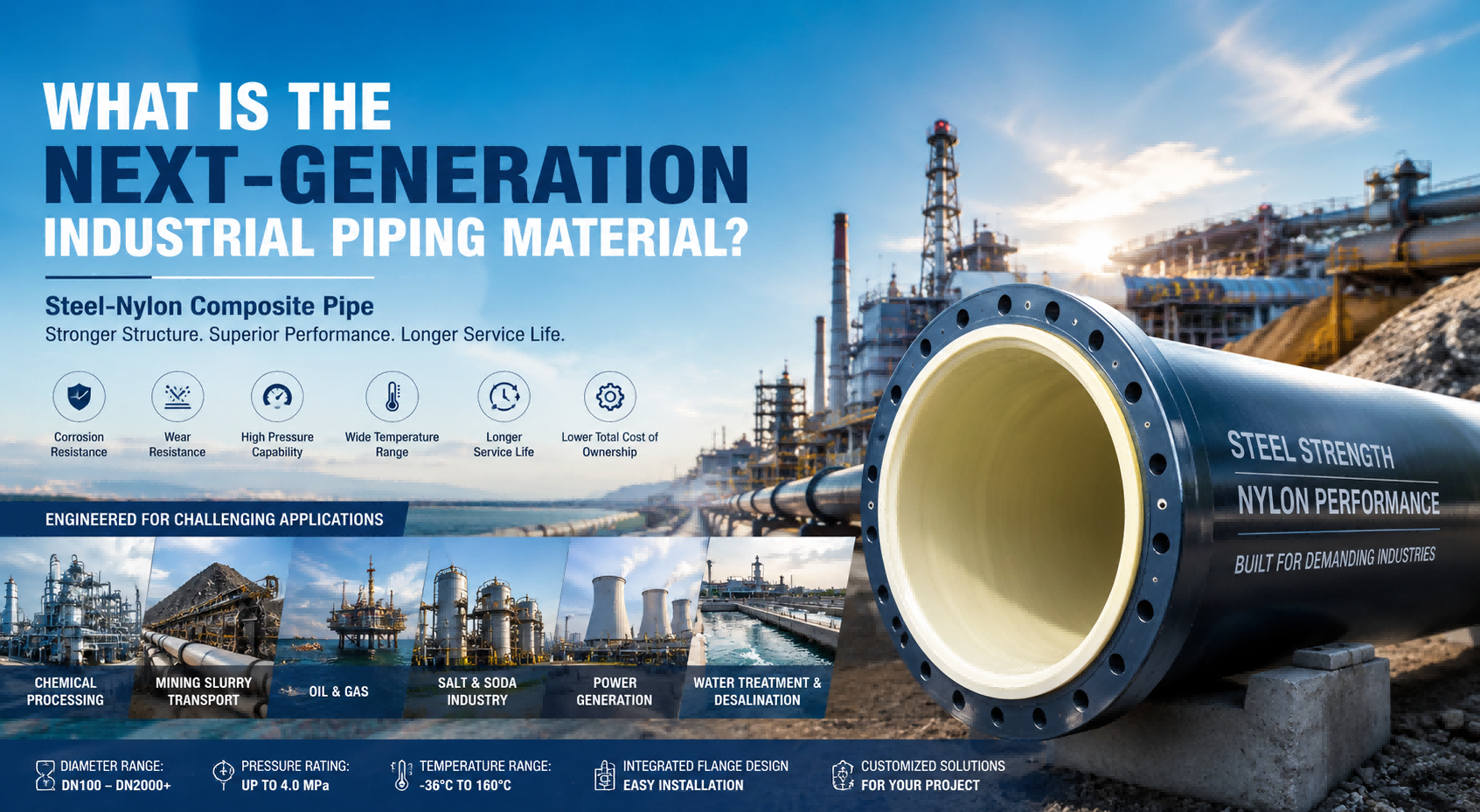
Steel-Nylon Composite Pipe can use an integrally formed, built-in flange design, which can reduce certain field welding and complicated anti-corrosion operations.
This can help reduce installation workload and project costs.
③ Maintenance Cost
During operation, industrial pipelines may experience:
-
Corrosion
-
Internal abrasion
-
Pitting corrosion
-
Lining failure
-
Delamination
-
Mechanical damage
-
Flange leakage
-
Wall thinning
For highly abrasive or corrosive services, maintenance frequency can have a direct impact on 10-year TCO.
④ Replacement Cost
If a pipeline does not last for the full 10-year period, replacement costs must be included.
For example, if a pipeline has an average service life of three years, it may require several replacements during a 10-year period.
Every replacement involves not only new pipe costs but also removal, transportation, labor, installation, testing, and potential production downtime.
⑤ Downtime Cost
This is one of the most overlooked components of pipeline economics.
For continuous-production facilities, failure of a DN500, DN800, or DN1000+ main pipeline may affect an entire production system rather than just one pipe section.
If a production line generates significant value per hour, even a short shutdown can cost more than the pipeline itself.
Therefore:
The most expensive part of a pipeline failure may not be the pipe—it may be the production lost during the shutdown.
⑥ Leakage and Safety Costs
In chemical, salt chemical, mining slurry, and oil & gas applications, leakage can result in:
-
Product loss
-
Environmental contamination
-
Safety risks
-
Equipment corrosion
-
Site cleanup
-
Emergency maintenance
A highly reliable pipeline system can therefore reduce a significant amount of potential risk-related cost.
3. 10-Year Cost Characteristics of Different Industrial Pipeline Materials
The following table provides a general qualitative comparison.
| Pipeline Type | Initial Cost | Corrosion Resistance | Wear Resistance | Installation & Maintenance | Long-Term Cost |
|---|---|---|---|---|---|
| Carbon Steel Pipe | Low | Low | Medium | Medium | High |
| 304 Stainless Steel Pipe | High | Medium-High | Medium | Medium | Medium-High |
| 316L Stainless Steel Pipe | Very High | High | Medium | Medium | High |
| HDPE Pipe | Low-Medium | High | Medium-High | Relatively Low | Application Dependent |
| FRP Pipe | Medium | High | Medium | More Complex | Application Dependent |
| Rubber-Lined Steel Pipe | Medium | High | Medium-High | Medium | Lining-Life Dependent |
| Steel-Nylon Composite Pipe | Medium | High | High | Relatively Low | Low |
This comparison does not mean that one material is suitable for every application.
The correct approach is to evaluate:
Medium + Temperature + Pressure + Flow Velocity + Solids Content + Pipe Diameter + Installation Environment
before selecting the pipeline material.
4. Why Can Low-Cost Carbon Steel Have a Higher 10-Year Cost?
Carbon steel has major advantages, including low initial cost, wide availability, and mature fabrication technology.
However, carbon steel is vulnerable to corrosion in corrosive media.
Over time, corrosion can cause:
Corrosion → Wall Thinning → Local Weakening → Leakage → Replacement
External coatings or internal protective linings can reduce corrosion, but these systems may require periodic inspection and maintenance.
Therefore, for highly corrosive services, selecting carbon steel solely because of its low purchase price can result in significantly higher long-term maintenance costs.
5. Why Is Stainless Steel Not Always the Most Economical Choice?
A common engineering assumption is:
"If the service is highly corrosive, use 316L stainless steel."
However, stainless steel is not a universal solution.
Under conditions involving chlorides, elevated temperatures, or specific chemical environments, stainless steel can still experience:
-
Pitting corrosion
-
Crevice corrosion
-
Stress corrosion
-
Localized corrosion
At the same time, large-diameter stainless steel pipelines can have very high material costs.
For DN500, DN800, DN1000, or larger industrial pipelines, using high-grade stainless steel throughout the system can require a substantial initial investment.
Therefore:
High corrosion resistance does not automatically mean the lowest 10-year cost.
6. Why Does HDPE Have a Cost Advantage but Not Fit Every Industrial Application?
HDPE offers excellent corrosion resistance and relatively convenient installation, making it attractive for water supply, drainage, and certain chemical applications.
However, in high-temperature, high-pressure, and demanding industrial environments, engineers must carefully evaluate:
-
Long-term pressure capability at elevated temperatures
-
Thermal expansion
-
Pipeline support requirements
-
External mechanical damage
-
Large-diameter installation
-
Service life under elevated-temperature conditions
Therefore, the economic advantage of HDPE depends on whether the actual operating temperature and pressure remain within an appropriate design range.
7. What Are the Main Lifecycle Cost Risks of FRP Pipe?
FRP pipe offers excellent corrosion resistance and relatively low weight. However, its composite structure requires careful consideration of:
-
Interlaminar bonding
-
Impact loading
-
Installation stress
-
Pipe support
-
Temperature variation
-
Local mechanical damage
Especially in applications involving solid particles, high flow velocities, or mechanical impact, material price alone cannot accurately determine 10-year cost.
8. Rubber-Lined Steel Pipe: Why Should Lining Life Be Considered?
Rubber-lined steel pipe combines the structural strength of steel with the corrosion and abrasion resistance of a rubber lining.
However, the system consists of two different material structures:
Steel Substrate + Rubber Lining
During long-term operation, engineers need to consider:
-
Lining wear
-
Lining aging
-
Bond failure
-
Local delamination
-
Edge damage
-
Temperature limitations
Once the lining fails, the steel substrate may be rapidly exposed to the process medium.
Therefore, the 10-year economics of rubber-lined steel pipe depend heavily on the actual service life of the lining under operating conditions.
9. Why Can Steel-Nylon Composite Pipe Deliver Better Long-Term Economics?
The core concept of Steel-Nylon Composite Pipe is to combine the advantages of two materials:
Steel provides structural strength, while nylon provides corrosion and wear resistance.
This composite structure can address several limitations associated with traditional metal pipelines and single-material plastic pipelines.
Advantages of the Steel Layer
The steel substrate provides:
-
High mechanical strength
-
High stiffness
-
Good resistance to external loads
-
Excellent suitability for large-diameter applications
-
Strong engineering adaptability
Advantages of the Nylon Inner Layer
The nylon lining provides:
-
High wear resistance
-
Excellent corrosion resistance
-
Low friction characteristics
-
Good impact resistance
-
Good suitability for particle-containing media
As a result, Steel-Nylon Composite Pipe can be particularly attractive in industrial services where corrosion and abrasion occur simultaneously.
10. The Real Difference in 10-Year Cost: How Many Times Will the Pipeline Need to Be Replaced?
Suppose a project requires a 1,000-meter industrial pipeline.
If one pipeline material has an average service life of approximately three years, the system may require multiple replacements over 10 years.
If another pipeline can provide stable service for eight to ten years, its initial purchase price may be higher, but it can potentially achieve a lower 10-year TCO through:
-
Fewer replacements
-
Less maintenance
-
Less downtime
-
Lower labor requirements
-
Lower spare-parts inventory
-
Reduced leakage risk
This illustrates an important principle in industrial pipeline procurement:
A higher purchase price does not necessarily mean a higher lifecycle cost.
Conversely:
A lower purchase price does not necessarily mean a lower lifecycle cost.
11. Installation Cost Advantages of Steel-Nylon Composite Pipe
In addition to material performance, pipeline structure can have a significant impact on project cost.
Our Steel-Nylon Composite Pipe uses an integrally formed, built-in flange design, which can reduce certain field welding requirements.
A conventional steel pipeline installation may involve:
Cutting → Alignment → Welding → Inspection → Anti-Corrosion Treatment → Installation
An integrally formed composite pipeline can reduce some of these field fabrication steps.
Potential benefits include:
-
Shorter installation time
-
Less field welding
-
Reduced hot-work operations
-
Fewer welded joints
-
Fewer potential leakage points
-
Lower installation labor costs
For large industrial pipeline networks, these differences can become substantial.
12. Why Does Lifecycle Economics Become More Important in Large-Diameter Projects?
As pipeline diameter increases, both material and installation costs generally increase.
When the pipe diameter reaches DN800, DN1000, DN1200, or even DN2000+, the cost of a single replacement can be extremely high.
Our Steel-Nylon Composite Pipe covers:
DN100–DN2000+
with pressure ratings up to:
1.0–4.0 MPa
For large-scale transportation pipelines, engineers should therefore evaluate more than price per meter.
A more meaningful equation is:
Service Life × Maintenance Frequency × Number of Replacements × Downtime Cost
13. Which Applications Are Best Suited to Steel-Nylon Composite Pipe?
Steel-Nylon Composite Pipe is particularly suitable for applications where corrosion and abrasion occur simultaneously.
Chemical Industry
-
Salt chemical processing
-
Soda ash
-
Chlor-alkali
-
Phosphate chemicals
-
Chemical slurry transportation
Mining
-
Ore slurry transportation
-
Tailings transportation
-
Mine backfilling pipelines
-
Sand-containing media
Oil & Gas
-
High-water-cut crude oil
-
Sand-containing fluids
-
Corrosive transportation media
Water Treatment
-
Seawater desalination
-
Industrial circulating water
-
Corrosive wastewater
-
High-solids-content transportation
14. A More Practical 10-Year Pipeline Procurement Model
Procurement teams should not only ask:
"Which pipe has the lowest quotation?"
A better question is:
"Which pipeline will deliver the lowest total cost over 10 years?"
A practical evaluation model can include:
| Cost Factor | Suggested Weight |
|---|---|
| Initial Purchase | 20% |
| Installation | 15% |
| Service Life | 25% |
| Maintenance | 15% |
| Replacement | 10% |
| Downtime Risk | 10% |
| Leakage & Safety Risk | 5% |
For continuous-production facilities, the weighting of service life and downtime risk can be increased further.
This approach is much more representative of real-world industrial economics than simply comparing material quotations.
15. The Core Value of Steel-Nylon Composite Pipe: Lower Lifecycle Cost
Steel-Nylon Composite Pipe does not compete simply by offering the lowest initial purchase price.
Its real value comes from combining:
High Strength + High Wear Resistance + Corrosion Resistance + Long Service Life + Low Maintenance + Fewer Replacements
This is especially valuable in applications where conventional pipelines are prone to corrosion, abrasion, lining failure, or frequent replacement.
Our products offer:
-
DN100–DN2000+ large-diameter capability
-
1.0–4.0 MPa pressure ratings
-
Integrally formed composite construction
-
Built-in flanges
-
Reduced field welding requirements
-
Highly wear-resistant nylon inner layer
-
High-strength steel structural layer
-
Suitability for demanding corrosive and abrasive industrial services
16. Conclusion: The Cheapest Pipeline Is the One That Costs Less Over 10 Years
Industrial pipeline procurement should not stop at comparing price per meter.
A professional material-selection process should evaluate:
Purchase Cost + Installation Cost + Maintenance Cost + Replacement Cost + Downtime Cost + Risk Cost
For ordinary applications, low-cost materials may offer an economic advantage.
However, for corrosive, highly abrasive, high-solids, continuous-operation, large-diameter, and high-maintenance applications, Steel-Nylon Composite Pipe can provide strong long-term economic value.
The key principle is simple:
The cheapest pipe to buy is not always the cheapest pipe to own.
The most economical industrial pipeline is the one that can provide stable operation for years while minimizing maintenance, replacement, leakage, and unplanned downtime.
For projects involving industrial pipeline material selection, it is therefore recommended to establish a 10-Year TCO model rather than comparing purchase quotations alone.
Steel-Nylon Composite Pipe can be an important candidate for demanding industrial transportation systems where corrosion resistance, wear resistance, mechanical strength, and long-term reliability are all required.
The Most Worthwhile Pipeline Material to Invest in for the Chemical Industry: How to Select Industrial Piping Based on Lifecycle Cost
Which Industrial Pipe Has the Lowest Total Cost? A Deep Analysis of Lifecycle Cost