The Most Worthwhile Pipeline Material to Invest in for the Chemical Industry: How to Select Industrial Piping Based on Lifecycle Cost

When dealing with acids, alkalis, salts, chlorides, slurries, high-temperature media, and solid particles, many companies focus first on initial purchase price. However, for continuously operating chemical plants, the pipeline material that deserves the greatest investment is often not the cheapest option, but the one that delivers the best combination of corrosion resistance, wear resistance, mechanical strength, reliability, low maintenance requirements, and long service life.
So, which pipeline materials are truly worth investing in for the chemical industry?
There is no single material that is universally superior. A more reliable selection method is to evaluate piping materials across seven key dimensions:
Process compatibility + mechanical strength + corrosion resistance + wear resistance + installation efficiency + maintenance cost + service life
For many chemical conveying systems where corrosion and abrasion occur simultaneously, Steel-Nylon Composite Pipe is becoming an increasingly attractive option from a total lifecycle investment perspective.
1. Why Should Chemical Companies Look Beyond Purchase Price?
Consider two pipeline systems:
-
Pipeline A: Lower initial purchase price, but requires frequent repairs or replacement after several years.
-
Pipeline B: Slightly higher initial investment, but offers a longer service life and requires less maintenance.
If we only compare purchase prices, Pipeline A appears to be more economical.
However, the actual project cost should include:
Total Cost of Ownership (TCO) = Purchase Cost + Installation Cost + Maintenance Cost + Downtime Losses + Replacement Cost + Operational Risk Cost
For chemical companies, the losses caused by unplanned downtime can sometimes be many times higher than the cost of the pipeline itself.
Therefore, a truly worthwhile pipeline investment should follow one fundamental principle:
The best pipeline is not necessarily the cheapest to purchase, but the one that delivers the lowest total cost throughout its service life.
This is particularly important in continuously operating industries such as chemical processing, mining, soda ash production, chlor-alkali, and phosphate chemical production. A sudden pipeline leak or failure can result in production shutdowns, material losses, environmental risks, and significant repair costs.
2. What Pipeline Materials Are Commonly Used in the Chemical Industry?
Common industrial pipeline materials include:
| Pipeline Material | Corrosion Resistance | Wear Resistance | Mechanical Strength | High-Temperature Capability | Overall Characteristics |
|---|---|---|---|---|---|
| Carbon Steel | Low | Good | High | High | Low cost, but significant corrosion concerns |
| 304 Stainless Steel | Good | Moderate | High | High | Vulnerable to pitting in certain chloride environments |
| 316L Stainless Steel | Very Good | Moderate | High | High | Excellent corrosion resistance but relatively expensive |
| FRP | Very Good | Moderate | Moderate | Limited | Lightweight, but potential delamination concerns |
| PE/HDPE | Very Good | Good | Lower | Limited | Suitable for certain low-temperature, low-pressure applications |
| Rubber-Lined Steel Pipe | Good | Good | High | Limited by lining | Potential lining detachment and aging issues |
| Reinforced Nylon Pipe | Very Good | Very Good | Relatively High | Good | Lightweight, wear-resistant, and corrosion-resistant |
| Steel-Nylon Composite Pipe | Very Good | Very Good | High | Good | Balances strength, corrosion resistance, and wear resistance |
It is important to emphasize that no single pipeline material is suitable for every chemical application.
Professional material selection should consider:
Medium + temperature + pressure + flow velocity + solids content + particle size + concentration + pipe diameter
3. Why Is Steel-Nylon Composite Pipe Worth Serious Consideration?
The major advantage of Steel-Nylon Composite Pipe is that it does not rely on a single material. Instead, it combines the complementary properties of two materials.
The basic concept can be summarized as:
Steel provides structural strength, while nylon provides corrosion resistance, wear resistance, and protection against direct contact with the conveyed medium.
This addresses one of the fundamental challenges in pipeline material selection:
Materials with high mechanical strength do not always provide the best corrosion resistance, while highly corrosion-resistant materials may not always provide sufficient mechanical strength.
By combining these properties, Steel-Nylon Composite Pipe can provide both structural load-bearing capability and protection of the internal flow surface.
4. Advantage 1: Addressing Both Corrosion and Wear
One of the most challenging conditions in chemical piping is not simple corrosion, but the combination of:
Corrosion + erosion + particle abrasion
Examples include:
-
Salt-containing media
-
Chloride solutions
-
Alkaline media
-
Chemical slurries
-
Mother liquor containing solids
-
Mineral slurries
-
Sand-containing fluids
-
High-velocity particle-containing media
Traditional metal pipelines may suffer from corrosion, while some plastic pipelines may face limitations in pressure, temperature, or mechanical strength.
Steel-Nylon Composite Pipe uses the nylon inner layer to reduce direct exposure of the steel substrate to corrosive media while taking advantage of nylon's excellent wear resistance to reduce particle-induced wall erosion.
This makes it particularly suitable for applications where corrosion and abrasion occur simultaneously.
5. Advantage 2: Higher Pressure Capability Than Conventional Plastic Pipes
Chemical pipelines must withstand more than corrosion. They also need to withstand internal pressure, external loads, installation stresses, and long-term mechanical stress.
PE and HDPE pipes offer excellent corrosion resistance under many conditions, but their pressure capability can be significantly affected as operating temperature increases.
Steel-Nylon Composite Pipe uses the steel substrate as the primary structural support, allowing it to cover a broader range of industrial pressure applications.
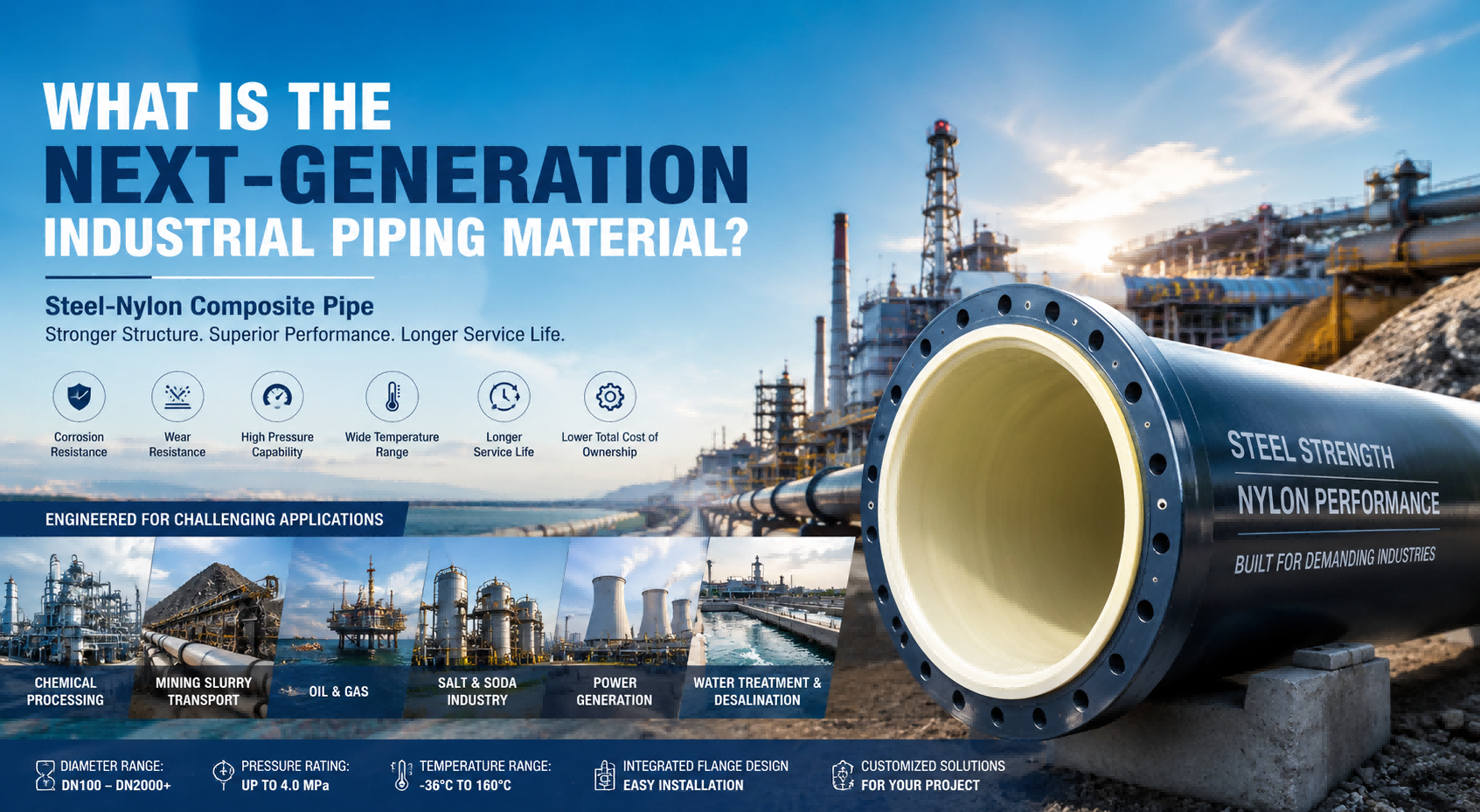
Depending on the product series and engineering requirements, solutions can be provided in sizes ranging from:
DN100 to DN2000+
with different pressure ratings. Certain product series can reach:
1.0–4.0 MPa
This makes Steel-Nylon Composite Pipe suitable not only for general chemical conveying but also for demanding industrial pipeline systems.
Of course, the final pressure rating must be determined based on pipe diameter, operating temperature, medium, design standards, and connection method. The material name alone cannot determine the allowable pressure.
6. Advantage 3: Wider Operating Temperature Range
Chemical processes often involve much more complex temperature conditions than conventional water-supply systems.
A pipeline may need to operate under low ambient temperatures in winter while simultaneously handling elevated process temperatures.
Depending on the specific material grade and product design, reinforced nylon and Steel-Nylon Composite Pipe product series can cover an approximate operating temperature range of:
-36°C to 160°C
Compared with some conventional thermoplastic pipelines, this can provide a wider range of industrial applications.
However, it is important to emphasize:
A 160°C material temperature capability does not mean that every medium and pressure condition is suitable for continuous operation at 160°C.
Actual engineering design must consider temperature, pressure, medium concentration, and the specific nylon material grade.
7. Advantage 4: Reducing Certain Risks Associated with Conventional Lining Systems
One of the major concerns with conventional plastic-lined and rubber-lined steel pipes is the interface between the lining and the steel substrate.
If manufacturing quality, thermal cycling, mechanical impact, or medium penetration causes interface failure, problems may include:
-
Blistering
-
Delamination
-
Bulging
-
Cracking
-
Local peeling
-
Corrosion of the steel substrate
These risks can become particularly important in elbows, tees, reducers, pump outlets, and other high-wear locations where the lining is continuously exposed to impact.
Steel-Nylon Composite Pipe uses an engineered composite structure that can reduce some of the potential risks associated with conventional loose or bonded lining systems.
Therefore, pipeline material selection should not stop at the question:
“Is this pipe corrosion-resistant?”
A more important question is:
“Can the corrosion-resistant layer remain stable and functional for 10, 20, or more years of operation?”
That is one of the factors that ultimately determines lifecycle cost.
8. Advantage 5: Integrated Flange Design Can Reduce Installation Costs
Installation costs are often underestimated during chemical pipeline projects.
In reality, a significant portion of field costs can come from:
-
Welding
-
Weld inspection
-
Corrosion protection
-
Flange installation
-
Scaffolding
-
Work at height
-
Hot-work permits
-
Field repairs
Steel-Nylon Composite Pipe can be manufactured with an integrally formed, built-in flange design.
This can reduce the amount of on-site welding and fabrication required for certain installations.
Its value is not simply that “installation is faster.”
More importantly:
Less field welding = less hot work = fewer construction risks = lower installation costs
For chemical plants, petrochemical facilities, and large industrial projects, this can be a significant advantage.
9. Advantage 6: Particularly Suitable for High-Wear Pipeline Components
In real-world pipeline systems, straight pipe sections are not always the first components to fail.
High-risk wear locations often include:
-
Elbows
-
Tees
-
Reducers
-
Pump outlets
-
Upstream and downstream valve sections
-
Slurry turning points
-
Diameter-change sections
The reason is straightforward:
When the flow direction changes, particles can generate greater impact and turbulence.
Therefore, simply upgrading the material of straight pipe sections may not completely solve the problem.
A more effective approach is to establish a:
“Critical Wear Point Protection”
strategy.
Steel-Nylon Composite Pipe can be used for high-wear components such as:
-
Elbows
-
Tees
-
Reducers
-
Pump outlet sections
-
Valve upstream/downstream sections
-
Local replacement sections
-
Test sections
This allows companies to concentrate maintenance resources on the locations that have the greatest impact on pipeline reliability.
10. When Is Steel-Nylon Composite Pipe Most Worth Considering?
Steel-Nylon Composite Pipe is not necessary for every chemical pipeline.
If the medium is relatively simple, operating temperature and pressure are low, and there is little or no particle abrasion, a conventional plastic pipeline may already provide sufficient economic performance.
However, Steel-Nylon Composite Pipe deserves serious consideration under the following conditions.
① Corrosive Media
Examples include:
-
Brine
-
Chloride solutions
-
Alkaline solutions
-
Certain acidic media
-
Chemical mother liquor
-
Corrosive industrial wastewater
② Combined Corrosion and Abrasion
Examples include:
-
Chemical slurries
-
Mother liquor containing solids
-
Mineral slurry
-
Sand-containing fluids
-
High-speed particle transport
③ Large-Diameter Industrial Pipelines
For DN500, DN800, DN1000, and even DN2000+ systems, pipeline replacement can require substantial labor, equipment, and downtime.
As diameter increases, service life and maintenance costs become increasingly important.
④ Continuous-Production Systems
For continuous chemical production, a single unexpected shutdown can create significant economic losses.
Therefore:
The more difficult a system is to shut down, the more important pipeline reliability becomes.
11. From a 10-Year Lifecycle Perspective, What Is Really Worth Investing In?
Imagine a chemical company constructing a new process pipeline.
Option A has a lower purchase price but requires major maintenance or replacement every three to four years.
Option B requires slightly higher initial investment but significantly extends the maintenance interval.
In this case, it is not enough to compare:
Option A purchase price < Option B purchase price
Instead, the company should compare the 10-year TCO:
Initial purchase
Installation
Maintenance
Spare parts
Downtime
Replacement
Labor
Safety management
Potential leakage losses
This is why industrial procurement is increasingly shifting from:
“Lowest Purchase Price”
toward:
“Lowest Lifecycle Cost.”
The real competitiveness of Steel-Nylon Composite Pipe is therefore not simply its price per meter, but its potential to:
Provide stable conveying performance over a long service life with fewer maintenance interventions and fewer replacements.
12. The Right Logic for Pipeline Investment in the Chemical Industry
The pipeline material selection process can be summarized as a seven-stage decision model.
Step 1: Medium Compatibility
Can the pipeline withstand long-term contact with the process medium?
↓
Step 2: Temperature and Pressure
Can the material withstand the design operating conditions?
↓
Step 3: Wear
Are there particles, high flow velocities, erosion, or severe elbow wear?
↓
Step 4: Structural Reliability
Can the pipeline withstand transportation, installation, and long-term operating loads?
↓
Step 5: Installation Efficiency
Does installation require extensive welding, hot work, and field fabrication?
↓
Step 6: Maintenance Cost
Is the system easy to repair? Are there high-frequency failure locations?
↓
Step 7: Lifecycle Cost
What will the total cost be over 10–20 years?
Only after completing this evaluation can a company determine whether a pipeline material represents a truly worthwhile investment.
13. Why Does Steel-Nylon Composite Pipe Offer High Overall Investment Value?
From a comprehensive performance perspective, the key advantages of Steel-Nylon Composite Pipe can be summarized as follows:
Steel = Strength
The steel substrate provides mechanical strength and structural support.
Nylon = Corrosion & Wear Resistance
The nylon inner layer provides corrosion and wear resistance.
Composite = Balanced Performance
The composite structure creates a balance between mechanical strength, corrosion resistance, wear resistance, and service life.
At the same time, features such as integral forming and built-in flanges can further reduce on-site installation requirements.
This makes Steel-Nylon Composite Pipe particularly attractive for industrial projects that prioritize:
Safety + Reliability + Service Life + Maintenance Cost + TCO
14. Conclusion: The Most Worthwhile Pipeline Material Is Not Necessarily the Most Expensive
There is no universal “best pipeline material” for every chemical application.
The material worth investing in is the one that delivers the best balance of:
Reliability × Service Life × Maintenance Efficiency × Total Cost
under the actual operating conditions.
For demanding industrial conveying systems where corrosion, abrasion, pressure, and temperature occur simultaneously, Steel-Nylon Composite Pipe offers a compelling engineering solution.
It is not simply a replacement of steel with nylon, nor merely a steel pipe with a conventional lining. Instead, it combines:
High-strength steel substrate + corrosion- and wear-resistant nylon + engineered composite structure + efficient connection design
to address limitations that conventional pipeline materials may struggle to overcome simultaneously.
Therefore, if your chemical project is experiencing:
-
Frequent pipeline corrosion
-
Severe wear at elbows and tees
-
Delamination risks in rubber- or plastic-lined pipelines
-
Pressure or temperature limitations with PE/HDPE pipelines
-
High procurement and maintenance costs for stainless steel
-
Frequent production shutdowns caused by pipeline replacement
then instead of asking only:
“Which pipeline has the lowest purchase price?”
consider asking:
“Which pipeline can deliver the lowest total lifecycle cost and highest operational reliability over the next 10–20 years?”
For many chemical conveying systems, this is where the real investment value of Steel-Nylon Composite Pipe becomes clear.
Final Takeaway
The best pipeline material is not necessarily the cheapest material to buy. It is the material that delivers the lowest total cost and highest reliability over its entire service life.
For demanding chemical applications where corrosion, abrasion, pressure, temperature, and maintenance costs must all be considered, Steel-Nylon Composite Pipe offers a compelling combination of mechanical strength, corrosion resistance, wear resistance, installation efficiency, and long-term value.
Choose for the lifecycle—not just the purchase order.
Alternatives to Stainless Steel Pipes Amid Rising Prices: Why Steel-Nylon Composite Pipes Are Becoming a New Industrial Solution
10-Year Lifecycle Cost Comparison: Which Industrial Pipeline Is Truly the Most Cost-Effective?