Non-Metallic Pipeline Development Trends: From Traditional Plastic Pipes to High-Performance Reinforced Nylon Pipes The industrial piping industry is undergoing a profound transformation.
In particular, under corrosive conditions, abrasive slurry transportation, and challenging temperature environments, conventional metal pipes often face corrosion, erosion, scaling, and high maintenance costs. At the same time, conventional PE, PVC, and HDPE pipes, while offering excellent corrosion resistance, may have limitations in temperature resistance, pressure capacity, stiffness, and long-term reliability.
Therefore, the future of non-metallic piping is not simply about “replacing metal with plastic.” Instead, the industry is moving toward higher performance, higher strength, better wear and corrosion resistance, composite structures, and more application-specific engineering.
Among these technologies, reinforced nylon pipes and steel-nylon composite pipes are emerging as particularly promising industrial piping solutions.
1. Why Is Non-Metallic Piping Becoming an Important Industrial Trend?
Industrial piping material selection is essentially a comprehensive engineering optimization problem.
Engineers typically need to consider:
-
Chemical corrosiveness
-
Operating temperature
-
Working pressure
-
Solid particle concentration
-
Flow velocity
-
Pipe diameter
-
Mechanical strength
-
Installation method
-
Maintenance intervals
-
Initial purchase cost
-
Total lifecycle cost
One of the biggest challenges of traditional metal piping is corrosion.
For example, in chloride-containing media, saltwater, chemical solutions, and certain acid or alkaline environments, even stainless steel can experience pitting corrosion, crevice corrosion, or stress corrosion. Carbon steel is generally even more vulnerable to corrosion.
The major advantage of non-metallic materials is precisely their inherent resistance to many corrosive environments.
As industrial systems place greater emphasis on equipment longevity and maintenance costs, the value of non-metallic piping is becoming increasingly apparent.
2. Stage One: Moving from “Corrosion Resistance” to Overall Performance
The early development of industrial non-metallic piping was primarily driven by one question:
How can corrosion of metal pipes be avoided?
Materials such as PE, PVC, HDPE, and FRP consequently gained widespread application.
These materials offer varying levels of resistance to acids, alkalis, saltwater, and other chemical media, making them useful in water supply, chemical processing, and water treatment.
However, as industrial operating conditions have become more demanding, corrosion resistance alone is no longer sufficient.
High-Temperature Conditions
Conventional plastic pipes generally have limited temperature resistance.
As operating temperatures increase, material strength, stiffness, and long-term pressure-bearing capability can decrease.
Therefore, an important future requirement for non-metallic piping is to achieve a better balance between:
Corrosion Resistance + Temperature Resistance.
High-Pressure Conditions
Many conventional plastic pipes are primarily used in low- and medium-pressure systems.
However, chemical, mining, energy, and industrial transportation systems increasingly require higher pressure ratings.
Future non-metallic pipes therefore need improvements in:
Hoop Strength + Axial Strength + Long-Term Pressure Capacity.
Abrasive Conditions
Slurry, mineral pulp, sand-containing water, and solid-containing fluids continuously impact and erode pipe walls.
In these applications, corrosion resistance alone is not enough.
The pipe material must also provide:
High Wear Resistance + Low Friction + Impact Resistance.
This is one of the key reasons why high-performance nylon materials are attracting increasing attention.
3. Stage Two: Non-Metallic Piping Enters the Era of High-Performance Materials
The future of non-metallic piping is likely to move beyond conventional plastics toward high-performance engineering polymers.
Nylon is one of the materials with particularly strong overall performance.
Compared with conventional plastics, engineering nylon can be further enhanced through material modification, reinforcement, and structural optimization, making it more suitable for demanding industrial environments.
Its major advantages include:
High Wear Resistance
Nylon offers a relatively low coefficient of friction and excellent wear resistance.
This is particularly valuable in mining, mineral slurry, coal slurry, sand-containing fluids, and other solid-liquid transportation systems.
For long-term industrial pipeline operation, improved wear resistance can mean:
Reduced wall thinning → Longer maintenance intervals → Lower downtime and replacement costs.
Excellent Corrosion Resistance
High-performance nylon can resist a wide range of weak acids, strong alkalis, salts, and other industrial media.
As a result, it can serve as an alternative to conventional metal piping in selected chemical, water treatment, salt chemical, and mining applications.
In environments where metals are highly vulnerable to corrosion, a non-metallic inner surface can significantly reduce the risk of wall-thickness loss caused by corrosion.
Low Flow Resistance
Nylon typically provides a smooth internal surface with relatively low surface roughness.
A smooth inner wall can reduce frictional resistance during fluid transportation and reduce the tendency of certain media to adhere to the pipe wall.
This is particularly important for long-distance transportation systems.
Pipeline operating costs are not determined solely by pipe purchase price. They also include:
Pump power + Energy consumption + Long-term maintenance.
Therefore, when selecting pipeline materials, engineers should evaluate long-term operating costs rather than comparing only the initial price per meter.
4. Stage Three: From Conventional Nylon to Reinforced Nylon Pipes
Although pure nylon provides excellent wear and corrosion resistance, industrial pipelines must also withstand pressure, temperature, mechanical loads, and long-term service conditions.
This is driving an important development trend:
Reinforced nylon.
Through material reinforcement and structural optimization, the mechanical strength and dimensional stability of nylon pipes can be improved, allowing them to serve in more demanding industrial pressure-piping applications.
This is also one of the key product directions of our company: reinforced nylon pipes.
Our reinforced nylon pipes are not simply conventional plastic pipes with increased wall thickness. Instead, they are engineered around real industrial operating conditions, combining material performance, structural design, and connection technology.
The key advantages include:
Wear Resistance + Corrosion Resistance + High Strength + Lightweight + Long Service Life.
This combination allows reinforced nylon pipes to address certain industrial applications where conventional plastic pipes may have limitations.
5. Steel-Nylon Composite Pipes: Combining Non-Metallic Materials with Metal Structural Strength
Another major development direction for non-metallic piping is:
Composite construction.
The future of industrial piping will not necessarily be a simple choice between “metal” and “non-metal.”
A more effective approach is:
Allow different materials to perform the functions they are best suited for.
Steel is excellent at providing mechanical strength and structural support.
Nylon is excellent at providing corrosion resistance, wear resistance, and a low-friction internal surface.
The engineering concept behind steel-nylon composite pipe is therefore:
Steel provides structural strength, while nylon provides corrosion and wear resistance on the fluid-contacting surface.
This combination allows the advantages of both materials to be utilized within a single piping system.
For large-diameter, high-pressure, and long-distance industrial transportation systems, this composite structure can offer significant engineering value.
6. Why Could Steel-Nylon Composite Pipe Become an Important Future Industrial Piping Solution?
The future competition in industrial piping will not simply be about:
“Which pipe has the lowest purchase price?”
The more important question will be:
1. Which pipe provides the longest service life?
If a pipeline requires frequent replacement, a low initial purchase price does not necessarily mean a low overall cost.
Industrial users are therefore increasingly focused on:
Lifetime — not just Purchase Price.
2. Which pipe requires less maintenance?
Pipeline maintenance involves much more than material costs.
It can include:
-
Shutdown costs
-
Labor costs
-
Transportation costs
-
Replacement costs
-
Welding costs
-
Safety management
If a material can extend maintenance intervals, it can significantly reduce the total cost of ownership of an industrial pipeline system.
3. Which pipe is easier and faster to install?
Future industrial pipeline projects will increasingly emphasize modular construction and shortened installation schedules.
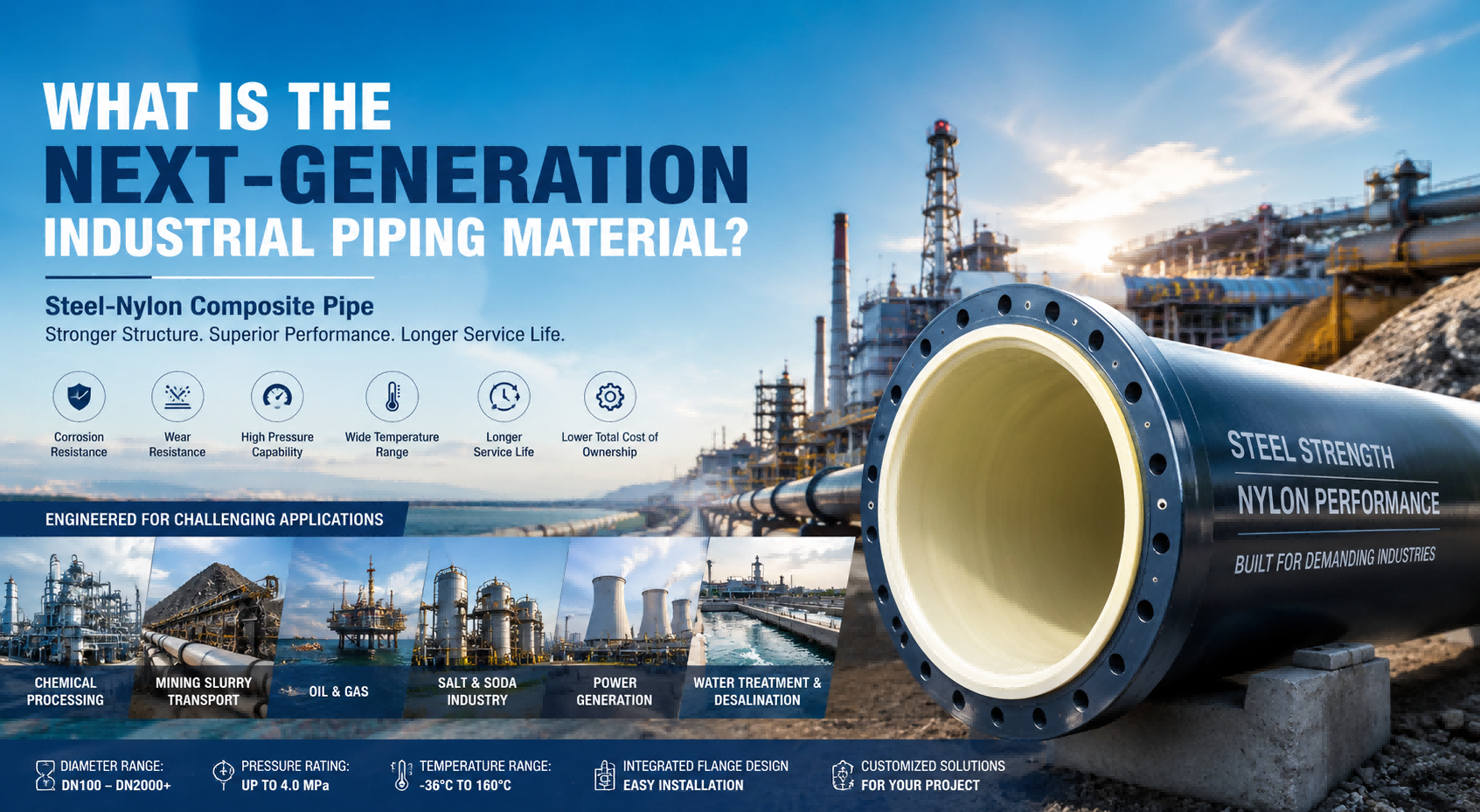
Our nylon and steel-nylon composite pipe systems can utilize an integrally formed, built-in flange design, helping reduce the amount of field welding required.
For large industrial projects, this can mean:
Shorter installation time + Less welding + Fewer potential leakage points + Improved construction safety.
7. Large-Diameter Piping Will Become an Important Direction for Non-Metallic Pipelines
When people think about non-metallic piping, they often associate it with small-diameter water and drainage pipes.
However, the industrial market is changing.
As mining, chemical processing, water treatment, seawater desalination, and other large-scale industrial projects expand, demand for large-diameter transportation pipelines is also increasing.
Therefore:
Large-diameter capability will become an important development direction for industrial non-metallic piping.
Our products cover sizes from DN100 to DN2000+, with pressure ratings ranging from 1.0 to 4.0 MPa, enabling them to serve selected large-scale industrial transportation systems.
This demonstrates that non-metallic piping is gradually moving from traditional small-diameter auxiliary lines toward large-diameter industrial main pipelines.
8. Five Major Development Trends in Non-Metallic Piping
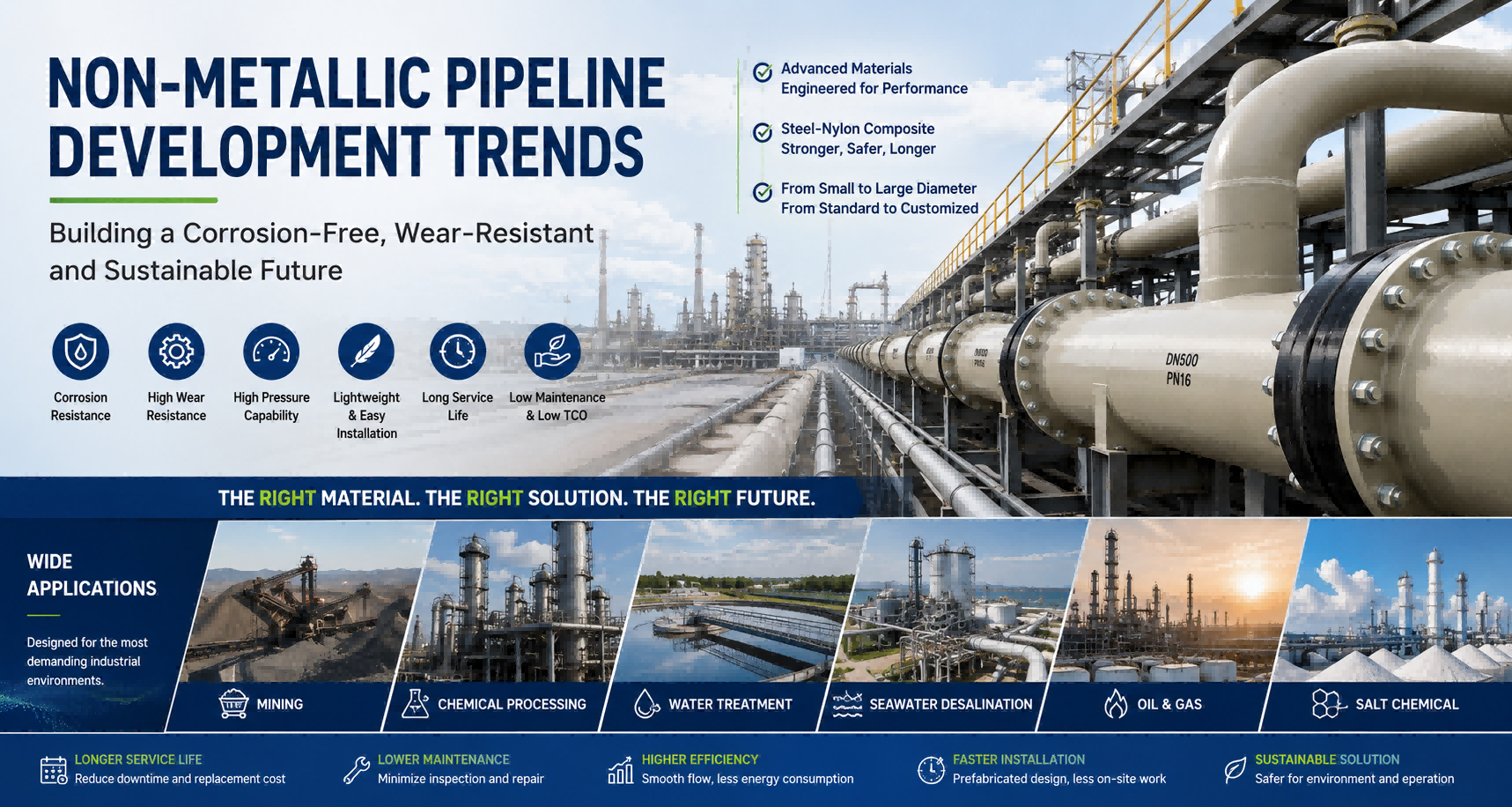
Based on material technology and industrial demand, the future of non-metallic piping is likely to develop in five major directions.
Trend 1: Higher Performance
Conventional PE and PVC pipes will continue to have broad applications, but demanding high-temperature, high-pressure, and high-wear environments will accelerate the adoption of engineering polymers.
Reinforced nylon and modified engineering plastics are expected to expand into more industrial applications.
Trend 2: Composite Structures
It is becoming increasingly difficult for a single material to meet every performance requirement simultaneously.
As a result, steel-nylon composites, fiber-reinforced polymers, and other multi-material structures are likely to become increasingly important.
Trend 3: Larger Diameters
As mining, chemical, water treatment, and energy projects continue to increase in scale, non-metallic and composite pipes in sizes above DN1000 and even DN2000 will attract greater attention.
Trend 4: Lower Maintenance
Pipeline procurement decisions are gradually shifting from purchase price toward total lifecycle cost.
Corrosion resistance, wear resistance, long service life, and reduced maintenance frequency will become increasingly important evaluation criteria.
Trend 5: Faster Installation
Industrial projects are under increasing pressure to shorten construction schedules.
Therefore, pipeline systems featuring built-in flanges, integrally formed structures, reduced welding requirements, and modular installation can provide significant advantages.
9. Which Industries Are Best Suited for High-Performance Nylon Pipes?
Based on current industrial requirements, high-performance nylon pipes are particularly suitable for the following applications.
Mining
Applications include:
-
Mineral slurry
-
Tailings
-
Backfill slurry
-
Sand-containing fluids
Key requirements:
Wear resistance + Corrosion resistance + Long service life.
Chemical Processing
Applications include the transportation of acids, alkalis, salts, and other corrosive industrial media.
Key requirements:
Chemical resistance + Reduced maintenance.
Salt Chemical and Chlor-Alkali Industries
High-salt and highly corrosive environments can create significant challenges for conventional metal piping.
Nylon materials can provide an effective corrosion-resistant alternative in appropriate applications.
Water Treatment and Seawater Desalination
Seawater and high-salinity water can be highly corrosive to many metal materials.
Non-metallic piping can help reduce corrosion-related risks.
Oil & Gas and Energy
For fluid transportation systems involving water, sand, or corrosive components, wear and corrosion resistance can be highly valuable.
10. The Future Is Not About Eliminating Metal Pipes — It Is About More Specialized Material Selection
It is important to emphasize that:
The development of non-metallic piping does not mean that metal pipes will disappear.
Metal materials will continue to offer irreplaceable advantages in extremely high-temperature, high-pressure, and highly demanding mechanical applications.
The real change is:
Industrial pipeline material selection is becoming increasingly application-specific.
Future engineers will not simply ask:
“Steel pipe or plastic pipe?”
Instead, they will ask:
-
What is the fluid?
-
What is the operating temperature?
-
What is the working pressure?
-
Does the medium contain abrasive particles?
-
How corrosive is the medium?
-
What service life is required?
-
What are the maintenance costs?
-
How long will installation take?
-
What is the total lifecycle cost?
The most suitable material can then be selected based on these conditions.
11. Where Is the Core Competitive Advantage of Reinforced Nylon Pipe?
From the perspective of material development, the biggest advantage of reinforced nylon pipe is not necessarily that it is the absolute best material in every individual performance category.
Its real advantage is its balanced combination of properties.
It aims to address the limitations and trade-offs between traditional materials:
| Performance | Conventional Metal Pipe | Conventional Plastic Pipe | Reinforced Nylon Pipe |
|---|---|---|---|
| Corrosion Resistance | Medium / Limited | Excellent | Excellent |
| Wear Resistance | Medium | Medium | Excellent |
| Mechanical Strength | Excellent | Relatively Low | High |
| Weight | Heavy | Lightweight | Lightweight |
| Internal Friction | Relatively High | Low | Low |
| Complex Industrial Conditions | Good | Limited | Good |
| Maintenance Requirements | Relatively High | Medium | Relatively Low |
| Overall Service Life | Environment Dependent | Temperature/Pressure Dependent | Suitable for Various Industrial Conditions |
Therefore, in an industrial market increasingly focused on TCO, the value of reinforced nylon pipe is evolving from simple material substitution to system optimization.
12. Conclusion: Non-Metallic Piping Is Entering a New Industrial Era
Over the next decade, the industrial pipeline market is unlikely to simply transition from the “steel pipe era” to the “plastic pipe era.”
The real trend is:
Single Materials → High-Performance Materials → Composite Materials → Integrated Piping Solutions.
During this transition, nylon is becoming an increasingly important engineering polymer because of its wear resistance, corrosion resistance, low friction, and overall mechanical performance.
Reinforced nylon pipes and steel-nylon composite pipes further extend these advantages into high-pressure, large-diameter, and demanding industrial transportation applications.
For chemical processing, mining, energy, water treatment, salt chemical, and other corrosive industrial sectors, future pipeline selection will increasingly focus on:
Longer service life, lower maintenance frequency, higher transportation efficiency, and lower total lifecycle cost.
This is the fundamental value driving the continued development of high-performance non-metallic piping.
Our goal is not simply to replace steel pipes with nylon. Instead, through reinforced nylon materials, steel-nylon composite structures, large-diameter manufacturing capabilities, and integrally formed connection technologies, we aim to provide industrial customers with more reliable, wear-resistant, corrosion-resistant, and cost-effective pipeline solutions.
As industrial piping enters a new era centered on service life, efficiency, and total cost of ownership, high-performance non-metallic piping will have an increasingly important role to play.
The future of industrial piping is not simply metal or plastic. It is the right material, engineered for the right application.
What Is the Next-Generation Industrial Piping Material? How Steel-Nylon Composite Pipe Is Reshaping Industrial Piping Systems
Alternatives to Stainless Steel Pipes Amid Rising Prices: Why Steel-Nylon Composite Pipes Are Becoming a New Industrial Solution