What Is the Next-Generation Industrial Piping Material? How Steel-Nylon Composite Pipe Is Reshaping Industrial Piping Systems
Traditional carbon steel, stainless steel, rubber-lined steel, plastic-lined steel, HDPE, and FRP pipes all have established applications. However, as industrial media become more complex, pipelines become longer and larger, and companies pay greater attention to lifecycle costs, the limitations of conventional piping materials are becoming increasingly apparent.
This raises an important question for the industrial piping industry:
What will the next-generation industrial piping material be?
The answer may not be a single material. Instead, it may be a new generation of composite piping technology that combines structural strength with advanced inner-surface performance.
Among the technologies attracting increasing attention, Steel-Nylon Composite Pipe is an important example.
1. Why Are Traditional Industrial Piping Materials Facing New Challenges?
In the past, pipe selection was often relatively straightforward:
-
High strength → Carbon steel pipe
-
High corrosion resistance → Stainless steel or non-metallic pipe
-
High wear resistance → Rubber-lined or wear-resistant pipe
-
Low initial cost → Plastic pipe
However, modern industrial conveying systems are becoming increasingly demanding.
A single pipeline may need to handle:
-
Corrosive chemical media
-
High-concentration salt solutions
-
Solid-particle erosion
-
Long-distance transportation
-
Relatively high operating pressure
-
Temperature fluctuations
-
Outdoor installation
-
Large-diameter transportation
-
Frequent start-stop cycles and pressure fluctuations
This makes it difficult for a single material to provide an optimal solution for every requirement.
For example, steel pipe offers excellent mechanical strength and pressure capacity, but its metal surface can be vulnerable to corrosion and erosion. Conventional plastic pipes provide excellent corrosion resistance, but their temperature resistance, stiffness, pressure rating, and large-diameter capabilities can limit their use in demanding industrial applications.
The next generation of industrial piping is therefore not necessarily about finding one “universal material.” It is about allowing different materials to perform the functions they are best suited for.
2. The Core Concept of Next-Generation Industrial Piping: Let Different Materials Do What They Do Best
The design philosophy behind Steel-Nylon Composite Pipe follows exactly this principle.
Its basic structure can be understood as:
Steel provides structural strength and pressure support, while nylon provides corrosion resistance, wear resistance, and protection against the conveyed medium.
This “functional division” is fundamentally different from conventional single-material piping.
Steel Layer: Structural Strength and Pressure Capacity
Steel has well-established mechanical properties and extensive engineering applications. It can provide:
-
Overall structural strength
-
Pressure resistance
-
External load resistance
-
Rigidity for large-diameter pipelines
-
Structural support for long-distance pipelines
As a result, a steel-nylon composite structure can retain many of the structural advantages of metal piping.
Nylon Layer: Protection Against the Conveyed Medium
Nylon serves as the inner functional layer and can provide:
-
Corrosion resistance
-
Wear resistance
-
Low friction characteristics
-
Good resistance to various industrial media
-
A non-metallic inner surface that is less susceptible to conventional steel rusting
This is one of the most important differences between Steel-Nylon Composite Pipe and conventional steel pipe.
3. Why Could “Steel + Nylon” Become an Important Combination for Next-Generation Industrial Piping?
A truly valuable composite material is not simply two materials placed together. The key is achieving effective cooperation between them.
The value of Steel-Nylon Composite Pipe lies in this principle:
Steel addresses structural strength, while nylon addresses the service environment.
This creates a better balance among multiple critical performance requirements.
| Performance | Carbon Steel | Stainless Steel | HDPE | FRP | Steel-Nylon Composite Pipe |
|---|---|---|---|---|---|
| Mechanical Strength | ★★★★★ | ★★★★ | ★★ | ★★★ | ★★★★★ |
| Corrosion Resistance | ★★ | ★★★★ | ★★★★★ | ★★★★★ | ★★★★★ |
| Wear Resistance | ★★★ | ★★★ | ★★★ | ★★★ | ★★★★★ |
| High-Pressure Potential | ★★★★★ | ★★★★ | ★★ | ★★★ | ★★★★★ |
| Large-Diameter Applications | ★★★★★ | ★★★★ | ★★★ | ★★★★ | ★★★★★ |
| Lifecycle Cost Potential | ★★★★ | ★★ | ★★★★ | ★★★ | ★★★★★ |
| Complex Industrial Media | ★★★ | ★★★★ | ★★★ | ★★★★ | ★★★★★ |
The comparison above is a qualitative assessment of general material characteristics. Actual pipe selection should be based on the specific medium, temperature, pressure, concentration, flow conditions, design life, and applicable engineering standards.
4. Corrosion Resistance: From “Changing the Material” to “Protecting the Structural Material”
Corrosion has always been one of the major factors affecting industrial pipeline service life.
This is especially important in industries such as:
-
Chlor-Alkali
-
Soda Ash
-
Salt Chemical
-
Phosphate Chemical
-
Oil & Gas
-
Mining
-
Power Generation
-
Seawater Desalination
-
Industrial Water Treatment
Pipelines may be continuously exposed to acids, alkalis, salts, slurries, and other complex media.
Conventional carbon steel pipes typically require additional measures such as increased wall thickness, coatings, rubber lining, or plastic lining to improve corrosion resistance.
Steel-Nylon Composite Pipe takes a different approach by separating the steel substrate from direct contact with the conveyed medium. The nylon inner layer serves as the primary protective surface.
This changes the design philosophy from:
“Make the steel resist corrosion.”
to:
“Use corrosion-resistant material to protect the pressure-bearing structure.”
This is an important shift in industrial piping design.
5. Wear Resistance: An Important Advantage for Slurry Transportation
For mining, mineral processing, phosphate chemical, salt chemical, and other slurry transportation systems, corrosion resistance alone is not enough.
High-velocity slurry may contain:
-
Mineral particles
-
Crystals
-
Sand
-
Suspended solids
-
High concentrations of abrasive particles
These particles continuously impact the inner pipe wall.
Traditional metal pipes may therefore experience a combination of:
Corrosion + Erosion
The nylon inner layer of Steel-Nylon Composite Pipe provides good wear resistance and can reduce direct impact of solid particles on the steel substrate.
This is particularly valuable in high-wear areas such as:
-
Elbows
-
Tees
-
Reducers
-
Pump outlet sections
-
Valve upstream and downstream sections
-
Other high-velocity flow areas
As a result, future industrial piping design may increasingly need to consider not only corrosion rate, but also wear rate.
Composite materials provide an effective approach for environments where corrosion and erosion occur simultaneously.
6. Temperature and Pressure Resistance: Critical for High-Performance Industrial Applications
Many non-metallic pipes perform well under normal-temperature and low-pressure conditions, but industrial applications are not always that simple.
Real-world projects often need to consider:
Temperature + Pressure + Corrosion + Wear
For Steel-Nylon Composite Pipe, the steel layer provides structural support while the nylon layer provides inner-surface protection.
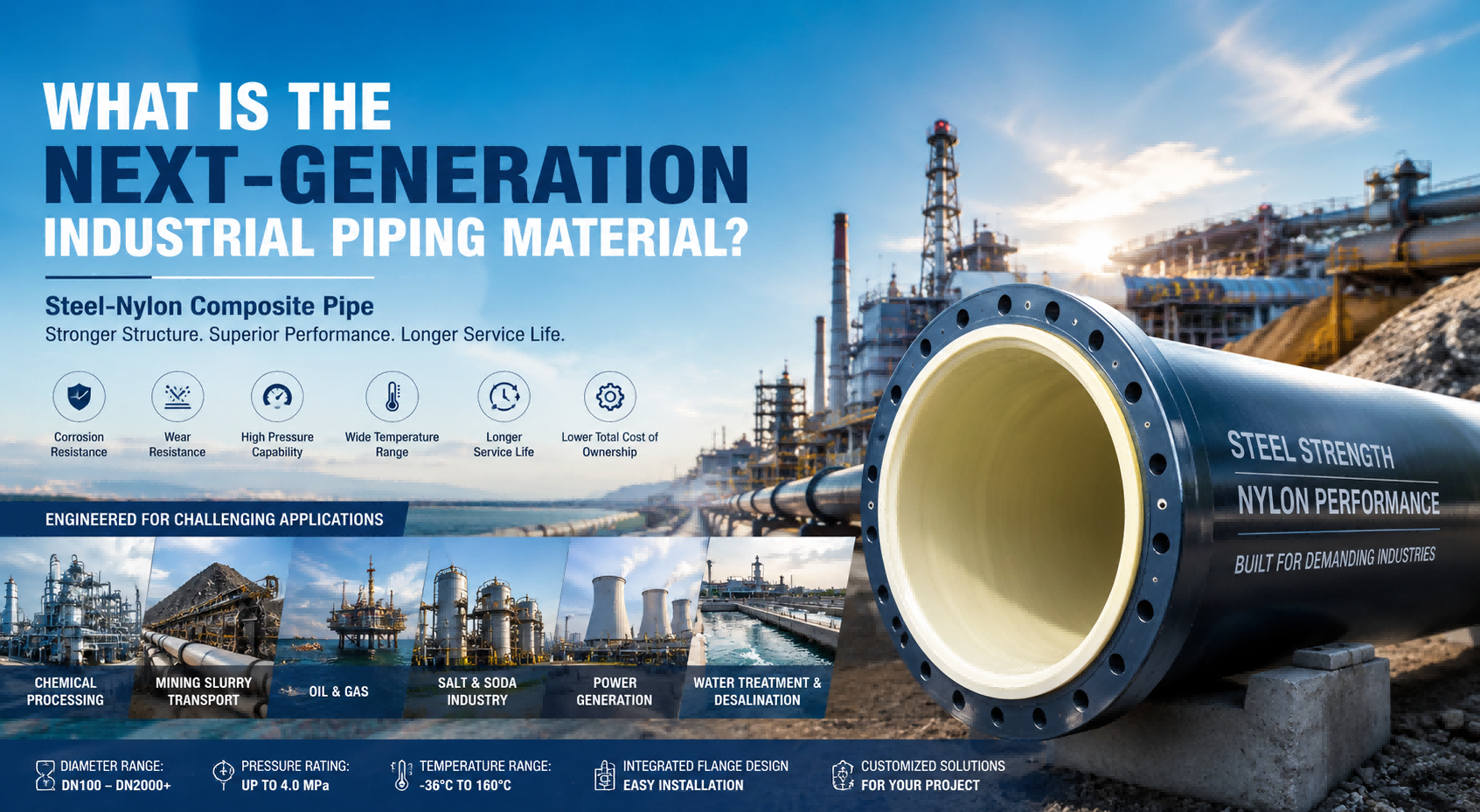
Depending on the product structure and engineering requirements, our Steel-Nylon Composite Pipe products can cover large diameters from approximately DN100 to DN2000+, with pressure ratings of up to approximately 1.0–4.0 MPa for applicable product configurations.
The applicable temperature range can reach approximately -36°C to 160°C, depending on the nylon grade, medium, pressure, temperature, safety factor, and specific engineering conditions.
This is an important advantage of the steel-nylon composite concept compared with many conventional plastic piping systems:
The goal is not simply to make the pipe lightweight. The goal is to achieve balanced performance under demanding industrial conditions.
7. Large Diameter: A Key Competitive Area for Next-Generation Industrial Piping
Industrial piping systems are becoming increasingly larger.
Mining slurry transportation, chemical plants, salt production facilities, seawater desalination systems, industrial water treatment plants, and large-scale energy projects may all require large-diameter pipelines.
As pipe diameter increases, engineers must consider not only internal pressure but also:
-
Self-weight
-
Structural rigidity
-
Support spacing
-
External loads
-
Transportation
-
Lifting and installation
-
Thermal expansion and contraction
-
Long-distance operating stability
Therefore, simply relying on flexible plastic materials may not always be the best solution for large-diameter industrial projects.
Steel-Nylon Composite Pipe can use the steel layer to provide structural support while the nylon layer improves inner-wall performance.
This makes the technology particularly attractive for applications requiring:
Large Diameter + Corrosion Resistance + Wear Resistance + Pressure Capacity
8. The Real Competitive Advantage Is Not Purchase Price—It Is TCO
One of the most frequently overlooked factors in industrial pipe selection is:
Total Cost of Ownership (TCO).
The true cost of a pipeline is much more than its purchase price.
A simple model is:
TCO = Initial Cost + Installation + Maintenance + Replacement + Downtime
This can include:
-
Pipe procurement
-
Installation
-
Welding
-
Corrosion protection
-
Hot-work operations
-
Inspection
-
Maintenance
-
Fitting replacement
-
Production downtime
-
Labor costs
-
Long-term operating expenses
A pipe with a lower purchase price may not necessarily have the lowest lifecycle cost if it requires frequent replacement.
Conversely, a pipe with a higher initial purchase price may provide better economics if it significantly extends maintenance intervals and service life.
This is where Steel-Nylon Composite Pipe can create value.
9. Integrated Flanges and Formed Connections: Rethinking Pipeline Installation
Installation costs are often underestimated when industrial piping systems are evaluated.
Traditional metal piping may require:
-
Welding
-
Weld inspection
-
Corrosion protection
-
Hot-work permits
-
Weld quality control
-
Post-welding maintenance
In chemical plants, mines, and complex construction environments, hot work can introduce additional safety and management requirements.
Our Steel-Nylon Composite Pipe adopts an integrally formed, built-in flange design, which can reduce the need for conventional field welding.
Potential advantages include:
1. Less Field Welding
Reducing hot-work operations can simplify installation management in complex industrial environments.
2. Fewer Potential Leak Points
Traditional welded pipelines rely on numerous weld joints. An integrated flange structure can reduce dependence on welded joints.
3. Faster Installation
Flanged connections are well suited to modular installation and maintenance.
4. Easier Maintenance
Valves, elbows, and equipment connection sections that require regular maintenance can be easier to disassemble and replace.
Therefore, the competition among next-generation industrial piping systems is no longer simply:
“Which material has the best properties?”
It is increasingly:
“Which system can deliver better efficiency across design, manufacturing, installation, operation, and maintenance?”
10. How Is Steel-Nylon Composite Pipe Different from Conventional Plastic-Lined or Rubber-Lined Steel Pipe?
Many engineers may ask:
“What is the difference between Steel-Nylon Composite Pipe and conventional plastic-lined or rubber-lined steel pipe?”
One of the key considerations is the long-term reliability of the composite structure.
Conventional lining systems require careful attention to:
-
Adhesion between the lining and steel substrate
-
Thermal expansion and contraction
-
Pressure fluctuations
-
Liner shrinkage and expansion
-
Local delamination
-
Edge-related failures
These factors become particularly important when pipelines experience repeated temperature and pressure changes.
Steel-Nylon Composite Pipe uses a composite structural design intended to allow the steel and nylon layers to work together.
Therefore, the technical approach is not simply:
Steel Pipe + Plastic Lining
but rather:
Integrated Steel-Nylon Composite Structure
This is another reason why steel-nylon composite technology deserves attention as a potential next-generation industrial piping solution.
11. Five Development Trends for Next-Generation Industrial Piping Materials
Looking at the development of industrial piping technology, several major trends are becoming increasingly important.
Trend 1: Greater Use of Composite Materials
The future will not be limited to “steel pipe” or “plastic pipe.”
More products will combine different materials to achieve complementary performance.
Trend 2: Higher Corrosion Resistance
As chemical processing, salt production, seawater desalination, and related industries expand, resistance to complex corrosive media will become increasingly important.
Trend 3: Higher Wear Resistance
Mining, slurry transportation, and solid-liquid two-phase flow applications will continue to drive demand for advanced wear-resistant materials.
Trend 4: Larger Diameters
Larger industrial projects will continue to drive the development of DN1000, DN1600, DN2000, and even larger pipeline technologies.
Trend 5: Lower Maintenance Requirements
Future industrial users will not only ask:
“Can this pipeline operate?”
They will increasingly ask:
“How long can it operate, how often will it require maintenance, and how much downtime will it create?”
Therefore, low-maintenance operation, long service life, and high reliability will become increasingly important competitive factors.
12. Application Potential of Steel-Nylon Composite Pipe
With the complementary advantages of steel and nylon, Steel-Nylon Composite Pipe is particularly suitable for applications such as:
Chemical Industry
Corrosive chemical media, chemical mother liquor, salt solutions, and other complex chemical transportation systems.
Mining
Mineral slurry, tailings, backfill slurry, and solid-particle-containing media.
Oil & Gas
Transportation systems exposed to water, sand, corrosion, and erosion risks.
Soda Ash & Chlor-Alkali
Brine, mother liquor, and related chemical media transportation.
Phosphate Chemical
Corrosive and abrasive slurry transportation.
Power Generation
Industrial water, circulating water, flue gas desulfurization-related systems, and other challenging media.
Seawater Desalination
Water transportation systems exposed to high salinity and corrosion risks.
13. From “Pipe” to “Piping System”: The Real Value of Next-Generation Materials
The future of industrial piping should not focus only on the material itself.
A truly advanced piping system should address:
Material + Structure + Installation + Maintenance + Lifecycle Cost
The value of Steel-Nylon Composite Pipe lies in its ability to rethink the functional roles of different materials.
Steel → Strength & Pressure
Nylon → Corrosion & Wear Resistance
Integrated Structure → Reliability
Built-In Flange → Installation Efficiency
Long Service Life → Lower Lifecycle Cost
This is why Steel-Nylon Composite Pipe deserves to be considered as an important candidate for next-generation industrial piping applications.
14. Conclusion: The Next-Generation Industrial Pipe May Not Be a More Expensive Material, but a Smarter Combination of Materials
The future competition in industrial piping will not simply be:
Steel Pipe vs. Plastic Pipe
The real competition will be:
Which material system can achieve the best balance among strength, corrosion resistance, wear resistance, temperature resistance, pressure capacity, installation efficiency, and lifecycle cost?
From this perspective, Steel-Nylon Composite Pipe has a clear technical concept:
Steel provides the structural framework, while nylon provides protection. Steel carries the pressure, while nylon interfaces with the conveyed medium. The composite structure enables the two materials to complement each other.
For industrial transportation systems exposed to the combined challenges of corrosion + wear + pressure + large diameter + long service life, this composite material approach has significant development potential.
Our company specializes in the development and manufacturing of Enhanced Nylon Pipe and Steel-Nylon Composite Pipe, offering large-diameter products from approximately DN100 to DN2000+, with different pressure ratings and configurations for a wide range of industrial applications.
If your project is considering a pipeline material upgrade—particularly in chemical processing, mining, oil & gas, salt chemical, soda ash, chlor-alkali, power generation, seawater desalination, or industrial water treatment—Steel-Nylon Composite Pipe is worth evaluating as a next-generation industrial piping solution.
The next generation of industrial piping may not be a single material. It may be a smarter combination of materials.
Steel-Nylon Composite Pipe is one practical example of this new direction in industrial piping technology.
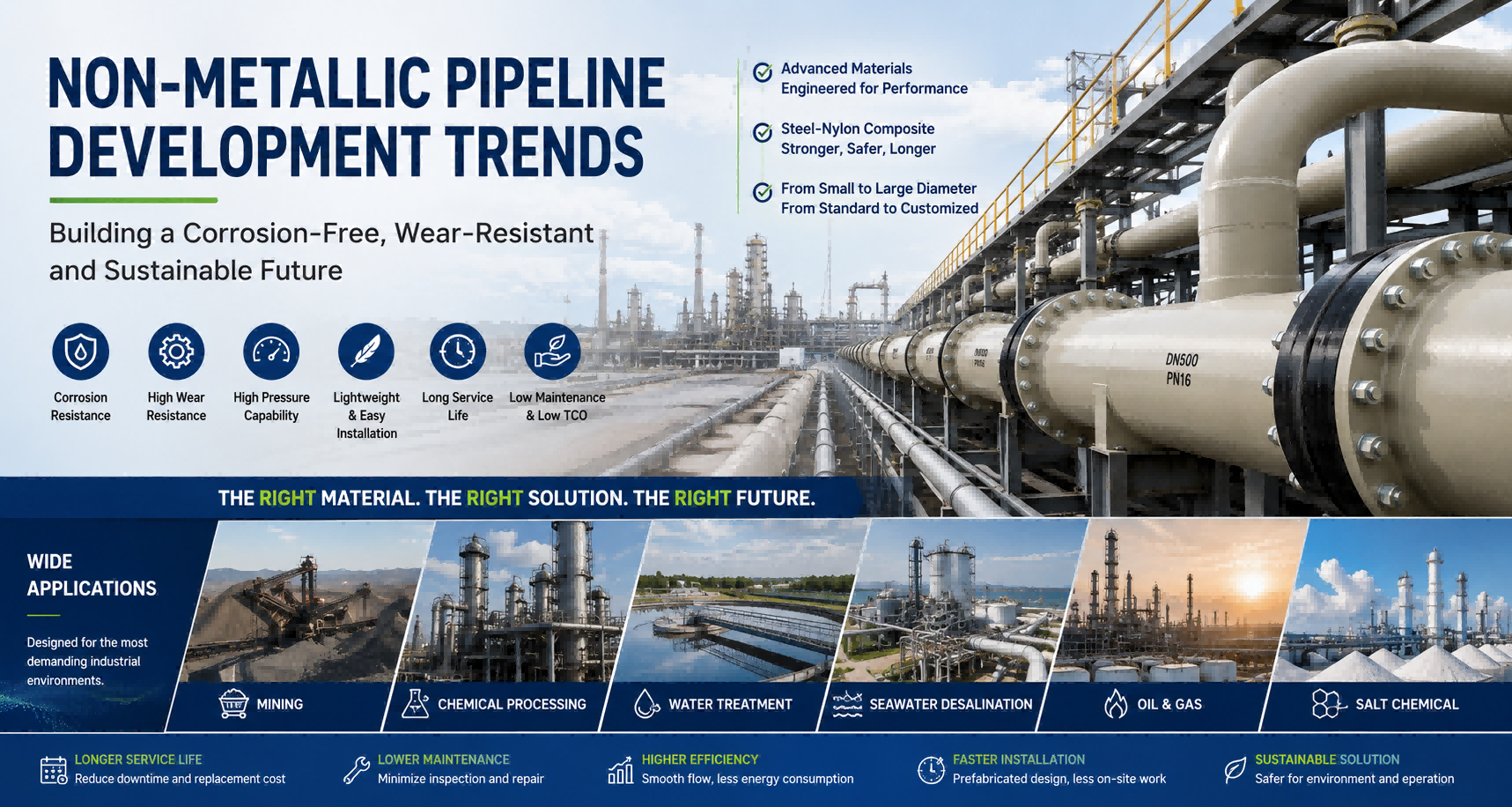
Non-Metallic Pipeline Development Trends: From Traditional Plastic Pipes to High-Performance Reinforced Nylon Pipes The industrial piping industry is undergoing a profound transformation.