
Carbon Steel Pipeline Perforated by Corrosion in 3 Years, While Reinforced Nylon Pipe Keeps Even Flange Bolts Rust-Free for 10 Years – Where Does This “Lifespan Divide” in Material Selection Come From?
Introduction: Same Soil, Radically Different Fates
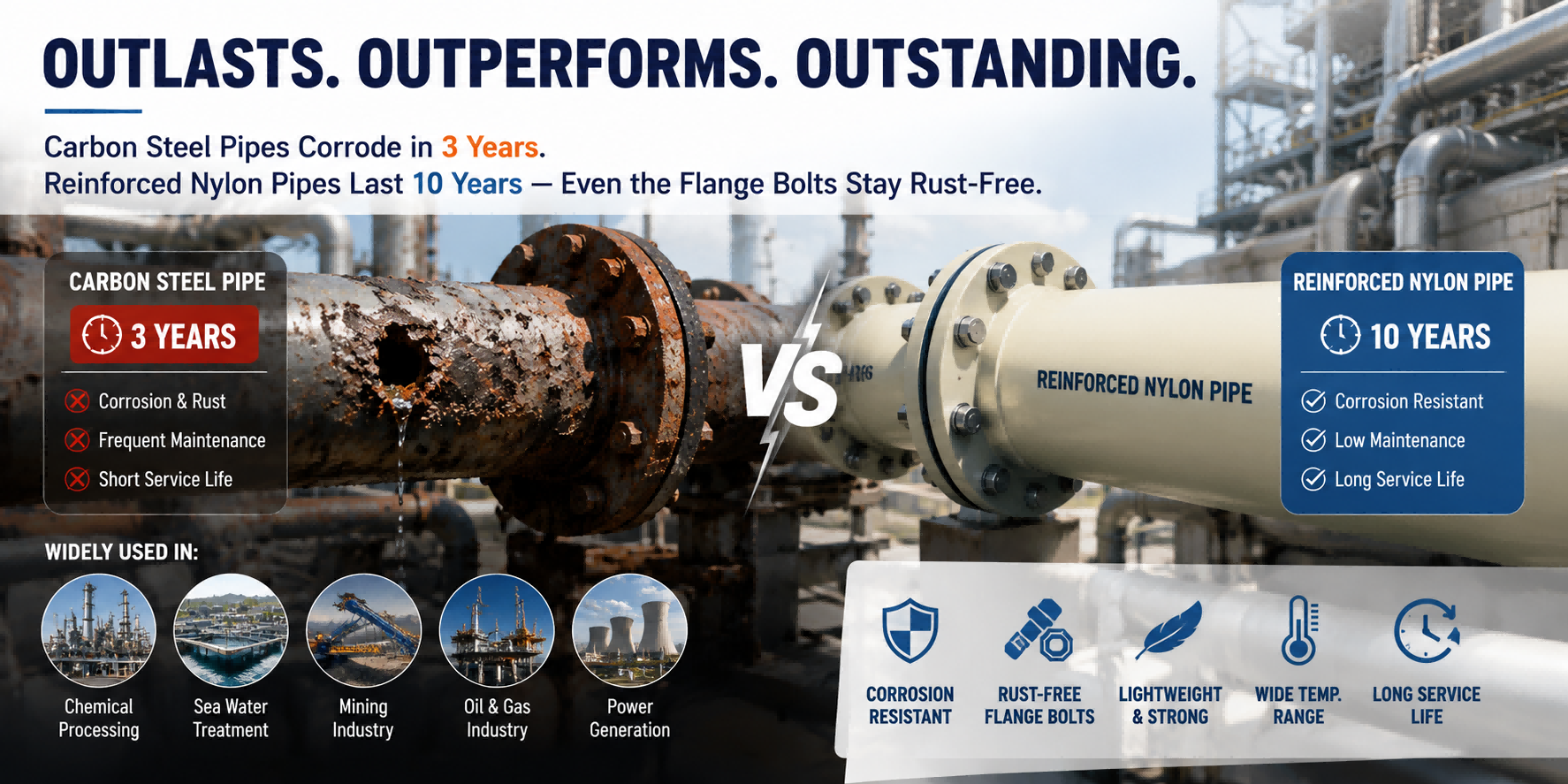
At a certain oil transfer station, an L290 carbon steel pipeline leaked after only **3 years** in service. Macroscopic inspection revealed severe external wall thinning due to corrosion. Chloride ions (Cl⁻) enriched in the soil induced pitting, forming occluded corrosion cells that propagated through the wall thickness until perforation. Yet in the very same industrial setting, reinforced nylon pipelines have been running for **10 years** – not only are the pipes intact, but even the flange bolts show no signs of rust.
3 years versus 10 years – this is not merely a numerical gap; it is a fundamental divide in materials science and engineering mindset.
I. The “3‑Year Tragedy” of Carbon Steel: Corrosion Is Never an Accident
The perforation of carbon steel pipes within 3 years is not an isolated case. In a gas field in Sichuan, chloride‑rich produced water pipelines frequently suffered corrosion perforation. Analysis showed the primary causes were CO₂ corrosion combined with microbiologically influenced corrosion (MIC) by sulfate‑reducing bacteria (SRB). Carbon steel pipelines buried in the Avery Island salt mine in Louisiana, USA, experienced maximum corrosion penetration rates of approximately **1 mm/year** after 3 years. Similarly, an L245 carbon steel header pipe in a western oilfield failed due to coating detachment near welds, exposing the bare metal to corrosive media and leading to CO₂‑induced failure.
These cases reveal a harsh reality: **corrosion of carbon steel is not an “accident” – it is “inevitable.”**
The corrosion mechanisms of carbon steel can be divided into two categories:
**Chemical corrosion** – direct chemical reaction between the metal and the medium, causing metal ions to dissolve.
**Electrochemical corrosion** – the metal and electrolyte form a galvanic cell, triggering electrolytic reactions. Buried pipelines with exposed metal and soil electrolyte create such cells, sustaining continuous corrosion. Meanwhile, Cl⁻ enrichment in the soil induces pitting and forms occluded corrosion cells that accelerate wall‑thickness penetration.
More critically, carbon steel pipes rely on protective **coatings** – inherently a weak link. Coatings are vulnerable to construction conditions and environmental factors, often developing pinholes, blistering, or peeling, which expose the pipe substrate directly to corrosive environments. Once the coating fails, corrosion becomes irreversible.
II. The “10‑Year Rust‑Free” Performance of Reinforced Nylon: Material Nature Decides the Outcome
The corrosion resistance of reinforced nylon pipes stems from the material’s **chemical inertness**. The molecular chain structure of nylon (polyamide) is inherently stable, offering natural resistance to most acids, alkalis, oils, and salt solutions. It does not rely on a “coating” for protection – **the material itself does not react with corrosive media**.
In engineering practice, this advantage has been repeatedly validated. Since 1993, Qingdao Soda Ash Co., Ltd. has used reinforced MC nylon pipes in its ammonia‑brine system to replace cast iron pipes – **the first batch has been in service for over 20 years** and remains fully operational. Multiple field evaluations have shown that the overall anti‑corrosion performance of steel‑skeleton composite pipes and nylon composite pipes is significantly superior to that of PE‑lined pipes and glass‑enamel‑lined pipes.
MC nylon pipes can withstand working pressures up to **10.0 MPa**, weigh only **1/7** of steel pipes, and offer abrasion resistance **8 times** that of steel. Their service life exceeds **30 years** under optimal conditions, and even in moderate corrosive environments such as industrial drainage and chemical piping, they achieve **20 to 30 years** of reliable service.
III. Even Flange Bolts Stay Rust‑Free: The Devil Is in the Details
“Even the flange bolts do not rust” – this phrase precisely highlights another core advantage of reinforced nylon piping: **systemic corrosion protection**.
Corrosion in traditional metal pipelines is never confined to the pipe body alone. Flanges, bolts, and welds – every connection point is a potential “breach” for corrosion. Metal flanges are highly susceptible to oxidation, and once the coating near welds peels off, corrosive media can penetrate deep. In contrast, reinforced nylon pipes are manufactured using **integral molding** – no welds exist. Flanges can be molded integrally with the pipe body, and the steel reinforcing inserts are fully encapsulated within the nylon flange, forming a protective layer. This design fundamentally eliminates the persistent problem of “joint corrosion” that plagues metal piping.
IV. Life‑Cycle Cost: Which One Is Truly “Cheap”?
Many engineering decision‑makers only look at the **initial procurement cost** – carbon steel is cheap, nylon is expensive. But the full life‑cycle cost (LCC) tells a completely different story.
A carbon steel pipeline that perforates and requires replacement in 3 years entails:
Repeated material procurement and transportation costs every 3 years
Production losses due to shutdowns
Excavation, installation, and welding labour costs
Environmental cleanup and compliance costs from leaks
Repeated investment in weld inspection and coating repair
Repeated material procurement and transportation costs every 3 years
Production losses due to shutdowns
Excavation, installation, and welding labour costs
Environmental cleanup and compliance costs from leaks
Repeated investment in weld inspection and coating repair
Meanwhile, a reinforced nylon pipeline installed once can deliver 20 or even 30 years of maintenance‑free operation. With only 1/7 the weight of steel, transportation and installation costs are significantly reduced. **“Replacing steel with plastics”** is not a compromise in performance – it is an optimisation of total economic benefit.
V. Conclusion: A Paradigm Shift in Material Selection
“Carbon steel pipeline perforated by corrosion in 3 years, while reinforced nylon pipe keeps even flange bolts rust‑free for 10 years” – this comparison is not meant to completely dismiss carbon steel. Carbon steel remains a good choice in clean, dry, non‑corrosive environments. But the problem is that **more and more industrial scenarios simply do not offer such “ideal conditions”** .
Cl⁻‑bearing soils, high‑salinity produced water, media containing both CO₂ and H₂S, frequent wet‑dry cycles – these are the real engineering environments. In such conditions, carbon steel that depends on “coating protection” is destined to be a **consumable**, whereas reinforced nylon that offers **intrinsic material corrosion resistance** is a true **asset**.
The gap between 3 years and 10 years is essentially the gap between **passive defence** and **active immunity**. When you face your next pipeline material selection decision, ask yourself one question:
**Do you want to dig up the ground and replace pipes after 3 years, or do you want to open a flange after 10 years and see a gleaming bolt?**
The answer is self‑evident.
Carbon Steel Backfill Pipelines Wear Out Every Quarter? Reinforced Nylon Pipes Extend the Replacement Cycle to Three Years
Frequent Pipe Blockage Due to Carbon Steel Pipe Lining Detachment: Integrated Steel‑Nylon Composite Pipe Never Delaminates
Related blog


SEND MESSAGE