Carbon Steel vs Stainless Steel vs FRP vs Composite Pipes

Carbon Steel vs. Stainless Steel vs. FRP vs. Composite Pipes: Future Market Competition Analysis
Introduction: The Industrial Piping Market Is Shifting from Material Price Competition to Lifecycle Value
The global industrial piping market is undergoing a significant transformation as industrial infrastructure continues to evolve.
For decades, carbon steel pipes have maintained a strong position in industrial applications due to their competitive costs, mature manufacturing processes, and extensive supply chains.
Stainless steel pipes have gained widespread acceptance in chemical processing, energy production, and demanding industrial environments because of their mechanical strength and corrosion resistance.
Meanwhile, Fiber Reinforced Plastic (FRP) pipes have established a presence in water treatment, seawater transportation, and selected chemical processing applications thanks to their lightweight construction and corrosion-resistant properties.
However, as industrial operating environments become increasingly complex, the limitations of conventional piping materials are becoming more apparent.
High salinity, severe abrasion, corrosive media, frequent operational fluctuations, and continuous production requirements are placing greater demands on pipeline systems.
Industrial operators must consider not only the initial investment in piping materials but also long-term maintenance, replacement, production downtime, and environmental risks.
According to corrosion cost research referenced by the Association for Materials Protection and Performance (AMPP), the estimated global economic cost of corrosion amounts to approximately USD 2.5 trillion annually. This figure originates from historical research rather than a new assessment conducted in 2026.
The research highlights the substantial economic potential of effective corrosion prevention and management.
This development points to an important market trend:
The future competitiveness of industrial piping materials will increasingly depend on their reliability, expected service life, maintenance requirements, and Total Cost of Ownership (TCO), rather than simply their initial purchase price.
Against this background, advanced composite piping technologies, particularly Steel-Nylon Composite Pipes, are creating new opportunities for industrial pipeline optimization.
This article examines the competitive positioning of carbon steel, stainless steel, FRP, and steel-nylon composite pipes from the perspectives of material properties, lifecycle costs, industrial applications, engineering risks, and technological development.
It also explores how the competitive landscape of industrial piping materials may evolve over the next five to ten years.
1. Market Positioning and Competitive Foundations of Four Industrial Piping Materials
1.1 Carbon Steel Pipes: Cost Competitiveness with Long-Term Corrosion Challenges
Carbon steel pipes remain among the most widely used materials in industrial pipeline systems.
Their competitive advantages come from established manufacturing technologies, broad dimensional availability, high structural load-bearing capacity, and relatively economical procurement costs.
Carbon steel remains a practical material for industrial pipelines operating under high pressure, elevated temperatures, or conditions where corrosion risks can be effectively controlled.
Key advantages include:
-
Relatively low raw material and manufacturing costs.
-
High mechanical strength and mature structural design methods.
-
Well-established welding, fabrication, and installation technologies.
-
Extensive global supply chains and standardized product availability.
-
Proven suitability for many demanding industrial pressure systems when properly designed and protected.
However, the primary limitation of carbon steel is its susceptibility to corrosion.
In oilfield produced-water transportation, salt chemical processing, saline wastewater systems, and coastal industrial water networks, carbon steel pipelines may experience various corrosion mechanisms.
These include general corrosion, localized corrosion, and combined erosion-corrosion.
To control these risks, operators often implement protective coatings, corrosion inhibitors, cathodic protection, corrosion monitoring, and scheduled maintenance programs.
Although these methods can effectively extend pipeline service life, they also introduce additional operating costs and maintenance complexity.
Future outlook: Carbon steel pipes will remain important in cost-sensitive, relatively low-corrosion, high-temperature, and high-load applications. However, they will face growing competition from alternative materials in environments involving severe corrosion, difficult maintenance conditions, and demanding continuous-operation requirements.
1.2 Stainless Steel Pipes: High-Performance Materials Facing Cost and Environmental Limitations
Stainless steel pipes are widely used in chemical processing, pharmaceuticals, food production, water treatment, and energy facilities.
Their corrosion resistance primarily results from the formation of a protective passive film containing chromium.
Different stainless steel grades, including 304, 316L, duplex stainless steel, and higher-alloy materials, offer different levels of performance for industrial applications.
Their major advantages include:
-
Strong mechanical performance.
-
Established engineering standards and design practices.
-
Good temperature resistance.
-
Corrosion resistance in suitable operating environments.
-
Availability of specialized grades for demanding industrial applications.
However, stainless steel is not universally resistant to corrosion.
In chloride-containing environments, stainless steel may experience pitting corrosion and crevice corrosion.
The risks depend on chloride concentration, operating temperature, pH, oxidizing conditions, and the presence of structural crevices.
Technical guidance published by the Nickel Institute also emphasizes that different stainless steel grades exhibit significantly different levels of resistance in chloride-containing environments.
For high-salinity and certain aggressive chemical environments, engineers may need to specify duplex stainless steel, super duplex stainless steel, or specialized high-alloy grades.
As alloy requirements increase, material procurement and processing costs may rise substantially.
Future outlook: Stainless steel will continue to dominate applications requiring high cleanliness, elevated operating temperatures, high pressure, and strict material specifications. However, in certain low- to medium-temperature corrosive fluid transportation systems, it will face increasing competition from non-metallic and composite piping technologies.
1.3 FRP Pipes: Corrosion Resistance and Lightweight Construction with Design-Dependent Performance
Fiber Reinforced Plastic (FRP) pipes are generally manufactured by combining glass-fiber reinforcement with polymer resin systems.
By selecting suitable resins and reinforcement structures, FRP pipes can be engineered for a wide range of corrosive industrial environments.
Their key advantages include:
-
Lightweight construction.
-
Corrosion resistance when compatible resin systems are selected.
-
Flexible structural design possibilities.
-
Potential installation and transportation advantages.
-
Suitability for selected large-diameter industrial water systems.
FRP piping has established applications in seawater transportation, industrial cooling water, wastewater treatment, and chemical processing.
However, FRP performance depends heavily on several engineering factors, including:
-
Resin selection.
-
Fiber orientation and reinforcement design.
-
Manufacturing quality.
-
Joint configuration.
-
Operating temperature and pressure.
-
Installation conditions and external loading.
In applications involving mechanical impact, complex support loads, repeated pressure fluctuations, or abrasive solid particles, additional engineering verification may be necessary.
Material property data alone may not adequately predict long-term performance under these conditions.
International standards such as ISO 14692 establish requirements related to the design, manufacture, installation, and operation of glass-reinforced plastic piping systems for petroleum and natural gas applications.
These standards demonstrate the importance of systematic engineering design and quality management for FRP pipeline systems.
Future outlook: FRP pipes are expected to remain competitive in large-diameter, lightweight, and corrosion-resistant water transportation applications. Their future market development will increasingly depend on manufacturing consistency, joint reliability, and verified long-term performance.
1.4 Steel-Nylon Composite Pipes: Combining Structural Strength with Functional Material Protection
Steel-Nylon Composite Pipes represent a different approach to industrial pipeline engineering.
Rather than relying exclusively on higher alloy content to improve corrosion resistance, or replacing metal structures entirely with non-metallic materials, composite piping integrates different materials according to their functional strengths.
A typical steel-nylon composite pipe incorporates an external steel structure and an internal nylon lining.
The basic structural design consists of:
Steel Structural Layer
The steel structure provides mechanical strength, rigidity, and the ability to withstand external loads and internal pressure within the pipe's validated design limits.
Nylon Inner Lining
The nylon lining separates the transported fluid from the underlying steel structure.
Depending on the selected nylon formulation and operating environment, it may provide wear resistance, impact tolerance, and chemical compatibility.
This combination creates a distinctive competitive position.
Steel-nylon composite pipes retain important structural advantages associated with steel while reducing direct exposure of the internal steel surface to potentially corrosive transported media.
For industrial systems facing simultaneous corrosion and abrasive wear, steel-nylon composite pipes offer a material solution worthy of detailed engineering evaluation.
2. Performance Comparison: Carbon Steel vs. Stainless Steel vs. FRP vs. Steel-Nylon Composite Pipes
The following comparison provides general guidance for preliminary engineering material selection.
Actual performance depends on material grade, pipe dimensions, operating pressure, temperature, chemical exposure, and manufacturing quality.
| Performance Factor | Carbon Steel | Stainless Steel | FRP | Steel-Nylon Composite Pipe |
|---|---|---|---|---|
| Structural strength | High | High | Depends on reinforcement design | Steel structure provides load-bearing capability |
| Internal corrosion resistance | Generally requires protection | Depends on alloy grade and media | Depends on resin system | Depends on nylon lining compatibility |
| Abrasion resistance | Depends on hardness and flow conditions | Depends on grade and conditions | Erosion performance requires verification | Nylon lining offers wear-resistant application potential |
| High-temperature performance | Broad operating range | Broad operating range | Limited by resin system | Limited by nylon, interface, and structural design |
| Mechanical impact performance | Generally good | Generally good | Local damage must be considered | Steel structure and nylon lining provide complementary functions |
| Installation weight | Relatively high | Relatively high | Relatively low | Depends on steel construction and design |
| Maintenance priorities | Corrosion and wall-thickness monitoring | Localized corrosion and weld inspection | Joint integrity and structural damage | Lining integrity, joints, and external steel protection |
| Initial procurement cost | Generally economical | Higher for advanced alloys | Varies by size and resin | Depends on structure and manufacturing |
| Lifecycle cost potential | Depends on corrosion management | Depends on alloy and environment | Depends on design and installation | Potential savings in suitable operating conditions |
This comparison suggests that the future industrial piping market will not be characterized by one material completely replacing all others.
Instead, materials will compete based on their suitability and economic efficiency in specific industrial environments.
The strongest potential applications for steel-nylon composite pipes are systems that require structural strength, corrosion protection, abrasion resistance, and reduced long-term maintenance.
3. Five Major Trends Reshaping Competition in Industrial Piping Materials
Trend 1: Corrosion Protection Is Becoming an Integral Part of Material System Design
Traditional carbon steel piping systems often rely on corrosion-control measures applied after the base material has been selected.
These measures may include coatings, corrosion inhibitors, cathodic protection, and monitoring programs.
Composite piping follows a different engineering principle.
Corrosion protection can be incorporated into the material structure by separating the pressure-bearing layer from the layer exposed to the transported medium.
This does not mean composite pipes eliminate every corrosion-related maintenance requirement.
For example, steel-nylon composite pipe systems still require consideration of:
-
External corrosion of the steel structure.
-
Flange and joint sealing integrity.
-
Protection of lining terminations.
-
Potential corrosion if the lining becomes damaged.
-
Long-term material compatibility and structural stability.
Nevertheless, appropriate composite design can shift part of the corrosion-control strategy from recurring maintenance toward initial material selection and manufacturing.
For continuously operating chemical plants, mining operations, and oilfield transportation systems, this approach may reduce reliance on repetitive internal corrosion-related maintenance.
Trend 2: Combined Corrosion and Abrasion Resistance Is Becoming More Important
Industrial pipeline failures are rarely caused by a single mechanism.
In slurry transportation, tailings pipelines, salt mud handling, sand-containing oilfield fluids, and certain industrial wastewater systems, corrosion and abrasive wear may occur simultaneously.
For example:
-
Solid particles may cause localized impact and abrasion at pipeline bends.
-
Saline fluids may increase corrosion risks for susceptible metals.
-
Abrasive particles may damage protective surfaces and expose underlying steel.
-
Changes in flow velocity, particle size, and solids concentration may alter wear mechanisms.
Consequently, engineers must evaluate more than static chemical corrosion resistance.
Material selection should also consider performance under dynamic flow conditions.
Steel-nylon composite pipes can combine the wear-related properties of nylon materials with the mechanical support of a steel structure.
This makes them a potential solution for selected corrosive and abrasive transportation systems.
However, for highly concentrated slurries, high flow velocities, or sharp abrasive particles, application-specific erosion testing is essential to determine whether the material provides a measurable advantage.
Trend 3: Production Downtime Is Becoming a Major Procurement Consideration
Traditional industrial pipe procurement often begins with price comparisons.
How much does carbon steel pipe cost per meter?
What is the price difference between stainless steel and composite pipe?
Is composite piping more expensive than conventional steel piping?
However, for continuously operating industrial facilities, the purchase price may represent only a portion of the total economic impact.
Pipeline failure may cause additional costs, such as:
-
Unplanned production shutdowns.
-
Fluid cleanup and disposal.
-
Emergency maintenance labor.
-
Replacement materials and installation.
-
Equipment restart and production recovery.
-
Potential environmental or operational consequences.
Future piping decisions are therefore likely to place greater emphasis on reliability rather than simply minimizing initial material expenditure.
In industries with limited maintenance windows and high downtime costs, materials demonstrating lower maintenance requirements and validated service life may receive greater consideration.
Trend 4: Large-Diameter Manufacturing and Custom Engineering Are Becoming Competitive Differentiators
Large-diameter pipelines are increasingly important in industrial cooling water, mining transportation, chemical processing, and seawater infrastructure projects.
As pipeline diameter increases, engineers must address additional challenges beyond basic material properties.
These include:
-
Manufacturing consistency and dimensional accuracy.
-
Pipe stiffness and external loading.
-
Support configuration and structural stability.
-
Flange connection reliability.
-
Transportation, lifting, and installation.
-
Thermal expansion and mechanical stress.
-
Production of custom fittings and special configurations.
For steel-nylon composite pipe manufacturers, the ability to produce large-diameter pipes and provide compatible flange connections, elbows, and engineered fittings creates opportunities to participate in complex EPC projects.
Trend 5: Engineering Validation and Product Traceability Are Becoming Essential
Future competition among industrial piping materials will increasingly involve supplier quality management and technical documentation.
International EPC contractors and industrial end users generally require reliable engineering information before approving new piping materials.
Typical requirements include:
-
Material certificates and specifications.
-
Pressure testing records.
-
Dimensional inspection reports.
-
Chemical compatibility data.
-
Joint design and sealing specifications.
-
Manufacturing quality records.
-
Applicable third-party inspection documentation.
ISO 23936-1:2022 provides principles and requirements for evaluating the stability of thermoplastic materials in petroleum and natural gas production environments.
This reflects the need for application-specific qualification when non-metallic materials are used in demanding industrial conditions.
For steel-nylon composite pipe manufacturers, future competitiveness will depend not only on manufacturing capability but also on the ability to demonstrate why a product is suitable for a particular application.
Reliable engineering documentation, verifiable testing, and consistent product quality will become increasingly important competitive factors.
4. Why Steel-Nylon Composite Pipes Could Replace Conventional Piping in Selected Applications
4.1 Complementary Functions of Steel and Nylon
Conventional single-material metal pipes must provide both structural strength and direct resistance to the transported medium.
Steel-nylon composite pipes divide these responsibilities between different material layers.
The steel structure provides mechanical support, while the nylon lining separates the medium from the steel and offers appropriate wear-related functionality.
This structure is especially relevant for pipeline systems requiring corrosion protection, abrasion resistance, and mechanical strength simultaneously.
4.2 Wear-Resistant Material Technology Based on Nylon 6
Our steel-nylon composite piping products primarily use a Nylon 6 (PA6) material system.
Nylon 6 is recognized for its toughness, impact tolerance, and potential for wear-resistant applications.
Under appropriate operating conditions, these properties can contribute to reliable pipeline performance.
However, Nylon 6 is not universally compatible with all chemicals.
Moisture absorption can affect its dimensions and mechanical properties, while strong acids, certain oxidizing chemicals, and elevated-temperature chemical exposure may lead to material degradation.
Engineering plastic manufacturers, including BASF, emphasize the importance of evaluating polyamide compatibility under actual operating conditions.
For this reason, we focus on material selection based on specific fluid composition, pressure, operating temperature, and transportation requirements.
Rather than presenting nylon as a universal corrosion-resistant material, we believe that accurate application matching provides greater engineering value.
4.3 Multiple Pressure Classes and Large-Diameter Manufacturing Capability
To meet different industrial project requirements, our steel-nylon composite pipes are available in various product configurations and pressure classes.
Our manufacturing and engineering capabilities include:
-
Pressure classes ranging from 1.0 to 4.0 MPa.
-
Standard and customized pipe dimensions.
-
Manufactured pipe diameters up to DN1600.
-
Technical capability for developing larger-diameter solutions, including DN2000 and above.
-
Flanged connection designs and matching pipe fittings.
-
Customized structural configurations for special operating conditions.
These specifications describe our general product capability range.
They do not mean that every diameter is suitable for every pressure, temperature, or chemical environment.
The allowable design pressure and operating limits of each product must be verified through engineering calculations, product testing, and relevant project requirements.
4.4 Flanged Connections for Industrial Installation and Maintenance
Steel-nylon composite pipes can be manufactured with flanged connections.
This arrangement facilitates connections between pipeline sections, pumps, valves, and associated industrial equipment.
For projects requiring modular transportation, on-site assembly, and scheduled maintenance, appropriately designed flange connections can provide practical installation advantages.
However, reliable flange performance requires careful consideration of:
-
Nylon lining termination details.
-
Gasket material selection.
-
Bolt preload and tightening procedures.
-
Sealing surface design.
-
Pressure and temperature cycling.
A properly engineered flange connection is essential to the overall integrity of the pipeline system.
4.5 Potential Reduction in Total Lifecycle Costs
The economic value of steel-nylon composite pipes should not be judged solely by whether their purchase price is lower than that of carbon steel pipes.
In corrosion-prone or maintenance-intensive environments, potential economic benefits may include:
-
Reduced repair requirements associated with internal corrosion.
-
Lower demand for certain recurring corrosion-control activities.
-
Longer replacement intervals where verified by operating data.
-
Reduced risk of unexpected pipeline shutdowns.
-
Improved predictability of maintenance planning.
Whether these advantages translate into actual financial savings must be evaluated using project-specific operating records and lifecycle cost calculations.
5. TCO Competition: How Steel-Nylon Composite Pipes Can Redefine Pipeline Economics
Total Cost of Ownership (TCO) is becoming an increasingly important consideration in industrial pipeline procurement.
A comprehensive pipeline TCO model should include initial investment, maintenance, repairs, expected downtime costs, and end-of-life expenses.
The following formula represents a simplified discounted lifecycle cost model:
TCO = C₀ + Σ[(Mₜ + Rₜ + Dₜ) / (1 + r)ᵗ] + Cₑ / (1 + r)ⁿ
Where:
-
C₀: Initial procurement and installation cost.
-
Mₜ: Maintenance and inspection cost in year t.
-
Rₜ: Repair or replacement cost in year t.
-
Dₜ: Expected downtime cost in year t.
-
Cₑ: End-of-life disposal cost or net residual value.
-
r: Discount rate.
-
n: Project evaluation period.
Hypothetical Example: A 20-Year Lifecycle Cost Comparison
Consider a hypothetical industrial project comparing carbon steel pipes and steel-nylon composite pipes.
The example uses standardized cost units, a 20-year evaluation period, and an 8% discount rate.
Residual values and major replacement costs are excluded for simplicity.
These figures are illustrative assumptions, not actual project costs or verified product service-life data.
| Cost Category | Carbon Steel Pipe | Steel-Nylon Composite Pipe |
|---|---|---|
| Initial investment | 100 | 145 |
| Annual maintenance cost | 9 | 3 |
| Annual expected downtime cost | 5 | 1.5 |
| Discounted 20-year total cost | 237.5 | 189.2 |
Under these hypothetical assumptions, steel-nylon composite pipes require a 45% higher initial investment but achieve an approximately 20% lower discounted lifecycle cost.
The difference results from the assumed reductions in annual maintenance and expected downtime expenses.
This example illustrates an important principle:
A piping material with a higher initial purchase price may still deliver lower total project costs over its operating life.
However, the outcome depends entirely on the assumptions used.
If carbon steel performs reliably with minimal maintenance, or if composite piping experiences higher repair and replacement costs than expected, carbon steel may remain the more economical option.
Therefore, EPC contractors and industrial procurement teams should use project-specific operating data rather than assuming that any material will always deliver the lowest lifecycle cost.
6. Which Piping Materials Will Be More Competitive in Different Industries?
| Industrial Application | Major Engineering Challenges | Future Competitive Outlook |
|---|---|---|
| Oilfield gathering systems | Corrosive produced water, CO₂, H₂S, sand-related wear | Carbon steel remains important, while qualified composite pipes may replace it in selected applications |
| Chlor-alkali and soda ash processing | Brine, alkaline solutions, crystallized solids, salt mud | Stainless steel, FRP, and validated steel-nylon composite pipes compete according to medium compatibility |
| Mining slurry transportation | Particle erosion, changing solids concentration, long-distance transportation | Wear-resistant steel, rubber-lined pipes, and specialized composite piping compete |
| Seawater desalination and transportation | Chloride corrosion and continuous operation | FRP, corrosion-resistant metals, and qualified composite materials serve different requirements |
| Power plant cooling water | High flow rates, corrosion, maintenance cycles | Carbon steel, FRP, and composite pipes compete based on diameter, design, and lifecycle costs |
| Municipal water and drainage | Large diameters, buried loads, long-term performance | Ductile iron, steel, polymer, and composite piping technologies remain competitive |
6.1 Oil and Gas: Corrosion and Reliability Drive Material Upgrades
Internal corrosion is a continuing challenge in oilfield gathering systems, particularly where produced fluids contain high levels of water.
Steel-nylon composite pipes can reduce direct contact between transported fluids and the steel structure through their internal lining.
This creates potential applications in appropriately qualified oilfield environments.
However, projects involving CO₂, H₂S, hydrocarbons, gas permeation, pressure fluctuations, and elevated temperatures require specialized evaluation.
Compatibility cannot be established solely from general chemical resistance charts measured at room temperature.
6.2 Soda Ash and Chlor-Alkali: Long-Term Application Experience Strengthens Material Acceptance
Salt chemical industries frequently handle complex fluid mixtures involving brine, alkaline solutions, crystalline particles, and suspended solids.
These conditions may create simultaneous corrosion and abrasion challenges.
Steel-nylon composite pipes have a practical application background in selected chemical processing environments.
Our company has accumulated long-term experience in the soda ash industry.
For example, reinforced MC nylon pipes and reinforced MC nylon-steel composite pipes have been used in production-related pipeline systems at Shandong Haihua's soda ash operations since 2002.
Applications have included mother liquor transportation, brine and salt mud handling, and industrial wastewater pipelines.
Such historical projects provide valuable evidence of the technology's application potential.
Nevertheless, specific claims regarding service life and economic performance should be supported by operating records, maintenance information, and verified customer documentation.
6.3 Mining: Abrasion Resistance Becomes a Key Competitive Factor
Mining slurry pipelines operate under different conditions from conventional water transportation systems.
The abrasive characteristics of slurry depend on several variables:
-
Solids concentration.
-
Particle size distribution.
-
Particle shape and hardness.
-
Flow velocity.
-
Pipe geometry.
-
Localized impact at elbows and fittings.
Steel-nylon composite pipes can participate in these applications through their combination of structural steel support and an internal nylon wear-resistant layer.
However, material selection must reflect the actual characteristics of the transported ore or slurry.
In extremely abrasive conditions, wear-resistant alloys, ceramic linings, or other specialized materials may prove more suitable.
Direct comparison should therefore be based on comparable erosion testing and verified field performance.
6.4 Seawater and Industrial Water: Greater Material Diversification
Chloride ions in seawater create corrosion risks for many metallic materials.
Different stainless steel grades vary substantially in their suitability for seawater exposure.
FRP remains an important option because suitable resin systems can provide corrosion resistance, while lightweight construction offers additional engineering benefits.
Steel-nylon composite pipes provide another alternative where structural steel support, mechanical strength, and a protective inner lining are desirable.
However, long-term seawater exposure requires verification of nylon performance under moisture absorption, temperature variation, chemical cleaning, and pressure cycling.
External corrosion protection of the steel structure must also be addressed.
7. The Next 5–10 Years: How Will Industrial Piping Market Competition Evolve?
The industrial piping market is unlikely to develop toward a complete replacement of conventional metals by composite materials.
Instead, competition is expected to become increasingly segmented according to application conditions.
Carbon Steel Pipes: Continued Importance in Conventional Industrial Systems
Carbon steel will likely retain its strong position in general industrial piping applications due to cost competitiveness, structural performance, and established supply chains.
Future development will focus increasingly on improved corrosion management, more efficient protection systems, and optimized maintenance strategies.
Stainless Steel Pipes: Continued Strength in Specialized High-Performance Applications
Stainless steel will remain important in environments requiring elevated temperatures, high cleanliness, specialized chemical resistance, and demanding mechanical performance.
More advanced grades will continue to address challenging corrosion conditions, although material costs will remain an important procurement consideration.
FRP Pipes: Competition Through Lightweight Design and Long-Term Reliability
FRP will continue to compete in corrosion-resistant water transportation and appropriate chemical processing applications.
Greater emphasis will be placed on joint reliability, manufacturing quality, long-term structural performance, and installation standards.
Steel-Nylon Composite Pipes: Opportunities in Complex Corrosion and Abrasion Environments
Steel-nylon composite pipes have opportunities to expand in industrial segments where corrosion resistance, wear protection, and mechanical load-bearing capability are required simultaneously.
Their competitive strength will depend on accurately matching material properties to operating conditions and demonstrating reliable engineering performance.
Three Major Directions of Future Competition
First: Traditional metallic pipelines will continue to improve corrosion protection and material performance.
Carbon steel will compete through economic efficiency and optimized corrosion management, while stainless steel will continue advancing through alloy development and specialized manufacturing technologies.
Second: FRP and other non-metallic systems will focus increasingly on verified engineering reliability.
Competitive differentiation will depend not only on resin and reinforcement properties but also on joint quality, manufacturing consistency, and long-term operating data.
Third: Functional composite piping systems will increasingly target specific industrial applications.
Steel-nylon composite pipes will find their strongest opportunities in environments where both structural and lining-related advantages can be demonstrated.
The objective is not to replace every traditional pipe material, but to offer a more appropriate solution for selected operating requirements.
To compete internationally, steel-nylon composite manufacturers must provide more than attractive pricing.
Validated project references, material testing, consistent production quality, and comprehensive technical documentation will be essential.
8. How Should EPC Contractors and Industrial End Users Reevaluate Pipe Material Selection?
When comparing carbon steel, stainless steel, FRP, and composite pipes, engineering decisions should begin with a detailed assessment of operating conditions.
Seven factors deserve particular attention.
1. Chemical Composition of the Transported Medium
Identify salinity, pH, acid and alkali concentrations, dissolved gases, oxidizing substances, and other chemical components.
Material compatibility must be established under relevant exposure conditions.
2. Operating Temperature and Pressure
Evaluate not only normal operating conditions but also startup, shutdown, pressure fluctuations, and potential extreme conditions.
3. Abrasive Operating Conditions
Assess particle concentration, particle size, particle shape, flow velocity, and areas of localized impact.
4. Mechanical and Structural Loading
Consider buried loads, pipe supports, vibration, thermal expansion, external forces, and installation stresses.
5. Maintenance Accessibility
Determine whether pipelines can be inspected and repaired conveniently and whether production downtime carries significant economic consequences.
6. Engineering Standards and Quality Documentation
Verify applicable design standards, material testing requirements, pressure qualification, manufacturing records, and third-party inspection requirements.
7. Total Cost of Ownership
Compare initial investment, maintenance, expected failure costs, replacement expenditure, and long-term operating risk.
For steel-nylon composite piping projects, engineers should also examine:
-
Nylon lining thickness.
-
The bonding or attachment method between the lining and steel structure.
-
Long-term interface stability.
-
Lining termination and joint sealing design.
-
Material aging under actual fluid exposure.
-
Mechanical performance after long-term operation.
These factors determine whether the theoretical advantages of composite materials can be translated into dependable engineering performance.
9. How Our Steel-Nylon Composite Pipes Compete in the Future Global Industrial Piping Market
As an industrial pipeline manufacturer, we specialize in steel-nylon composite pipes and nylon piping solutions.
We recognize that industrial customers increasingly expect more than a piping product.
They require solutions that reflect their fluid characteristics, pressure requirements, installation environments, and long-term operational objectives.
Our competitive strategy focuses on five areas.
9.1 Functional Material Engineering
By integrating steel structural support with a Nylon 6-based lining system, we provide a potential solution for industrial applications requiring wear protection, internal corrosion resistance, and mechanical strength.
9.2 Large-Diameter and Customized Manufacturing
We support industrial projects requiring different pipe sizes, pressure classes, and structural configurations.
Our capabilities include engineered flanged connections, compatible fittings, and customized pipe designs.
9.3 Technical Support for Complex Operating Conditions
We focus on pipeline applications in industries such as:
-
Oil and gas production.
-
Soda ash manufacturing.
-
Chlor-alkali processing.
-
Mining and slurry transportation.
-
Industrial cooling water.
-
Seawater transportation.
-
Industrial wastewater handling.
Our approach is to evaluate product suitability according to the actual transported medium and operating conditions.
9.4 Long-Term Operational Value
Rather than focusing exclusively on initial procurement costs, we encourage customers to consider:
-
Expected operating life.
-
Maintenance requirements.
-
Corrosion and abrasion risks.
-
Unplanned downtime exposure.
-
Overall lifecycle economic performance.
This approach helps industrial operators evaluate material selection from a broader engineering and financial perspective.
9.5 Support for EPC Contractors and International Partners
We aim to support international engineering contractors, procurement companies, and distributors through technical communication, manufacturing quality management, project-specific product configurations, and relevant engineering documentation.
Our objective is to develop long-term relationships based on reliable products and practical industrial solutions.
We believe the value of steel-nylon composite pipes does not come from claiming superiority over conventional materials under every condition.
Instead, their value lies in delivering technically justified and economically competitive performance in applications where composite construction offers clear benefits.
10. Conclusion: The Future Winner Will Be the Material Best Suited to the Application
Competition among carbon steel, stainless steel, FRP, and steel-nylon composite pipes will remain an important force shaping the industrial piping market.
Carbon steel will continue to play a major role because of its mature supply chain, economic efficiency, and proven structural performance.
Stainless steel will maintain its position in specialized high-performance and demanding process applications.
FRP will remain competitive in lightweight construction and corrosion-resistant fluid transportation systems.
Steel-nylon composite pipes, meanwhile, have opportunities to expand in industrial applications where corrosion, abrasion, and structural loading create combined challenges.
The forces driving this market transformation extend beyond materials technology.
Industrial operators are placing greater emphasis on operating reliability, maintenance efficiency, production downtime, and long-term investment returns.
The future competitive advantage of industrial piping materials will increasingly shift from initial purchase price to verified engineering performance and lifecycle value.
For organizations upgrading oilfield gathering systems, chemical pipelines, mining transportation networks, and industrial water infrastructure, selecting the right piping material means looking beyond immediate transportation requirements.
It requires evaluating operating risks, maintenance expectations, and the long-term economic performance of the entire pipeline system.
Steel-nylon composite pipes represent an important candidate within this evolving market.
Through appropriate design, rigorous qualification, and application-specific material selection, they can provide industrial piping solutions that combine structural performance, media protection, and economic value.
Contact Us: Find the Right Industrial Piping Solution for Your Project
Is your industrial pipeline system experiencing corrosion, abrasive wear, frequent maintenance, or costly production downtime?
Our technical team can help evaluate whether steel-nylon composite pipes are suitable for your application.
Based on pipe diameter, design pressure, operating temperature, fluid composition, and installation conditions, we can assist with preliminary material selection and provide relevant product information and engineering solutions.
Learn More: //www.nylonpipeline.com
Steel-Nylon Composite Pipes — Engineered for Corrosion Resistance, Wear Protection, and Long-Term Industrial Reliability.
Editorial Note: The 2026–2035 market outlook presented in this article represents a qualitative assessment of technological and industrial procurement trends, not a verified market share forecast. Product suitability and performance commitments must be supported by applicable test results and project-specific engineering documentation.
Why Industrial Projects Prioritize Supply Chain Stability
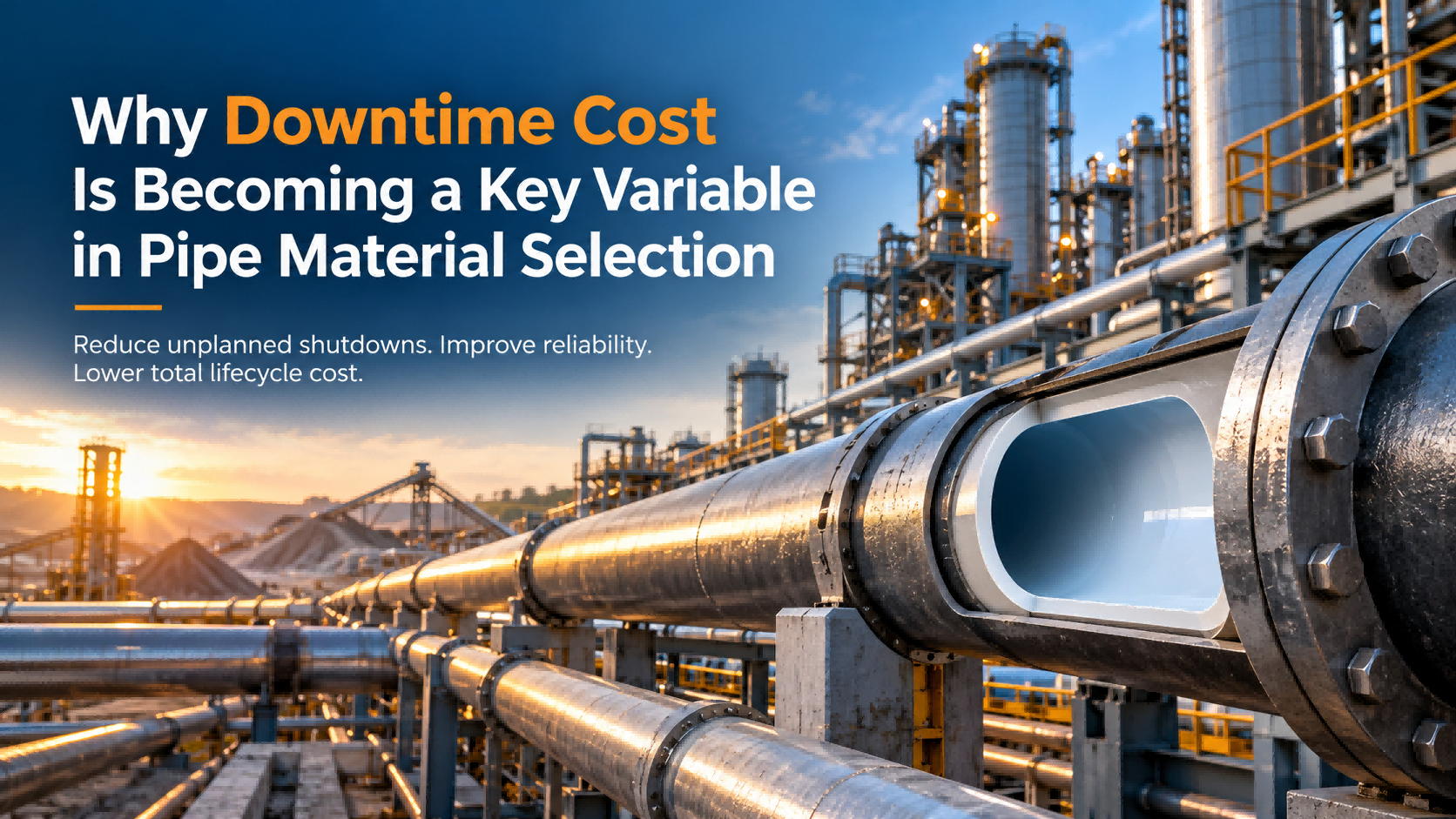
Why Is Downtime Cost Becoming a Critical Factor in Pipe Material Selection?