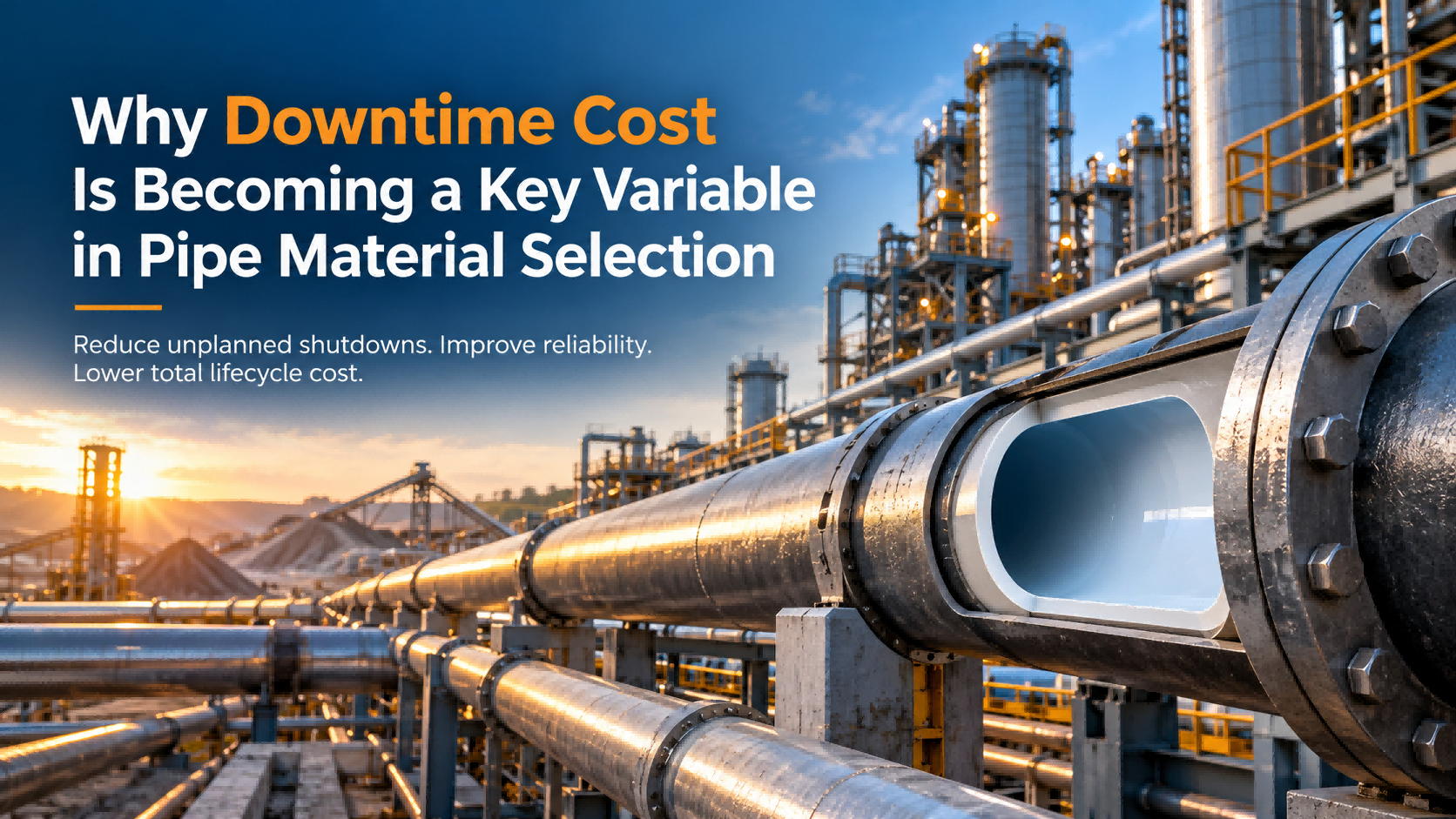
New Pipe Material Approval: 8 Engineering Requirements

What Validations Do Engineering Design Firms Require Before Approving New Pipe Materials?
How do engineering design firms evaluate innovative industrial piping materials? Explore the essential requirements for material qualification, standards compliance, corrosion resistance, pressure testing, field performance, and lifecycle cost analysis—and discover how steel-nylon composite pipes can meet the evolving demands of industrial projects.
Introduction: Why Is It Difficult for Innovative Pipe Materials to Gain Engineering Approval?
Across the global chemical, oil and gas, mining, power generation, and infrastructure sectors, the selection of industrial piping materials is undergoing significant changes.
Traditional materials such as carbon steel, stainless steel, and fiberglass-reinforced plastic (FRP) have established engineering applications. However, they may still face limitations in highly corrosive, abrasive, or maintenance-intensive environments.
As industrial projects increasingly prioritize operational reliability, extended service life, and total cost of ownership (TCO), innovative piping solutions such as steel-nylon composite pipes are attracting greater attention.
However, one important question remains:
Why do engineering design firms sometimes hesitate to approve a new piping material, even when it offers promising corrosion resistance, wear resistance, and mechanical properties?
The answer lies in the responsibilities of engineering design organizations.
Their role extends beyond selecting materials with attractive performance characteristics. They must also ensure that piping systems meet applicable design codes, safety requirements, reliability expectations, and long-term operational objectives.
For innovative piping materials without extensive standardized design data or established project references, engineers often require additional technical evidence before approving their use.
This article examines eight essential verification requirements commonly considered by engineering design firms and explores how steel-nylon composite pipes can demonstrate their engineering value through systematic qualification.
1. Why Are Engineering Design Firms Cautious About New Piping Materials?
Engineering design firms are responsible for evaluating the technical integrity, safety, and long-term performance of piping systems.
For conventional materials such as carbon steel and stainless steel, internationally recognized design methods, mechanical property databases, manufacturing specifications, and operating histories are relatively well established.
However, introducing a new composite piping material may raise several important questions:
-
Are recognized design codes available for the proposed pipe construction?
-
Can the piping system withstand the specified design pressure and temperature over its intended service life?
-
Has its corrosion resistance been verified under actual operating conditions?
-
Are there potential risks of liner failure, separation, or structural instability?
-
Are flanges, fittings, and other connections sufficiently reliable?
-
Can the manufacturer consistently maintain product quality across production batches?
-
Are there verifiable references from comparable industrial projects?
-
Can the material deliver measurable maintenance or economic benefits?
Consequently, engineering approval is not based solely on maximum pressure ratings, temperature resistance, or projected service life.
Instead, design engineers require a comprehensive technical evidence package demonstrating that the proposed piping system can perform safely and reliably throughout its intended operating conditions.
For steel-nylon composite pipe manufacturers, the key challenge is translating product advantages into measurable, verifiable, and engineering-relevant data.
2. First Verification: Material Standards and Design Code Compliance
Standards Compliance and Design Qualification
Compliance with applicable engineering standards is often the first major requirement for approving an innovative piping material.
In international industrial projects, several standards may be relevant to the technical evaluation process.
| Standard | Main Scope | Relevance to Engineering Qualification |
|---|---|---|
| ASME B31.3 | Process piping design and safety requirements | Identifies applicable design, fabrication, examination, and testing requirements |
| ASTM F1545 | Plastic-lined ferrous metal pipe, fittings, and flanges | Provides a potential reference for qualifying piping products within its specified scope |
| ASTM D543 | Resistance of plastics to chemical reagents | Supports chemical compatibility evaluation of nylon materials |
| ASME B16.5 | Pipe flanges and flanged fittings | Provides requirements for applicable flange dimensions and pressure-temperature ratings |
| ISO 9001 | Quality management systems | Supports evaluation of manufacturing quality management processes |
An important distinction must be made:
Compliance with a material testing standard does not automatically mean that an entire steel-nylon composite piping system is certified under that standard.
For example, ASTM F1545 applies to specific categories of plastic-lined ferrous metal piping products. Its applicability to a particular steel-nylon composite pipe must be confirmed based on the product's actual construction and material requirements.
Similarly, ASME B31.3 is a process piping design code, not a standalone product certification for every type of composite pipe.
When an innovative piping product is not directly covered by an established material or product specification, engineering design firms may require supplementary engineering assessments, additional testing, and project-specific approval.
What Should Manufacturers Provide?
Instead of broadly claiming compliance with international standards, manufacturers should prepare a clear standards applicability matrix identifying:
-
Standards applicable to the steel pipe structure and flanges.
-
Standards relevant to nylon material testing.
-
Tests required for the complete composite piping assembly.
-
Additional qualifications necessary for non-standard applications.
A transparent approach to technical compliance can help strengthen confidence among international EPC engineering teams.
3. Second Verification: Mechanical Strength and Pressure Resistance
Mechanical Strength and Pressure Resistance
Industrial piping systems must do more than transport fluids. They must withstand various mechanical loads throughout installation and operation.
Engineering design firms typically assess the ability of a piping system to resist:
-
Internal design pressure and transient pressure.
-
External loads, pipe weight, and support reactions.
-
Thermal stress caused by temperature fluctuations.
-
Bending and installation loads.
-
Pressure surges associated with pump startup and shutdown.
-
Vibration, impact, and fatigue under applicable operating conditions.
3.1 Engineering Advantages of Steel-Nylon Composite Construction
One of the distinguishing characteristics of steel-nylon composite pipes is their combination of two materials with different engineering functions.
The steel structure primarily provides mechanical load-bearing capacity.
Steel offers established mechanical properties and design methodologies, allowing the pipe structure to be designed for internal pressure and external loads.
Actual pressure-bearing capacity depends on steel grade, wall thickness, manufacturing quality, and design conditions.
The nylon inner layer primarily provides a functional interface with the transported medium.
When compatibility has been verified, the nylon lining can help reduce direct exposure of the steel substrate to corrosive fluids while contributing to wear resistance.
This composite structure combines mechanical strength with medium-contact performance, offering an alternative approach to industrial piping design.
However, the strengths of steel and nylon cannot simply be added together.
Engineers must clearly establish the load-bearing contribution of each material, the behavior of the interface, and potential failure mechanisms.
3.2 What Mechanical Tests Are Typically Required?
Common qualification tests may include:
| Verification Test | Main Engineering Objective |
|---|---|
| Hydrostatic pressure test | Verify integrity under specified test pressure |
| Burst pressure test | Determine ultimate pressure behavior and failure modes |
| Axial and bending tests | Evaluate resistance to installation and operational loads |
| Pressure cycling test | Assess performance under repeated pressure fluctuations |
| Thermal cycling test | Evaluate differential thermal expansion and associated stresses |
| Vacuum or external pressure test | Investigate liner instability, separation, and structural deformation |
| Joint strength test | Verify flange and fitting integrity |
For manufacturers offering products in pressure classes such as 1.0–4.0 MPa, engineering firms generally need to review the applicable pressure-temperature ratings and supporting qualification records for each relevant pipe configuration.
Engineering Value
The value of steel-nylon composite piping is not simply achieving a higher nominal pressure rating.
Its potential advantage lies in combining a properly engineered steel pressure-bearing structure with a functional nylon lining, balancing mechanical reliability with resistance to selected corrosive environments.
4. Third Verification: Corrosion Resistance and Chemical Compatibility
Chemical Compatibility and Corrosion Resistance
For chemical processing, salt chemical production, oilfield gathering, and industrial wastewater applications, compatibility with the transported medium is a critical factor in piping material selection.
Conventional carbon steel pipes may experience electrochemical corrosion.
Stainless steel can also be susceptible to localized corrosion under certain chloride concentrations, temperatures, and stress conditions.
Therefore, steel-nylon composite pipes with a suitable corrosion-resistant inner layer may offer an alternative in selected operating environments.
4.1 Engineers Evaluate More Than the Chemical Name
Even when two projects transport the same chemical substance, differences in operating conditions can produce significantly different material behavior.
For example, the corrosion and compatibility characteristics of sodium chloride solutions can vary depending on concentration, temperature, and other dissolved components.
Engineering teams commonly evaluate:
-
Detailed chemical composition.
-
Concentration and pH.
-
Normal and maximum operating temperatures.
-
Presence of dissolved oxygen or oxidizing agents.
-
Solid particle content.
-
Continuous-flow or stagnant-flow conditions.
-
Cleaning chemicals, disinfectants, and abnormal operating conditions.
Nylon 6 (PA6) is one of the principal nylon materials used in steel-nylon composite piping applications.
PA6 offers useful performance characteristics in many suitable industrial environments. However, it does not provide universal resistance to all chemicals.
In particular, exposure to certain strong acids, powerful oxidizing agents, and hot aqueous environments may introduce risks of chemical degradation, hydrolysis, moisture absorption, or changes in mechanical properties.
Consequently, the suitability of nylon piping materials should never be determined from the polymer name alone.
4.2 What Corrosion Tests Should Be Conducted?
Depending on the project conditions, chemical resistance evaluations may reference ASTM D543 and other applicable methods.
Typical assessments include:
-
Chemical immersion testing.
-
Changes in material mass and dimensions.
-
Retention of tensile strength and other mechanical properties.
-
Long-term compatibility under actual fluid and temperature conditions.
-
Inspection of liner integrity and pipe-end sealing structures.
When the transported medium has a complex chemical composition, testing with actual process fluids can provide particularly useful information.
Product Advantage
Compared with piping solutions in which the metal surface is directly exposed to the process fluid, a steel-nylon composite pipe with a continuous and reliable nylon lining can reduce direct contact between the steel substrate and the transported medium.
This may help lower the risk of internal corrosion under compatible operating conditions.
However, the overall corrosion performance still depends on liner integrity, chemical compatibility, and the design of pipe-end and joint protection.
5. Fourth Verification: Abrasion Resistance and Long-Term Service Life
Abrasion Resistance and Long-Term Reliability
In mining, soda ash production, brine handling, salt-mud transportation, and industrial slurry systems, pipes may experience simultaneous corrosion and abrasive wear.
Common wear mechanisms include:
-
Erosion from suspended solid particles.
-
High-velocity fluid impingement.
-
Localized particle impact at elbows.
-
Repeated abrasion caused by deposited solids.
-
Combined corrosion and erosion mechanisms.
Under these conditions, comparing material hardness or a single abrasion-test result is not sufficient.
5.1 Why Consider Nylon for Abrasive Applications?
Nylon materials possess useful toughness and can demonstrate competitive wear performance under suitable particle, velocity, and contact conditions.
Compared with systems relying exclusively on steel surfaces, a nylon inner layer provides different friction and particle-contact characteristics.
When properly qualified for the intended service, steel-nylon composite pipes may offer several benefits:
-
Reduced internal wear in selected particle-handling applications.
-
Fewer replacements associated with corrosion and abrasion.
-
Improved ability to maintain consistent internal flow conditions.
-
Alternative material solutions for straight pipe sections, elbows, and specialized conveying systems.
5.2 How Can Service-Life Advantages Be Demonstrated?
Engineering design firms generally place greater confidence in repeatable test results than in unsupported service-life claims.
Manufacturers should consider providing:
-
Comparative abrasion losses under identical test conditions.
-
Test data covering different solid concentrations and particle velocities.
-
Wear distribution assessments for elbows and straight pipe sections.
-
Liner thickness measurements after extended operation.
-
Maintenance and replacement records from operating projects.
It is also important to recognize that nylon linings may experience creep, dimensional changes, or property degradation under sustained pressure, temperature, and chemical exposure.
For long-term pressure performance, the technical principles of methods such as ISO 9080 may be informative where applicable.
However, long-term strength extrapolation methods developed for thermoplastic piping cannot automatically establish the service life of an entire steel-nylon composite piping system.
The strongest evidence of long-term reliability is performance demonstrated under clearly defined operating conditions and failure criteria—not an unsupported claim of a 20-, 30-, or 50-year service life.
6. Fifth Verification: Flange Connections, Fittings, and Complete System Integrity
Joint Integrity and Complete Piping System Validation
Engineering design firms do not evaluate straight pipes in isolation.
In industrial applications, flanges, elbows, tees, reducers, and other connection components can play a critical role in overall system reliability.
Steel-nylon composite pipes can be designed with flanged connections to interface with pumps, valves, pressure vessels, and existing piping systems.
6.1 Engineering Benefits of Flanged Connections
In suitable industrial applications, flanged connections can provide several practical advantages:
-
Compatibility with existing metallic piping and equipment interfaces.
-
Convenient sectional installation and maintenance.
-
Reduced need for certain types of on-site hot work.
-
Support for modular piping layouts.
-
Easier replacement of designated pipe sections during maintenance.
However, flanged construction does not necessarily eliminate welding from an entire project.
Fabrication of steel components, flange assemblies, structural supports, and other equipment connections may still require welding operations.
6.2 What Joint-Related Risks Must Be Verified?
Engineering teams should pay particular attention to the following areas.
Sealing performance
Can the flange faces, gaskets, and bolt preload maintain effective sealing under changing pressure and temperature conditions?
Liner continuity
Does the nylon lining remain continuous around the pipe ends and flange sealing areas, preventing process fluids from reaching unprotected steel surfaces?
Differential thermal expansion
Steel and nylon have different thermal expansion characteristics.
Engineers should evaluate whether repeated temperature changes could introduce interface stress, liner movement, or sealing problems.
Long-term dimensional stability
Moisture absorption and creep behavior of PA6 may affect dimensional stability and mechanical loading near connection areas.
Installation consistency
Installation procedures should specify bolt-tightening sequences, appropriate torque values, gasket selection, and dimensional tolerances.
For projects using ASME B16.5 flanges, the applicable size range and pressure class must also be confirmed.
Large-diameter flange designs outside the scope of the selected standard require another suitable standard or an approved project-specific engineering solution.
Core principle: The reliability of a piping system must be verified under complete assembled conditions. Passing straight-pipe tests alone does not prove the integrity of the entire system.
7. Sixth Verification: Manufacturing Quality Control and Batch Consistency
Manufacturing Quality and Traceability
For major international EPC projects, satisfactory product performance is only one part of the technical approval process.
Engineering firms and project owners must also determine whether the manufacturer can consistently produce pipes that meet the same technical requirements.
For steel-nylon composite pipes, the steel structure, nylon material, and manufacturing processes all influence final product quality.
Recommended Manufacturing Quality Control System
Raw material control
Verify steel specifications, Nylon 6 raw material properties, material batch identification, and related inspection records.
Production process control
Document the manufacturing process for the nylon lining, critical process parameters, dimensional controls, and the quality of the steel-nylon interface.
Final product inspection
Conduct dimensional checks, visual inspections, pressure tests, and sealing tests as required by applicable product specifications and contracts.
Product traceability
Establish traceability between raw material batches, finished product identification, test reports, and shipment records.
Project quality documentation
Provide inspection and test plans (ITPs), manufacturing quality records, certificates of conformity, and third-party inspection reports when required by the contract.
For high-specification international projects, the owner or EPC contractor may also require third-party inspections, factory acceptance testing (FAT), or independent laboratory testing.
It should also be emphasized that ISO 9001 certification demonstrates conformity of a quality management system to specified requirements.
It does not replace product qualification testing for a particular steel-nylon composite pipe design.
For composite pipe manufacturers, consistent quality across production batches is an essential foundation for long-term engineering acceptance.
8. Seventh Verification: Engineering References and Field Performance Data
Project References and Field Performance
Even when an innovative piping material demonstrates satisfactory laboratory results, engineering firms may remain cautious about adopting it for large-scale projects without field performance records.
Laboratory tests verify performance under controlled conditions.
Actual industrial environments introduce additional variables, including pressure fluctuations, temperature changes, installation deviations, and variations in process-fluid composition.
For this reason, real engineering references are valuable in establishing technical credibility.
8.1 Which Types of Project References Are Most Valuable?
For steel-nylon composite pipes, relevant application areas may include:
-
Mother liquor, brine, and salt-mud transportation in soda ash production.
-
Chlor-alkali and salt chemical processing.
-
Suitable liquid transportation applications in oil and gas production.
-
Mining slurry and industrial wastewater pipelines.
-
Power plant and industrial circulating water systems.
-
Piping applications involving compatible corrosive fluids in coastal environments.
However, suitability cannot be determined by industry category alone.
Even within the same industry, operating conditions and fluid compositions can vary significantly between projects.
8.2 What Should a Project Reference Report Include?
An engineering reference package should ideally contain the following information:
| Project Information | Engineering Value |
|---|---|
| Project name and installation location | Establishes project background |
| Pipe diameter and pressure class | Supports comparison with proposed design conditions |
| Transported fluid and concentration | Demonstrates relevant chemical compatibility |
| Operating temperature and flow velocity | Defines actual operating loads |
| Commissioning date and operating duration | Provides a time-based reliability reference |
| Maintenance and failure records | Helps evaluate maintenance requirements |
| Periodic inspection results | Identifies long-term performance changes |
| Customer feedback and authorized records | Strengthens reference credibility |
Manufacturers with operating experience in soda ash production and other industrial sectors can build strong technical reference portfolios by organizing historical project documentation, inspection reports, and customer feedback.
For new markets or applications without comparable operating records, a pilot installation may be a useful intermediate step.
Performance monitoring in a limited test section can help generate field data before the product is considered for wider application.
9. Eighth Verification: Total Cost of Ownership and Economic Feasibility
Total Cost of Ownership and Economic Assessment
When recommending an innovative piping material, engineering design firms may also need to justify its economic value to project owners.
Traditional procurement approaches often place significant emphasis on initial purchase price.
However, for chemical plants, mines, and oilfields operating continuously over many years, the actual cost of a piping system extends well beyond material procurement.
9.1 How Should Total Cost of Ownership Be Calculated?
A simplified lifecycle cost model can be expressed as:
TCO = Initial Procurement Cost + Installation Cost + Maintenance Cost + Replacement Cost + Downtime Losses + Related Operating Expenses − Residual Value
Frequently underestimated cost components include:
-
Repairs resulting from pipe corrosion.
-
Maintenance of fittings and connections.
-
Labor and equipment required for pipe replacement.
-
Production losses caused by unplanned shutdowns.
-
Changes in pumping energy consumption associated with internal pipe conditions.
9.2 Potential Economic Benefits of Steel-Nylon Composite Pipes
In applications where corrosion and abrasion are major causes of pipe failure, properly qualified steel-nylon composite pipes may reduce maintenance requirements by limiting internal corrosion exposure and abrasive damage.
If their verified service life, maintenance intervals, and operating efficiency compare favorably with an existing material, they may offer competitive lifecycle economics—even when the initial purchase cost is not the lowest.
However, these conclusions must be supported by actual project data, appropriate comparison baselines, and transparent cost assumptions.
For example, a lifecycle assessment of the same industrial pipeline could compare the following factors:
| Evaluation Criteria | Conventional Carbon Steel Pipe | Steel-Nylon Composite Pipe |
|---|---|---|
| Initial procurement cost | Based on project quotation | Based on project quotation |
| Internal corrosion risk | Depends on process fluid and protective measures | Depends on liner compatibility and integrity |
| Abrasion performance | Depends on steel grade, fluid, and velocity | Depends on nylon material, fluid, and velocity |
| Maintenance frequency | Based on operating records | Based on test results or field records |
| Replacement interval | Based on historical data or service-life models | Based on qualification results and verifiable field data |
| Total lifecycle cost | Calculated using a defined cost model | Calculated using the same assumptions and boundaries |
A credible economic assessment should not assume that steel-nylon composite pipes will always outperform conventional materials.
Instead, the objective is to identify the specific operating conditions under which the composite solution provides measurable value.
For industrial project owners, the most important question is not which pipe has the lowest purchase price, but which solution offers lower long-term operating risks and overall costs while meeting all applicable safety requirements.
10. How Do Steel-Nylon Composite Pipes Address the Core Requirements of Engineering Design Firms?
The eight verification areas discussed above can be summarized in a practical technical evaluation matrix.
| Engineering Requirement | Steel-Nylon Composite Pipe Characteristics | Required Verification Evidence |
|---|---|---|
| Structural safety | Steel load-bearing structure | Strength calculations and pressure tests |
| Chemical compatibility | Nylon lining separating the steel from the fluid | Chemical compatibility tests |
| Abrasion resistance | Potential wear advantages of the nylon inner surface | Abrasion tests and field inspection records |
| Long-term reliability | Functional division between composite materials | Pressure and thermal cycling tests |
| Installation flexibility | Availability of flanged connections | Connection drawings and sealing tests |
| Manufacturing consistency | Controlled factory production | ITPs, batch records, and inspection reports |
| Engineering maturity | Potential for references across industrial sectors | Verifiable project case studies |
| Economic feasibility | Potential to reduce corrosion-related and abrasion-related maintenance | TCO analysis and operating data |
By establishing this structured qualification process, steel-nylon composite pipes can move from being a promising material concept toward becoming a technically assessable option for formal engineering specifications.
11. How Can Manufacturers Accelerate Engineering Acceptance of New Piping Materials?
For steel-nylon composite pipe manufacturers, sending product catalogs or price quotations to engineering firms is rarely sufficient to secure inclusion in engineering specifications.
A more effective approach involves a phased technical qualification strategy.
Stage 1: Initial Technical Consultation
Provide design engineers with:
-
Product construction and operating principles.
-
Material property data.
-
Typical application conditions.
-
Applicable pressure and temperature ranges.
-
Technical limitations and engineering considerations.
The initial objective is to determine whether the product is fundamentally suitable for the proposed application.
Stage 2: Technical Documentation Submission
Submit relevant test reports, design calculations, chemical compatibility data, manufacturing quality documents, and standards applicability statements.
Critical performance data should clearly identify the test conditions, sample specifications, procedures, results, and conclusions.
Stage 3: Project-Specific Suitability Assessment
Evaluate the proposed piping system based on the project's actual process fluid, pressure, temperature, flow velocity, installation method, and design life.
Where important evidence is missing, additional testing should be planned rather than substituting unrelated performance data.
Stage 4: Pilot Installation or Demonstration Project
For applications without sufficient comparable field experience, an approved pilot installation may be appropriate.
Actual operating pressure, temperature, process-fluid conditions, and inspection records can then be monitored to establish field performance.
Stage 5: Inclusion in Project Technical Specifications
Once standards compliance, structural safety, chemical compatibility, installation arrangements, and owner approval requirements have been satisfactorily addressed, an engineering firm may consider including the product in a formal project specification or procurement document.
There is no universal approval procedure applicable to every country and industrial project.
Specific requirements depend on local regulations, project specifications, and the owner's technical approval procedures.
12. Why Should Engineering Design Firms Consider Steel-Nylon Composite Pipes?
Modern industrial piping systems often face multiple operating challenges simultaneously.
For example, a chemical production pipeline may be exposed to saline fluids, suspended solids, continuous internal pressure, and long operating cycles.
For conventional carbon steel, internal corrosion and maintenance may be important concerns.
For stainless steel, engineers may need to consider specific corrosion mechanisms and material procurement costs.
For FRP and other non-metallic materials, structural performance, connections, temperature limits, and installation conditions also require assessment.
Steel-nylon composite pipes offer a different engineering approach:
Use steel to provide the primary structural strength while employing a nylon lining to deliver corrosion-resistant and wear-resistant functionality under suitable operating conditions.
This material combination offers several potential advantages.
1. Integration of Structural Strength and Functional Performance
Combining the load-bearing function of steel with the fluid-contact properties of nylon provides additional options for demanding industrial applications.
2. Potential Suitability for Combined Corrosion and Abrasion
When chemical compatibility and operating conditions have been verified, steel-nylon composite pipes may provide an alternative to traditional piping materials in environments where both corrosion and abrasion are important.
3. Compatibility with Industrial Flanged Connections
In applicable projects, flanged interfaces can facilitate connection with existing valves, equipment, and metallic piping systems.
They can also support sectional installation and maintenance.
4. Custom Engineering Potential
Different pipe diameters, pressure classes, fittings, and connection arrangements can be evaluated according to project requirements, subject to the necessary design calculations and qualification tests.
5. Opportunities for Lifecycle Cost Optimization
When internal corrosion or abrasion represents a major source of maintenance expenditure, an appropriately selected material upgrade may reduce unplanned repairs and pipe replacement requirements.
However, external corrosion protection of the steel structure must still be considered.
The nylon lining must also be qualified for the specified chemical, thermal, and mechanical conditions.
Final application suitability should always be determined through a comprehensive engineering assessment.
13. Frequently Asked Questions (FAQ)
Q1: Do engineering design firms always require international certification for new piping materials?
Not necessarily.
The need for specific certification depends on local regulations, the transported medium, applicable standards, and project owner requirements.
Some projects may allow approval based on applicable design codes, engineering assessments, and additional qualification testing.
Other projects may explicitly require particular product certifications or third-party type testing.
Q2: Is a pressure test report sufficient to prove long-term reliability?
No.
A pressure test primarily verifies performance under specified test conditions.
It does not independently establish long-term corrosion resistance, fatigue resistance, thermal cycling performance, or service life.
Additional long-term performance data and application-specific assessments are usually necessary.
Q3: Can steel-nylon composite pipes completely replace stainless steel pipes?
Not in every application.
Steel-nylon composite pipes may provide technical and economic advantages in selected corrosive or abrasive environments.
However, replacing stainless steel requires evaluation of chemical compatibility, pressure, temperature, hygiene requirements, fire risks, and applicable engineering codes.
Q4: Do engineering firms place greater importance on laboratory testing or actual project references?
Both are important.
Laboratory testing provides repeatable technical data under controlled conditions.
Project references help demonstrate how the piping system performs under actual industrial operating conditions.
Combining both types of evidence provides a stronger foundation for engineering approval.
Q5: How can steel-nylon composite pipes be included in international EPC procurement specifications?
Manufacturers should engage with engineering teams early and provide complete technical documentation, including product specifications, design conditions, test reports, quality records, and verifiable project references.
Depending on the project, the product may then undergo technical review, owner approval, and supplier qualification before being included in an approved vendor list or procurement specification.
Conclusion: Engineering Acceptance Depends on Verifiable Technical Evidence
As industrial projects place greater emphasis on corrosion resistance, abrasion resistance, system reliability, and long-term economic performance, conventional piping materials are no longer the only options worth considering.
By combining a steel structure with a functional nylon lining, steel-nylon composite pipes offer an engineering solution worthy of further evaluation in chemical processing, mining, oilfields, industrial water treatment, and related applications.
However, material innovation alone does not guarantee engineering acceptance.
Standards compliance, mechanical performance, chemical compatibility, joint integrity, manufacturing consistency, field performance records, and lifecycle cost analysis all play important roles in determining whether a new material can be introduced into an industrial piping system.
The pipe manufacturers most likely to earn the confidence of engineering design firms and international EPC contractors are those that deliver not only competitive products, but also complete, transparent, and verifiable engineering solutions.
This approach is essential for positioning steel-nylon composite piping as more than a material product—as a long-term industrial piping solution.
Contact Us: Technical Support for Steel-Nylon Composite Piping Projects
Are you evaluating corrosion-resistant or abrasion-resistant piping solutions for a chemical plant, oilfield, mining operation, salt chemical facility, or industrial water treatment project?
We can discuss the suitability of steel-nylon composite pipes based on your specific engineering requirements.
To support a preliminary technical evaluation, please provide the following information:
-
Transported medium and chemical composition.
-
Design pressure and operating temperature.
-
Required pipe diameter and pipeline length.
-
Flow velocity and solid particle content, if applicable.
-
Installation method and flange connection requirements.
-
Required design life and applicable engineering standards.
Our objective is to support engineering design firms, EPC contractors, and industrial project owners through material selection discussions, technical documentation, customized piping solutions, and appropriate engineering qualification activities.
We are committed to helping industrial customers evaluate piping solutions that balance mechanical reliability, corrosion and abrasion performance, and long-term economic value.
Discover more about our steel-nylon composite pipes and industrial piping solutions:
Technical Standards Referenced
-
ASME B31.3: Requirements for process piping design, materials, fabrication, examination, and testing.
-
ASTM F1545: Standard specification for plastic-lined ferrous metal pipe, fittings, and flanges within its defined scope.
-
ASTM D543: Standard practices for evaluating the resistance of plastics to chemical reagents.
-
ASME B16.5: Requirements for pipe flanges and flanged fittings.
-
ISO 9080: Statistical extrapolation methods for determining the long-term hydrostatic strength of thermoplastic piping materials.
Top 10 Future Trends in Industrial Pipe Procurement
Why Industrial Projects Prioritize Supply Chain Stability