
Why Is Downtime Cost Becoming a Critical Factor in Pipe Material Selection?
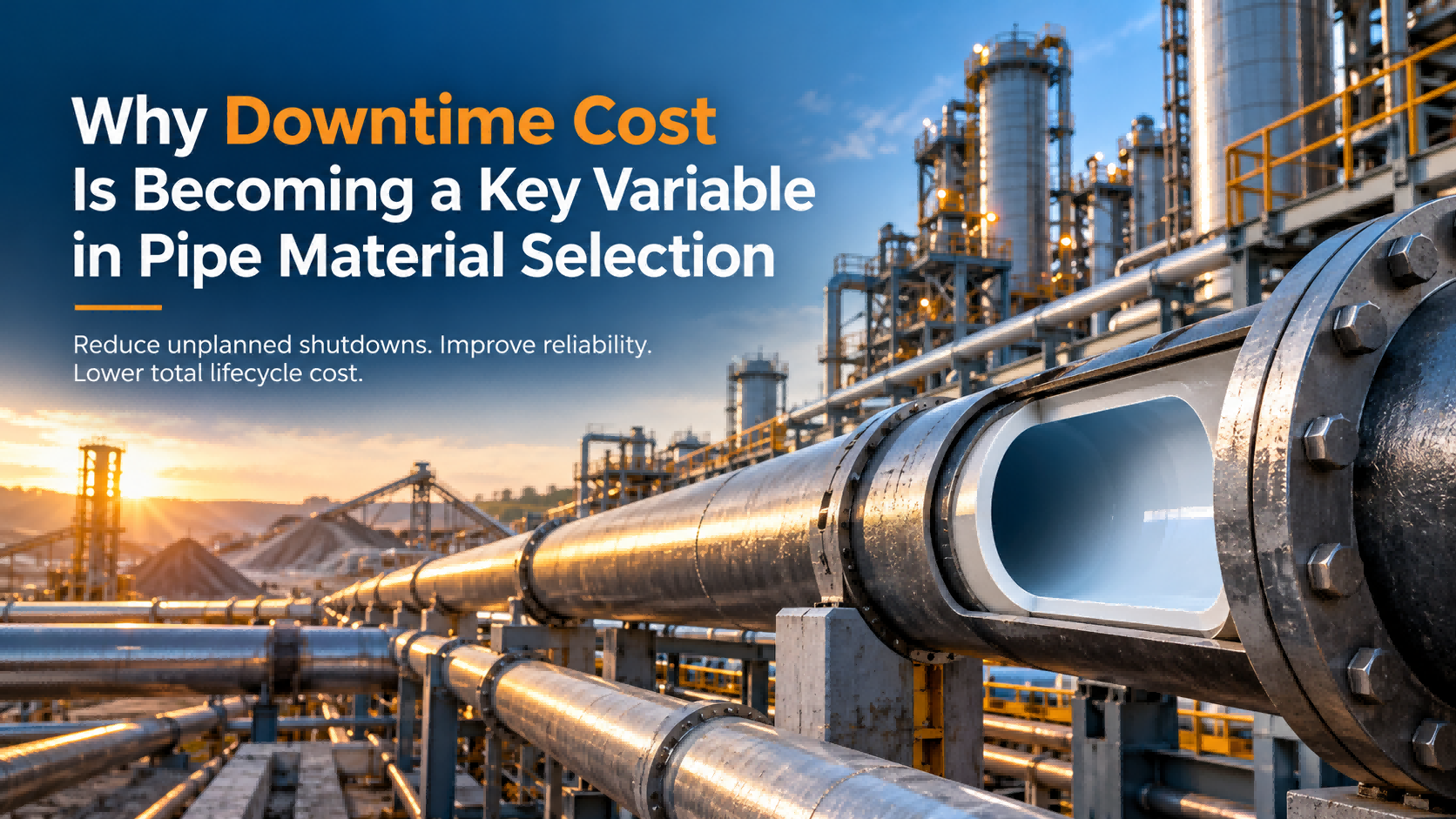
Why Is Downtime Cost Becoming a Critical Factor in Pipe Material Selection?
Introduction: Why Can an Inexpensive Pipe Become One of the Most Expensive Components in an Industrial Plant?
For decades, purchase price has been one of the most influential factors in industrial pipeline procurement.
When two piping materials meet the basic technical requirements of a project, procurement departments often prefer the option with the lower initial price.
However, this traditional purchasing approach is increasingly being challenged.
Across industries such as mining, chemical processing, oil and gas, power generation, seawater desalination, and industrial water transportation, engineers and project owners are paying greater attention to a cost that has historically been underestimated:
Downtime Cost — the financial consequences of interrupted operations.
For industrial facilities that depend on continuous production, the true value of a pipeline goes far beyond its ability to transport fluids.
A reliable pipeline helps maintain the continuity of the entire production system.
A single corrosion-related leak, pipe rupture, connection failure, or unexpected cleaning operation can interrupt production.
The direct cost of repairing a damaged pipe may be only a few thousand dollars. However, the associated production losses, emergency maintenance expenses, equipment restart costs, and contractual risks can be substantially higher than the original purchase price of the pipe.
This raises a fundamental question for industrial decision-makers.
Instead of asking:
"Which pipe has the lowest purchase price?"
Companies are increasingly asking:
"Which piping system can deliver reliable long-term operation at the lowest acceptable lifecycle cost and risk?"
This shift in purchasing priorities creates new opportunities for advanced piping materials, including steel-nylon composite pipes, which combine the structural strength of steel with the functional advantages of engineered nylon.
1. Why Is Downtime Cost Changing Industrial Pipeline Procurement?
1.1 Modern Industrial Facilities Depend on Continuous Operation
In traditional batch-processing facilities, certain pipeline maintenance activities can be scheduled between production cycles.
However, modern continuous-process industries operate under very different conditions.
Consider the following applications:
-
Mining operations: Slurry and tailings pipelines must transport abrasive materials continuously.
-
Chemical plants: Piping systems maintain the flow of raw materials, intermediates, and process fluids.
-
Oil and gas facilities: Gathering pipelines transport produced water, multiphase fluids, and other production streams.
-
Power plants: Cooling-water and process pipelines support critical equipment.
-
Desalination facilities: Pipelines continuously supply seawater, treated water, and other process streams.
In these environments, a pipeline failure can affect much more than an individual pipe section.
A local failure may disrupt an entire production process, particularly when the facility has no standby pipeline, bypass system, or sufficient buffer capacity.
Consequently, pipeline reliability becomes directly connected to production availability.
1.2 The Economic Impact of Downtime Can Exceed Repair Costs
Siemens' 2024 analysis of industrial downtime highlights the significant financial consequences of unplanned equipment failures.
These consequences extend beyond direct repair expenses and may include lost production, emergency labor, replacement components, and contractual penalties.
Downtime costs differ substantially between industries and individual facilities. Therefore, general industry estimates should not automatically be applied to a particular project.
Nevertheless, the underlying economic principle is clear:
The financial consequences of equipment failure cannot be measured by repair costs alone.
For critical industrial pipelines, investing more in suitable materials may generate long-term economic benefits when that investment demonstrably reduces unexpected failures and production interruptions.
1.3 Procurement Decisions Are Moving Toward Operational Reliability
Traditional pipe procurement generally focuses on:
-
Purchase price per meter
-
Material specifications
-
Design pressure
-
Installation costs
-
Supplier delivery schedules
Modern procurement evaluations increasingly include additional factors:
-
Expected failure frequency
-
Downtime associated with each failure
-
Repair and production recovery time
-
Corrosion and abrasion risks
-
Maintenance intervals
-
Spare-part availability
-
Total lifecycle costs
As a result, pipeline procurement is evolving beyond a simple capital expenditure (CAPEX) decision.
It is becoming an important component of operating expenditure (OPEX) management, asset reliability, and industrial risk management.
2. What Does Industrial Pipeline Downtime Actually Cost?
The true cost of pipeline downtime is considerably more complex than the expense of replacing a damaged pipe section.
It can generally be divided into five major categories.
2.1 Lost Production
When a critical pipeline stops transporting fluids, the connected production system may need to reduce output or shut down completely.
A simplified economic model is:
Lost Production Contribution = Downtime Hours × Lost Contribution Margin per Hour
It is important to distinguish between lost revenue and actual economic losses.
A more accurate assessment uses the contribution margin associated with lost production while considering variable expenses that may be avoided during shutdown.
If production can later be recovered through additional shifts or available inventory, the estimated financial impact should also be adjusted.
2.2 Emergency Maintenance Expenses
Unexpected pipeline failures may require:
-
Emergency maintenance personnel and overtime
-
Replacement pipes, valves, and fittings
-
Cutting, lifting, and installation equipment
-
Leakage containment and cleanup
-
Pressure testing and system inspections
Compared with scheduled maintenance, emergency repairs often involve additional operational and logistical complications.
2.3 System Restart Costs
Repairing a pipeline does not necessarily mean that production can resume immediately.
Depending on the process, restarting operations may require:
-
Pipeline draining and flushing
-
System refilling
-
Pressure stabilization
-
Equipment commissioning
-
Process adjustments
-
Product quality verification
These additional activities can extend the total interruption period.
2.4 Contractual and Delivery Risks
For industrial companies operating under strict delivery commitments, unexpected shutdowns can result in delayed shipments.
Potential consequences include contractual penalties, emergency transportation expenses, customer dissatisfaction, and reputational damage.
2.5 Safety and Environmental Consequences
Pipeline failures involving hazardous materials may create additional risks, including chemical exposure, environmental contamination, and regulatory consequences.
These risks should be evaluated separately through appropriate safety and environmental assessments rather than relying exclusively on average repair costs.
A more comprehensive downtime cost model is:
Total Downtime Cost = Lost Production Contribution + Emergency Repair Costs + Additional Restart Costs + Contractual Losses + Other Quantifiable Consequences
Each cost category must be clearly defined to avoid double counting.
3. Why Can Conventional Pipe Materials Increase Unplanned Downtime Risks?
Pipeline failures rarely result from a single factor.
They are often caused by interactions between material properties, fluid characteristics, operating conditions, pipeline design, and maintenance practices.
3.1 Carbon Steel Pipes: Corrosion and Wall Thickness Reduction
Carbon steel pipes are widely used because of their mechanical strength, established manufacturing processes, and relatively competitive initial costs.
However, without suitable protection, carbon steel can experience internal corrosion when exposed to environments containing:
-
High concentrations of dissolved salts
-
Chloride ions
-
Corrosive gases
-
Certain acidic or chemically aggressive fluids
Over time, corrosion may reduce the effective wall thickness of the pipe.
A typical failure progression is:
Internal Corrosion → Wall Thickness Reduction → Localized Perforation → Leakage → Emergency Shutdown
Corrosion allowances, internal coatings, liners, and other protection systems can reduce these risks.
However, the associated costs and maintenance requirements must be included in lifecycle evaluations.
3.2 Stainless Steel Pipes: Corrosion Resistance Does Not Mean Universal Compatibility
Stainless steel provides excellent corrosion resistance in many industrial applications.
Nevertheless, certain stainless steel grades remain susceptible to localized corrosion under specific operating conditions.
Potential problems include:
-
Pitting corrosion
-
Crevice corrosion
-
Chloride-induced stress corrosion cracking
Selecting higher-alloy stainless steel grades can improve performance in some environments, but may also significantly increase capital costs.
Therefore, material selection should depend on the actual chemical environment rather than assuming that all stainless steels are universally corrosion-resistant.
3.3 HDPE Pipes: Pressure, Temperature, and Structural Limitations
High-density polyethylene (HDPE) pipes offer excellent resistance to many corrosive fluids and are widely used in water transportation and selected industrial applications.
However, engineers must carefully consider:
-
Long-term creep behavior
-
Temperature-dependent pressure ratings
-
Dimensional stability
-
External loading
-
Joint performance
These factors become particularly important in large-diameter pipelines, high-pressure systems, and installations involving complex mechanical loads.
3.4 FRP Pipes: Structural Integrity and Impact Resistance
Fiberglass-reinforced plastic (FRP) pipes provide valuable corrosion-resistant solutions when the resin system and structural design are compatible with the application.
However, certain installations require additional consideration of impact damage, concentrated loads, handling damage, and structural integrity under demanding service conditions.
Inspection and repair requirements should also be evaluated during material selection.
3.5 Conventional Lined Steel Pipes: Long-Term Lining Integrity
Rubber-lined and polymer-lined steel pipes can protect metallic substrates against direct contact with aggressive fluids.
Nevertheless, certain lining systems may face challenges involving:
-
Thermal cycling
-
Negative pressure
-
Fluid permeation
-
Lining deterioration
-
Localized separation from the substrate
Therefore, the reliability of a lined piping system depends not only on the corrosion resistance of the lining material but also on its mechanical integrity, interface design, and connection performance.
4. How Can Steel-Nylon Composite Pipes Help Reduce Pipeline Downtime?
Steel-nylon composite pipes combine two materials with complementary functions.
The steel structure provides mechanical strength, while the engineered nylon layer forms the fluid-contacting surface.
This composite construction provides a practical foundation for addressing corrosion, abrasion, mechanical loading, and long-term pipeline reliability.
Advantage 1: Corrosion-Resistant Nylon Protection
One of the primary advantages of steel-nylon composite pipes is the separation of the transported medium from the steel substrate.
When the nylon material is correctly selected and the protective layer remains intact, it can help prevent direct contact between corrosive fluids and the underlying steel.
This design can be valuable in applications involving:
-
High-salinity industrial water
-
Certain chemical processing fluids
-
Salt-processing solutions
-
Selected industrial wastewater streams
-
Other chemically compatible corrosive media
Some engineering nylon grades offer good resistance to salts, alkaline solutions, and specific industrial chemicals.
Compared with unprotected carbon steel, a properly engineered steel-nylon composite pipe may reduce internal corrosion-related failure risks.
However, chemical compatibility must always be verified against the actual nylon grade, chemical concentration, operating temperature, and exposure conditions.
Not all nylon materials are suitable for strong acids, aggressive solvents, or elevated-temperature service.
Advantage 2: Abrasion Resistance for Demanding Industrial Applications
In mining, slurry transportation, tailings management, and certain oilfield applications, abrasive particles can gradually damage pipeline interiors.
Continuous particle impact and sliding abrasion may accelerate material loss, particularly at:
-
Pipeline elbows
-
Directional changes
-
Reducers
-
High-velocity sections
-
Areas experiencing turbulent flow
Properly engineered nylon materials can offer useful toughness and abrasion-resistant characteristics.
For suitable applications, steel-nylon composite pipes may provide an alternative to conventional pipeline materials that experience frequent abrasive wear.
However, actual wear resistance depends on material formulation, particle characteristics, velocity, temperature, and operating conditions.
Performance should therefore be confirmed through representative abrasion testing.
For facilities where abrasive wear causes frequent pipeline replacement, reducing the frequency of unplanned repairs can create meaningful economic value.
Advantage 3: Steel Structural Strength for Pressure and Large-Diameter Applications
Although polymer pipes provide numerous benefits, certain large-diameter and mechanically demanding applications require careful consideration of deformation and structural stability.
Steel-nylon composite pipes use steel as the primary load-bearing structure.
This provides a foundation for developing industrial pressure piping systems and large-diameter transportation pipelines.
Our steel-nylon composite piping solutions can be evaluated for different diameter requirements, pressure ratings, and connection configurations according to project specifications.
Final allowable operating pressures and temperatures must be determined through engineering design, material selection, manufacturing quality control, and appropriate testing.
Advantage 4: Smooth Internal Surfaces and Hydraulic Performance
In conventional metallic pipelines, internal corrosion products, deposits, and scaling can increase flow resistance over time.
As internal surface conditions deteriorate, more pumping energy may be required to maintain the same flow rate.
Engineering nylon layers generally provide relatively smooth fluid-contacting surfaces.
Under suitable operating conditions, this characteristic may help reduce certain surface roughening and deposit-related problems.
Potential operational benefits include:
-
Reduced cleaning requirements
-
More stable flow performance
-
Improved long-term hydraulic consistency
-
Lower maintenance requirements in appropriate applications
Actual energy savings must be validated through hydraulic calculations and operating data.
A smooth internal surface alone does not guarantee a specific reduction in pumping costs.
Advantage 5: Flanged Connections and Maintenance Efficiency
In operating industrial facilities, replacing conventional welded steel pipelines can involve extensive onsite work.
Typical activities may include:
-
Pipe cutting
-
Field welding
-
Weld inspection
-
Corrosion protection repairs
-
Pressure testing
-
Hot-work permits
Some of our steel-nylon composite piping systems incorporate integral flanged connection designs.
When the connection geometry is compatible with the existing system and appropriate installation procedures are followed, flanged connections can reduce onsite welding requirements and facilitate pipe-section removal or replacement.
This can be particularly valuable for industrial facilities with limited maintenance shutdown windows.
However, flange sealing surfaces, gasket compatibility, bolt preload, and installation accuracy must be properly controlled.
5. Steel-Nylon Composite Pipes vs. Conventional Materials: A Downtime Risk Comparison
| Pipe Material | Main Advantages | Potential Risks or Limitations | Key Selection Considerations |
|---|---|---|---|
| Carbon Steel | High mechanical strength and competitive initial cost | Internal corrosion and abrasive wear | Corrosion protection and corrosion allowance |
| Stainless Steel | Good strength and corrosion resistance | Localized corrosion under certain conditions and higher material costs | Alloy selection and chemical compatibility |
| HDPE | Corrosion resistance and relatively low weight | Temperature, pressure, creep, and joint-design limitations | Long-term pressure and deformation |
| FRP | Corrosion resistance and lightweight construction | Impact damage and structural integrity considerations | Mechanical loading and installation quality |
| Rubber-Lined Steel | Steel strength combined with lining protection | Lining deterioration and possible localized separation | Lining compatibility and interface reliability |
| Steel-Nylon Composite | Steel structural strength combined with nylon corrosion and abrasion protection | Nylon compatibility, composite interface integrity, and temperature limitations | Fluid compatibility, lining integrity, and connection reliability |
This comparison does not suggest that steel-nylon composite pipes are the best solution for every industrial application.
Instead, it highlights an important engineering consideration:
When corrosion, abrasion, mechanical strength, and downtime losses are all significant factors, steel-nylon composite pipes deserve serious consideration during material selection.
6. Cost Analysis: Why Can a More Expensive Pipe Be More Economical?
To understand the financial implications of downtime, consider a hypothetical industrial pipeline replacement project.
Important: The following figures are illustrative assumptions intended to demonstrate lifecycle cost calculations. They do not represent actual project results or verified performance data for our products.
6.1 Project Background
An industrial facility plans to replace a critical process pipeline.
The engineering team is evaluating two alternatives that have already passed preliminary technical suitability assessments:
-
Option A: Conventional piping system
-
Option B: Steel-nylon composite piping system
Both alternatives are evaluated over a 10-year operating period.
Initial investments include procurement and installation costs.
| Evaluation Item | Option A: Conventional Pipe | Option B: Steel-Nylon Composite Pipe |
|---|---|---|
| Initial procurement and installation | $120,000 | $155,000 |
| Average annual pipeline-related unplanned downtime | 10 hours | 4 hours |
| Effective downtime loss per hour | $2,500 | $2,500 |
| Average annual maintenance cost, excluding downtime losses | $9,000 | $6,500 |
| Evaluation period | 10 years | 10 years |
The model assumes that Option B reduces downtime through improved pipeline reliability.
In an actual project, this assumption should be supported by operating records, comparable field applications, or reliability engineering analysis.
6.2 Annual Downtime Cost Calculation
Option A: Conventional Pipe
10 hours × $2,500/hour = $25,000 per year
Option B: Steel-Nylon Composite Pipe
4 hours × $2,500/hour = $10,000 per year
Annual downtime cost savings:
$25,000 − $10,000 = $15,000
The assumed annual maintenance savings are:
$9,000 − $6,500 = $2,500
Therefore, total annual economic savings equal:
$15,000 + $2,500 = $17,500
6.3 Ten-Year Total Cost of Ownership
For this simplified comparison, financing, inflation, energy costs, and other excluded expenses are not considered.
The calculation uses:
TCO = Initial Investment + Cumulative Maintenance Costs + Cumulative Downtime Losses
Option A: Conventional Pipe
$120,000 + 10 × ($9,000 + $25,000)
= $460,000
Option B: Steel-Nylon Composite Pipe
$155,000 + 10 × ($6,500 + $10,000)
= $320,000
Total 10-Year Cost Difference: $140,000
Although Option B requires an additional initial investment of $35,000, it produces a substantially lower total cost under the stated assumptions.
6.4 Simple Payback Period
The incremental investment is:
$155,000 − $120,000 = $35,000
The annual assumed savings are:
$17,500
Therefore:
Simple Payback Period = $35,000 ÷ $17,500
= 2 years
Using an 8% annual discount rate, the estimated 10-year incremental net present value of choosing Option B is approximately +$82,400.
These calculations demonstrate that higher initial investment can be financially justified when improvements in pipeline reliability and maintenance performance are supported by evidence.
6.5 How Does the Cost of Downtime Affect Material Selection?
The same example reveals another important factor.
If downtime costs only $500 per hour, reducing annual downtime by six hours produces:
6 × $500 = $3,000 in annual production-loss savings
However, if downtime costs $10,000 per hour, the same six-hour improvement produces:
6 × $10,000 = $60,000 in annual production-loss savings
Therefore, the higher the economic consequences of downtime, the greater the potential financial value of improved pipeline reliability.
The most competitive pipe is not necessarily the one with the lowest purchase price. It is the pipe that delivers the best balance of cost, reliability, and operational risk under actual service conditions.
7. Which Industries Should Prioritize Downtime Costs in Pipeline Selection?
7.1 Mining and Tailings Transportation
Mining slurry and tailings pipelines frequently operate under challenging conditions involving abrasive particles, high solids concentrations, and localized erosion.
In mineral processing plants, failure of a critical pipeline can affect several interconnected operations, including grinding, flotation, thickening, and tailings transportation.
For these applications, engineers should carefully assess:
-
Abrasion resistance
-
Mechanical strength
-
Pressure performance
-
Maintenance requirements
-
Pipeline replacement intervals
Steel-nylon composite pipes can be considered as a potential corrosion- and abrasion-resistant solution, subject to application-specific testing.
7.2 Chemical and Salt Processing Industries
Chemical processing pipelines may be exposed to aggressive fluids, variable temperatures, and demanding production schedules.
Some salt-processing solutions may also contain suspended or crystallized particles, creating combined corrosion and abrasion challenges.
Under these conditions, material selection should consider not only chemical resistance but also:
-
Thermal cycling
-
Lining integrity
-
Joint sealing performance
-
Cleaning procedures
-
Long-term mechanical compatibility
When the nylon layer is compatible with the transported medium, steel-nylon composite pipes may offer advantages over unprotected metallic systems affected by internal corrosion.
7.3 Oil and Gas Produced-Water Transportation
Oilfield gathering and produced-water pipelines may transport high-salinity fluids containing suspended solids and corrosive components.
Unexpected pipeline failures can result in production interruptions, increased field maintenance, and additional safety and environmental management requirements.
Steel-nylon composite construction offers a potential approach for internal protection in selected produced-water applications.
However, systems containing CO₂, H₂S, hydrocarbons, and complex multiphase fluids require detailed engineering evaluations.
Chemical compatibility, permeation resistance, pressure performance, and applicable industry requirements must be verified before implementation.
7.4 Power Plant Cooling Water and Desulfurization Systems
Power generation facilities operate piping systems that may experience high flow rates, corrosion, suspended solids, and limited maintenance windows.
Cooling-water circuits and flue gas desulfurization systems are examples where pipeline reliability can influence critical plant operations.
For these applications, steel-nylon composite pipes may be evaluated based on their internal protection, abrasion performance, and connection design.
7.5 Seawater Desalination and Industrial Water Transportation
Industrial facilities that depend on uninterrupted water supplies may experience production impacts when critical pipelines fail.
High-salinity fluids and demanding environmental conditions also increase the importance of corrosion protection.
Steel-nylon composite pipes may be evaluated for selected seawater and industrial water transportation applications.
External steel surfaces still require appropriate corrosion protection.
For potable-water applications, relevant hygienic and material compliance requirements must also be satisfied.
8. How Should EPC Contractors Evaluate Pipeline Materials When Downtime Matters?
Engineering, procurement, and construction (EPC) contractors increasingly need to evaluate piping systems from both technical and economic perspectives.
A structured procurement process can help identify the most suitable materials.
Step 1: Classify Pipeline Criticality
The first step is to determine how important each pipeline is to the overall production process.
Pipelines can be classified as:
-
Critical production pipelines
-
Standard process pipelines
-
Auxiliary pipelines with standby capacity or redundancy
Pipelines with the greatest potential operational consequences should receive greater attention during reliability assessment.
Step 2: Analyze Historical Failure Data
Where available, project teams should review three to five years of pipeline failure and maintenance records.
Important information includes:
-
Failure locations
-
Failure mechanisms
-
Fluid characteristics
-
Operating temperatures and pressures
-
Corrosion and abrasion conditions
-
Repair duration
-
Production impacts
-
Pipe replacement frequency
When reliable operating data are limited, engineers should use sensitivity analysis rather than assuming precise failure rates without supporting evidence.
Step 3: Calculate Risk-Adjusted Total Cost of Ownership
A more complete pipeline economic assessment should include both normal operating expenses and expected failure consequences.
A simplified reliability model is:
Expected Annual Failure Loss = Expected Failure Frequency × Average Economic Consequence per Failure
Low-probability, high-consequence incidents require additional assessment and should not be evaluated solely through average economic losses.
Step 4: Verify Material Performance
Before selecting steel-nylon composite pipes, the technical evaluation should include:
-
Compatibility between the actual nylon grade and transported medium
-
Design pressure and operating temperature
-
Transient pressure and temperature conditions
-
Nylon layer thickness and uniformity
-
Long-term composite interface integrity
-
Abrasion and erosion resistance
-
Flange and sealing performance
-
Vacuum conditions, thermal cycling, and water hammer
-
External corrosion protection
-
Manufacturing quality records and inspection results
For projects with significant downtime costs, a representative pilot installation can provide valuable evidence before full-scale material replacement.
Step 5: Include Supplier Engineering Support
Pipeline reliability is not determined by material properties alone.
It also depends on design quality, manufacturing consistency, installation practices, delivery reliability, and access to technical support.
A capable industrial pipe supplier should assist customers with:
-
Material selection
-
Operating-condition analysis
-
Pipe specification confirmation
-
Connection design evaluation
-
Installation planning
-
Technical documentation
These services can help EPC contractors reduce project uncertainty and improve long-term pipeline performance.
9. Why Are Steel-Nylon Composite Pipes Worth Considering for High-Reliability Industrial Projects?
As a manufacturer specializing in steel-nylon composite pipes and industrial nylon composite piping systems, we focus on developing pipeline solutions for demanding industrial transportation applications.
Our product philosophy is based on combining complementary material properties rather than relying on a single material to meet every engineering requirement.
Steel provides the primary structural strength, while the engineered nylon layer can offer corrosion protection, abrasion resistance, and toughness for compatible operating conditions.
For industrial customers seeking greater operational reliability, the potential value of steel-nylon composite pipes can be summarized in three areas.
9.1 Reducing Internal Corrosion and Abrasion Risks
By combining appropriate material selection with composite pipe design, steel-nylon composite systems can address certain failure mechanisms commonly encountered in conventional pipelines.
This approach is particularly relevant for industrial applications where internal corrosion and abrasive wear are major contributors to maintenance requirements.
9.2 Improving Long-Term Maintenance Economics
When the protective lining, pipe connections, and overall system design perform as intended, steel-nylon composite pipes may help extend maintenance intervals and reduce unexpected pipe replacement.
Lower maintenance frequency can improve production planning and potentially reduce operational costs.
9.3 Supporting Lifecycle-Based Procurement Decisions
Instead of evaluating pipeline materials solely by initial purchase price, we encourage project owners and EPC contractors to consider:
-
Initial investment
-
Material compatibility
-
Expected operating performance
-
Maintenance requirements
-
Potential downtime losses
-
Service-life expectations
-
Overall lifecycle costs
This approach helps industrial buyers make material selections based on long-term engineering and economic value.
Our objective is not to suggest that steel-nylon composite pipes are suitable for every industrial environment.
Rather, we aim to provide application-specific piping solutions for projects facing corrosion, abrasion, mechanical loading, and operational reliability challenges.
10. Frequently Asked Questions (FAQ)
Q1: Why is downtime cost important when selecting industrial piping materials?
Downtime costs can include lost production, emergency repairs, system restart expenses, and contractual consequences.
In critical industrial pipelines, these indirect losses may exceed the original cost of replacing damaged pipe sections.
Therefore, downtime risk should be considered alongside material price and technical performance.
Q2: Can steel-nylon composite pipes completely eliminate pipeline downtime?
No.
Every piping system has potential failure risks associated with operating conditions, material compatibility, design, manufacturing, installation, and maintenance.
Steel-nylon composite pipes are intended to address specific corrosion and abrasion challenges through the combination of steel structural strength and engineered nylon protection.
Actual reliability depends on correct engineering and application-specific validation.
Q3: Are steel-nylon composite pipes always more economical than carbon steel or stainless steel?
Not necessarily.
Economic performance depends on purchase costs, installation costs, chemical compatibility, operating conditions, maintenance frequency, expected downtime losses, and the evaluation period.
For applications involving significant corrosion, abrasion, and high downtime costs, steel-nylon composite pipes may offer attractive lifecycle economics when their performance advantages are demonstrated.
Q4: How can industrial operators determine whether pipeline replacement is financially justified?
Start by evaluating historical pipeline failures, annual repair frequency, downtime duration, and total maintenance costs.
Next, compare the required replacement investment with the expected reduction in operating expenses and downtime losses.
If internal corrosion or abrasive wear is a major cause of existing pipeline failures, steel-nylon composite pipes may be a suitable option for further evaluation.
Q5: What technical information is required before purchasing steel-nylon composite pipes?
Customers should provide the following information whenever possible:
-
Transported medium and chemical composition
-
Fluid concentration
-
Operating temperature
-
Working and design pressures
-
Flow velocity
-
Solids concentration and particle characteristics
-
Required pipe diameter
-
Installation environment
-
Expected operating period
-
Applicable engineering standards
These parameters help determine whether steel-nylon composite piping is technically appropriate for the project.
Conclusion: The Future of Industrial Pipeline Procurement Is About Reliability, Not Just Purchase Price
Downtime cost is becoming an increasingly important variable in industrial pipe material selection.
For facilities that depend on continuous production, the initial purchase price represents only one component of the total economic cost of a piping system.
Corrosion, abrasion, leakage, emergency repairs, and production interruptions can create significant long-term financial consequences.
As a result, industrial pipeline procurement should move beyond the traditional question:
"How can we purchase pipes at the lowest possible price?"
A more valuable question is:
"How can we select piping materials and engineering solutions that reduce long-term failure risks while maintaining reliable production?"
Steel-nylon composite pipes combine the mechanical strength of steel with the protective characteristics of engineered nylon, offering a promising solution for selected applications in mining, chemical processing, oil and gas, power generation, and industrial water transportation.
For projects where long-term reliability, maintenance economics, and downtime risk are major concerns, steel-nylon composite piping should be evaluated based on its overall lifecycle value rather than purchase price per meter alone.
The ultimate objective is not simply to install a pipeline.
It is to maintain reliable industrial fluid transportation while reducing avoidable operational risks and long-term costs.
Looking for a More Reliable Industrial Piping Solution?
Is your industrial project experiencing pipeline corrosion, abrasive wear, frequent maintenance, or costly production interruptions?
As a manufacturer of steel-nylon composite pipes, we provide industrial piping solutions designed to address demanding transportation requirements.
Our team can assist with preliminary material selection, project specification evaluation, and customized piping solutions based on actual operating conditions.
Share your pipe diameter, transported medium, working pressure, temperature, and current pipeline challenges with us to discuss the suitability of steel-nylon composite piping for your project.
Visit our website: //www.nylonpipeline.com/
Steel-Nylon Composite Pipes — Engineered for Reliability, Designed for Lower Lifecycle Costs.
Carbon Steel vs Stainless Steel vs FRP vs Composite Pipes
Industrial Pipe Procurement: Lowest Price vs. Lowest TCO


