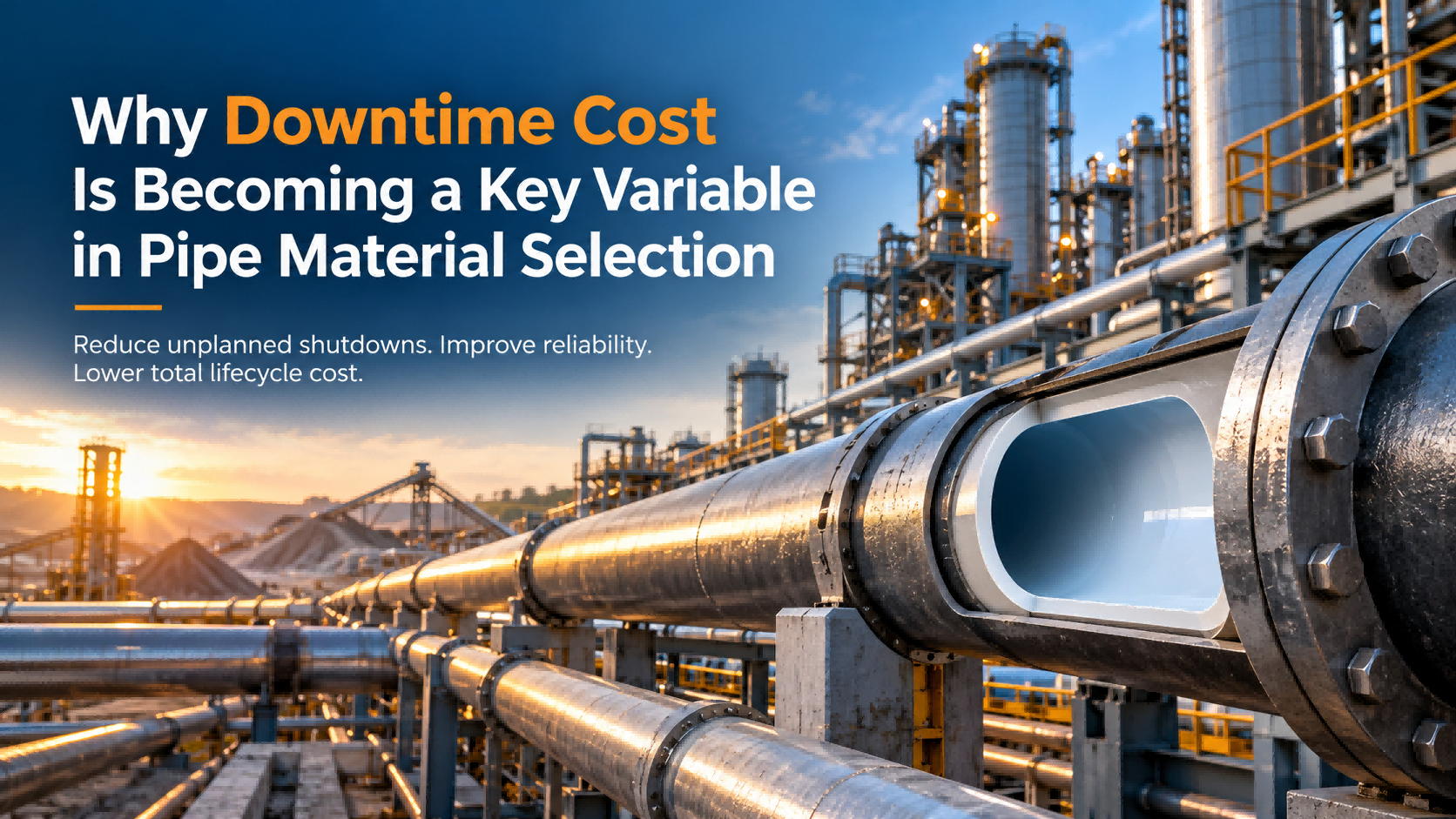
Top 10 Future Trends in Industrial Pipe Procurement

Top 10 Future Trends in Industrial Pipe Procurement: From Lowest Price to Long-Term Value
Introduction: Industrial Pipe Procurement Is Undergoing a Fundamental Transformation
In the past, industrial pipe procurement decisions were largely driven by three key factors: material price, pressure rating, and delivery time.
For many industrial projects, a piping product could become the preferred choice as long as it met basic technical specifications, offered a competitive quotation, and could be delivered on schedule.
However, this traditional procurement approach is increasingly being challenged.
As industrial infrastructure continues to evolve, maintenance costs rise, supply chains become more complex, and companies place greater emphasis on operational efficiency, industrial pipe procurement is entering a new era.
Today, industrial plant owners, EPC contractors, engineering consultants, and procurement professionals are asking a more important question:
Does purchasing the lowest-priced piping system really deliver the greatest long-term value?
This question is particularly relevant in industries such as chemical processing, oil and gas, mining, power generation, seawater transportation, and municipal infrastructure.
In these sectors, pipelines are no longer viewed simply as replaceable engineering materials. Instead, they are critical assets that directly influence production continuity, operational safety, maintenance expenses, and overall project profitability.
According to a global corrosion cost study published in 2016 and referenced by the Association for Materials Protection and Performance (AMPP), the estimated worldwide economic cost of corrosion was approximately USD 2.5 trillion, equivalent to 3.4% of global GDP based on 2013 economic data.
Although these figures represent a historical estimate rather than current economic conditions, they demonstrate the substantial financial impact of corrosion-related failures, maintenance, replacement, and production interruptions.
Against this background, advanced piping materials such as steel-nylon composite pipes are attracting attention as alternative solutions for demanding industrial applications.
By combining the structural strength of steel with the protective properties of a nylon inner lining, steel-nylon composite pipes offer an engineering approach designed to address corrosion, abrasion, and mechanical loading within industrial piping systems.
Looking ahead, the competitive advantage of industrial piping materials will increasingly depend on their ability to deliver reliable long-term performance rather than simply offering the lowest initial purchase price.
This article explores the ten major trends expected to influence industrial pipe procurement decisions and explains how steel-nylon composite piping solutions can address emerging requirements.
Trend 1: From Lowest Purchase Price to Lowest Total Cost of Ownership (TCO)
Purchase Price Is No Longer the Same as Project Cost
Traditional procurement strategies often emphasize the initial cost per meter of pipe.
For example, procurement teams may compare quotations for carbon steel pipes, stainless steel pipes, fiberglass-reinforced plastic (FRP) pipes, and composite pipes before selecting the lowest-priced option.
However, this approach can overlook significant expenses that arise after installation.
These include:
-
Installation and construction costs
-
Corrosion protection and maintenance expenses
-
Repair costs caused by internal abrasion
-
Pipeline leakage and replacement expenses
-
Production shutdown losses
-
Pumping energy consumption
-
End-of-life removal and disposal costs
Future procurement strategies are expected to place greater emphasis on Total Cost of Ownership (TCO).
A simplified calculation is:
TCO = Initial Purchase Cost + Installation Cost + Operating Energy Cost + Maintenance Cost + Replacement Cost + Downtime Losses + Disposal Cost
For long-term industrial projects, future costs should also be discounted to present value to reflect the time value of money.
How Steel-Nylon Composite Pipes Can Reduce Lifecycle Costs
The potential economic value of steel-nylon composite pipes extends beyond their initial purchase price.
When properly designed and validated for the intended operating conditions, these pipes can provide several important advantages.
1. Reduced Internal Corrosion Risk
The nylon inner lining separates the transported medium from the steel structure, helping reduce direct contact between corrosive fluids and the load-bearing steel wall.
2. Improved Abrasion Resistance
In applications involving solid particles, salt sludge, slurry, or other abrasive media, an appropriately selected nylon lining may help reduce internal wear.
3. Lower Maintenance Requirements
By addressing corrosion and abrasion mechanisms, composite piping systems may reduce the frequency of repair and replacement activities.
4. Reduced Risk of Unplanned Shutdowns
For continuously operating industrial facilities, preventing unplanned downtime may generate greater financial benefits than reducing the initial material purchase cost.
As a result, future procurement decisions will increasingly shift from:
Which piping material is the cheapest?
To:
Which piping solution delivers the lowest total ownership cost throughout the required operating life?
Trend 2: From Individual Material Properties to Comprehensive Reliability Under Complex Operating Conditions
Industrial Pipe Failures Rarely Result from a Single Factor
Actual industrial operating environments are significantly more complex than laboratory testing conditions.
For example, a pipeline in a chemical processing facility may be exposed simultaneously to:
-
Long-term contact with corrosive media
-
Temperature fluctuations and pressure variations
-
Abrasion caused by flowing liquids or slurries
-
Mechanical vibration and external loads
-
Pressure surges during startup and shutdown
Selecting piping materials based only on tensile strength, static chemical resistance, or a single abrasion test may not provide a complete understanding of long-term performance.
Future industrial procurement will increasingly prioritize overall material reliability under combined operating conditions.
Steel and Nylon: A Complementary Composite Structure
Steel-nylon composite pipes use different materials to perform different engineering functions.
Steel provides structural strength.
The external steel structure provides rigidity and the primary load-bearing capacity required for industrial piping systems, supporting applications where pressure resistance and mechanical strength are important.
Nylon provides internal protection.
The nylon inner lining helps prevent direct contact between the transported medium and the steel wall. Under suitable operating conditions, it can also provide protection against abrasive wear.
The essential advantage of this composite design is that it does not depend on a single material to deliver every required property.
Instead, it combines complementary material characteristics to improve overall piping system performance.
However, successful application requires proper evaluation of lining thickness, interfacial integrity, temperature effects, pressure cycling, and chemical compatibility.
Future pipe procurement will focus on comprehensive engineering reliability rather than isolated material specifications.
Trend 3: From Purchasing Qualified Products to Selecting Engineering-Validated Piping Solutions
Technical Verification Will Become a Key Supplier Qualification Requirement
Traditionally, some industrial piping projects relied mainly on product catalogs, material grades, and factory inspection reports to support procurement decisions.
For demanding industrial applications, this is no longer sufficient.
Engineering teams increasingly require technical documentation that demonstrates whether a proposed piping system can perform reliably under specific operating conditions.
Manufacturers must therefore do more than confirm that their products have been successfully manufactured.
They must provide credible evidence supporting their suitability for the intended application.
Key Technical Verification Requirements
| Verification Item | What Buyers Need to Confirm |
|---|---|
| Pressure performance | Ability to withstand design pressure, pressure fluctuations, and required testing pressure |
| Chemical compatibility | Suitability of the lining for the actual medium, concentration, and temperature |
| Abrasion resistance | Performance under relevant particle concentrations, particle sizes, and flow velocities |
| Temperature resistance | Effects of temperature on lining properties and structural integrity |
| Joint reliability | Performance of flanges, gaskets, and lining termination details |
| Structural integrity | Reliability under pressure cycling, vibration, and applicable vacuum conditions |
| Quality consistency | Stable performance across different manufacturing batches |
| Project references | Verifiable operating experience in comparable applications |
For steel-nylon composite pipes, manufacturers should provide appropriate design information, inspection records, and application-specific technical documentation.
For nylon materials such as Nylon 6 (PA6), engineers must also account for moisture absorption, dimensional changes, and variations in mechanical properties at elevated temperatures.
ISO 175 provides a reference test method for evaluating the effects of immersion in liquid chemicals on plastics. However, immersion testing alone cannot replace comprehensive long-term validation of a complete piping system.
What This Means for Industrial Buyers
Future procurement practices will increasingly move beyond basic product specification compliance toward evidence-based supplier qualification.
Manufacturers capable of providing reliable testing documentation, comprehensive quality records, and verified project references will have a stronger position in technically demanding industrial markets.
Trend 4: From Procurement-Department Decisions to Collaborative EPC and Cross-Functional Procurement
Industrial Pipe Procurement Is No Longer Just the Purchasing Manager's Responsibility
Large industrial projects involve multiple stakeholders, including:
-
Engineering design institutes
-
EPC contractors
-
Project owners
-
Maintenance and operations teams
-
Quality and safety departments
-
Procurement and supply chain managers
Each stakeholder evaluates piping materials from a different perspective.
Design engineers focus on material strength, pressure ratings, applicable design codes, and installation requirements.
Procurement managers concentrate on price, payment terms, delivery schedules, and supplier reliability.
Maintenance teams prioritize corrosion resistance, abrasion performance, repair frequency, and shutdown risks.
Project owners ultimately want safe, reliable, and economically sustainable operations.
Future pipe suppliers will need to address all these requirements rather than competing solely on price.
Early Engineering Involvement Creates Greater Value
Introducing steel-nylon composite pipe solutions during the engineering design stage allows project teams to evaluate important questions before procurement begins.
These include:
-
Can steel-nylon composite pipes replace conventional carbon steel or stainless steel pipes in this specific application?
-
Do the proposed pipe dimensions, wall thicknesses, and pressure ratings satisfy the design requirements?
-
Is the nylon lining chemically compatible with the transported medium?
-
Can flanged connections be used to integrate the pipes into existing systems?
-
Are customized elbows, tees, reducers, or other fittings required?
-
Can the supplier provide the necessary inspection reports and project acceptance documentation?
For EPC contractors, addressing these questions early may reduce the risk of material-related design changes during construction.
In the future, competitive industrial pipe manufacturers will increasingly participate in technical discussions before formal purchase orders are issued.
Trend 5: From Standardized Pipe Purchasing to Application-Specific Customization
Standard Products Cannot Meet Every Industrial Requirement
Industrial piping applications are becoming increasingly diverse and technically demanding.
Different industries face different combinations of chemical exposure, mechanical stress, temperature, pressure, and abrasion.
Oil and Gas
High-water-cut production fluids, saline media, and environments involving CO₂ or H₂S create complex corrosion challenges.
Chemical Processing
Caustic solutions, brine, mother liquor, and industrial wastewater require careful material compatibility assessments.
Mining
Tailings, mineral slurries, and salt sludge transportation involve abrasive wear, pressure losses, and structural reliability.
Seawater and Coastal Engineering
High-salinity environments require appropriate protection of both internal surfaces and exposed external steel components.
As these applications become more demanding, industrial buyers are expected to favor manufacturers capable of providing customized piping solutions.
Customization Opportunities for Steel-Nylon Composite Pipes
Depending on project specifications, steel-nylon composite pipes can be engineered around several requirements:
-
Different nominal diameters and non-standard dimensions
-
Steel structures designed for specified operating pressures
-
Nylon lining configurations suitable for the transported medium
-
Modified lining designs for particular abrasion requirements
-
Flanged connection arrangements
-
Customized elbows, tees, reducers, and transition fittings
-
Connection solutions compatible with existing piping systems
For large-diameter industrial applications, composite piping technology can combine structural load-bearing design with internal corrosion and wear protection.
However, customized designs must undergo appropriate structural calculations, material compatibility evaluations, and manufacturing feasibility assessments.
Future industrial pipe procurement will focus increasingly on manufacturers' ability to engineer reliable application-specific solutions rather than simply supply standard catalog products.
Trend 6: From Competitive Delivery Pricing to Supply Chain Stability and Delivery Reliability
Pipeline Delivery Delays Can Affect Entire Industrial Projects
Industrial pipelines are rarely purchased as isolated components.
In large industrial facilities, pipe installation must often be coordinated with civil construction, pumping stations, equipment installation, commissioning, and plant startup schedules.
If critical piping materials are delivered late, downstream construction activities may be disrupted.
In some cases, delays can affect the commissioning of an entire industrial production system.
Consequently, procurement teams will increasingly evaluate supply chain resilience and delivery predictability.
Five Critical Supplier Evaluation Factors
1. Raw Material Supply Stability
Can the manufacturer maintain reliable supplies of steel, nylon resin, flanges, and other essential components?
2. Manufacturing Capability
Can the supplier manufacture the required diameters, lengths, pressure ratings, and customized fittings?
3. Quality Management
Can consistent product quality be maintained across multiple production batches?
4. Project Delivery Management
Does the supplier have effective production planning, inspection scheduling, packaging, and transportation procedures?
5. International Project Support
Can the manufacturer provide English technical documents, inspection records, and export-related support required by overseas EPC projects?
Why Manufacturing Consistency Matters
For steel-nylon composite pipe manufacturers, competitiveness depends not only on the quality of individual products but also on the ability to deliver entire project orders consistently.
This is particularly important for large-diameter pipelines, long-distance transportation projects, and customized industrial applications.
Future buyers will increasingly prefer long-term suppliers that can demonstrate predictable delivery, stable manufacturing quality, and effective technical communication.
Trend 7: From Material Cost and Performance to Sustainability and Resource Efficiency
Sustainability Is Becoming Part of Industrial Procurement
Sustainable procurement is emerging as an important consideration in global engineering supply chains.
ISO 20400, Sustainable Procurement — Guidance, provides a framework for incorporating sustainability considerations into purchasing decisions.
Future industrial pipe evaluations may increasingly consider:
-
Environmental impacts associated with raw material production
-
Resource consumption during pipeline operation
-
Leakage and waste caused by corrosion-related failures
-
Frequency of pipeline replacement
-
Materials and energy used in maintenance activities
-
End-of-life disposal and recycling considerations
However, sustainable material selection is not simply a choice between metallic and non-metallic pipes.
Environmental comparisons must be based on equivalent functional requirements, expected service lives, operating conditions, and lifecycle assessment boundaries.
The Potential Sustainability Benefits of Steel-Nylon Composite Pipes
Steel-nylon composite pipes combine a structural steel component with a protective polymer lining.
In suitable corrosive or abrasive environments, this design may help extend maintenance and replacement intervals.
If engineering data confirms reductions in pipe replacements, maintenance activities, and material consumption, these improvements can be included in lifecycle environmental assessments.
Nevertheless, a composite structure alone does not prove that a product has a lower carbon footprint than stainless steel, FRP, or HDPE.
Reliable sustainability claims require measurable and verifiable data.
In future industrial procurement, environmental performance will need to be demonstrated through engineering evidence rather than promotional claims.
Trend 8: From One-Time Product Delivery to Digital Traceability and Asset Lifecycle Management
Industrial Pipelines Are Becoming Data-Managed Assets
Under traditional procurement models, a supplier's responsibility often ended after the delivery and acceptance of the piping products.
However, chemical plants, mining facilities, and energy infrastructure are expected to operate for extended periods.
Their piping systems require ongoing inspection, maintenance, documentation, and asset management.
The lifecycle asset management principles described in ISO 55000:2024 provide a useful framework for these activities.
Future procurement teams may increasingly require comprehensive product documentation, including:
-
Raw material batch information
-
Product dimensions and manufacturing identification numbers
-
Design pressure and operating temperature limitations
-
Material and lining inspection records
-
Factory testing and pressure test reports
-
Fitting and connection specifications
-
Installation and maintenance recommendations
-
Engineering modification records
Why Digital Traceability Matters
Consider a large industrial pipeline that requires partial replacement after several years of operation.
If detailed manufacturing and installation records are available, maintenance teams can more easily determine:
What materials were used in the original piping system?
What pressure and temperature limits apply?
What specifications must replacement fittings meet?
Are existing flanges compatible with the proposed replacement pipes?
Complete traceability records help reduce uncertainty during inspection, maintenance, and system upgrades.
For steel-nylon composite pipe manufacturers, establishing effective batch management, quality traceability, and project documentation systems can strengthen competitiveness in international engineering markets.
Future procurement will increasingly favor piping products that are traceable, verifiable, and easier to manage throughout their operating lives.
Trend 9: From Material Cost to Installation Efficiency, Maintenance Accessibility, and Downtime Reduction
The True Cost of Pipeline Failure May Occur During Shutdown
In continuously operating chemical plants, mining facilities, and energy projects, pipeline failure can result in costs far beyond replacing the damaged pipe section.
A typical repair operation may involve:
-
Production shutdown
-
Draining and cleaning the piping system
-
Work permits and safety isolation
-
Labor and lifting equipment
-
Pipe removal, installation, and inspection
-
System restart and recommissioning
-
Interrupted production or product delivery
For critical pipelines, the economic consequences of unplanned downtime can become a decisive factor in material selection.
The Practical Advantages of Flanged Connections
Steel-nylon composite pipes can be designed with flanged connections where appropriate for the application.
Properly engineered flanged systems offer several practical benefits.
1. Reduced On-Site Welding Requirements
Prefabricated flanged pipe sections can reduce the need for certain field welding operations during assembly.
2. Convenient Sectional Disassembly
Where the piping layout permits, flanged connections facilitate the removal and replacement of individual pipe sections.
3. Easier Equipment Integration
Properly specified flanged connections allow composite pipelines to be connected to pumps, valves, and other industrial equipment.
4. Improved Maintenance Accessibility
For systems requiring periodic inspection or dismantling, appropriate flange arrangements can simplify maintenance activities.
However, reliable flange performance still depends on correct sealing surface design, gasket selection, bolt preload, and installation practices.
For lined composite pipes, special attention must also be given to the sealing and protection of nylon lining terminations.
Future procurement teams will increasingly evaluate whether piping solutions can help reduce installation complexity, simplify maintenance, and shorten shutdown periods.
Trend 10: From Buying Pipe Products to Choosing Long-Term Industrial Piping Solution Partners
Supplier Competition Is Expanding Beyond Product Manufacturing
As industrial piping projects become more complex, customers increasingly expect technical and operational support in addition to product delivery.
Future industrial pipe suppliers will need to contribute value throughout the project lifecycle.
During Project Planning
Support the evaluation of transported media, operating pressures, temperatures, and potential failure mechanisms.
During Material Selection
Provide relevant material recommendations, structural design information, and technical validation documentation.
During Procurement
Clarify supply scope, product specifications, inspection requirements, and delivery schedules.
During Installation
Provide appropriate technical guidance for connections, installation procedures, and quality control.
During Operation
Assist with technical questions related to inspection, maintenance, replacement, and pipeline upgrades.
The Future Role of Steel-Nylon Composite Pipe Manufacturers
For manufacturers specializing in steel-nylon composite pipes, future competitiveness will depend on more than production capacity.
The most valuable suppliers will be those capable of answering questions such as:
How can long-term corrosion risks be reduced?
How can maintenance costs be controlled in high-abrasion applications?
How can piping products meet EPC engineering documentation and quality requirements?
How can lifecycle costs be optimized without compromising engineering safety?
How can a stable and reliable industrial piping supply chain be established?
Manufacturers capable of providing credible answers to these questions will be better positioned to evolve from conventional pipe suppliers into comprehensive industrial piping solution providers.
How Will These Ten Trends Change the Competitive Landscape of Industrial Piping Materials?
The future industrial piping market is unlikely to be dominated by a single material.
Instead, different piping materials will continue to compete based on their suitability for specific industrial applications.
| Piping Material | Main Advantages | Key Procurement Considerations |
|---|---|---|
| Carbon Steel Pipe | Structural strength, established manufacturing processes, competitive initial cost | Internal and external corrosion, protective systems, and maintenance expenses |
| Stainless Steel Pipe | Good mechanical properties and suitability for many industrial media | Material price, chloride exposure, and application-specific corrosion mechanisms |
| HDPE Pipe | Resistance to many chemical environments and good flexibility | Temperature limits, stiffness, pressure rating, and long-term creep |
| FRP Pipe | Corrosion resistance and relatively low weight | Resin compatibility, impact resistance, laminate integrity, and joint quality |
| Steel-Nylon Composite Pipe | Combines steel structural capacity with protective nylon lining for selected corrosive and abrasive services | Lining compatibility, temperature and pressure limits, interface integrity, end sealing, and external corrosion protection |
This comparison highlights an important point:
Steel-nylon composite pipes do not need to outperform every competing material in every operating environment.
Their strongest market opportunities exist in applications where conventional piping materials struggle to balance corrosion protection, mechanical strength, abrasion resistance, and long-term economic performance.
For example, in selected salt chemical, soda ash, slurry transportation, and industrial wastewater applications, steel-nylon composite pipes may offer a valuable alternative when chemical compatibility and structural performance have been properly verified.
Conversely, applications involving elevated temperatures, strong oxidizing agents, aggressive acids, or unusual vacuum conditions require specialized technical evaluation.
Material selection should always be based on verified operating conditions rather than general assumptions about material superiority.
How Can Procurement Teams Build a Future-Ready Industrial Pipe Evaluation System?
To translate these trends into practical purchasing decisions, industrial companies can adopt a structured evaluation process.
Step 1: Identify Non-Negotiable Technical Requirements
Before comparing prices, procurement and engineering teams should confirm:
-
Chemical composition, concentration, and potential reactions of the transported medium.
-
Normal operating temperatures and extreme temperature conditions.
-
Design pressure, pressure fluctuations, and water hammer risks.
-
Solid particle concentration, particle size, and flow velocity.
-
Installation conditions, external corrosion exposure, and mechanical loads.
-
Applicable engineering standards, inspection requirements, and acceptance criteria.
Materials that fail to satisfy essential safety or technical requirements should not proceed to final selection simply because they offer lower prices.
Step 2: Establish a Weighted Supplier Evaluation Model
The following example illustrates how industrial procurement teams can evaluate competing piping solutions.
| Evaluation Criteria | Suggested Weight |
|---|---|
| Technical suitability and engineering reliability | 25% |
| Total cost of ownership | 25% |
| Corrosion resistance, abrasion resistance, and maintenance performance | 20% |
| Quality verification and proven project experience | 15% |
| Manufacturing capability and supply chain stability | 10% |
| Technical support and long-term partnership capability | 5% |
| Total | 100% |
These weightings are illustrative and should be adjusted to reflect project risks and procurement objectives.
For example, hazardous chemical transportation projects may require greater emphasis on engineering validation and safety.
Emergency pipeline replacement projects, by contrast, may place greater importance on delivery reliability and installation speed.
Step 3: Calculate Risk-Adjusted Lifecycle Costs
Beyond traditional TCO calculations, industrial procurement teams can also estimate the expected financial consequences of potential failures.
A simplified model is:
Expected Risk Cost = Probability of a Specific Failure Event × Financial Consequence of That Event
Where multiple failure scenarios exist, an appropriate risk model should be used to combine their expected impacts while avoiding double-counting maintenance, downtime, or accident-related costs.
Long-term evaluations should also consider discount rates, potential material price fluctuations, maintenance intervals, and equipment service life.
This approach helps procurement teams explain why a piping material with a higher initial quotation may still represent a more economical solution under specific operating conditions.
Which Industrial Applications Offer the Greatest Opportunities for Steel-Nylon Composite Pipes?
1. Corrosive Media Transportation in Chemical Processing
Industrial piping systems in salt chemical, soda ash, chlor-alkali, and wastewater processing facilities frequently encounter challenging corrosion environments.
Steel-nylon composite pipes use an internal lining to separate transported media from the load-bearing steel structure.
This design offers an alternative worth evaluating for selected chemical transportation applications where structural strength and corrosion protection are both important.
Potential applications include brine, selected alkaline solutions, process mother liquor, and industrial wastewater.
Actual suitability must be verified against chemical concentration, temperature, impurities, and operating conditions.
2. Abrasive Slurry Transportation in Mining
Mining pipelines carrying mineral slurries, tailings, or other particle-laden media must withstand abrasive wear while maintaining structural reliability.
Under suitable particle characteristics and flow conditions, a nylon lining can be evaluated as an internal wear protection solution.
Special consideration should be given to elbows, tees, and other components exposed to concentrated wear.
These areas may require application-specific design based on fluid dynamics and actual abrasion mechanisms.
3. Oilfield Gathering and Industrial Saline Water Transportation
High-water-cut oilfield operations and industrial saline water systems often face a combination of corrosion, deposits, operating pressure, and maintenance challenges.
Steel-nylon composite pipes offer one possible approach to isolating steel structures from corrosive transported fluids.
However, systems containing CO₂, H₂S, hydrocarbons, or other complex fluid components require careful evaluation of lining compatibility, permeation behavior, pressure cycling, and applicable engineering standards.
4. Coastal Industrial Facilities and Seawater-Related Applications
Coastal industrial facilities frequently operate in environments characterized by high salinity and difficult maintenance conditions.
Steel-nylon composite pipes may be evaluated for selected seawater and saline industrial fluid transportation systems.
However, protection of the outer steel surface and exposed connection components remains essential.
For marine exposure, buried pipelines, or similarly demanding environments, an appropriate external corrosion protection system must be included in the overall design.
5. Replacement and Upgrading of Aging Industrial Pipelines
Steel-nylon composite pipes may be particularly relevant where existing pipelines require frequent replacement because of internal corrosion or abrasion.
By reviewing maintenance records, failure mechanisms, and downtime costs, plant owners can develop a more reliable economic justification for material upgrades.
This problem-oriented approach often provides stronger engineering support than a simple comparison of initial pipe prices.
Frequently Asked Questions About Steel-Nylon Composite Pipe Procurement
1. Are steel-nylon composite pipes worth purchasing if their initial price is higher?
The answer depends on operating conditions and total lifecycle costs.
If corrosion risks are relatively low, maintenance is straightforward, and the project is primarily constrained by initial capital expenditure, conventional piping materials may be more economical.
However, where corrosion, abrasion, and unplanned shutdowns generate significant expenses, steel-nylon composite pipes may deserve serious consideration.
The final decision should be based on actual quotations, engineering validation, and realistic maintenance cost forecasts.
2. Can steel-nylon composite pipes replace stainless steel pipes?
Steel-nylon composite pipes can serve as an alternative to stainless steel in certain validated applications, but they are not a universal replacement.
For high-temperature applications, specialized chemical environments, demanding cleanliness requirements, or unusual pressure cycling conditions, materials must be compared individually.
The most effective procurement strategy is to select materials based on their suitability for the intended service rather than assuming that one material is always superior.
3. What technical documents should buyers request from steel-nylon composite pipe manufacturers?
Buyers should request:
-
Product construction and structural design information
-
Dimensions and pressure rating specifications
-
Nylon lining material documentation
-
Chemical compatibility assessments
-
Relevant inspection and testing records
-
Flange and connection design details
-
Quality traceability documentation
-
Verifiable project references in comparable service conditions
For specialized applications, applicable engineering codes, testing procedures, and acceptance criteria should also be clearly defined.
Conclusion: Long-Term Value Will Define the Future of Industrial Pipe Procurement
The changing landscape of industrial pipe procurement reflects a broader transformation in how industrial companies manage their assets.
Purchasing decisions are evolving:
From initial price to total cost of ownership.
From individual material properties to comprehensive engineering reliability.
From standardized products to application-specific solutions.
From one-time product delivery to long-term technical partnerships.
From conventional purchasing practices to evidence-based lifecycle decision-making.
For industrial buyers, the most important question is no longer:
How much does this pipe cost per meter?
Instead, it is:
Can this piping solution help our industrial facilities operate more safely, reliably, and economically under the required service conditions?
Steel-nylon composite pipes provide a technical approach that combines the structural capabilities of steel with the protective characteristics of a nylon inner lining.
In selected corrosive, abrasive, and mechanically demanding industrial environments, this composite construction offers potential benefits that deserve engineering evaluation.
When appropriately designed and validated, these benefits may include reduced internal corrosion risks, improved abrasion performance, lower maintenance requirements, and more favorable lifecycle economics.
Looking ahead, successful industrial pipe manufacturers will not be defined solely by their production capacity or ability to offer competitive prices.
They will be distinguished by their understanding of customer requirements, reliable engineering evidence, consistent manufacturing quality, and ability to support long-term industrial operations.
The future of industrial pipe procurement will belong not simply to suppliers offering the lowest price, but to partners capable of delivering the greatest long-term value.
Partner With Us: Explore Reliable Industrial Piping Solutions
We specialize in the manufacturing and application of steel-nylon composite pipes and related industrial piping products.
Our solutions are designed to support various industrial transportation requirements across chemical processing, oil and gas, mining, power generation, seawater-related infrastructure, and other industrial applications.
By combining steel structural components with protective nylon lining technology, we focus on addressing practical engineering challenges related to corrosion, abrasion, operating pressure, installation, and long-term maintenance.
We work with industrial plant owners, engineering consultants, EPC contractors, procurement teams, and international partners to evaluate suitable piping solutions for demanding industrial applications.
Our approach emphasizes technical communication, application-specific product design, quality management, and practical engineering support.
If your project is experiencing corrosion problems, severe pipeline wear, frequent pipe replacements, or increasing maintenance expenses, we welcome the opportunity to discuss whether steel-nylon composite pipes could provide a suitable solution.
Explore Our Industrial Piping Solutions
Website: //www.nylonpipeline.com
Steel-Nylon Composite Pipes — Engineered for Corrosion Resistance, Wear Protection, and Long-Term Industrial Value.
References and Further Reading
-
Association for Materials Protection and Performance (AMPP) — Corrosion and Corrosion Management
//www.ampp.org/question/what-is-corrosion -
ISO 55000:2024 — Asset Management: Vocabulary, Overview and Principles
-
ISO 20400:2017 — Sustainable Procurement: Guidance
-
ISO 15686-5:2017 — Life-Cycle Costing
-
ISO 175:2010 — Plastics: Methods of Test for the Determination of the Effects of Immersion in Liquid Chemicals
-
ISO 14040:2006 — Environmental Management: Life Cycle Assessment — Principles and Framework
Disclaimer: The future procurement trends discussed in this article represent forward-looking industry analysis. The suitability, performance, and economic value of any piping material must be evaluated against actual project operating conditions, technical documentation, and appropriate engineering validation.
New Pipe Material Approval: 8 Engineering Requirements