
Why Do Pipes in the Soda Ash Industry Frequently Scale and Corrode? Where Does the Problem Lie?
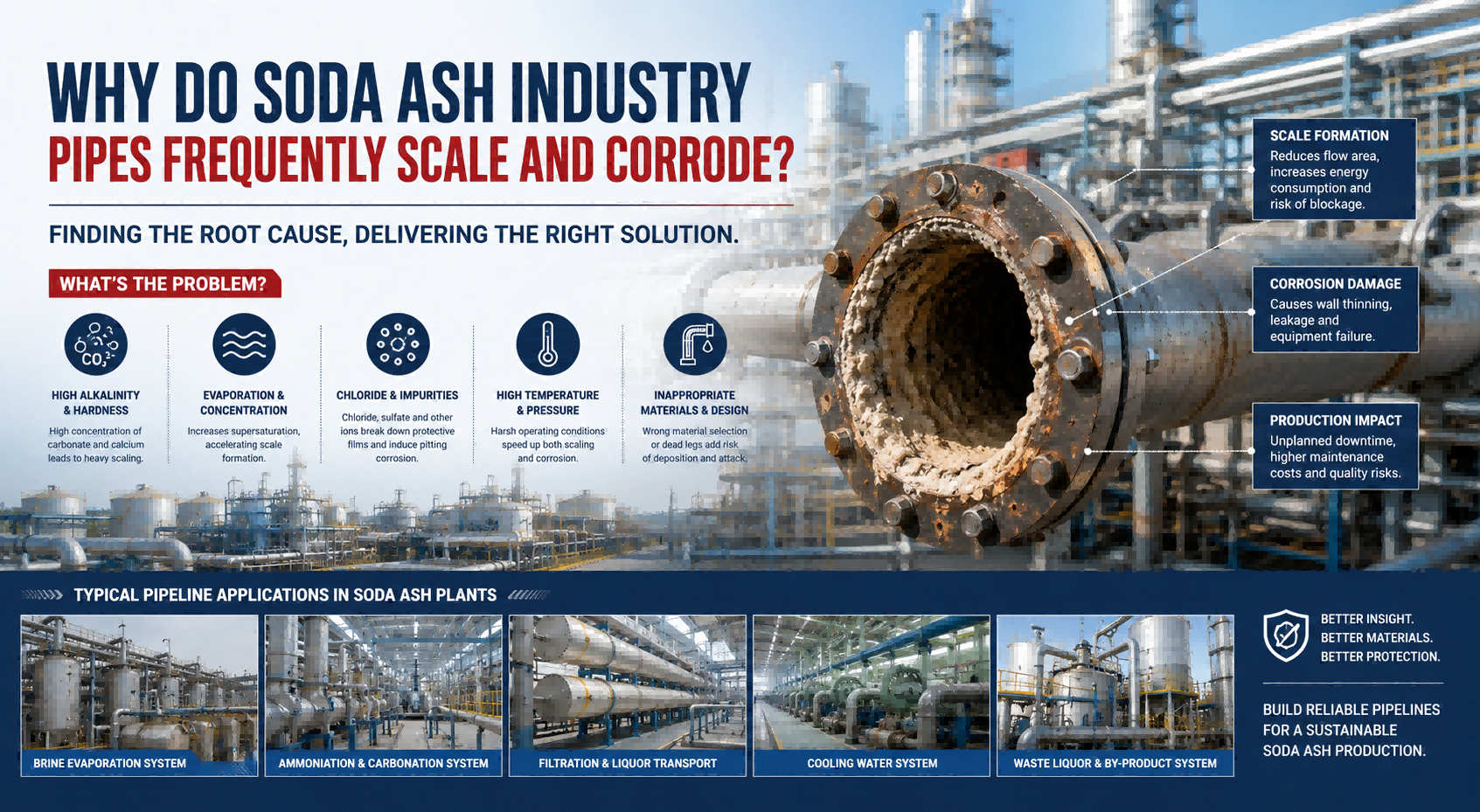
In the modern chemical industry, caustic soda (sodium hydroxide, $\text{NaOH}$) is an indispensable foundational raw material, known as one of the "three acids and two bases." However, for any chlor-alkali plant or facility utilizing high-concentration caustic soda, the piping system is arguably the "most fragile lifeline" of the entire process.
"Why is our caustic soda pipe clogged again?" "Why is this pipe leaking again?" These are the exact questions that give maintenance and operation engineers their biggest headaches. Frequent pipeline scaling and corrosion not only lead to unscheduled shutdowns and skyrocketing maintenance costs but can even trigger severe safety and environmental accidents.
What exactly is going on? This article dives deep into three dimensions—chemical mechanisms, materials science, and fluid dynamics—to uncover the hidden culprits behind caustic soda pipeline scaling and corrosion.
Part 1: Scaling—How Pipelines Are Silently "Choked" to Death
Caustic soda itself has an incredibly strong dissolving capacity, so why does hard scale form on the inner walls of the pipes? The issue boils down to impurity reactions, temperature fluctuations, and the introduction of carbon dioxide.
1. Carbon Dioxide Absorption and Sodium Carbonate Crystallization
Caustic soda is an excellent CO2 scrubber. If there are micro-leaks in the piping system (especially at tank breather valves, pump seals, or valve packing), or if it is exposed to air in an open process, the following chemical reaction occurs:
2NaOH + CO2 → Na2CO3 +H2O
The resulting sodium carbonate (Na2CO3) has a much lower solubility in concentrated caustic soda solutions than the caustic soda itself. As the reaction continues, sodium carbonate crystals precipitate onto the inner walls of the pipe, forming a rock-hard white scale.
2. The "Gordian Knot" of Hardness Ions
Although industrial-grade caustic soda is highly pure when leaving the factory, if water that hasn't been deeply softened ("hard water") is introduced during dilution, preparation, or process circulation, the calcium and magnesium ions ( Ca2+ and Mg2+) will instantly react with the high concentration of OH- :
Ca2+ + 2OH- → Ca(OH)2 ↓
Mg2+ + 2OH- → Mg(OH)2 ↓
These hydroxide precipitates stick to the pipe walls like cement, continuously trapping other flowing particulates and narrowing the pipe diameter over time.
3. "Salting-Out" Triggered by Sudden Temperature Drops
Concentrated caustic soda (such as a 50% NaOH solution) has a remarkably high freezing point (crystallization point), sitting around 12°C. If winter insulation is inadequate, or if there are "dead legs" in the piping, localized temperature drops can cause the caustic soda to crystallize rapidly, completely blocking the pipe.
Part 2: Corrosion—Who is Quietly Eating Away at the Metal Pipe Walls?
If scaling is a "chronic intestinal obstruction," then corrosion is the "invisible killer." Corrosion in the caustic soda industry is often far more complex than in ordinary water pipes.
1. The Deadly "Caustic Embrittlement"
This is the most notorious metal killer in caustic soda piping, scientifically known as Caustic Stress Corrosion Cracking (ASCC).
-
Conditions: It easily occurs when standard carbon steel pipes transport high-concentration caustic soda at temperatures exceeding 40°C to 50°C.
-
Mechanism: The alkaline solution destroys the protective passivation film on the metal surface. Under the combined action of residual welding stress, mechanical stress, or thermal stress, grain boundaries are selectively corroded. This leads to sudden "brittle fractures" without any noticeable thinning of the metal.
2. The Double Whammy of Erosion-Corrosion
Caustic soda solutions are relatively viscous. When the flow velocity is too high, or when the fluid carries the "sodium carbonate particles" mentioned earlier, the high-speed fluid exerts intensive mechanical erosion on pipe elbows, tees, and reducers. This erosion repeatedly strips away the newly formed protective oxide film on the metal surface, exposing fresh metal matrix to the harsh alkali, creating a vicious cycle of "corrosion-erosion-recorrosion."
3. Electrochemical Corrosion and the Tragedy of Amphoteric Metals
If materials are selected incorrectly—such as using aluminum, zinc, copper, or certain low-end stainless steels—the caustic soda will react directly with these amphoteric metals. For example, aluminum dissolves rapidly in caustic soda, releasing hydrogen gas. Even with standard carbon steel, variations in local concentration or oxygen levels in hot, concentrated alkali can form micro-galvanic cells, triggering severe pitting corrosion.
Part 3: Core of the Issue—A Deep Comparison of Scaling and Corrosion Root Causes
To give you a clearer picture, we have systematically laid out the core drivers behind scaling and corrosion:
|
Phenomenon
|
Core Drivers
|
Primary Locations
|
Potential Hazards
|
|
Pipeline Scaling
|
$\text{CO}_2$ intrusion, excess hardness ions, system temperature drops causing crystallization
|
Dead legs, low-flow zones, uninsulated segments, valves
|
Increased resistance, higher energy consumption, total pipe blockage
|
|
Pipeline Corrosion
|
High temperature, high concentration, residual stress, incorrect material selection
|
Welds, elbows, high-velocity zones near pump outlets, stress concentration areas
|
Sudden pipe rupture, hazardous chemical leaks, catastrophic safety incidents
|
Expert Insight:Scaling and corrosion often go hand in hand. Uneven scaling leads to under-deposit corrosion. The environment beneath the scale layer tends to trap highly concentrated alkali and lack oxygen, drastically accelerating metal pitting and perforation.
Part 4: Breaking the Cycle—How to Completely Resolve This "Industrial Malady"
Now that we know where the problem lies, how can companies apply the right remedy to break this vicious cycle?
1. Material Upgrades: Rejecting "Caustic Embrittlement" from the Source
-
Low Temperature & Low Concentration: High-quality carbon steel can be used, but it must undergo Post-Weld Heat Treatment (PWHT) to eliminate residual welding stress. This is the gold standard for preventing caustic embrittlement.
-
Medium Temperature & Medium Concentration: Opt for 304 or 316L stainless steel. However, keep in mind that stainless steel still faces caustic embrittlement risks at extreme temperatures.
-
High Temperature & High Concentration (Severe Service): It’s time to bring out the heavy artillery—Nickel-based alloys (such as Nickel 200/201) or Monel 400. Nickel exhibits extraordinary stability in strong alkalis.
-
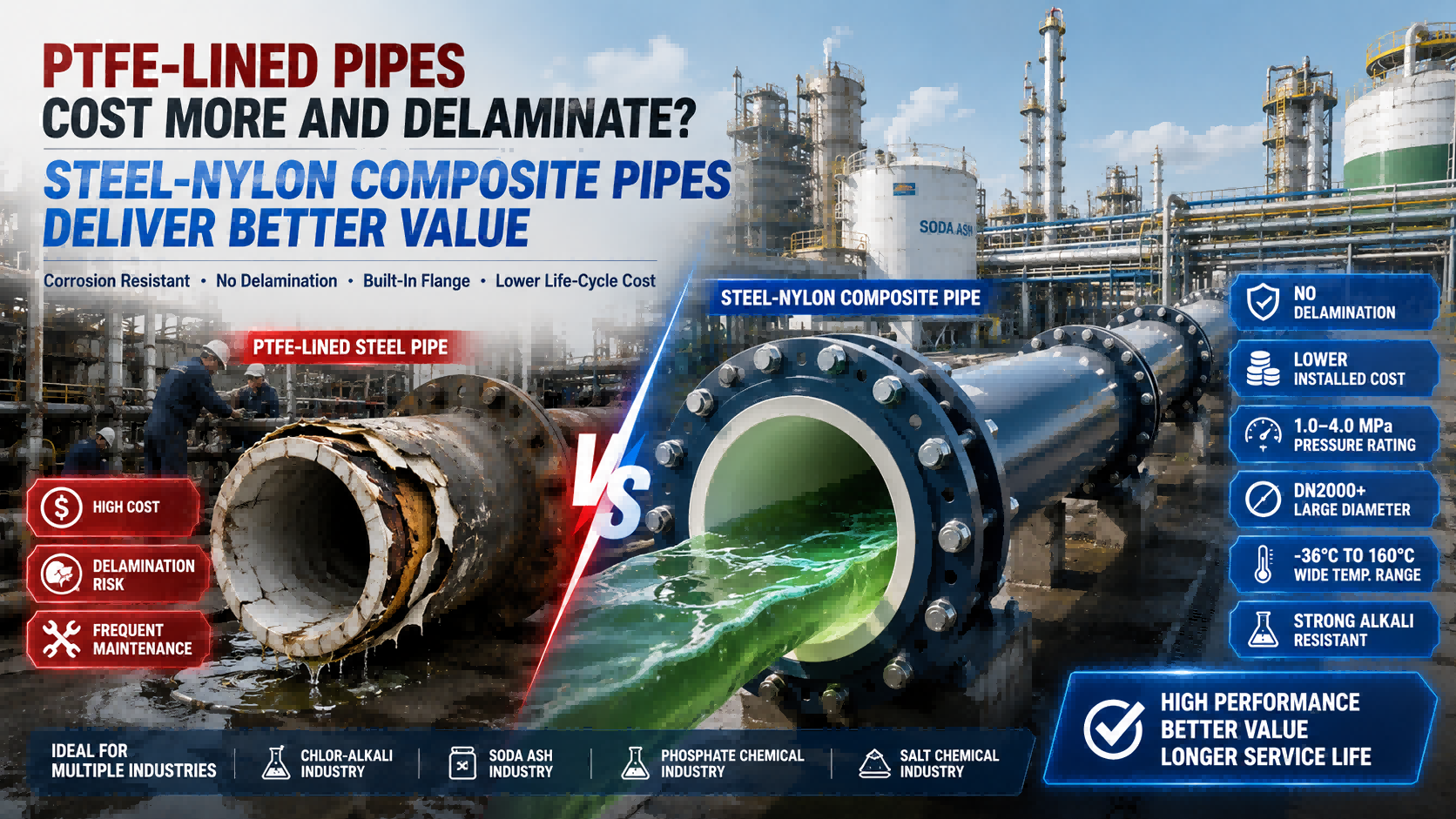
Non-Metallic Alternatives: Where temperature and pressure allow, implementing PTFE (Teflon) lined piping, PFA lining, or PP/FRP composite piping completely bypasses corrosion. Their ultra-smooth inner walls also significantly minimize scale adhesion.
2. Process Control: Locking Down the Trigger Conditions
-
Strict Control over Heat Tracing and Insulation: Implement steam or electric heat tracing to keep concentrated caustic lines strictly above the crystallization point (usually maintained between 25°C to 40°C). This avoids crystallization from cold temperatures while preventing corrosion acceleration from overheating.
-
Isolate from Air: Implement nitrogen blanketing on caustic storage tanks and systems to prevent atmospheric $\text{CO}_2$ from entering and creating sodium carbonate.
-
Water Quality Control: Ensure that deionized water or softened water is strictly used for caustic dilution and system flushing, keeping calcium and magnesium ions far away.
3. Optimizing Design and Standardizing Operations
-
Eliminate Dead Legs: Piping layouts should be as straight and streamlined as possible, eliminating stagnant zones where materials can settle or drop in temperature.
-
Control Flow Velocity: Keep fluid velocity within a reasonable range of 1.0 to 1.5 m/s. This range is fast enough to prevent sediment deposition but slow enough to avoid erosion-corrosion.
-
Regular Chemical Cleaning: Establish a predictive maintenance schedule. Periodically use weak acids (such as dilute citric acid or specialized inhibited acids) combined with chelating agents for online or offline cleaning, wiping out scale layers before they turn rock-hard.
Conclusion
Pipeline scaling and corrosion in the caustic soda industry may seem like an unavoidable "occupational disease," but it is ultimately a mismatch between materials science, chemical equilibrium, and fluid dynamics. Through smart material selection (like fluoropolymer-lined pipes or nickel alloys), strict temperature controls, flawless nitrogen blanketing, and scientific stress-relief treatments, this industrial headache can be thoroughly cured.
How to Choose Pipes for Salt Chemical and Seawater Transport? Non-Toxic, Corrosion-Resistant, Integral-Flanged Reinforced Nylon Pipe—A Complete Package
Frequent Corrosion Leaks in Chlor-Alkali and Soda Ash Pipelines? Strong-Alkali & Weak-Acid Resistant Reinforced Nylon Pipe Has Become the Industry Standard
Related blog


SEND MESSAGE