Rubber-Lined Pipes Suffer from Collapse and Bulging Under Negative Pressure? Reinforced Nylon Pipes, Formed as an Integral Structure, Withstand Vacuum Conditions with Ease.
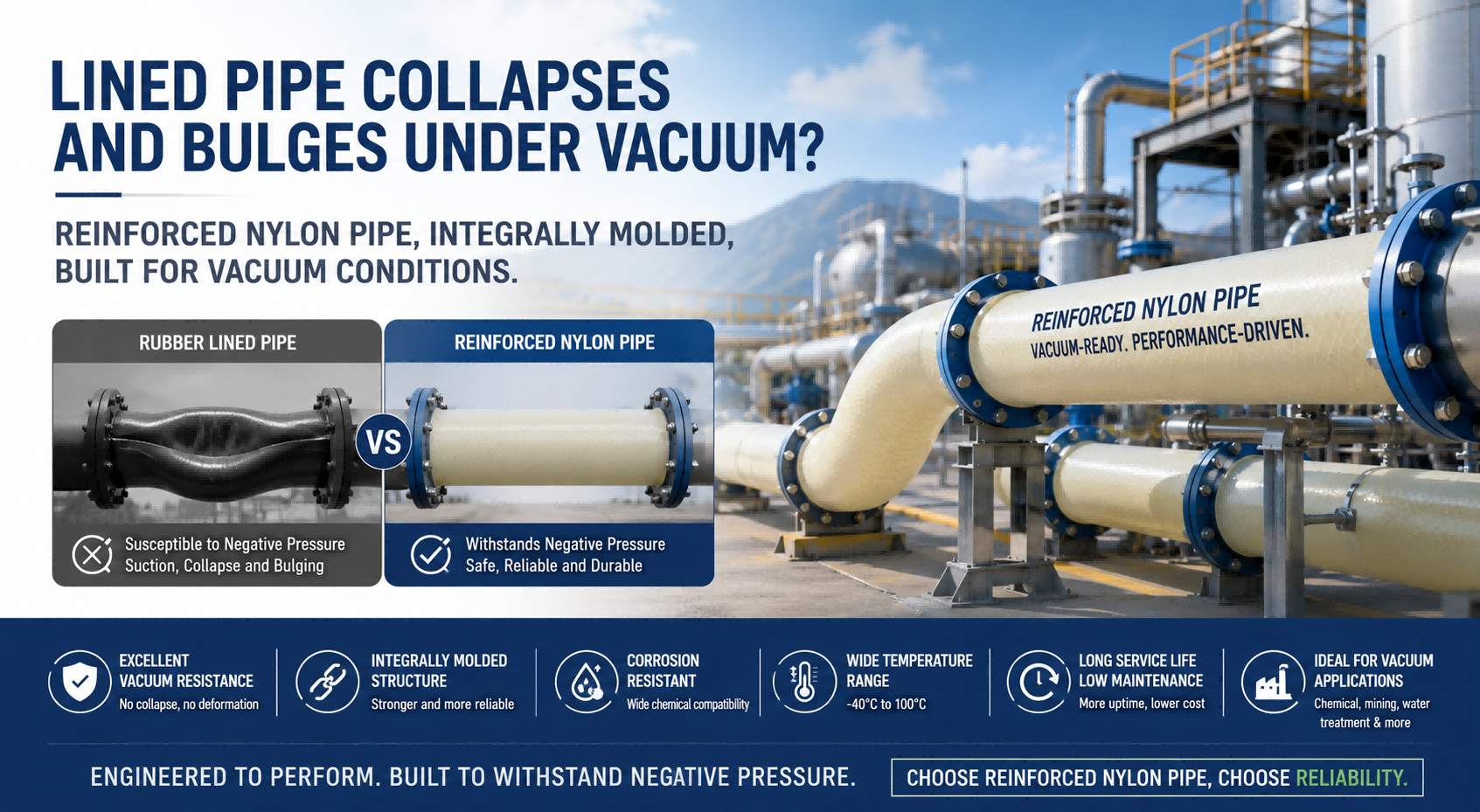
In industrial fluid conveying systems—such as those in chemical, power, and metallurgical sectors—pipeline selection directly impacts production safety and continuity. Negative pressure, a seemingly minor operating condition, often proves to be the “Achilles’ heel” of traditional rubber-lined pipes. When a vacuum or negative pressure develops inside the pipe due to insufficient medium, system adjustments, or operational fluctuations, the rubber lining is prone to collapse, bulging, and even detachment, crippling the entire conveying system. Reinforced nylon pipes, with their integrally molded construction, are fundamentally rewriting this narrative.
**I. The Achilles’ Heel of Rubber-Lined Pipes: Why Do They Fail Under Negative Pressure?**
The structure of a rubber-lined pipe is inherently a “composite”—an external steel shell with a rubber lining bonded to the inner surface via adhesives. This design performs well under positive pressure, where the steel provides strength and the rubber offers abrasion and corrosion resistance. However, once the environment turns to negative pressure, the “interface” between the two materials becomes the weakest link.
Under negative pressure, the internal pressure drops below atmospheric, exerting an inward suction force on the lining. If the rubber is not perfectly bonded to the steel substrate, or if micro-bubbles or bonding defects exist, the vacuum amplifies these weak points. More critically, the manufacturing of rubber-lined pipes relies heavily on manual operations; the joints in the rubber layer are difficult to perfect, and the middle sections often suffer from inadequate compression or poor adhesion. Over time, as the rubber undergoes thermo-oxidative aging, blistering issues become inevitable.
The flange turn-up areas are particularly problematic—during installation, they experience compressive stress, and during operation, they endure repeated bending stress. The rubber sheet is prone to cracking under mechanical fatigue. When negative pressure strikes, these already fragile zones are the first to fail. Minor bulging restricts flow, while severe detachment can break off and block downstream equipment, leading to catastrophic consequences.
**II. Integral Forming of Reinforced Nylon Pipes: Eliminating the “Interface Problem” at the Structural Level**
Unlike the “composite” approach of rubber-lined pipes, reinforced nylon pipes are manufactured using a **centrifugal casting, reaction molding** process. Reactive MC nylon feedstock is injected into a rapidly rotating mold, where the material spreads evenly against the mold wall and undergoes polymerization—**material reaction and product forming occur simultaneously**, yielding a finished pipe in a single step, with no secondary lining required.
What does this mean? It means that reinforced nylon pipes have **no interface**. The pipe wall is a monolithic mass of material, homogeneous from inner to outer surface, lacking the “steel + rubber” two-layer structure of lined pipes. Consequently, under negative pressure, the entire wall acts as a unified body to withstand the suction force, and there is no risk of the lining being “sucked” away from the skeleton.
MC nylon itself is a high-performance engineering plastic, with mechanical strength far superior to common plastics like UPVC, HDPE, and PP. After reinforcement modification, its continuous service temperature can reach 150°C, with an aging life of 40 to 50 years. The centrifugal casting process can produce large-diameter pipes from DN200 to DN3000, with lengths up to 6000–8000 mm, meeting the vast majority of large-diameter conveying needs in industrial applications.
**III. Performance Comparison Under Negative Pressure Conditions**
| Aspect | Rubber-Lined Pipe | Reinforced Nylon Pipe (Integrally Formed) |
|---|---|---|
| Structural Type | Steel shell + rubber lining (composite) | Single material, integrally formed (monolithic) |
| Interface Risk | Bonding interface exists; prone to peeling under vacuum | No interface; delamination is impossible |
| Negative Pressure Resistance | Lining collapses, bulges, or detaches easily | Unified structure, stable performance |
| Process Consistency | Heavy manual intervention; quality varies | Centrifugal casting; uniform and controllable quality |
| Flange Connection | Turn-up areas are weak points | Integral flanges can be formed in one piece; excellent sealing |
**IV. Beyond Negative Pressure: Comprehensive Advantages of Reinforced Nylon Pipes**
The value of reinforced nylon pipes extends well beyond solving the vacuum challenge. They offer a combination of high strength, light weight, abrasion resistance, corrosion resistance, temperature endurance, and aging resistance. In chemical, metallurgical, mining, and thermal power industries, they are suitable for medium- to high-pressure conveying of liquids and solid slurries. Compared to rubber-lined pipes, they eliminate complex issues such as rubber aging, swelling, and material selection errors.
In terms of installation and maintenance, the integrally formed pipes are lighter, facilitating easier on-site handling; the capability to cast flanges integrally significantly improves joint sealing reliability.
**Conclusion**
Negative pressure is never a “rare event” in pipeline systems—system commissioning, medium fluctuations, or operational errors can instantly create a vacuum. For rubber-lined pipes that rely on adhesive bonding, this is a perpetual “sword of Damocles.” Reinforced nylon pipes, however, with their **integral forming** design philosophy, fundamentally eliminate the risk of lining detachment—not by “reinforcing” the weakness, but by making the weakness non‑existent.
When your conveying system faces the challenge of negative pressure, ask yourself one question: Do you need a layer of protection that is “stuck on,” or a body that is “grown” as one?
Glass‑Lined Piping Shatters at the First Knock – Reinforced Nylon Pipe Delivers Impact Resistance and Lifetime Peace of Mind
PE Pipe Connections Rely on Heat Fusion – Which Hides Risks. Nylon Pipe with Integral Flanges Makes Joints Safer.
Related blog