Anti-Corrosion Guide for Chlor-Alkali & Salt Chemical Piping: Why Traditional Metal Pipes Frequently Corrode—And How Steel-PAMC Composite Pipes Solve It Once and for All

In the modern salt chemical and chlor-alkali industries, piping systems are often referred to as the "blood vessels" of the production line. However, these vessels have long been relentlessly ravaged by extreme corrosive media, including high-concentration brine, strong alkalis (such as caustic soda), wet chlorine gas, and hydrochloric acid.
When facing these "industrial monsters," traditional metal pipes—such as carbon steel, stainless steel, and even expensive exotic alloys—frequently succumb to localized pitting, stress corrosion cracking (SCC), or uniform thinning. This leads not only to frequent shutdowns for emergency maintenance but also to soaring maintenance costs and severe safety hazards.
How can the industry overcome these chronic corrosion headaches in salt chemical processing? This in-depth article analyzes the failure mechanisms of traditional metal pipes and introduces a disruptive, long-life solution: Steel-PAMC (Polyamide Composite) Composite Pipes.
1. The "Fatal Flaws" of Traditional Metal Pipes in Salt Chemical Environments
Due to the high electrical conductivity, extreme pH levels, and strong permeability of chlor-alkali and salt chemical media, traditional metal pipes face severe operational challenges.
1.1 The "Chloride Ion Nightmare" for Carbon & Stainless Steel
-
Pitting and Crevice Corrosion: Chloride ions ($Cl^-$) are omnipresent in salt chemical processing. Because of their small ionic radius and high penetrability, they easily destroy the passive film on the surface of stainless steel. Once local passivation fails, a galvanic micro-battery effect occurs ("large cathode, small anode"), causing the pipe to puncture in a very short period.
-
Stress Corrosion Cracking (SCC): Under the combined action of welding residual stresses (or operational stresses) and environments containing chloride ions at temperatures exceeding 60°C, austenitic stainless steels like 316L are highly prone to sudden, catastrophic brittle fracture, which is incredibly difficult to detect in advance.
1.2 Limitations of Traditional Anti-Corrosion Coatings and Linings
To protect metal, industries often use rubber-lined or PE/PO-lined pipes. However:
-
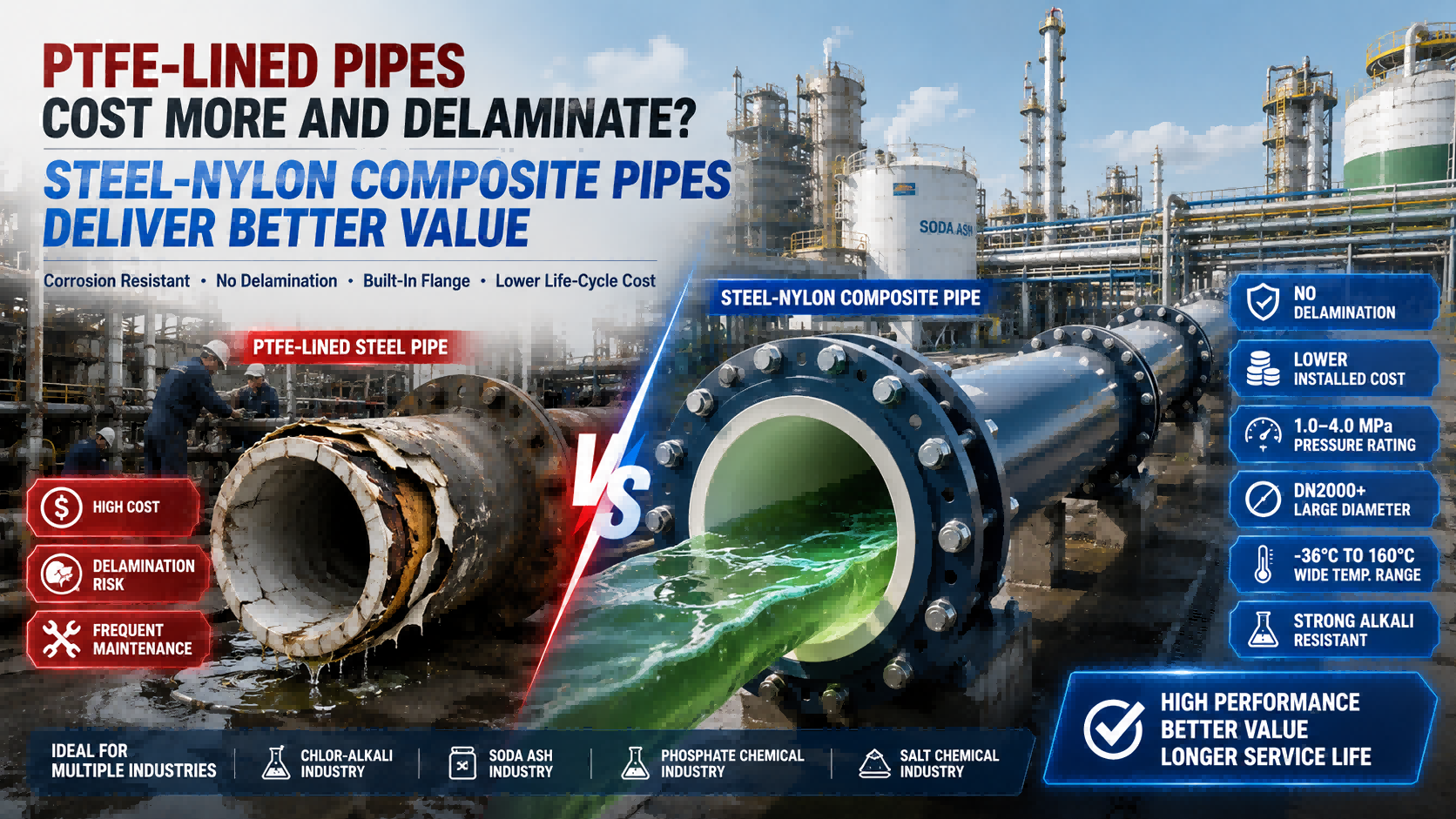
Thermal Expansion Mismatch: The linear expansion coefficient of plastics and rubber is far greater than that of steel. In process sections with drastic temperature fluctuations (e.g., 80°C to 120°C), the lining layer is highly susceptible to delamination, blistering, and peeling.
-
Temperature and Wear Limits: Ordinary PE/PO pipes suffer a sharp drop in strength when temperatures exceed 60°C. Furthermore, when dealing with highly abrasive media containing crystalline salt particles or silt, the inner lining is easily eroded, leading to rapid anti-corrosion failure.
2. What is a Steel-PAMC Composite Pipe?
To combine the high-pressure resistance of steel pipes with the ultimate anti-corrosion and wear-resistant properties of high-performance polymers, and backed by 40 years of critical engineering application experience and cutting-edge materials science, the Steel-PAMC Composite Pipe (Steel-Polyamide Composite Pipe) was engineered.
This technology utilizes a high-strength carbon steel pipe as the outer structural backbone for pressure bearing. The inner wall is firmly fused with a lining of high-molecular modified specialty nylon (PAMC, Polyamide Composite) through an advanced, proprietary composite process.
Key Technical Specifications:
-
Nominal Diameter (DN): Supports ultra-large diameters (up to DN2000mm and above).
-
Working Pressure: 1.0 MPa to 4.0 MPa.
-
Applicable Temperature: -36°C to 160°C, perfectly covering the vast majority of chlor-alkali and salt chemical process temperatures.
3. How Steel-PAMC Composite Pipes Permanently Solve Corrosion and Wear
Compared to traditional piping, the exceptional performance of Steel-PAMC composite pipes in salt chemical environments stems from their unique material properties and microstructure:
3.1 Superior Resistance to Strong Alkalis and High-Concentration Brine
Modified nylon (PAMC) possesses immense chemical stability. Its tightly packed molecular chain structure makes it virtually "immune" to electrochemical corrosion and pitting when exposed to core media of the chlor-alkali industry—such as high-concentration $NaCl$ solutions, 32% to 50% $NaOH$ (caustic soda) solutions, and depleted brine from ion-exchange membrane electrolysis.
3.2 Eliminating "Steel-Plastic Separation": Perfect Interface Adhesion
Traditional plastic-lined pipes are most vulnerable to "negative pressure" and "temperature fluctuations." Steel-PAMC composite pipes employ an advanced composite process that achieves a high-strength, metallurgical/mechanical-grade interlocking bond between the PAMC lining and the inner steel wall. Even under alternating temperatures up to 160°C or vacuum negative pressure conditions, the lining layer will never delaminate or blister.
3.3 Excellent Anti-Scaling and Anti-Abrasion Properties
-
Zero Scaling: Salt chemical pipes are highly prone to crystallization and scaling on the inner walls due to salt saturation, which narrows the pipe diameter and increases fluid resistance. The ultra-smooth inner wall of PAMC boasts an extremely low coefficient of friction and low surface energy, effectively preventing the deposition of inorganic salt crystals.
-
Erosion and Wear Resistance: In processes involving solid particles—such as rock salt slurry transportation, raw salt washing, and tailings discharge—the wear resistance of nylon far surpasses that of carbon steel and ordinary plastics. Its abrasion resistance is several times that of 316L stainless steel, drastically extending the service life of piping in high-scour process zones.
4. Comprehensive Evaluation: Steel-PAMC vs. Traditional Piping
The table below provides an objective comparison of different piping systems under typical chlor-alkali and salt chemical operating conditions:
| Performance Metric | Carbon Steel Lined (Rubber/PE) | 316L Stainless Steel | Fiberglass Reinforced Plastic (FRP) | Steel-PAMC Composite Pipe |
| Chloride Corrosion Resistance | Fair (Lining prone to electro-osmosis leading to shell corrosion) | Extremely Poor (Prone to pitting & SCC) | Excellent | Excellent (Zero electrochemical corrosion) |
| Wear & Erosion Resistance | Poor (Prone to thinning and wear) | Moderate | Poor (Fibers easily peel off) | Extreme (Nylon is naturally highly wear-resistant) |
| Working Temperature Range | < 60°C to 80°C | < 300°C | < 90°C | -36°C to 160°C |
| Pressure Bearing Capacity | Relatively High | High | Relatively Low (Poor impact resistance) | Extremely High (Up to 4.0 MPa) |
| Anti-Scaling Performance | Moderate | Poor | Good | Excellent (Low surface energy prevents adhesion) |
| Total Lifecycle Cost (LCC) | Moderate (High maintenance, short lifespan) | Extremely High (Expensive material, prone to sudden failures) | Moderate (Prone to aging and cracking) | Extremely Low (One-time investment, long-term maintenance-free) |
5. Typical Application Scenarios
Throughout the entire process flow of chlor-alkali and salt chemical manufacturing, Steel-PAMC composite pipes serve as precise, drop-in upgrades in the following critical nodes:
-
Raw Salt & Brine Section: Salt dissolving water, saturated brine pipelines, and purified brine pipelines.
-
Ion-Exchange Membrane Electrolysis Section: Depleted brine dechlorination circulation pipelines (withstanding the dual corrosion of residual chlorine and high salt).
-
Evaporation & Solid Caustic Soda Section: High-temperature caustic soda solution circulation and delivery pipelines.
-
Environmental Protection & Waste Treatment: Salt-laden wastewater, high-concentration acid-base neutralization lines, and crystallizer circulation loops.
Conclusion
As the chlor-alkali and salt chemical industries pivot toward high-quality development and enforce increasingly stringent safety and environmental baselines, relying on high-maintenance, high-risk traditional metal piping is no longer a viable option for forward-thinking enterprises.
With a temperature limit of 160°C, outstanding resistance to chloride ions and strong alkalis, exceptional anti-abrasion/anti-scaling performance, and a robust steel outer casing for high-pressure containment, the Steel-PAMC Composite Pipe delivers the ultimate anti-corrosion solution that balances safety, efficiency, and economy. Choosing Steel-PAMC is not just a material upgrade—it is a strategic investment ensuring long-cycle, stable, and worry-free operation for your chemical plant.
Tubing Selection for Harsh Oil & Gas Field Conditions: Why Flanged Nylon-Steel Composite Pipe Is Becoming the New Industry Darling
Nylon-Steel Composite Pipes vs. 304 Stainless Steel for Mining Slurry and Chemical Plant Slurry Transport: How Ultra-High Wear Resistance Challenges Traditional Material Choices