
Shutting Down for Pipeline Replacement Costing Millions? Corrosion‑Resistant Nylon Pipes Slash Maintenance Cycles from Months to Days
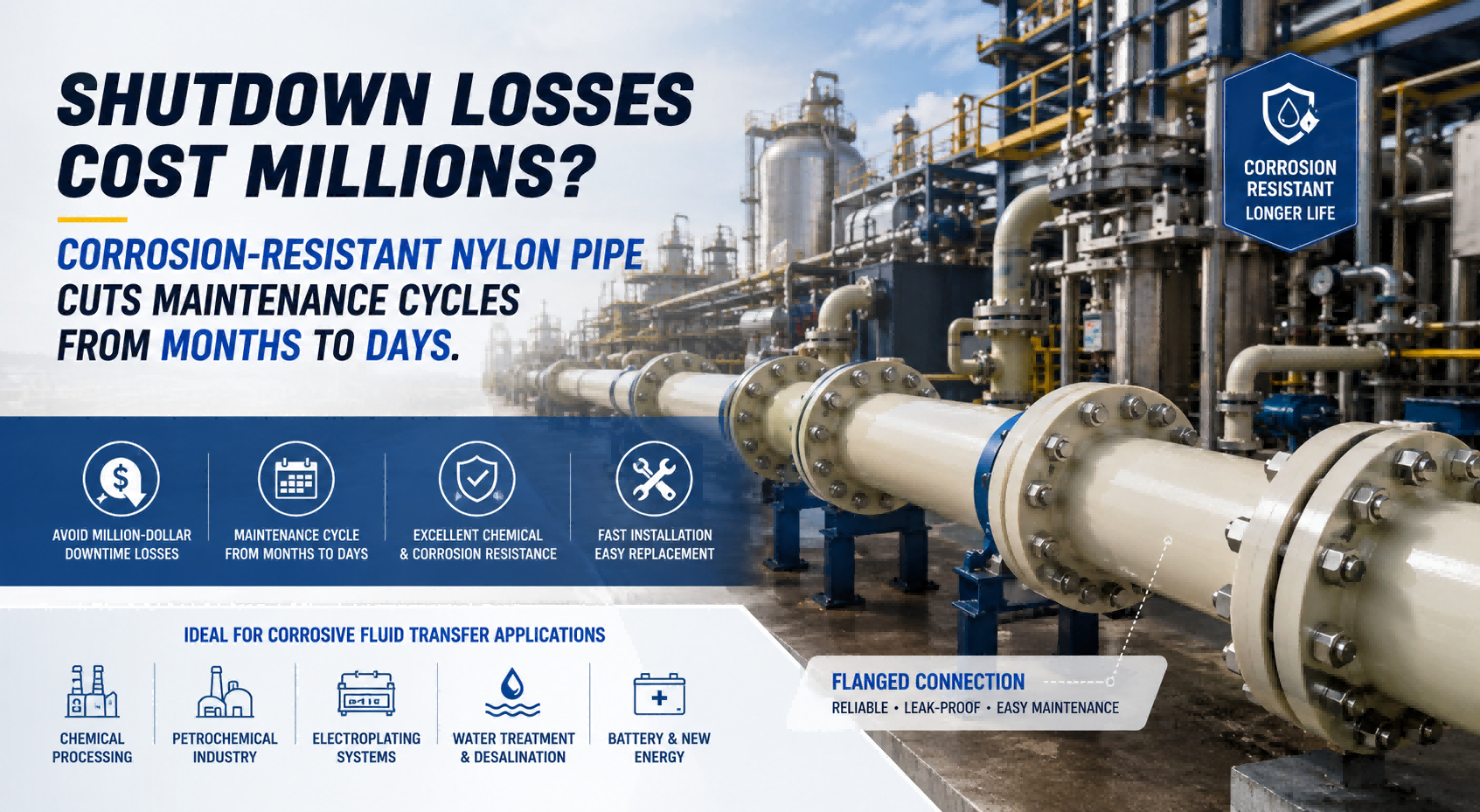
In industries such as chemicals, petrochemicals, and pharmaceuticals, piping systems are the “blood vessels” of production. Once a blood vessel ruptures, the entire production line can be paralysed. Yet the corrosion problems that plague traditional metal pipes are exacting a crippling toll on more and more companies – a single unscheduled shutdown can easily incur losses of millions of dollars per day. Replacing a corroded metal line often takes weeks or even months, and the real cost goes far beyond the repair bill itself.
**1. The chronic disease of conventional piping: corrosion is eating away at profits**
Stainless steel piping has long been regarded as the “standard answer” for chemical transport. But in the face of high temperatures and highly concentrated acid or alkaline media, even stainless steel surrenders. China Pingmei Shenma Group’s Nylon Technology Co., Ltd. once suffered repeated corrosion in the stainless steel nitric acid pipelines at the bottom of the second nitric acid concentration tower in its adipic acid plant. They were forced to invest RMB 800,000 to replace the entire section with titanium piping – a project that took several months from fault detection to completion.
Even more frustrating is that repairing metal pipes is never just “changing a section”. Depressurising the system, draining, medium replacement, hot‑work permits, re‑commissioning – every step consumes time and money. A one‑day outage at an oil refinery can easily exceed a million yuan in lost production, and that is no exaggeration. Over a three‑year period, a petrochemical park recorded 17 leaks in its buried carbon‑steel circulating‑water pipelines (DN300 to DN1200), with total direct economic losses amounting to RMB 8.42 million.
**2. Nylon pipes: from “steel substitutes” to “steel surpassers”**
If stainless steel is the first‑generation answer for pipe materials, corrosion‑resistant nylon pipes are fast becoming the second‑generation solution.
Nylon pipes (made of PA11, PA6, PA12, etc.) offer a suite of properties that traditional metal pipes simply cannot match: low weight, high toughness, excellent fatigue resistance, low friction coefficient, and outstanding abrasion resistance. They resist fats, oils, hydrocarbons, ketones, and many other chemicals; they are dimensionally stable and have low permeability. More importantly, the smooth inner surface prevents rust, scaling, and fouling – meaning that flow capacity is not reduced by internal deposits, and corrosion is not accelerated by localised build‑up.
In terms of temperature tolerance, nylon pipes perform stably across a wide range from –40 °C to 120 °C. Some specialty nylon grades can even handle environments above 180 °C. For pressure resistance, MC nylon pipes can operate at working pressures up to 10.0 MPa.
Even more telling is the wear resistance: when transporting slurries, nylon pipes show 8 to 10 times the abrasion resistance of carbon steel and stainless steel, and 6 times that of PE100. Under identical conditions, their wear resistance is 8 times that of steel and 10.3 times that of fibreglass‑reinforced plastic.
**3. From “months” to “days” – a qualitative leap in maintenance lead time**
Why is maintenance on traditional metal pipes so slow? Because corrosion is rarely a local problem – it is systemic damage. A leak at one point often means that the entire section has been compromised over a wider area. Maintenance crews must inspect, cut out affected sections, weld, and re‑inspect – each step a slow, painstaking process.
Nylon pipes change that logic entirely.
First, nylon pipes fundamentally eliminate the corrosion problem. Nylon 12, as a high‑performance engineering plastic, offers excellent chemical resistance, low moisture absorption, and high mechanical strength. Compared with conventional steel pipes, nylon lines remove the root cause of leak‑inducing corrosion. When pipes do not corrode, the frequency of required maintenance plummets.
Second, even when intervention is needed, the lightweight nature of nylon makes maintenance extraordinarily fast. The specific gravity of nylon pipes is only one‑eighth that of metal pipe materials, and they weigh only about one‑seventh as much as steel. A pipe of the same length can be easily carried and installed by a few workers, without the need for heavy lifting equipment. Their flexibility also simplifies installation – no special tools are required.
In actual soda‑ash industry applications, after MC reinforced nylon pipes and fittings replaced cast‑iron materials, more than two years of production experience showed that these materials offer outstanding benefits: strong corrosion resistance, excellent erosion resistance, scale‑retarding properties, and good ageing resistance. In construction projects at Jiangsu Jingshen Co., Ltd., Huai’an Shilian Chemical, Kunshan Chemical, Qinghai Wucai Mining, and other soda‑ash plants, MC nylon or steel‑lined nylon pipes were adopted for almost all lines except steam and water services.
**4. More than just cost savings: comprehensive benefits across the board**
The advantages of corrosion‑resistant nylon pipes go far beyond “fewer repairs”:
**Installation cost**: Light weight translates into dramatically lower transport and installation costs. No large cranes or hoists are required – ordinary workers can handle the job.
**Operating cost**: The smooth, non‑fouling bore reduces fluid friction and improves conveying efficiency. No clogging means fewer cleaning cycles.
**Service life**: Under light‑duty conditions, nylon pipes can last 8 to 10 years. In corrosive media, their lifespan far exceeds that of stainless steel.
**Total cost of ownership**: Cheaper than stainless steel, yet more durable than carbon steel – this is not marketing hype, but a demonstrable economic fact.
**Operating cost**: The smooth, non‑fouling bore reduces fluid friction and improves conveying efficiency. No clogging means fewer cleaning cycles.
**Service life**: Under light‑duty conditions, nylon pipes can last 8 to 10 years. In corrosive media, their lifespan far exceeds that of stainless steel.
**Total cost of ownership**: Cheaper than stainless steel, yet more durable than carbon steel – this is not marketing hype, but a demonstrable economic fact.
**5. Conclusion: pipe material selection demands a paradigm shift**
“Shutting down for pipeline replacement costing millions” is not an exaggerated headline – it is a grim reality that chemical companies face every day. When stainless steel pipes are repeatedly defeated by corrosion, and when every repair means weeks of lost production and millions in losses, the industry’s mindset on pipe material selection urgently needs to change.
Corrosion‑resistant nylon pipes are not simply “plastic pipes”. They are high‑performance engineering materials validated by decades of real‑world application – from experimental installations in natural‑gas transmission lines in Essen, Germany, to large‑scale adoption in China’s soda‑ash sector; from standard use in automotive fuel lines to comprehensive penetration in chemical, mining, and power‑plant desulphurisation systems. Nylon pipes are proving with hard data that shortening maintenance cycles from months to days is not a distant dream – it is a reality already unfolding.
The next time your pipeline is breached by corrosion, ask yourself one question: do you keep patching it up, or do you change your approach?
Power Plant Desulfurization Carbon Steel Pipe Scaling and Blockage – Steel‑Nylon Composite Pipe with Smooth Inner Wall Never Scales
Internal and External Corrosion of Steel Pipes in Oilfield Produced Water Treatment: Nylon Pipes Offer Full Anti‑Corrosion Protection from Inside Out
Related blog


SEND MESSAGE