Steel-Nylon Composite Pipe vs. 316L Stainless Steel Pipe: Which Is the Better Choice for Industrial Fluid Transportation?
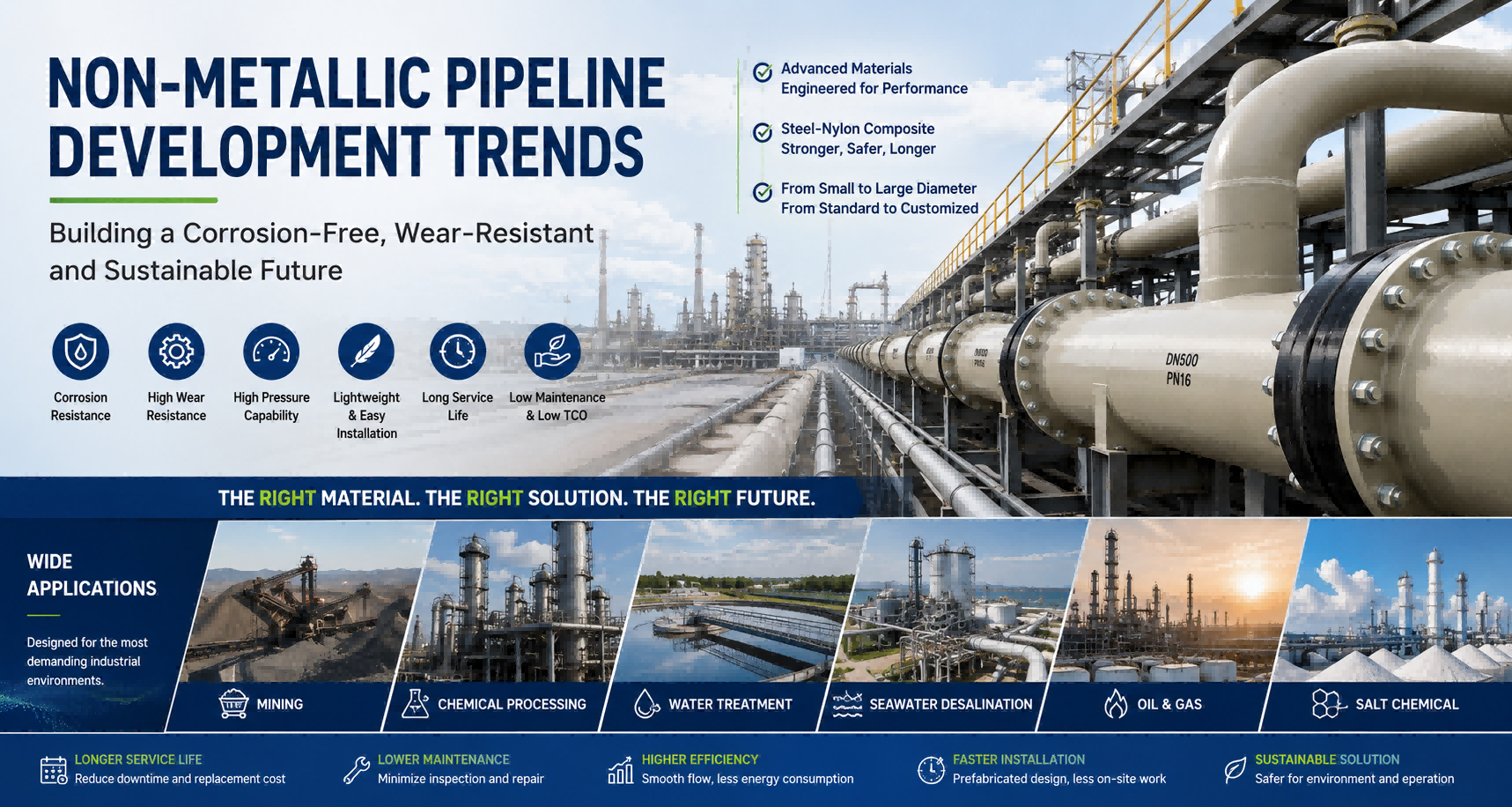
In industries such as chemical processing, mining, municipal water systems, power generation, flue gas desulfurization (FGD), and marine engineering, selecting the right piping material is critical to ensuring system reliability, service life, and overall operating costs.
For decades, 316L stainless steel pipe has been regarded as a premium solution due to its excellent corrosion resistance. However, with the advancement of composite material technologies, Steel-Nylon Composite Pipe has emerged as a superior alternative in many demanding industrial applications.
So, how does Steel-Nylon Composite Pipe compare with 316L stainless steel pipe? Which solution delivers better performance and long-term value?
This article provides an in-depth comparison from the perspectives of corrosion resistance, wear resistance, flow efficiency, installation, lifecycle cost, and service life.
What Is a Steel-Nylon Composite Pipe?
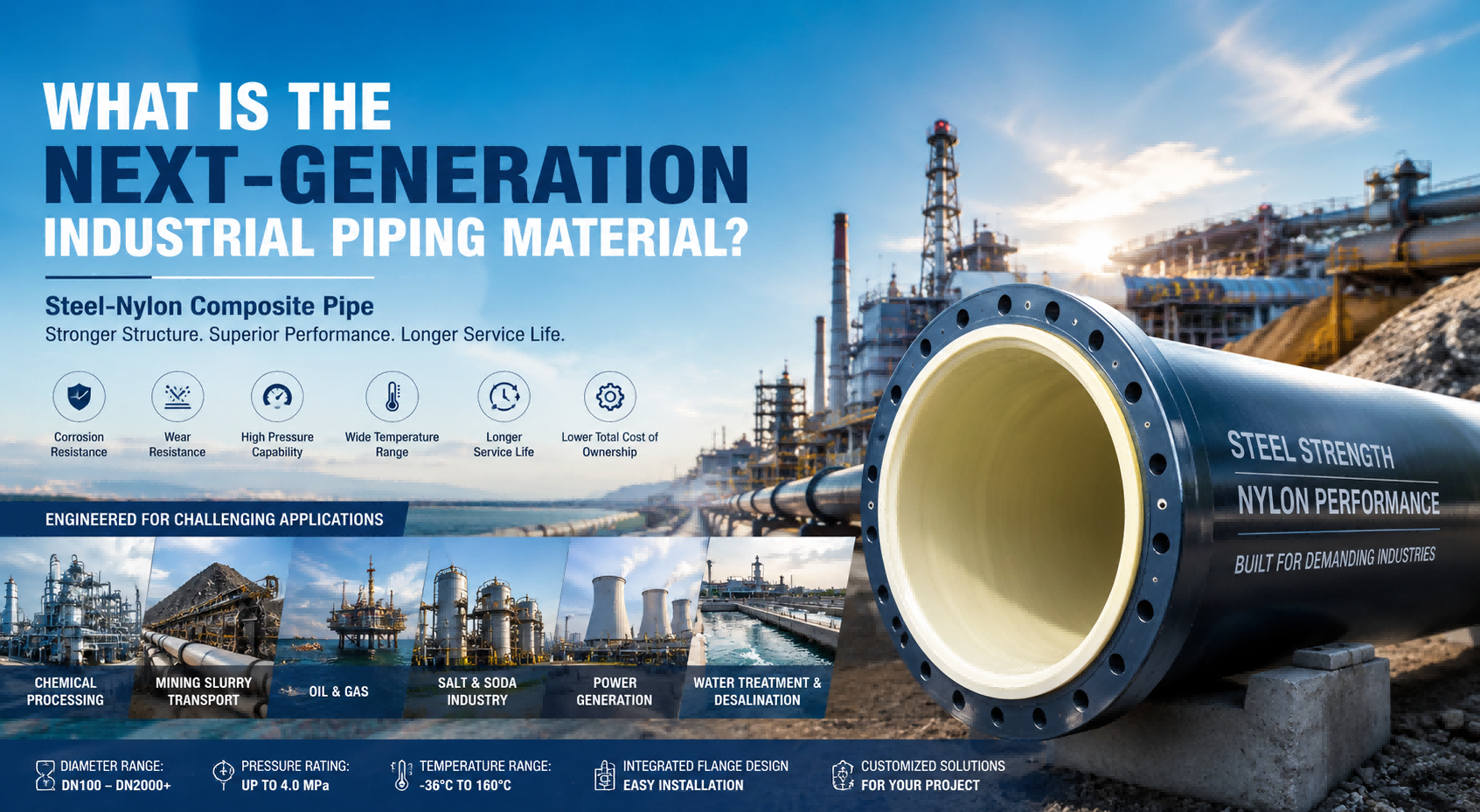
A Steel-Nylon Composite Pipe combines a high-strength carbon steel outer layer with an engineered nylon inner lining through advanced composite manufacturing technology.
This innovative structure integrates:
-
The mechanical strength of steel
-
The corrosion resistance of engineering nylon
-
Exceptional abrasion resistance
-
Smooth internal surfaces with low flow resistance
By combining the advantages of metal and polymer materials, Steel-Nylon Composite Pipe offers a highly efficient and durable solution for industrial fluid transportation.
Understanding 316L Stainless Steel Pipe
316L stainless steel is an austenitic stainless steel alloy containing molybdenum and nickel, which provide improved corrosion resistance compared to standard stainless steels.
Key advantages include:
-
Good resistance to corrosion
-
Excellent weldability
-
High mechanical strength
-
Suitable for marine environments
-
Long-established industry acceptance
However, increasing material costs and more demanding industrial conditions have revealed several limitations of 316L stainless steel.
1. Corrosion Resistance Comparison
316L Stainless Steel Pipe
Although 316L stainless steel offers excellent corrosion resistance, it is not immune to corrosion.
Under certain conditions, it may experience:
-
Pitting corrosion
-
Crevice corrosion
-
Stress corrosion cracking
-
Chloride-induced corrosion
These issues are particularly common in:
-
High-chloride environments
-
Seawater applications
-
Acidic processing systems
-
Electrochemical corrosion environments
Over time, corrosion can compromise system reliability and increase maintenance costs.
Steel-Nylon Composite Pipe
In Steel-Nylon Composite Pipe systems, the transported medium only contacts the nylon lining rather than the steel substrate.
The nylon layer provides excellent resistance to:
-
Acids
-
Alkalis
-
Salt solutions
-
Many organic chemicals
-
Electrochemical corrosion
By completely isolating the steel layer from corrosive media, the pipe achieves superior long-term corrosion protection.
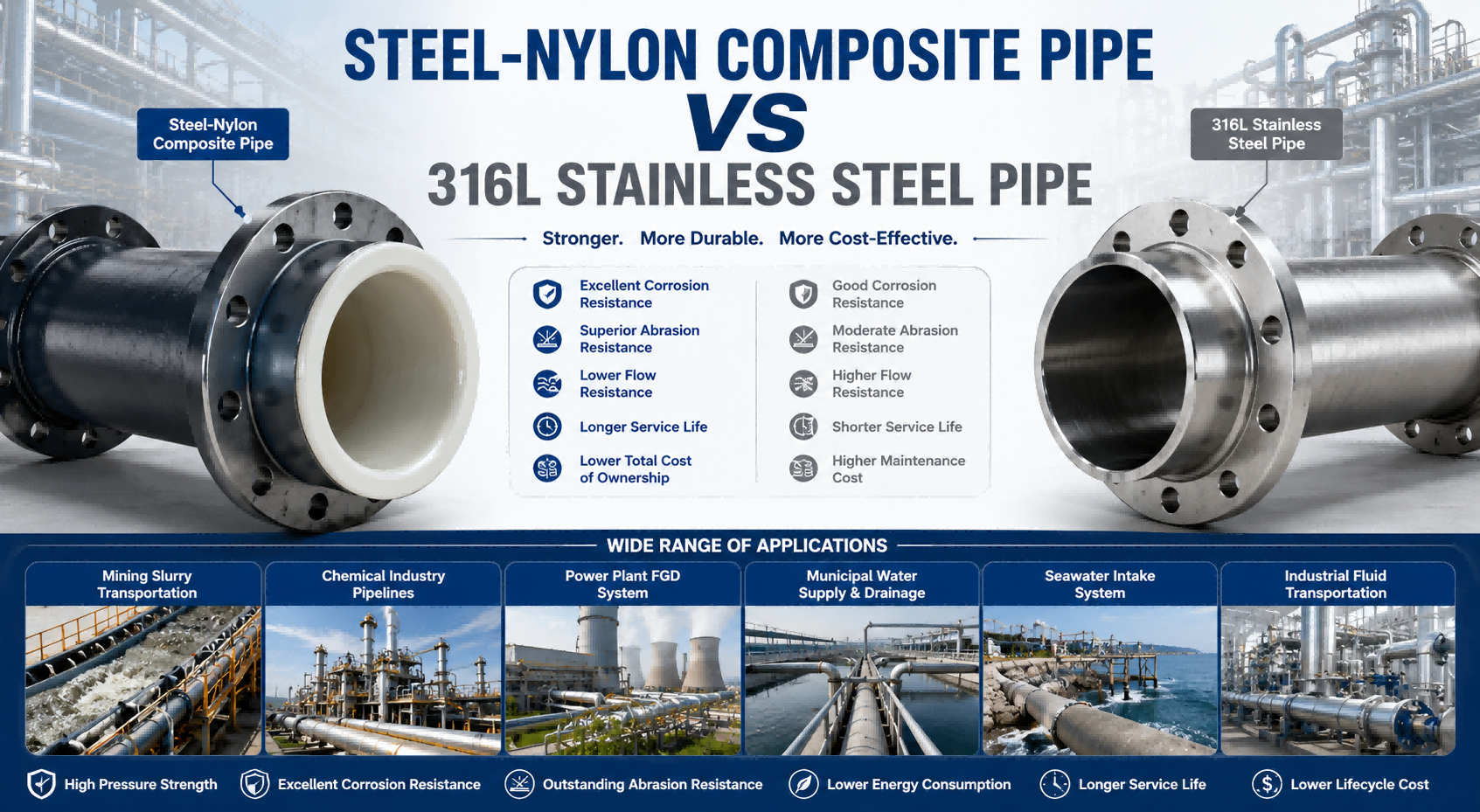
Winner: Steel-Nylon Composite Pipe
For highly corrosive applications, Steel-Nylon Composite Pipe often delivers better long-term corrosion resistance than 316L stainless steel.
2. Abrasion Resistance Comparison
Many industrial pipelines transport abrasive media rather than clean liquids, including:
-
Mining slurry
-
Tailings
-
Coal slurry
-
Fly ash
-
Sand-containing fluids
-
Solid-liquid mixtures
These materials can cause severe wear on pipeline surfaces.
316L Stainless Steel Pipe
Although stainless steel is strong, continuous particle impact can gradually wear down the pipe wall, leading to:
-
Reduced wall thickness
-
Increased maintenance requirements
-
Shortened service life
Steel-Nylon Composite Pipe
Engineering nylon possesses an extremely low coefficient of friction and outstanding wear resistance.
Compared with stainless steel, nylon-lined composite pipes provide:
-
Significantly higher abrasion resistance
-
Better protection against particle erosion
-
Extended service life in slurry transportation systems
Applications such as mining, power plants, and mineral processing facilities particularly benefit from these advantages.
Winner: Steel-Nylon Composite Pipe
In abrasive service conditions, Steel-Nylon Composite Pipe significantly outperforms 316L stainless steel.
3. Flow Efficiency Comparison
316L Stainless Steel Pipe
Although stainless steel initially provides a smooth internal surface, long-term operation can result in:
-
Scale formation
-
Corrosion deposits
-
Crystal accumulation
These factors increase friction losses and reduce flow efficiency.
Steel-Nylon Composite Pipe
The nylon lining offers an exceptionally smooth internal surface that helps:
-
Reduce friction losses
-
Prevent scaling
-
Minimize material adhesion
-
Improve pumping efficiency
As a result, operators can benefit from:
-
Lower energy consumption
-
Reduced pumping costs
-
Improved operational efficiency
Winner: Steel-Nylon Composite Pipe
Its smoother internal surface contributes to better hydraulic performance and lower operating costs.
4. Installation and Construction Cost Comparison
316L Stainless Steel Pipe
316L stainless steel pipelines typically require:
-
Specialized welding procedures
-
Skilled welders
-
Higher transportation costs
-
More complex installation processes
These factors can significantly increase project costs.
Steel-Nylon Composite Pipe
Steel-Nylon Composite Pipe systems offer:
-
Easier installation
-
Reduced construction time
-
Lower labor requirements
-
Simplified maintenance procedures
For large-scale industrial projects, these benefits can translate into substantial cost savings.
Winner: Steel-Nylon Composite Pipe
Its ease of installation contributes to lower project implementation costs.
5. Cost Effectiveness Comparison
Cost remains one of the most important considerations for industrial projects.
316L Stainless Steel Pipe
The price of 316L stainless steel is heavily influenced by fluctuations in:
-
Nickel prices
-
Molybdenum prices
-
Global stainless steel market conditions
As a result, material costs can be significantly higher.
Steel-Nylon Composite Pipe
Steel-Nylon Composite Pipe offers substantial economic advantages:
Lower Initial Investment
Compared with 316L stainless steel, composite pipes typically provide lower procurement costs for equivalent pipe sizes.
Lower Maintenance Costs
Because of their superior resistance to corrosion, abrasion, and scaling, maintenance requirements are significantly reduced.
Lower Total Cost of Ownership (TCO)
Over the entire lifecycle of a piping system, Steel-Nylon Composite Pipe often delivers greater value and lower overall operating expenses.
Winner: Steel-Nylon Composite Pipe
For most industrial applications, the lifecycle cost advantage is substantial.
6. Service Life Comparison
Pipeline lifespan is primarily affected by:
-
Corrosion
-
Abrasion
-
Scaling
-
Pressure fluctuations
In aggressive environments where corrosion and wear occur simultaneously, 316L stainless steel may experience accelerated degradation.
Steel-Nylon Composite Pipe addresses these challenges through its dual-layer design:
-
Steel layer for structural strength
-
Nylon lining for corrosion protection
-
Nylon lining for wear resistance
This combination significantly extends service life in demanding industrial environments.
Winner: Steel-Nylon Composite Pipe
Its composite structure provides superior long-term durability.
Why Steel-Nylon Composite Pipe Is Becoming the Future of Industrial Piping
As industries increasingly focus on:
-
Cost reduction
-
Operational efficiency
-
Sustainability
-
Lifecycle value
Traditional single-material piping systems often struggle to meet modern performance requirements.
Steel-Nylon Composite Pipe offers an ideal balance of:
✔ High pressure resistance
✔ Excellent corrosion resistance
✔ Outstanding abrasion resistance
✔ Low flow resistance
✔ Longer service life
✔ Lower total ownership cost
These advantages explain why more mining companies, chemical plants, power stations, municipal utilities, and marine engineering projects are adopting Steel-Nylon Composite Pipe solutions.
Conclusion
While 316L stainless steel pipe has long been a trusted solution for corrosion-resistant piping systems, its high cost and relatively limited abrasion resistance can become significant disadvantages in modern industrial environments.
Steel-Nylon Composite Pipe combines the strength of steel with the corrosion and wear resistance of engineering nylon, creating a more balanced and cost-effective solution for challenging applications.
As a professional manufacturer of Steel-Nylon Composite Pipes, we are committed to delivering high-quality piping solutions that meet the demanding requirements of industries worldwide. Our products are widely used in mining, chemical processing, power generation, municipal infrastructure, and industrial fluid transportation systems.
With advanced manufacturing technology, strict quality control, and extensive project experience, we help customers achieve safer operations, longer service life, and lower lifecycle costs.
If you are looking for a high-performance alternative to 316L stainless steel pipe, Steel-Nylon Composite Pipe may be the ideal solution for your next project.
Steel-Nylon Composite Pipe vs 304 Stainless Steel Pipe: A New Choice for Industrial Pipeline Upgrading