Enhanced Nylon Pipe VS PE Pipe: A Comprehensive Guide to Industrial Pipeline Material Selection

Over the past decades, PE (Polyethylene) pipes have been widely used in water supply, drainage systems, and some industrial applications due to their advantages such as excellent corrosion resistance, lightweight structure, and easy installation.
However, as modern industries continue to develop, pipeline systems are facing increasingly challenging operating conditions:
-
High-temperature media transportation
-
High-pressure operation
-
Abrasive particle-containing fluids
-
Strong corrosive chemical environments
-
Long-distance continuous transportation
These demanding applications require higher-performance pipeline solutions.
Although traditional PE pipes have solved many corrosion problems found in metal pipelines, they still have limitations in terms of:
-
Temperature resistance
-
Pressure capability
-
Wear resistance
-
Long-term operational stability
Therefore, Enhanced Nylon Pipe has become an advanced alternative for industrial pipeline applications requiring higher reliability and longer service life.
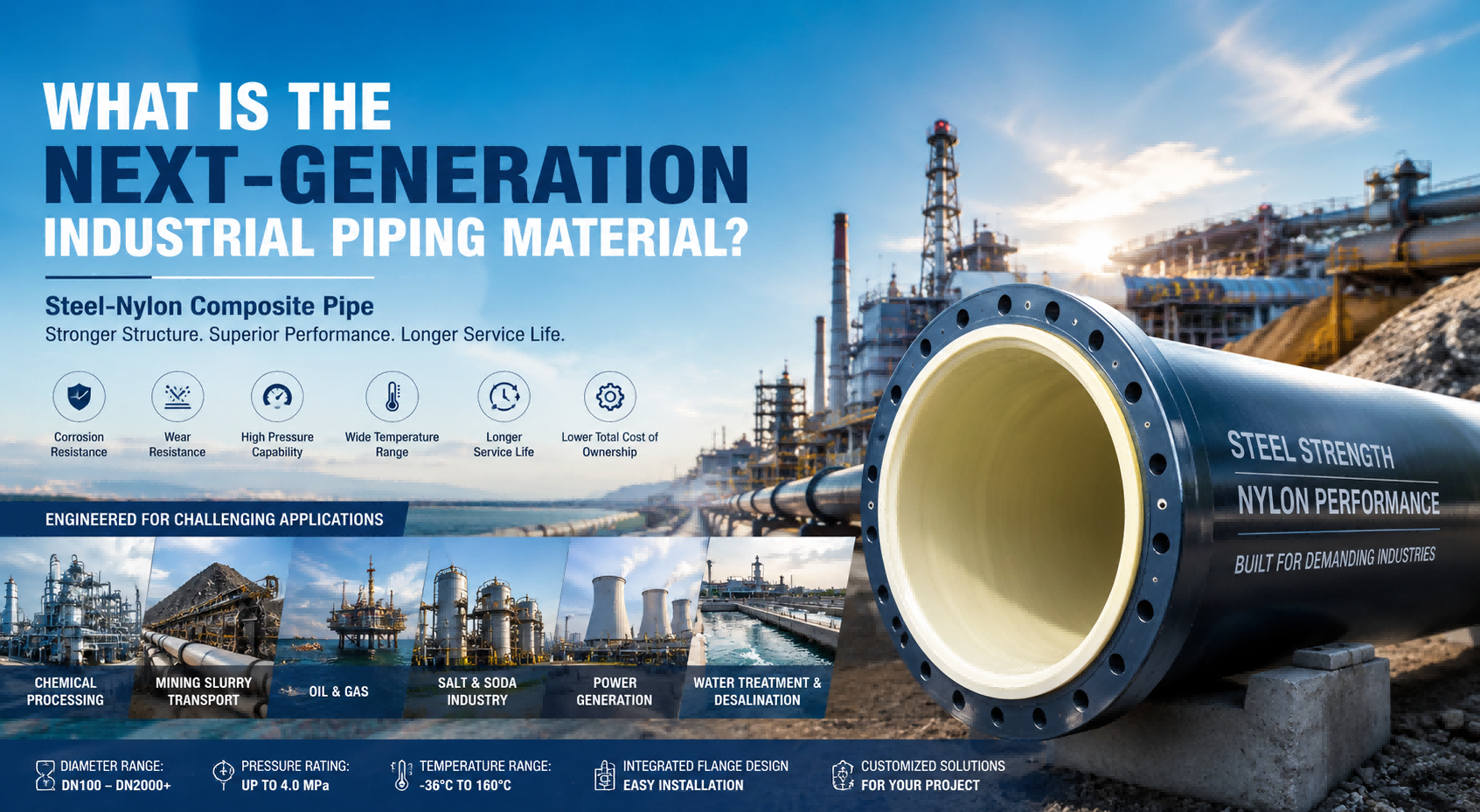
As a professional nylon pipe manufacturer, our company focuses on the research, development, and production of enhanced nylon pipes and steel-nylon composite pipes, providing high-performance pipeline solutions for chemical, mining, oil & gas, power generation, and other industries.
1. Performance Comparison: Enhanced Nylon Pipe vs PE Pipe
| Performance | Enhanced Nylon Pipe | PE Pipe |
|---|---|---|
| Material | Reinforced MC Nylon | Polyethylene |
| Mechanical Strength | High strength | Medium |
| Wear Resistance | ★★★★★ | ★★★ |
| Corrosion Resistance | ★★★★★ | ★★★★ |
| Operating Temperature | -36℃ to 160℃ | Normally ≤60℃ |
| Working Pressure | Up to 4.0 MPa | Normally ≤1.6 MPa |
| Impact Resistance | Excellent | Good |
| Large Diameter Application | DN100–DN2000+ | Limited by stiffness |
| Long-distance Transportation | Excellent | Moderate |
| Harsh Industrial Conditions | Suitable | Limited |
From an overall performance perspective:
PE pipes are suitable for general transportation systems, while enhanced nylon pipes are designed for demanding industrial applications.
2. Wear Resistance Comparison: Enhanced Nylon Pipe Performs Better in Slurry Transportation
Wear Limitations of PE Pipes
PE materials have certain wear resistance, but long-term transportation of particle-containing fluids can cause significant damage.
Typical applications include:
-
Mining tailings slurry
-
Coal slurry transportation
-
Phosphate slurry pipelines
-
Sand-containing oilfield fluids
Continuous impact from high-speed particles can lead to:
-
Wall thinning
-
Rapid elbow wear
-
Local leakage
-
Increased replacement frequency
Especially under high-flow-rate and high-concentration slurry conditions, PE pipe service life can be significantly reduced.
Wear Resistance Advantages of Enhanced Nylon Pipe
Enhanced nylon materials provide:
-
Self-lubricating properties
-
Low friction coefficient
-
High toughness
-
Excellent impact resistance
These characteristics effectively reduce:
✔ Particle erosion
✔ Internal wall abrasion
✔ Elbow damage
✔ Maintenance frequency
For mining filling systems and slurry transportation applications, enhanced nylon pipes can achieve significantly longer operating cycles.
3. Temperature Resistance Comparison: 160℃ Capability Exceeds PE Limitations
Temperature is one of the key factors affecting plastic pipeline performance.
Temperature Limitations of PE Pipes
The typical long-term operating temperature of PE pipes is:
-20℃ to 60℃
When exposed to higher temperatures:
-
Material strength decreases
-
Pressure resistance declines
-
Creep deformation increases
-
Service life is shortened
Therefore, PE pipes are not suitable for:
-
High-temperature chemical fluids
-
Thermal circulation systems
-
Hot corrosive media transportation
Temperature Advantages of Enhanced Nylon Pipe
Through material modification and reinforcement technology, enhanced nylon pipes can operate under:
-36℃ to 160℃ conditions
Suitable applications include:
-
Chemical process pipelines
-
High-temperature circulation systems
-
Corrosive hot fluids
-
Industrial process transportation
Compared with PE pipes, enhanced nylon pipes provide a much wider operating temperature range.
4. Pressure Performance Comparison: Enhanced Nylon Meets High-Pressure Industrial Requirements
Pressure capability is a critical factor in industrial pipeline selection.
Pressure Limitations of PE Pipes
Due to material strength limitations, PE pipes are mainly used for:
-
Low-pressure water transportation
-
Municipal pipeline systems
-
General industrial applications
Under high-pressure conditions, PE pipes may experience:
-
Deformation
-
Long-term creep
-
Reduced pressure performance
High-Strength Advantages of Enhanced Nylon Pipe
Enhanced nylon pipes use high-performance reinforced nylon materials to improve:
-
Hoop strength
-
Impact resistance
-
Dimensional stability
They can achieve:
Pressure ratings from 1.0 to 4.0 MPa
Suitable for:
-
Slurry transportation systems
-
Chemical process pipelines
-
Oilfield gathering systems
-
Large industrial projects
5. Large Diameter Transportation Capability: Enhanced Nylon Supports Large Industrial Projects
With the expansion of industrial projects, the demand for large-diameter pipelines continues to grow.
Large PE pipes may face challenges such as:
-
Insufficient stiffness
-
Thermal deformation
-
Higher support requirements
Enhanced nylon pipes provide:
-
High structural strength
-
Excellent dimensional stability
-
Reliable long-distance transportation performance
Available sizes:
DN100–DN2000+
Suitable for:
-
Mining transportation systems
-
Chemical industrial networks
-
Long-distance pipeline projects
6. Connection Method Comparison: Enhanced Nylon Pipe Provides More Reliable Installation
Pipeline leakage often occurs at connection points.
PE Pipe Connection Methods
PE pipes commonly use:
-
Heat fusion
-
Electrofusion
Potential issues include:
-
Dependence on operator experience
-
Installation quality affected by site conditions
-
Long-term connection reliability concerns
Connection Advantages of Enhanced Nylon Pipe
Enhanced nylon pipes can adopt:
Integrated flange connection design
Advantages:
✔ No on-site welding required
✔ Faster installation
✔ Reduced construction errors
✔ Lower leakage risks
This makes them especially suitable for:
-
Chemical plants
-
Mining sites
-
Oil & gas projects
-
Large industrial pipeline systems
7. Corrosion Resistance Comparison: Enhanced Nylon Handles Complex Chemical Media
PE pipes have good corrosion resistance, but under severe industrial conditions they may still be affected by:
-
High temperatures
-
Stress cracking
-
Chemical permeation
Enhanced nylon pipes provide:
-
Excellent acid and alkali resistance
-
No rust problems
-
No electrochemical corrosion
-
Long-term operational stability
Applications include:
Chemical Industry
-
Soda ash mother liquor systems
-
Chlor-alkali processes
-
Salt chemical pipelines
Mining Industry
-
Tailings slurry
-
Backfilling pipelines
Oil & Gas Industry
-
Sand-containing fluids
-
Corrosive production fluids
8. Lifecycle Cost Analysis: Why High-Performance Pipelines Are More Economical
Many projects initially choose PE pipes because of their lower purchase cost.
However, industrial pipeline economics should consider:
Total Cost of Ownership (TCO)
Including:
-
Initial investment
-
Installation costs
-
Maintenance expenses
-
Production downtime losses
-
Replacement costs
Although enhanced nylon pipes may require higher initial investment than standard PE pipes, they provide:
-
Longer service life
-
Fewer maintenance requirements
-
Lower failure rates
-
Higher operational reliability
For continuous production industries, reducing downtime is often more valuable than minimizing initial purchase costs.
9. Typical Applications of Enhanced Nylon Pipe
1. Mining Industry
Applications:
-
Tailings transportation
-
Mineral slurry pipelines
-
Backfilling systems
Advantages:
Excellent wear resistance and longer replacement cycles.
2. Chemical Industry
Applications:
-
Strong alkaline transportation
-
Salt chemical processes
-
Chemical mother liquor systems
Advantages:
Outstanding corrosion resistance and long service life.
3. Oil & Gas Industry
Applications:
-
Oilfield gathering pipelines
-
Sand-containing fluid transportation
-
Valve group pipelines
Advantages:
Wear resistance, corrosion protection, and high reliability.
10. How to Choose Between Enhanced Nylon Pipe and PE Pipe?
PE Pipe Is Suitable For:
✔ General water supply and drainage
✔ Low-temperature environments
✔ Low-pressure systems
✔ Non-abrasive fluids
Enhanced Nylon Pipe Is Suitable For:
✔ High-temperature media
✔ High-pressure transportation
✔ Corrosive environments
✔ Particle-containing slurry
✔ Long-distance industrial pipelines
✔ High-reliability engineering projects
Conclusion: Enhanced Nylon Pipe Is Becoming a High-Performance Alternative to PE Pipe
PE pipes have played an important role in the development of plastic pipeline technology. However, under increasingly demanding industrial conditions, their limitations in temperature resistance, pressure capacity, and wear resistance are becoming more apparent.
Enhanced nylon pipes provide upgraded performance through:
-
Superior wear resistance
-
Wide operating temperature range from -36℃ to 160℃
-
Pressure ratings up to 4.0 MPa
-
DN100–DN2000+ diameter capability
-
Excellent corrosion resistance
-
Reliable connection design
-
Lower lifecycle costs
For industrial projects seeking long-term stable operation, improved safety, and reduced maintenance costs, enhanced nylon pipes are not only an alternative to PE pipes but also a future-oriented pipeline upgrade solution.
Reinforced Nylon Pipe vs Ductile Iron Pipe: How a New Generation of Industrial Pipelines Achieves Performance Upgrades
Reinforced Nylon Pipe vs FRP Pipe: A Comprehensive Comparison for Industrial Pipeline Selection