
Say Goodbye to Stainless Steel Welded Pipe Leak Worries – Eliminate Hot Work with Flanged Steel-Nylon Composite Pipe

In the world of industrial fluid transport, have you ever found yourself trapped in this frustrating cycle: a newly built stainless steel welded pipe system barely passes pressure testing, yet within half a year of operation it begins seeping from the edges of the weld seams? Every unplanned shutdown forces your emergency repair crew to issue yet another hot work permit, fully geared up, and work under the tense atmosphere of keeping sparks from flying. This recurring loop of leaks, hot work, and more leaks not only drains your maintenance budget but also turns site safety into a gamble. Today, we’re sending a clear message — it’s time to leave behind the “leak worries” of stainless steel welded pipe for good. Let flanged steel-nylon composite pipe take over your critical lines and eliminate hot work at its root.
Why Stainless Steel Welded Pipe Always “Fails” at the Weld
To put an end to a problem, you must first understand its true nature. Leaks in stainless steel welded pipe seldom result from perforation of the base metal itself; the overwhelming majority of leak points are concentrated at the weld seams and their heat-affected zones. The reasons often lie deep beneath the surface of conventional engineering logic:
**Welding metallurgical defects are almost impossible to eradicate**: In field manual or semi-automatic welding, defects such as porosity, lack of fusion, slag inclusions, and undercut are a matter of probability. Even in joints that pass radiographic inspection, the weld microstructure remains a cast dendritic structure, whose corrosion resistance is inherently inferior to that of the wrought parent material. Once the medium contains trace chlorides or is in a sensitive temperature range, intergranular corrosion and stress corrosion cracking tend to initiate right at the weld.
**Superimposed residual stress and fatigue**: Every circumferential weld is a concentrated source of residual tensile stress. Under the cyclic loading of pump vibrations and thermal expansion and contraction, fatigue cracks are most likely to initiate at the weld root. This progressive damage at the microscopic level often forms through-wall micro-cracks long before a visible leak is detected.
**The irreparable damage to the passive film**: The high heat of welding burns away the chromium-rich oxide film on the stainless steel surface. Although it can be rebuilt through pickling and passivation, it is extremely difficult under field conditions to restore the film to a density equal to that of the original base metal. The weld zone thereby becomes an electrochemical corrosion “anode,” accelerating localized corrosion leaks.
**Superimposed residual stress and fatigue**: Every circumferential weld is a concentrated source of residual tensile stress. Under the cyclic loading of pump vibrations and thermal expansion and contraction, fatigue cracks are most likely to initiate at the weld root. This progressive damage at the microscopic level often forms through-wall micro-cracks long before a visible leak is detected.
**The irreparable damage to the passive film**: The high heat of welding burns away the chromium-rich oxide film on the stainless steel surface. Although it can be rebuilt through pickling and passivation, it is extremely difficult under field conditions to restore the film to a density equal to that of the original base metal. The weld zone thereby becomes an electrochemical corrosion “anode,” accelerating localized corrosion leaks.
What’s even more troubling is that each leak-repair welding typically introduces secondary heat input, further expanding the heat-affected zone and continuously degrading the base metal properties — a vicious cycle of “the more you weld, the more it leaks.”
Steel-Nylon Composite Pipe: A Leak-Free Solution Written in the Material’s Genes
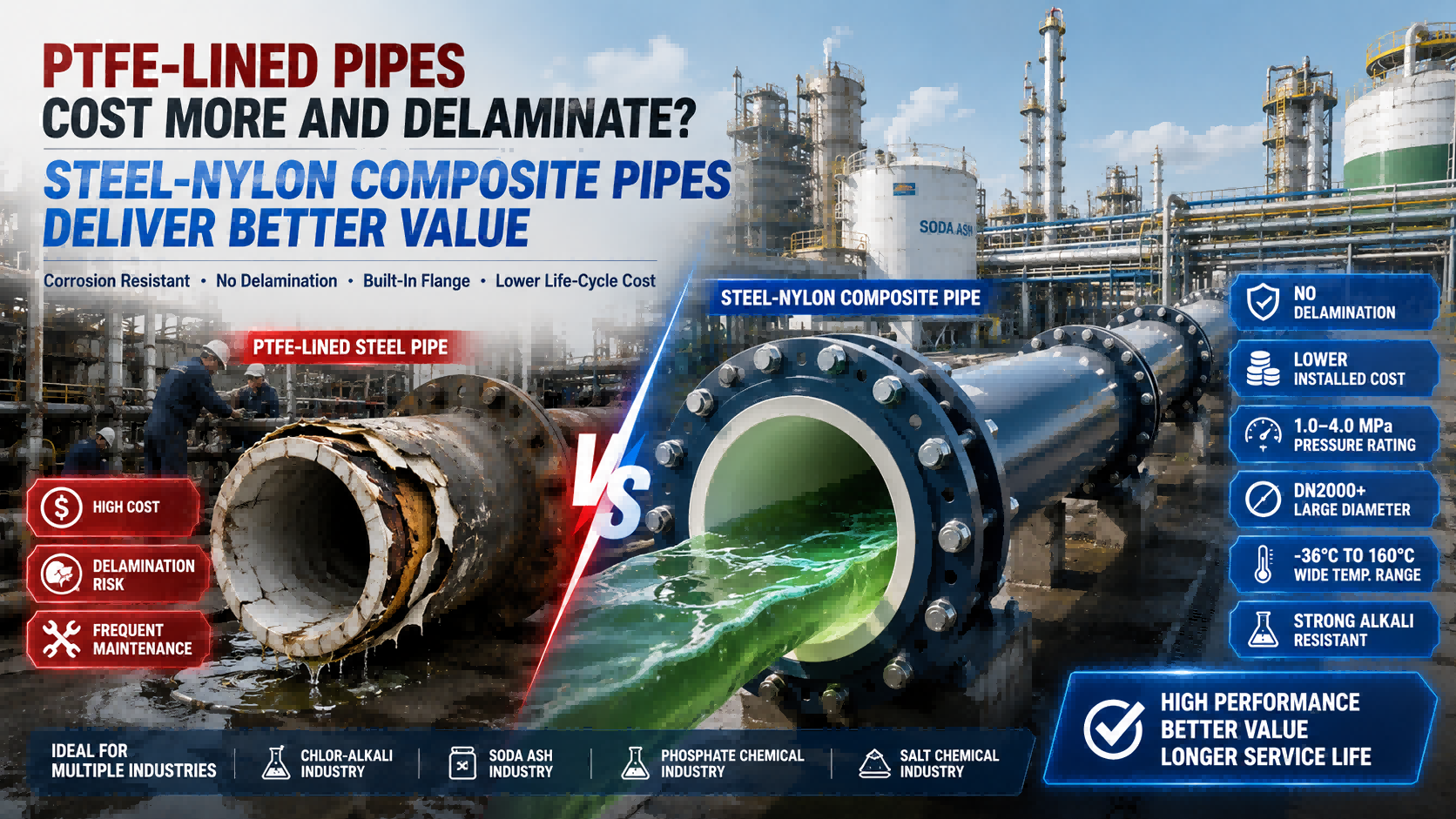
Flanged steel-nylon composite pipe offers an entirely new logic based on its material composite structure and joining method. The pipe body is formed by three layers bonded via metallurgical or molecular bonding: the outer layer of high-strength carbon steel or alloy steel bears all the mechanical load and external protection; the inner layer is made of modified nylon (PA6, PA12, or PA612, customizable according to the medium), forming a completely dense corrosion-resistant liner; and the intermediate layer consists of a special adhesive resin or structural interlock that fuses the two layers into one. Most critically, the pipe-end flanges are entirely prefabricated at the factory — the steel pipe end is flared to form the flange backing shoulder, the inner nylon layer extends simultaneously and flares out to create a full-face sealing surface, matched with a carbon steel or loose backing flange. What comes out of the factory is a finished pipe section that **requires absolutely no field welding**.
**The transformative significance of integrated flanges**: The flanges of traditional plastic-lined pipes are often created by lining and flaring on site, which still requires thermal processing. In contrast, the new generation of steel-nylon composite pipe employs CNC pre-flaring plus hot-melt setting, making the nylon layer’s flange sealing surface seamlessly integral with the pipe’s interior wall. This eliminates the common industry weakness of liner “disbondment at the flare.” On site, you simply bolt the flanges of two pipe sections together and tighten the gasket, and the system is built.
Why It Eliminates Leak Points and Reduces Hot Work to Zero
When you choose steel-nylon composite pipe, you are not merely replacing one type of pipe — you are directly removing the two root causes that generate leak points and necessitate hot work.
**1. No welds, therefore no weld-based leak sources**
The only connection points in the piping system are cold-assembled flanges. Sealing is achieved by a corrosion-resistant gasket and the fully flared nylon sealing face; no metallurgical defects from thermal cycling are introduced. You can think of it as a “fully mechanically sealed piping system” — as long as the flange bolt torque is tightened per specification, the seal is reliable over the long term, unaffected by electrochemical corrosion of the medium, because all wetted surfaces are engineering nylon. Nylon has far superior resistance to halogens, acids, alkalis, salt solutions, and seawater compared to stainless steel, and its smooth inner wall (absolute roughness ≤ 0.01mm) significantly reduces scaling and flow resistance, eliminating at the source the leaks caused by corrosion perforation.
The only connection points in the piping system are cold-assembled flanges. Sealing is achieved by a corrosion-resistant gasket and the fully flared nylon sealing face; no metallurgical defects from thermal cycling are introduced. You can think of it as a “fully mechanically sealed piping system” — as long as the flange bolt torque is tightened per specification, the seal is reliable over the long term, unaffected by electrochemical corrosion of the medium, because all wetted surfaces are engineering nylon. Nylon has far superior resistance to halogens, acids, alkalis, salt solutions, and seawater compared to stainless steel, and its smooth inner wall (absolute roughness ≤ 0.01mm) significantly reduces scaling and flow resistance, eliminating at the source the leaks caused by corrosion perforation.
**2. Completely eradicate hot work and its “hidden costs”**
Hot work means issuing permits, approvals, gas testing, clearing combustibles, deploying fire extinguishers, assigning fire watchers, and facing potential fire and explosion risks. In high fire-rating areas like petrochemical plants, mines, food and pharmaceutical facilities, a single hot work approval can take hours, while effective welding time amounts to mere tens of minutes. With flanged steel-nylon composite pipe, all installation is entirely cold work:
Zero open flame, zero high temperature, zero weld spatter — it can be safely installed directly inside classified explosion-proof zones.
No need to pay for hot work supervision, radiographic filming, pickling, or passivation.
During repairs or line modifications, flanges can be quickly disconnected and pipe sections reused, with no cutting or welding required.
Field installation speed is 3 to 5 times faster than welded stainless steel pipe, dramatically reducing downtime.
Hot work means issuing permits, approvals, gas testing, clearing combustibles, deploying fire extinguishers, assigning fire watchers, and facing potential fire and explosion risks. In high fire-rating areas like petrochemical plants, mines, food and pharmaceutical facilities, a single hot work approval can take hours, while effective welding time amounts to mere tens of minutes. With flanged steel-nylon composite pipe, all installation is entirely cold work:
Zero open flame, zero high temperature, zero weld spatter — it can be safely installed directly inside classified explosion-proof zones.
No need to pay for hot work supervision, radiographic filming, pickling, or passivation.
During repairs or line modifications, flanges can be quickly disconnected and pipe sections reused, with no cutting or welding required.
Field installation speed is 3 to 5 times faster than welded stainless steel pipe, dramatically reducing downtime.
**3. Thermal stress and galvanic corrosion are no longer threats**
There is no galvanic corrosion path between the inner and outer layers of steel-nylon composite pipe, as nylon is an electrical insulator, cutting off any stray current corrosion paths. At the same time, flange connections allow the system to compensate for thermal expansion and contraction to a certain extent; with a small number of expansion joints or compensators, the pipe is not plagued by the residual stress issues typical of rigid welded joints.
There is no galvanic corrosion path between the inner and outer layers of steel-nylon composite pipe, as nylon is an electrical insulator, cutting off any stray current corrosion paths. At the same time, flange connections allow the system to compensate for thermal expansion and contraction to a certain extent; with a small number of expansion joints or compensators, the pipe is not plagued by the residual stress issues typical of rigid welded joints.
An In-Depth Economic Comparison: Where Is the Unseen Money Going?
Consider, for example, a 300-meter DN150 pipeline carrying an acidic brine effluent as a life-cycle cost comparison. The installation process for stainless steel welded pipe — cutting, beveling, welding, NDT, hydrotesting, pickling and passivation — incurs a very high combined cost per weld joint. A single through-weld repair leak can cost enough directly to purchase several composite pipe sections. In contrast, steel-nylon composite pipe requires only spanners and a torque wrench for cold-joint installation, with very low skill demands on workers; the installation crew does not need certified welders. Real-world case studies show that after switching to flanged steel-nylon composite pipe, a chemical plant not only shortened the construction period by 65%, but also recorded zero leaks over three years of operation, reduced annual maintenance costs by over 90%, and earned an upgrade in its insurance safety rating as a result.
Application Boundaries and Confidence in Material Selection
Advanced steel-nylon composite pipe can cover a broad range of operating conditions from ambient temperature up to +90°C (certain high-temperature nylon grades can reach 120°C) and pressure ratings from PN10 to PN25. Flange standards can be customised to ANSI, DIN, JIS or HG national standards. For transport of high-purity water, food-grade liquids, solvents, or slurries, food-grade or anti-static nylon formulations are also available. This is by no means a stopgap measure, but a paradigm shift in piping engineering logic: **replacing an uncertainty system assembled on site by relying on manual skill and fire with a standardised, prefabricated cold-connect pipe system.**
Conclusion
The next time your plant plans to expand or refurbish fluid transport lines, don’t let traditional path dependency dominate your decision-making. Bid farewell to the endless leak worries of stainless steel welded pipe, and keep those hot work permits locked in the drawer for good. Let us configure a complete weld-free solution with **flanged steel-nylon composite pipe** for you. From the very first prefabricated pipe section, you will usher in the era of “zero leakage, zero hot work.”
**Contact us today to obtain a customised technical proposal and a comprehensive cost analysis report, and take the first step towards eliminating hot work.**
Cost-Effective Alternative to 316L: Why Steel-Nylon Composite Pipes Outperform Stainless Steel in Corrosion Resistance
Stainless Steel Pipes Worn Through in Phosphorus Chemical Processing: Steel–Nylon Composite Pipe Delivers 5× Better Abrasion Resistance
Related blog


SEND MESSAGE