
FRP Pipes Become Brittle from UV Aging, While Reinforced Nylon Pipes Still Perform Well After Years of Outdoor Exposure
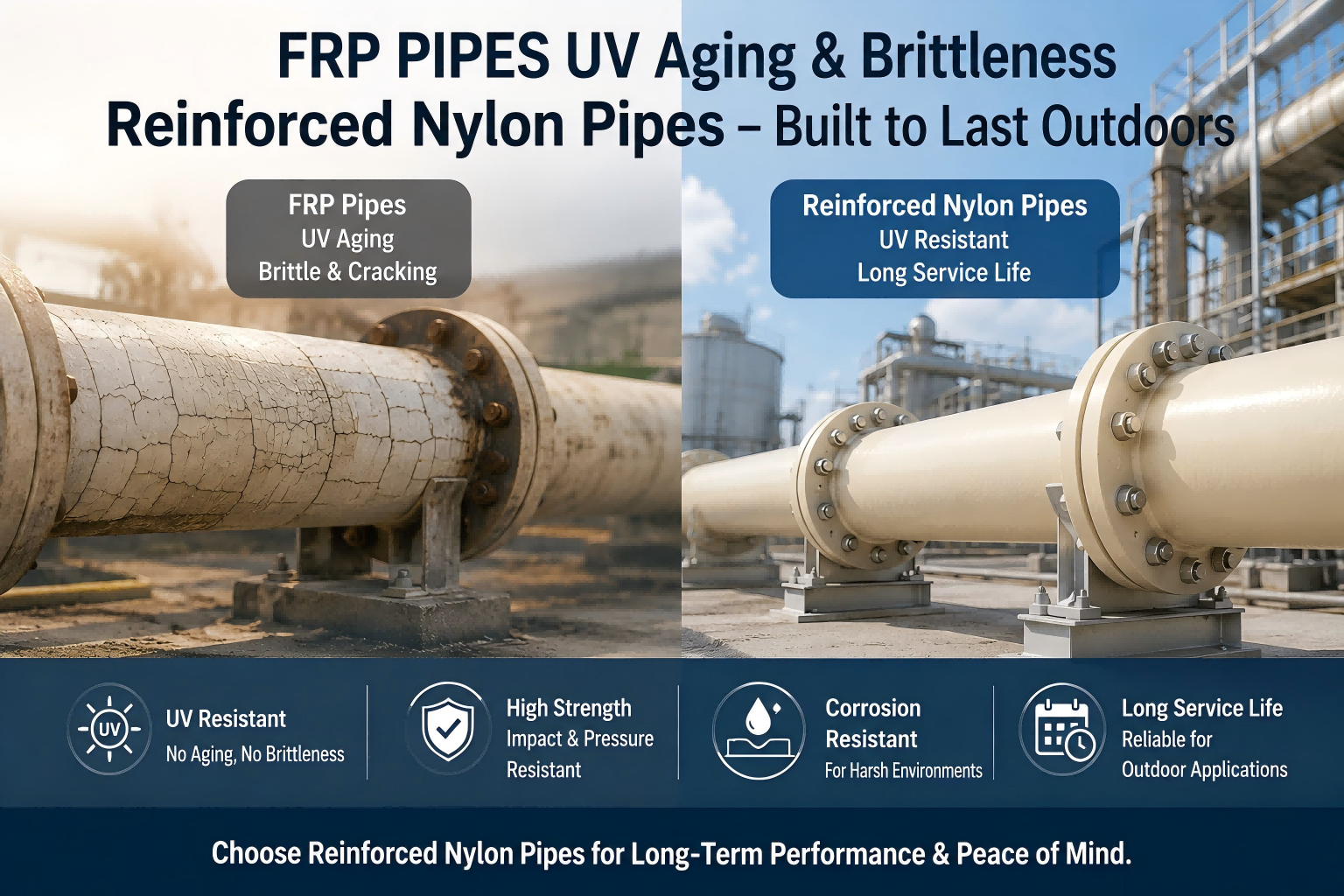
When selecting engineering materials for outdoor applications, weatherability is often the key factor determining long-term project success. Many engineers and procurement professionals face a common puzzle: Why do FRP (fiberglass reinforced plastic) pipes become brittle and crack after just a few years of outdoor exposure, while reinforced nylon pipes remain stable under the same harsh UV conditions for a remarkably long time? In this post, we will delve into the material science principles and practical applications behind this phenomenon, offering fresh insights for your outdoor piping system selection.
The “Invisible Killer” of FRP: UV-Induced Resin Degradation
FRP pipes – fiberglass reinforced plastic pipes – are widely used in chemical, municipal, and other fields due to their light weight, high strength, and corrosion resistance. However, when exposed to prolonged outdoor sunlight, a fatal weakness gradually emerges: UV aging of the resin matrix.
The unsaturated polyester, vinyl ester, or epoxy resins in FRP contain numerous unsaturated double bonds or aromatic structures in their molecular chains. When these chemical bonds absorb UV light in the 300–400 nm wavelength range, a series of photo-oxidation reactions are triggered: chain scission, abnormal crosslinking, and formation of polar groups such as hydroxyl and carbonyl on the surface.
The specific manifestations occur in three stages:
1. **Surface yellowing and chalking (6–12 months):** The resin matrix undergoes photo-degradation first. Surface gloss diminishes, yellow spots appear, and fine powder can be wiped off by hand.
2. **Microcrack initiation (1–2 years):** As aging progresses, microcracks invisible to the naked eye form on the surface. These cracks become stress concentration points and continue to grow under daily temperature cycles and wind loads.
3. **Brittle fracture and delamination (3–5 years):** The resin completely loses its toughness, and the fiber‑resin interfacial bond is destroyed. At this stage, even a small bending or impact load causes the pipe to fracture like glass, with fiber pull‑out and delamination visible at the fracture surface.
Data from an outdoor exposure test in the coastal region of South China show that for unmodified FRP pipes, flexural strength retention drops to 70% after 12 months, to less than 50% after 24 months, and the pipe loses its basic load‑bearing capacity after 36 months. The root cause is that UV light penetrates the 0.5–2 mm thick resin‑rich layer and reaches the fiber‑resin interface, triggering overall performance collapse.
The “Aging Resistance Code” of Reinforced Nylon: Molecular Design + Physical Stabilization
Unlike FRP, reinforced nylon (typically nylon 6 or nylon 66 with 30%–35% glass fiber) exhibits remarkable outdoor durability. This is attributable to its unique molecular structure and stabilization system.
**First line of defense: Saturated aliphatic molecular chain**
Nylon (polyamide) has a main chain consisting of repeating amide groups (-NH-CO-) and methylene groups (-CH2-), making it a saturated aliphatic polymer. Such a molecular chain contains no unsaturated double bonds or benzene rings (except for specialty aromatic nylons) that are highly sensitive to UV light. The energy of UV light is insufficient to directly break C-C or C-N single bonds, so the photo‑degradation rate is far lower than that of resins containing benzene rings.
**Second line of defense: Efficient UV absorption and stabilization system**
Industrial reinforced nylon materials commonly employ an “internal additive” technology, where the following are uniformly mixed during compounding:
**UV absorbers** (e.g., benzotriazoles, benzophenones): They preferentially absorb UV light in the 280–400 nm range and convert the energy into harmless heat.
**Hindered amine light stabilizers (HALS):** These radical scavengers efficiently quench peroxy radicals generated during photo‑oxidation, essentially stopping the chain reaction. HALS exhibit excellent permanence in nylon and even have a “regenerative” effect.
**Carbon black (for black products):** Carbon black particles of 20–30 nm diameter absorb nearly all UV light and provide a physical barrier for the polymer. Black reinforced nylon pipes can achieve an outdoor service life of more than 10 years.
**Third line of defense: Physical shielding by crystalline regions**
Nylon is a semi‑crystalline polymer. Its crystalline regions have closely and orderly packed molecular chains, with high density, making it difficult for oxygen and moisture to penetrate. UV light mainly attacks the amorphous regions, while the numerous tiny crystalline regions act like “stones” that block the inward progression of photo‑degradation. In contrast, the thermosetting resin in FRP is completely amorphous; once the surface is damaged, cracks can rapidly propagate inward.
Comparative Data: Which Is Better for Outdoor Exposed Use?
To clearly demonstrate the gap, we cite authoritative third‑party test data (based on ASTM G154 accelerated weathering, equivalent to 12 months of outdoor exposure in Florida):
| Property | Standard FRP (UP resin) | UV‑modified FRP | Black reinforced nylon (PA66+30%GF+UV stabilized) |
|---|---|---|---|
| Tensile strength retention | 58% | 72% | 94% |
| Flexural strength retention | 51% | 68% | 91% |
| Impact strength retention | 33% | 55% | 88% |
| Surface condition | Severe chalking, cracks | Light chalking, few cracks | Slight color change, no cracks |
| Estimated exposed life (practical) | 2–3 years | 5–6 years | 8–12 years |
It is important to note: **The extraordinary life of reinforced nylon comes not only from UV resistance but also from “toughness retention.”** Even after 10 years of outdoor exposure, the elongation at break of aged reinforced nylon remains above 60% of its initial value. This means that under strong winds, freeze‑thaw cycles, or foundation settlement, it can absorb energy through plastic deformation rather than sudden fracture.
Key Engineering Considerations
Despite the clear advantage of reinforced nylon in UV resistance, the final selection must account for specific service conditions:
**Strongly recommended applications**:
Open‑air pipe racks, solar panel supports, telecom towers – fully exposed outdoor areas
Deserts, plateaus, coastal zones – high UV intensity regions
Applications involving sand abrasion and mild mechanical impact
Projects requiring 20+ years of maintenance‑free operation
Open‑air pipe racks, solar panel supports, telecom towers – fully exposed outdoor areas
Deserts, plateaus, coastal zones – high UV intensity regions
Applications involving sand abrasion and mild mechanical impact
Projects requiring 20+ years of maintenance‑free operation
**Applications requiring careful evaluation**:
Continuous internal pressure >2.5 MPa for fluid transport (reinforced nylon creeps more than FRP)
Long‑term media temperature >120°C (nylon’s heat deflection temperature is typically 110–130°C; high‑temperature grades are needed)
Direct contact with strong polar solvents (e.g., concentrated formic acid, phenol)
Cost‑Benefit Analysis: Why “Buy More Expensive, Use Cheaper”?
The material unit price of reinforced nylon pipe is usually 30%–50% higher than that of ordinary FRP pipe, but the total lifecycle cost is significantly lower. Consider a 10‑year outdoor project:
**FRP solution**: Initial procurement cost = 1.0; replacement in Year 3 (1.0); second replacement in Year 6 (1.0); third replacement in Year 9 (1.0). Cumulative material cost = 4.0, plus 4 times labor for installation.
**Reinforced nylon solution**: Initial procurement cost = 1.4; no replacement needed in 10 years. Total cost = 1.4 + zero labor for replacement.
**Reinforced nylon solution**: Initial procurement cost = 1.4; no replacement needed in 10 years. Total cost = 1.4 + zero labor for replacement.
In addition, nylon pipe weighs only 1/7 of steel pipe and can be joined using press‑fit or quick‑connect fittings, making installation more than three times faster than FRP’s hand lay‑up or filament‑wound joints. For international projects, the savings from reduced maintenance downtime and overseas dispatch of service crews are even more dramatic.
Conclusion and Selection Advice
The enormous gap in outdoor UV resistance between FRP and reinforced nylon pipes stems from a fundamental difference in photo‑degradation mechanisms: thermosetting amorphous material vs. thermoplastic semi‑crystalline material. The UV embrittlement of FRP is irreversible and self‑accelerating, whereas reinforced nylon achieves true long‑term outdoor use through molecular structural advantages and a multi‑component stabilization system.
As an engineering decision‑maker, we recommend the following principles:
1. **For outdoor exposed applications exceeding 2 years, prioritize reinforced nylon pipes** – Even with UV‑resistant coatings, FRP is at risk once the coating is scratched or aged.
2. **For critical safety applications (e.g., elevated supports, electrical conduits, fire protection lines), standard FRP must be avoided** – Its brittle fracture mode provides no warning before failure.
3. **Demand “UV‑stabilized reinforced nylon” from suppliers, not ordinary nylon**, and request test reports per ASTM G154 or ISO 4892‑2, paying close attention to impact strength retention after 1000 hours (should be >80%).
In the era of Industry 4.0, where longevity, reliability, and low maintenance are paramount, material selection should not be based only on initial cost. Reinforced nylon pipe, with its far superior outdoor life compared to FRP, is redefining the boundary of “weather‑resistant engineering plastics.” The next time your project stands under the blazing sun, remember: UV light is not the end for all plastics – for reinforced nylon, it is just another endurance test it can easily pass.
**Looking for the right reinforced nylon pipe solution for your outdoor project?** Contact our engineering team. Provide your service parameters, and we will supply free selection advice and a comparison report of accelerated weathering test data.
Eliminating FRP Pipes in the Soda Ash Industry: Modified PA6 Nylon Pipes Resist Alkali Without Leaching, Eliminating Glass Fiber Contamination Risks
FRP Pipes Delaminate and Leak Under Long-Term Pressure? Steel-Nylon Composite Pipes Maintain Structural Stability Without "Peeling Off"
Related blog


SEND MESSAGE