The True Total Cost of Ownership (TCO) of Industrial Piping: FRP vs. 316 Stainless Steel vs. Steel-Nylon Composite Pipes—Which Offers the Best Long-Term Value?
Introduction: Is the Pipe with the Lowest Purchase Price Really the Most Economical Choice?
In the chemical processing, oil and gas, mining, soda ash, and chlor-alkali industries, piping systems do far more than transport fluids. They directly affect production efficiency, operational reliability, maintenance requirements, and long-term operating costs.
Traditionally, industrial piping procurement has focused on three fundamental questions:
-
What is the purchase price per meter of pipe?
-
Can the pipe meet the required operating pressure and temperature?
-
Is the pipe sufficiently corrosion-resistant for the intended application?
However, as industrial facilities place greater emphasis on continuous operation, safety, and maintenance efficiency, an increasingly important question emerges:
What is the actual cost of operating an industrial piping system over the next 10, 15, or even 20 years?
For example, a piping system with a relatively low initial purchase price may require frequent repairs, partial replacement, or corrosion protection. Over time, these expenses can exceed the initial investment.
Conversely, a high-performance piping system may have a higher upfront cost but generate substantial long-term savings through reduced maintenance and improved operational reliability.
However, a more expensive material is not necessarily the most economical choice if the operating conditions do not require its additional performance capabilities.
Therefore, industrial pipe selection should go beyond initial purchase price and adopt a comprehensive evaluation based on Total Cost of Ownership (TCO).
Among the various materials used in industrial piping, fiberglass-reinforced plastic (FRP), 316 stainless steel, and steel-nylon composite pipes represent three different approaches to material selection, structural design, and lifecycle cost management.
This article examines these three piping solutions from the perspectives of material cost, installation efficiency, corrosion resistance, abrasion resistance, energy consumption, maintenance expenses, unplanned downtime, and service life.
It also explores how steel-nylon composite pipes can create long-term economic value through advanced material combinations and optimized structural design.
1. What Is the Total Cost of Ownership (TCO) of Industrial Piping?
1.1 TCO Goes Beyond the Initial Purchase Price
Total Cost of Ownership refers to all expenses associated with purchasing, installing, operating, maintaining, replacing, and eventually decommissioning a piping system throughout its lifecycle.
For industrial piping, TCO can be expressed as:
TCO = Initial Purchase Cost + Installation Cost + Operating Energy Cost + Maintenance Cost + Downtime Losses + Replacement Cost + Other Risk and Disposal Costs
For long-term industrial projects, the time value of money should also be considered.
Future maintenance, energy, and replacement expenses can be discounted to their present value, allowing engineers and procurement managers to compare different piping solutions over the same evaluation period.
The principles of lifecycle cost analysis are addressed in ISO 15686-5, which covers the assessment of costs throughout an asset's lifecycle.
1.2 What Costs Should Be Included in Industrial Piping TCO?
| Cost Category | Main Components | Long-Term Impact |
|---|---|---|
| Initial purchase cost | Pipes, fittings, flanges, gaskets, and transportation | Determines initial capital investment |
| Installation cost | Welding, connections, lifting, supports, labor, and site construction | Affects construction budgets and project schedules |
| Operating cost | Pumping energy, pressure losses, cleaning, and scale removal | Influences long-term energy consumption |
| Maintenance cost | Corrosion inspections, leak repairs, wear monitoring, and partial replacement | Affects annual maintenance budgets |
| Downtime losses | Unplanned shutdowns, reduced production, lost output, and system restart | May create substantial financial losses in continuous-process industries |
| Replacement cost | Removal of existing pipes, procurement, reinstallation, and commissioning | Influences long-term capital expenditure |
| Risk and disposal cost | Leakage management, waste disposal, and applicable safety and environmental expenses | Affects overall project risk and expenditure |
Among these factors, downtime losses and replacement costs are frequently underestimated during the initial procurement stage.
For continuous chemical production, mining slurry transportation, and oilfield gathering systems, a single pipeline failure can interrupt an entire production process.
Therefore, the economic value of a piping system should not be measured solely by its purchase price per meter.
Its ability to maintain reliable operation over an extended period is equally important.
2. FRP, 316 Stainless Steel, and Steel-Nylon Composite Pipes: Three Different Material Technologies
Understanding the long-term cost differences between these piping materials requires an examination of their structures and engineering characteristics.
2.1 FRP Pipes: Lightweight Construction and Non-Metallic Corrosion Resistance
FRP stands for Fiberglass-Reinforced Plastic, also known as Glass Fiber-Reinforced Plastic (GRP).
FRP pipes generally consist of glass fiber reinforcement combined with a resin matrix.
Depending on the design, the pipe may include a corrosion-resistant internal layer and a structural reinforcement layer.
The main advantages of FRP piping include:
-
Low material density, which can reduce transportation and certain installation costs.
-
Resistance to conventional electrochemical corrosion affecting metallic materials.
-
Various resin systems that can be selected for different chemical environments.
-
Potential for long service life under suitable operating conditions.
However, FRP is not a single material with uniform performance characteristics.
Its chemical compatibility, pressure rating, operating temperature, and long-term reliability depend on the resin type, reinforcement structure, manufacturing process, and connection method.
For applications involving high temperatures, elevated pressures, severe abrasion, or fluctuating mechanical loads, engineers must carefully evaluate long-term pressure performance, internal liner wear, joint integrity, and installation conditions.
ASTM D2992 provides methods for establishing the long-term hydrostatic strength of fiberglass-reinforced thermosetting resin pipes.
This illustrates why long-term reliability cannot be determined solely through short-term pressure testing.
From a TCO perspective, FRP can offer economic value in lightweight, corrosion-resistant applications with relatively low abrasion. However, complex operating conditions require careful evaluation of long-term maintenance requirements and connection reliability.
2.2 316 Stainless Steel Pipes: A Mature Solution Combining Mechanical Strength and Corrosion Resistance
316 stainless steel is a molybdenum-containing austenitic stainless steel widely used in industrial piping systems.
Its principal advantages include:
-
Good mechanical strength and structural rigidity.
-
Good corrosion resistance in compatible operating environments.
-
Suitability for many applications requiring specific temperature, pressure, or hygiene performance.
-
Mature welding, fabrication, and inspection technologies.
Compared with 304 stainless steel, the addition of molybdenum improves the resistance of 316 stainless steel to certain forms of localized corrosion.
However, 316 stainless steel is not resistant to every corrosive environment.
Under certain conditions involving high chloride concentrations, elevated temperatures, and mechanical stress, it may experience pitting corrosion, crevice corrosion, or chloride-induced stress corrosion cracking.
For high-salinity produced water, chloride-containing chemical solutions, and certain industrial wastewater applications, engineers must evaluate whether 316 stainless steel is suitable for the actual operating conditions.
Furthermore, in large-diameter or long-distance piping projects, the costs of stainless steel materials, welding, inspection, and installation can represent a substantial initial investment.
Therefore, the long-term economic performance of 316 stainless steel depends on how well its capabilities match the project's actual requirements.
2.3 Steel-Nylon Composite Pipes: Combining Metallic Pressure-Bearing Strength with Polymer Corrosion Resistance
Steel-nylon composite pipes combine steel structures with high-performance nylon materials.
The steel structure primarily provides mechanical strength and pressure-bearing capability, while the nylon working layer contacts the transported medium and provides corrosion and abrasion protection.
Compared with piping made from a single material, this composite structure offers an alternative engineering approach:
Steel provides structural and pressure-bearing performance, while the nylon working layer helps protect the internal surface against corrosion and abrasion under compatible operating conditions.
For industrial transportation systems involving corrosive media, solid particles, and specific pressure requirements, this material combination offers considerable engineering potential.
Our company specializes in the research, development, and manufacturing of reinforced MC nylon pipes and steel-nylon composite pipes.
We focus on industrial applications in chemical processing, oil and gas production, salt chemical processing, and slurry transportation.
Through material modification, composite structure optimization, and improved connection technologies, we aim to provide industrial piping solutions that combine corrosion resistance, abrasion resistance, pressure-bearing capability, and installation efficiency.
The actual performance of a steel-nylon composite pipe depends on its nylon formulation, steel structure, interface design, and manufacturing quality.
Chemical compatibility, operating temperature, pressure rating, and service life must therefore be verified against the requirements of each project.
3. First TCO Comparison: Initial Purchase and Installation Costs
When selecting industrial piping materials, procurement teams generally consider the initial purchase price first.
However, the material purchase price is not equivalent to the total installed cost.
3.1 FRP: Lightweight Construction Can Reduce Transportation and Lifting Costs
The relatively low weight of FRP pipes can reduce transportation and certain installation expenses.
This can be particularly useful in large-diameter piping projects, long-distance transportation systems, and locations where lifting equipment is limited.
However, FRP installation also requires consideration of several factors:
-
Joint design and connection material costs.
-
Curing time and installation conditions for specific connection methods.
-
Pipe supports, anchoring, and thermal expansion requirements.
-
Risk of mechanical damage during transportation and installation.
-
Quality inspection of field connections.
Therefore, the actual installation cost of FRP must be determined according to the connection method, pipe diameter, installation environment, and project scale.
Pipe weight alone does not determine overall installation cost.
3.2 316 Stainless Steel: Material and On-Site Construction Costs Must Be Evaluated Together
The initial investment in 316 stainless steel piping is influenced by material costs, fittings, welding, and inspection requirements.
In large-diameter projects, pipe weight, welding workload, and construction conditions can substantially affect the final project budget.
Industrial systems with strict welding quality requirements may also require additional expenditure on weld inspection, post-weld treatment, and quality control.
Although stainless steel piping benefits from mature construction technologies, projects involving extensive on-site welding may experience higher labor costs and longer construction schedules.
3.3 Steel-Nylon Composite Pipes: Optimizing Installation Through Prefabrication and Flanged Connections
The economic potential of steel-nylon composite pipes should not be evaluated solely through their purchase price.
One important advantage is the opportunity to improve installation efficiency through optimized structural design and connection methods.
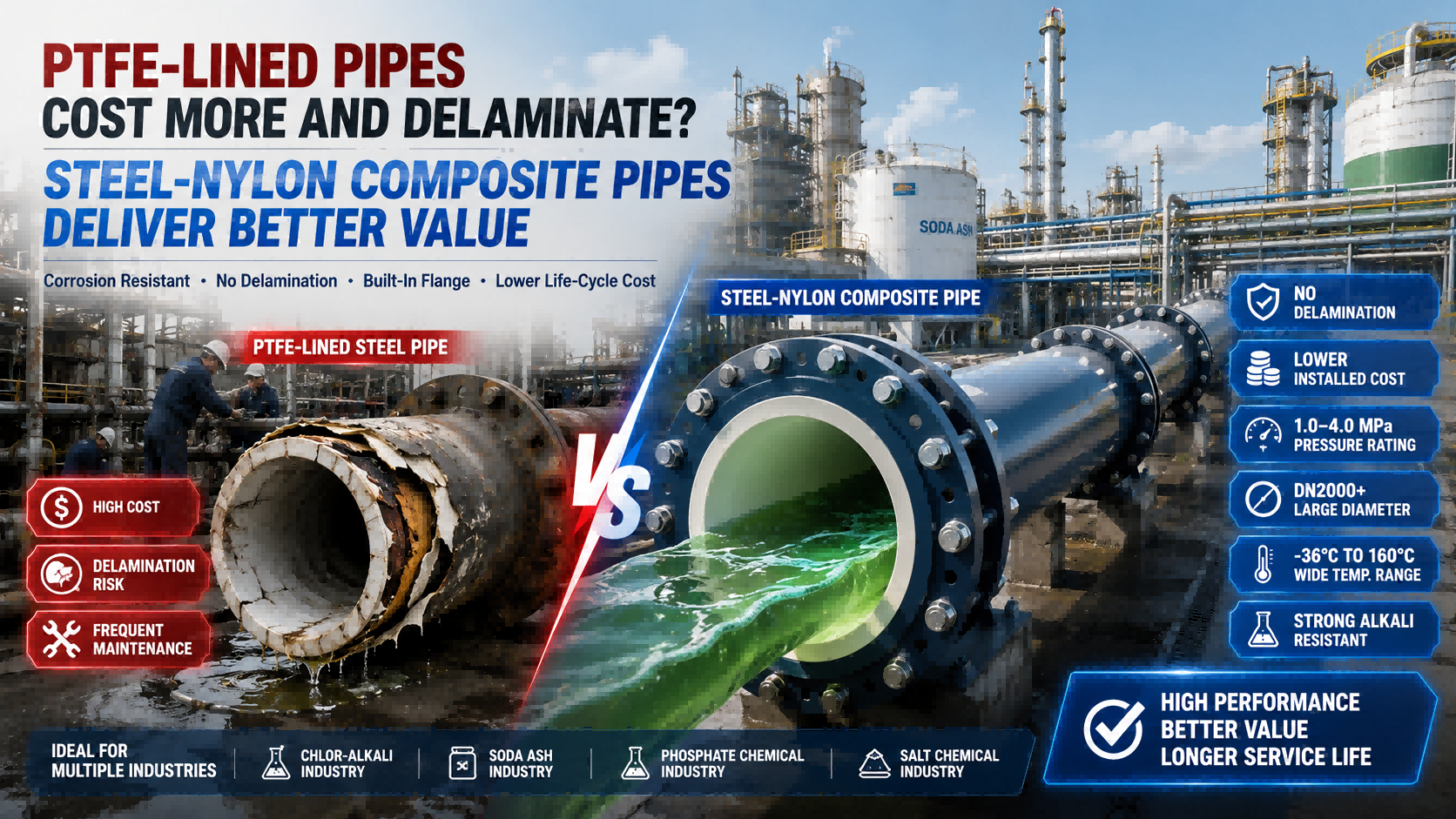
Our steel-nylon composite pipe products incorporate integrated flange designs in applicable specifications, providing modular, non-welded connection solutions for industrial piping systems.
Under suitable project conditions, this design can reduce the amount of on-site welding required.
For chemical plant upgrades, oilfield pipeline maintenance, and installations in restricted working environments, reducing field welding can help simplify construction planning and reduce certain hot-work-related requirements.
However, flanged connections still require appropriate gasket selection, controlled bolt tightening, installation inspection, and pressure testing.
From an initial investment perspective, the potential advantage of steel-nylon composite piping extends beyond material pricing to include reduced installation costs through factory prefabrication and optimized connection design.
4. Second TCO Comparison: How Corrosion and Abrasion Affect Long-Term Piping Costs
In systems transporting corrosive media or fluids containing solid particles, long-term material degradation may be more economically significant than the initial purchase price.
4.1 FRP: Resin Compatibility and Abrasion Risks Must Be Considered Together
FRP pipes can provide excellent corrosion resistance in suitable chemical environments.
However, when a pipeline is exposed to both chemical attack and solid-particle abrasion, the long-term condition of its internal layer becomes especially important.
For example, solid particles in slurry, salt sludge, or sand-containing wastewater may continuously impact and abrade the internal surface of the pipe.
If the corrosion-resistant internal layer becomes damaged, the transported medium may reach the reinforcement structure and affect long-term pipe integrity.
The suitability of FRP in these conditions depends on its abrasion-resistant liner, resin system, fitting design, flow velocity, and particle characteristics.
Therefore, the overall economic performance of FRP in highly abrasive applications cannot be determined solely from its chemical resistance.
4.2 316 Stainless Steel: Localized Corrosion in High-Salinity Environments
For high-salinity oilfield produced water, certain chemical wastewater streams, and chloride-containing media, the corrosion risks associated with 316 stainless steel require careful evaluation.
Potential failure mechanisms include pitting corrosion, crevice corrosion, and stress corrosion cracking under specific conditions.
Although stainless steel can provide long-term reliable service in many industrial environments, operating conditions that exceed the corrosion resistance of 316 stainless steel may require more frequent inspection or the selection of a more corrosion-resistant material.
This means that 316 stainless steel does not necessarily provide the most favorable TCO in every highly corrosive application.
4.3 Steel-Nylon Composite Pipes: Reducing Direct Contact Between Steel and Corrosive Media
Steel-nylon composite pipes use a nylon working layer to separate the transported medium from the steel structure.
When the working layer remains intact and is chemically compatible with the transported medium, it can reduce direct corrosion of the steel pipe's internal surface.
For compatible saline solutions, alkaline media, and fluids containing solid particles, a properly designed nylon working layer can also provide abrasion protection.
This creates three important potential advantages.
First: Improved corrosion protection
By reducing direct contact between corrosive media and the steel structure, the nylon working layer can reduce certain internal corrosion risks.
Second: Improved durability under specific abrasive conditions
A verified abrasion-resistant nylon working layer can help protect the primary pressure-bearing structure against direct particle erosion.
Third: The structural advantages of steel
The steel structure bears the primary mechanical and pressure loads, allowing the composite pipe to meet specific pressure and structural requirements under appropriate design conditions.
For high-salinity produced water, certain alkaline chemical solutions, and industrial fluids containing solid particles, steel-nylon composite pipes offer the potential to reduce long-term corrosion- and abrasion-related maintenance.
However, nylon is not chemically resistant to every substance.
Different nylon formulations exhibit different chemical resistance characteristics, and strong acids or certain high-temperature media may cause degradation or changes in material properties.
Therefore, material selection must be verified against the actual chemical composition, concentration, temperature, and long-term operating conditions.
It would be incorrect to assume that all steel-nylon composite pipes are suitable for every corrosive environment.
5. Third TCO Comparison: Operating Energy Consumption and Internal Pipe Surface Conditions
Operating energy consumption is an important component of TCO in long-distance industrial transportation projects.
This is especially relevant to oilfield gathering systems, water injection pipelines, and slurry transportation networks that operate continuously for extended periods.
Internal surface roughness, friction resistance, flow velocity, and scaling can all influence pumping energy requirements.
5.1 Why Does the Internal Pipe Surface Matter?
For a given transportation task, the required pumping power depends on the flow rate, total system pressure differential, and pump efficiency.
The relationship can be expressed as:
Pumping Power: P = Q × Δp / η
Where:
-
P = Pumping power.
-
Q = Volumetric flow rate.
-
Δp = Required system pressure differential.
-
η = Overall pumping efficiency.
Under otherwise identical conditions, reducing friction-related pressure losses can lower the energy required for pumping.
However, pipe diameter, actual internal diameter, flow regime, fluid viscosity, solid concentration, and the number of fittings can all affect energy consumption.
Therefore, it would be inaccurate to assume that one piping material is always more energy-efficient than another.
5.2 The Potential Advantages of Steel-Nylon Composite Pipes
The nylon working layer can provide a relatively smooth surface in contact with the transported medium.
With appropriate material design and operating conditions, this internal structure can help reduce the adverse effects of surface roughness during fluid transportation.
For piping systems operating continuously over many years, maintaining internal surface integrity and limiting corrosion products or abnormal deposits can help preserve the intended hydraulic performance.
However, whether steel-nylon composite pipes actually reduce pumping energy must be confirmed through hydraulic calculations using the actual internal diameter, working-layer characteristics, and properties of the transported medium.
For systems containing numerous elbows, valves, and complex fittings, local pressure losses must also be considered.
The long-term economic value of steel-nylon composite piping lies not simply in having a relatively smooth internal surface, but in its potential to maintain internal integrity and hydraulic performance under suitable operating conditions.
6. Fourth TCO Comparison: Maintenance Expenses and Unplanned Downtime
In continuous-process industries, the financial consequences of a single pipeline failure may far exceed the direct cost of repairing the damaged pipe.
For example, if a critical pipeline in a chemical production facility develops a leak, the operator may incur expenses associated with:
-
Production shutdown and system draining.
-
Failure inspection and leak management.
-
Procurement and installation of replacement piping.
-
System testing and recommissioning.
-
Lost production during the shutdown.
For systems transporting hazardous chemicals, additional safety, environmental, and waste disposal expenses may also arise.
Therefore, long-term reliability plays an essential role in lifecycle cost analysis.
6.1 Maintenance Costs of FRP Pipes
When correctly selected and installed, FRP pipes can provide reliable long-term performance.
However, under certain corrosive, abrasive, cyclic-loading, or installation conditions, particular attention may be needed to assess internal liner condition, joint integrity, and structural performance.
If localized damage occurs, the repair method, site conditions, and quality-control requirements will directly influence maintenance costs.
6.2 Maintenance Costs of 316 Stainless Steel Pipes
316 stainless steel can provide relatively low maintenance requirements when used in compatible operating environments.
However, localized corrosion, weld-related problems, and abrasion may increase inspection and repair expenses when operating conditions exceed the material's capabilities.
A thorough assessment of the actual process medium is therefore essential during project planning.
Material selection should not be based solely on the general reputation of stainless steel for corrosion resistance.
6.3 Maintenance Advantages of Steel-Nylon Composite Pipes
Under suitable operating conditions, steel-nylon composite pipes can reduce certain forms of internal damage through their corrosion-resistant and abrasion-resistant working layer.
Their potential economic benefits include the following.
Reduced internal corrosion-related maintenance
When the nylon working layer remains intact and is compatible with the transported medium, direct contact between the medium and the steel structure can be reduced.
Reduced replacement requirements caused by abrasion
Under verified abrasive conditions, the working layer can help protect the main pressure-bearing structure from direct wear.
Improved maintenance and replacement procedures
Flanged connections facilitate modular installation and localized pipe-section replacement, potentially reducing the need for certain on-site welding operations.
For industrial projects with high production continuity requirements and limited maintenance windows, these characteristics can represent important TCO advantages.
However, steel-nylon composite pipes still require appropriate inspection and maintenance.
Particular attention should be given to connection sealing, working-layer integrity, external steel condition, and corrosion protection.
The engineering objective should be to reduce unplanned maintenance and leakage risks, rather than assume that any piping system can operate indefinitely without maintenance.
7. Practical TCO Calculation: Why Can a Pipe with a Higher Purchase Price Be More Economical?
To illustrate the logic of Total Cost of Ownership, consider the following hypothetical industrial project.
Suppose a chemical processing company plans to construct a continuously operating pipeline with a 15-year evaluation period.
The company is comparing FRP, 316 stainless steel, and steel-nylon composite piping solutions.
For a meaningful comparison, assume that all candidate solutions have already passed the necessary technical evaluations for design pressure, chemical compatibility, operating temperature, and other project requirements.
Rather than using unverified service-life claims, we will examine how much long-term cost reduction a steel-nylon composite piping system would need to achieve to offset a potentially higher initial investment.
7.1 Assuming Steel-Nylon Composite Piping Has a Higher Initial Cost
Consider the following hypothetical investment figures:
| Item | Option A: Conventional Piping | Option B: Steel-Nylon Composite Piping |
|---|---|---|
| Initial material and installation investment | RMB 1,000,000 | RMB 1,300,000 |
| Additional initial investment | — | RMB 300,000 |
These figures are illustrative assumptions for demonstrating the calculation method. They are not actual market quotations for the three piping materials.
In this example, the steel-nylon composite piping solution requires an additional initial investment of RMB 300,000.
Is this additional investment economically justified?
The answer depends on the actual cost differences during the operating period.
7.2 How Maintenance Cost Differences Affect Long-Term Returns
Suppose steel-nylon composite piping reduces corrosion- and abrasion-related maintenance expenses by RMB 30,000 annually compared with the conventional piping solution.
Over the 15-year evaluation period, the undiscounted maintenance savings would be:
Total Maintenance Savings = RMB 30,000 × 15 Years = RMB 450,000
The accumulated savings exceed the additional initial investment of RMB 300,000.
However, RMB 30,000 saved each year over the next 15 years is not equivalent to receiving RMB 450,000 immediately.
Assuming a 5% annual discount rate, the present value of the annual maintenance savings can be calculated as follows:
The result is approximately:
RMB 311,000
Under these assumptions, the present value of maintenance savings alone is sufficient to offset the additional initial investment of RMB 300,000.
If the steel-nylon composite piping system also reduces downtime losses or avoids premature replacement, its lifecycle economic performance could improve further.
Conversely, if actual maintenance savings are lower than expected, or if additional working-layer repairs and replacement costs arise, the economic advantage may decrease or disappear.
Therefore, TCO calculations should always combine projected savings with verifiable operational data.
7.3 Unplanned Downtime Can Become a Critical Variable
Suppose the comprehensive financial loss caused by a single unplanned production shutdown is RMB 200,000.
If a particular piping solution enables the project to avoid one such shutdown during the 15-year evaluation period, this could generate an additional RMB 200,000 in economic value.
However, whether downtime will occur, how frequently it may happen, and whether a particular material can reduce failure frequency must be evaluated using historical operating records from comparable applications or appropriate reliability analysis.
Failure rates should not be predicted solely from promotional material claims.
This example demonstrates that the long-term economic performance of industrial piping is determined not only by its purchase price, but also by initial investment, maintenance cost differences, downtime losses, and replacement intervals.
8. Comprehensive TCO Comparison: FRP vs. 316 Stainless Steel vs. Steel-Nylon Composite Pipes
When conducting an economic evaluation of FRP, 316 stainless steel, and steel-nylon composite pipes, engineers should first confirm that all candidate solutions satisfy the project's technical requirements.
The following table summarizes the main characteristics of the three materials from different cost perspectives.
| TCO Evaluation Factor | FRP Pipes | 316 Stainless Steel Pipes | Steel-Nylon Composite Pipes |
|---|---|---|---|
| Material structure | Fiber-reinforced resin composite | Metallic structure | Steel structure combined with a nylon working layer |
| Initial purchase cost | Depends on resin type, pressure rating, and pipe diameter | Influenced by stainless steel prices, specifications, and fabrication requirements | Influenced by steel, nylon formulation, and composite manufacturing processes |
| Installation cost | Lightweight construction can reduce certain lifting expenses, but connection requirements must be evaluated | Welding, installation, and inspection costs must be included | Flanged connections and factory prefabrication can reduce certain on-site welding requirements |
| Corrosion resistance | Depends on the resin system and corrosion-resistant liner design | Good overall corrosion resistance, but localized corrosion in high-chloride environments requires attention | Nylon working layer can reduce direct contact between the transported medium and steel, subject to chemical compatibility |
| Abrasion resistance | Depends on resin formulation, internal layer design, and actual abrasive conditions | Depends on material properties, particle characteristics, and erosion conditions | Nylon working layer can provide abrasion protection, subject to operating-condition verification |
| Pressure-bearing and structural performance | Determined by reinforcement structure, long-term pressure design, and product specifications | Achieved through metallic material properties and pipe-wall design | Steel structure carries the primary mechanical and pressure loads |
| Operating energy consumption | Depends on internal diameter, surface conditions, and hydraulic design | Depends on internal diameter, corrosion condition, and operating parameters | An intact nylon working layer can help maintain the intended hydraulic performance |
| Maintenance requirements | Focus on joints, corrosion-resistant liner, and structural integrity | Focus on corrosion, welds, and abrasion | Focus on working-layer integrity, connection sealing, and external steel condition |
| Long-term economic potential | Suitable for projects compatible with the selected resin, structure, and installation conditions | Suitable for applications requiring the material's mechanical and corrosion-resistant properties | Offers potential TCO benefits in compatible applications involving combined corrosion, abrasion, and relatively high maintenance costs |
There is no universally fixed TCO ranking among these three piping materials.
Their economic performance changes with the design pressure, operating temperature, transported medium, installation conditions, and project-specific maintenance requirements.
Steel-nylon composite pipes are particularly worth evaluating for high-salinity fluids, alkaline media, particle-containing fluids, and industrial transportation systems where maintenance expenses are significant.
9. How Steel-Nylon Composite Pipes Create Long-Term Value in Demanding Industrial Applications
The core value of steel-nylon composite piping is not that it can replace every conventional industrial piping material.
Instead, its value lies in combining different material characteristics to address specific engineering challenges under suitable operating conditions.
Our company's product development focuses on helping industrial customers address corrosion, abrasion, pressure requirements, installation efficiency, and long-term maintenance simultaneously.
9.1 High-Salinity Oilfield Produced Water: Reducing Internal Corrosion-Related Maintenance
Oilfield produced water often contains varying concentrations of dissolved salts and may also contain CO₂, H₂S, and other corrosive components.
Under appropriate pressure, temperature, and chemical compatibility conditions, steel-nylon composite pipes can use their nylon working layer to reduce direct contact between corrosive fluids and the internal steel surface.
For oilfield operators seeking to reduce localized corrosion-related repairs and improve pipeline reliability, this composite structure offers an alternative engineering solution.
However, for applications involving H₂S or other particularly demanding conditions, engineers must also evaluate connection components, exposed metallic parts, permeation risks, and applicable technical standards.
The presence of a nylon working layer alone does not establish the safety of the entire piping system.
9.2 Soda Ash and Chlor-Alkali Industries: Combining Alkaline Media Transportation with Long-Term Reliability
Soda ash and chlor-alkali production processes involve the transportation of alkaline solutions, brine, and process fluids that may contain solid particles.
For certain pipelines exposed to both alkaline media and abrasion, steel-nylon composite pipes provide an alternative to traditional metallic piping materials.
Our company has maintained a long-term focus on the piping requirements of these chemical industries.
Through the development of reinforced MC nylon materials and steel-nylon composite structures, we provide corrosion-resistant and abrasion-resistant piping solutions for suitable industrial applications.
Actual material selection must account for alkaline concentration, continuous operating temperature, accompanying chemical substances, and long-term material stability.
For example, sodium hypochlorite and other oxidizing chemicals should not be treated as equivalent to ordinary alkaline solutions.
Their compatibility with the nylon working layer must be evaluated separately.
9.3 Slurry Transportation: Balancing Abrasion Resistance, Pressure Requirements, and Maintenance Costs
Slurry transportation in mining and phosphate processing frequently involves solid particles, specific flow velocities, and long transportation distances.
For these applications, pipe selection must consider more than corrosion resistance.
Important factors include:
-
Solid concentration, particle size, and particle hardness.
-
Flow velocity and flow regime.
-
Design pressure and pressure fluctuations.
-
Localized abrasion at elbows, tees, and other fittings.
-
Maintenance accessibility and replacement procedures.
Steel-nylon composite pipes use their steel structure to support the primary mechanical loads, while the nylon working layer can improve abrasion resistance under compatible operating conditions.
This structure provides an alternative material solution for certain slurry transportation projects involving both corrosion and abrasion.
However, applications involving high solids concentrations, large particles, or high-velocity erosion require material wear testing, field validation, and hydraulic calculations to confirm suitability.
10. Our Steel-Nylon Composite Pipes: From Pipe Manufacturing to Long-Term Transportation Solutions
For industrial pipe manufacturers, genuine technical capability involves more than the performance of a single material.
It also requires the ability to integrate materials, structural design, manufacturing processes, and real-world operating requirements.
Our company specializes in the production of reinforced MC nylon pipes and steel-nylon composite pipes.
We are committed to providing industrial piping products for corrosive media, particle-containing fluids, and demanding transportation environments.
To support the long-term operating requirements of industrial customers, we focus on four key areas.
10.1 Steel-Nylon Composite Structural Design
By combining a steel pressure-bearing structure with a nylon working layer, our composite piping solutions aim to provide an appropriate balance of mechanical strength, corrosion resistance, and abrasion resistance under suitable design conditions.
This approach allows the two materials to perform different but complementary functions within the piping system.
10.2 Pressure Rating Series from 1.0 to 4.0 MPa
We offer relevant piping product series with pressure ratings ranging from 1.0 to 4.0 MPa, supporting the selection requirements of different industrial transportation projects.
The actual design pressure, operating temperature, dimensional specifications, and chemical compatibility of each product must be confirmed using the technical documentation for the corresponding model and the specific project design requirements.
10.3 Large-Diameter Pipe Manufacturing Capability
We possess manufacturing capabilities for large-diameter industrial composite pipes.
Our standard product range extends to a maximum nominal diameter of DN1600, and we have the capability to develop and manufacture ultra-large-diameter products of DN2000 and above.
For large-volume chemical transportation, slurry pipelines, and major industrial infrastructure projects, we can provide product specifications and technical solutions based on actual project requirements.
The availability and applicable pressure rating of large-diameter products should be confirmed according to the specific product model, design conditions, and manufacturing requirements.
10.4 Integrated Flanges and Non-Welded Connection Solutions
For applicable product specifications, we employ integrated flange connection designs to improve installation and facilitate localized pipe-section replacement.
In projects where on-site hot work must be carefully controlled, this design can provide greater flexibility in construction planning.
Through coordinated improvements in material performance, manufacturing quality, and connection design, we aim to help customers reduce unnecessary maintenance and replacement expenses while satisfying their safety and process requirements.
Our goal is not simply to manufacture pipes that transport industrial media. We aim to provide reliable industrial transportation solutions with manageable maintenance requirements and verifiable long-term economic value.
11. Seven Questions to Answer Before Purchasing Industrial Pipes
For engineers, procurement managers, and project owners comparing FRP, 316 stainless steel, and steel-nylon composite pipes, we recommend addressing the following seven questions before making a final material selection.
1. What medium will the pipeline transport?
Identify the chemical composition, concentration, pH, solid content, and potentially corrosive impurities.
2. What are the actual operating temperature and pressure?
Consider not only normal operating conditions but also startup, shutdown, pressure fluctuations, and abnormal operating scenarios.
3. Will the pipeline experience both corrosion and abrasion?
For high-salinity produced water, slurry, and salt sludge, evaluate the combined effects of different degradation mechanisms.
4. How important is production continuity?
Determine the available maintenance windows, the financial impact of unplanned shutdowns, and the consequences of a critical pipeline failure.
5. What are the actual installation costs of the three piping solutions?
Include flanges, fittings, supporting structures, welding, connection materials, inspection, and labor in the complete project quotation.
6. Are verifiable operational and maintenance records available?
Give particular attention to long-term operating data from applications with comparable media, temperatures, pressures, flow velocities, and installation conditions.
7. What is the total cost over the next 10–20 years?
Use the same evaluation period, economic assumptions, and appropriate discount rate when comparing the lifecycle costs of different piping solutions.
Sensitivity analysis should also be conducted to determine how the TCO results change with different assumptions about shutdown frequency, service life, annual maintenance expenses, and replacement intervals.
This approach helps prevent engineering decisions from relying solely on purchase prices or unverified service-life claims.
12. Conclusion: Industrial Piping Competition Is Shifting from Initial Purchase Price to Lifecycle Value
FRP, 316 stainless steel, and steel-nylon composite pipes represent different approaches to industrial piping technology.
FRP offers lightweight construction and adaptable resin systems that can provide value in a variety of corrosive environments.
316 stainless steel combines mature metallic material properties, established fabrication technologies, and extensive industrial application experience.
Steel-nylon composite pipes combine a metallic pressure-bearing structure with a polymer working layer, offering an alternative for industrial transportation systems involving corrosion, abrasion, and mechanical loading.
For steel-nylon composite piping, its potential long-term economic value comes from four main areas:
First, reducing direct contact between corrosive media and the internal steel surface.
Second, protecting the primary pressure-bearing structure through an abrasion-resistant working layer.
Third, meeting specific industrial pressure requirements through composite structural design.
Fourth, improving installation and maintenance efficiency through flanged connections and modular construction methods.
Under suitable operating conditions, these characteristics can help reduce long-term maintenance and replacement requirements, improve pipeline reliability, and enhance project-level TCO performance.
However, the economic advantages of any piping material must be supported by verified performance, appropriate engineering design, and reliable operational data.
For industrial operators, the most important question is not simply which pipe has the lowest purchase price per meter.
Instead, it is:
Which piping solution can meet the required safety, process, and reliability standards while delivering the most favorable total cost throughout the project's entire lifecycle?
This is the fundamental purpose of TCO analysis.
It is also the guiding principle behind our continued development of high-performance steel-nylon composite piping solutions.
Contact Us: Evaluate the Total Cost of Ownership of Your Industrial Piping Project
Are you selecting piping materials for a chemical plant, oilfield gathering system, mining operation, or other industrial project?
Would you like to explore the potential benefits of steel-nylon composite pipes for corrosive media, particle-containing fluids, or pipelines with high maintenance costs?
As a manufacturer specializing in reinforced MC nylon pipes and steel-nylon composite pipes, we can provide product technical information, pipe selection support, and material solution analysis based on your project's actual requirements.
Our preliminary technical evaluation focuses on:
-
Transported media, chemical concentration, operating temperature, and design pressure.
-
Nominal pipe diameter, pipeline length, and installation environment.
-
Corrosion, abrasion, and existing pipeline failure conditions.
-
Maintenance intervals, downtime costs, and expected service life.
-
Long-term cost differences between steel-nylon composite pipes and existing piping solutions.
Contact us to discuss your industrial piping requirements, obtain steel-nylon composite pipe selection guidance, and explore practical opportunities to reduce the Total Cost of Ownership of your piping system.
The true value of an industrial piping system should not be measured solely by its purchase price, but by its ability to deliver reliable performance throughout its entire lifecycle.
A Powerful Tool for Pipeline Construction Efficiency: Why Nylon-Steel Composite Pipes with "Built-in Flanges + Welding-Free" Are Phasing Out Traditional Construction Methods
Tubing Selection for Harsh Oil & Gas Field Conditions: Why Flanged Nylon-Steel Composite Pipe Is Becoming the New Industry Darling