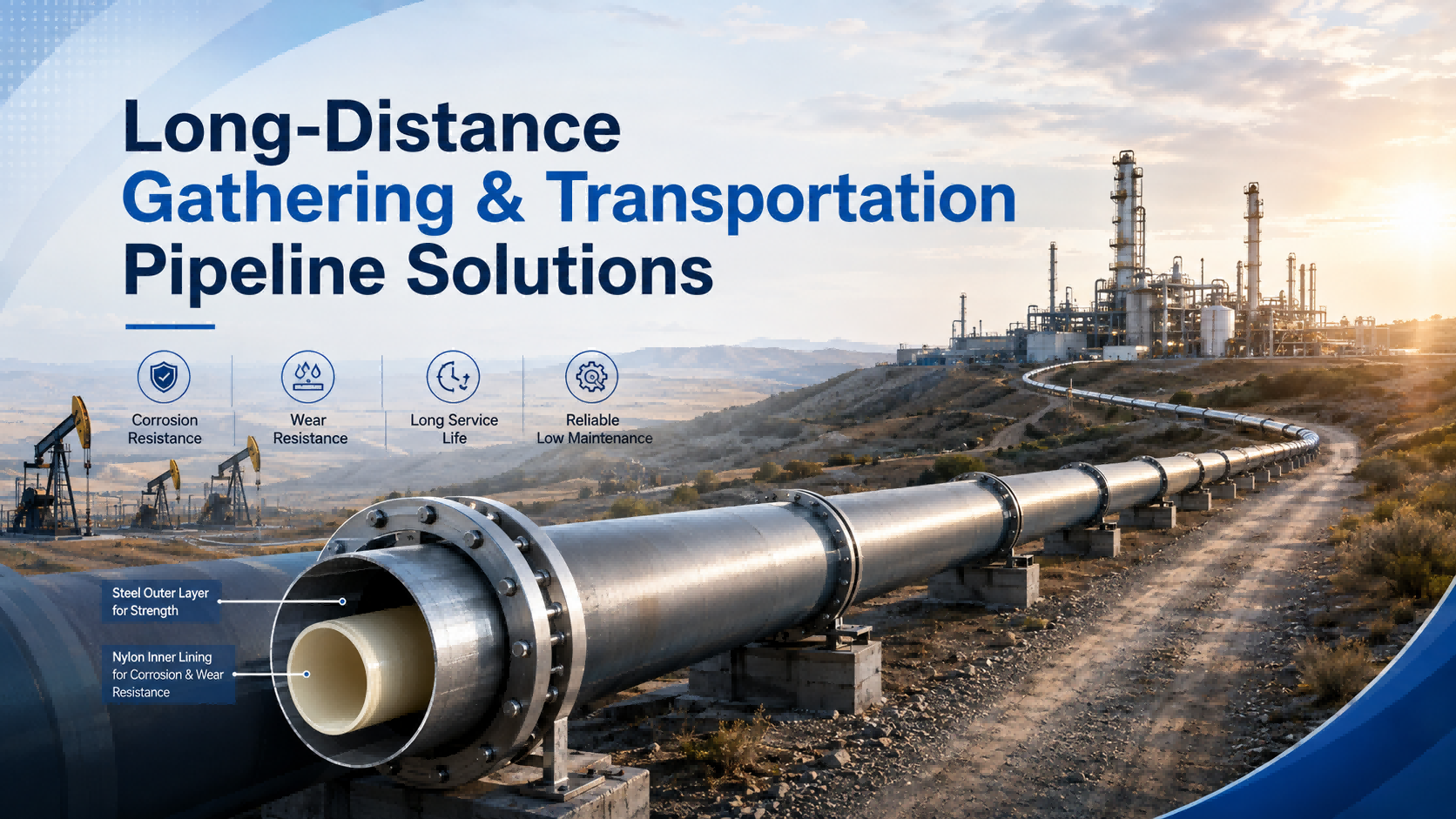
Pipeline Selection for High-H₂S Oilfields
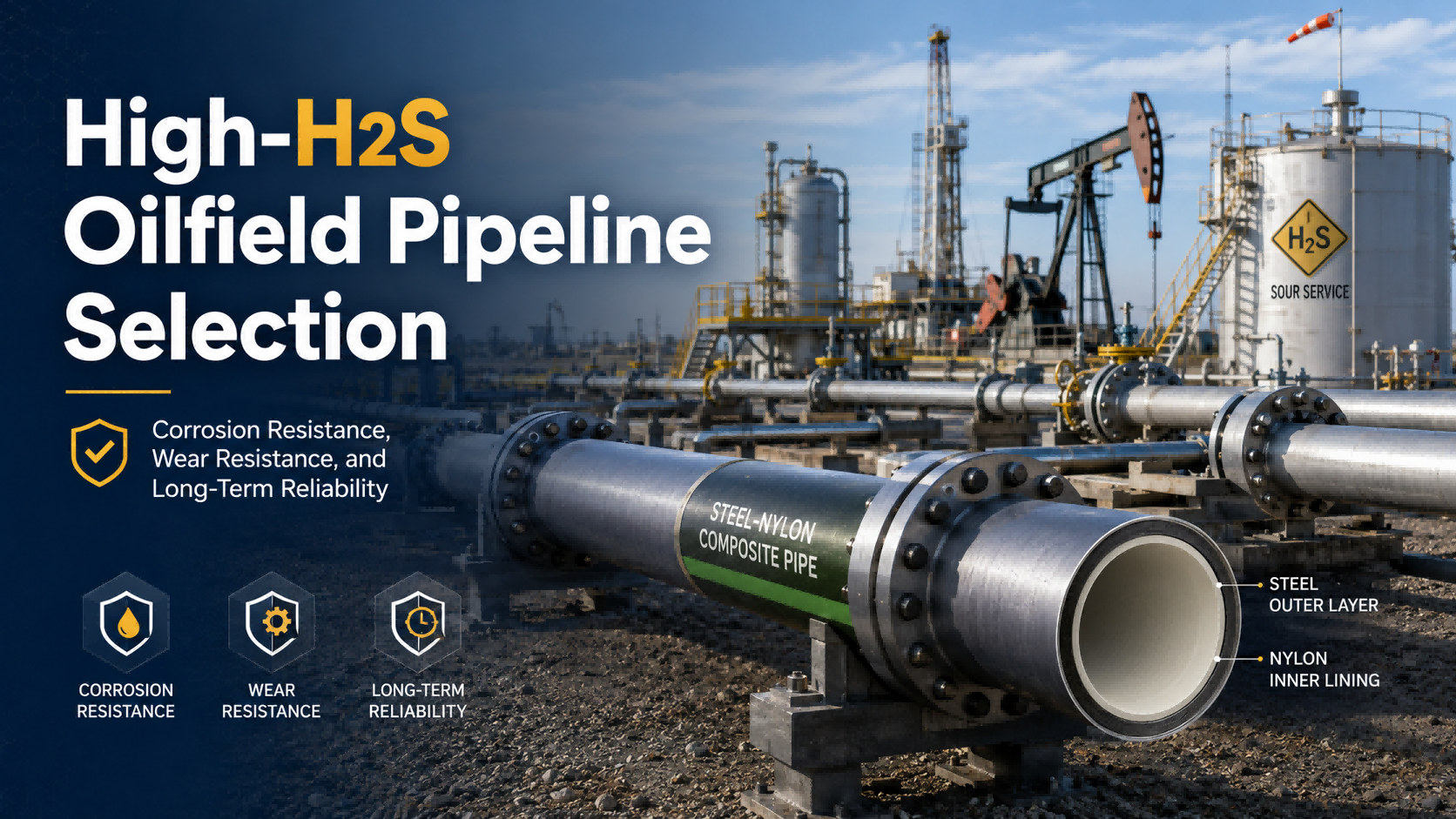
However, once the operating environment shifts to a high-H₂S or sour oilfield, the problem becomes fundamentally different.
The risk associated with H₂S is not limited to conventional metal wall thinning. Under certain combinations of water phase, stress, material properties, and operating conditions, H₂S can also contribute to sulfide stress cracking (SSC), hydrogen-induced cracking (HIC), stress-oriented hydrogen-induced cracking (SOHIC), and other forms of hydrogen-related damage.
This is why pipeline selection for high-H₂S oilfields cannot simply be reduced to:
The higher the H₂S concentration, the higher the stainless-steel grade required.
A sound material-selection strategy must simultaneously consider H₂S partial pressure, water cut, pH, chloride concentration, CO₂, temperature, pressure, flow velocity, solid particles, welds, and the total lifecycle cost of the pipeline system.
ISO 15156 / NACE MR0175 is one of the key international standards governing metallic material selection for H₂S-containing oil and gas production environments. It addresses damage mechanisms including SSC, HIC, and SOHIC.
For oilfield gathering systems involving severe corrosion, high water cut, H₂S, erosion, and scaling at the same time, continuously upgrading to more expensive metallic alloys may not always provide the best balance between reliability and cost.
This is where steel-nylon composite pipe deserves serious consideration.
1. Why Are High-H₂S Oilfields So Challenging for Pipeline Materials?
A high-H₂S oilfield is rarely a simple H₂S-only environment.
The transported fluid may simultaneously contain:
-
H₂S
-
CO₂
-
High-salinity produced water
-
Chloride ions
-
Crude oil
-
Sand and solid particles
-
Corrosive ions
-
Microorganisms
-
High-water-cut emulsions
As a result, pipelines may be exposed not to one failure mechanism, but to several interacting damage mechanisms.
H₂S Corrosion
In the presence of water, H₂S enters the aqueous phase and alters the electrochemical environment at the metal surface.
Iron sulfide corrosion products may form on carbon steel.
Under some operating conditions, this layer can reduce the general corrosion rate to a certain extent. However, it does not mean that the corrosion risk has disappeared.
If the protective layer is damaged by:
-
High fluid velocity
-
Sand or solid particles
-
Deposits
-
Flow disturbances
-
Changes in local chemistry
localized corrosion may develop.
Therefore:
A low average corrosion rate does not necessarily mean that a sour-service pipeline is safe.
2. Hydrogen Damage Can Be More Dangerous Than General Corrosion
This is one of the most important differences between high-H₂S service and ordinary corrosive environments.
H₂S can promote the entry of hydrogen into steel.
When material strength, hardness, residual stress, welding condition, and environmental severity reach certain combinations, several cracking mechanisms may become possible.
SSC — Sulfide Stress Cracking
High-strength steels, weld heat-affected zones, and locally hardened regions require particular attention.
The external appearance of the pipe may show little general corrosion, while cracking has already begun internally.
HIC — Hydrogen-Induced Cracking
Hydrogen entering the steel can accumulate around inclusions, laminations, or metallurgical defects and form internal cracks.
HIC may occur even without extremely high externally applied tensile stress.
SOHIC — Stress-Oriented Hydrogen-Induced Cracking
When hydrogen-induced cracking interacts with applied or residual stress, cracks can link in the through-thickness direction and form a more dangerous cracking pattern.
Therefore, the objective of high-H₂S pipeline design should not simply be:
“Reduce the corrosion rate.”
A more fundamental objective is:
Minimize direct contact between the corrosive medium and critical load-bearing metallic materials while controlling the overall risk of environmentally assisted cracking.
3. H₂S Partial Pressure Is a Key Selection Parameter
Many projects describe the environment only by saying:
H₂S concentration: 5%, 10%, or 20%.
That is not sufficient for proper material selection.
One of the critical parameters in sour-service evaluation is:
H₂S Partial Pressure
Conceptually:
H₂S Partial Pressure ≈ H₂S Mole Fraction × Total System Pressure
This means that the same H₂S concentration can represent very different levels of severity in a low-pressure system versus a high-pressure system.
Before selecting a pipeline material, engineers should therefore obtain at least the following information:
-
H₂S concentration
-
Operating pressure
-
H₂S partial pressure
-
CO₂ content and partial pressure
-
Aqueous-phase pH
-
Chloride concentration
-
Operating temperature
-
Water cut
-
Total dissolved solids
-
Flow velocity
-
Solid particle concentration
-
Pipeline stress condition
For stainless steels, duplex stainless steels, and other corrosion-resistant alloys, the allowable sour-service operating window is also affected by the interaction between H₂S partial pressure, pH, chloride concentration, and temperature.
Therefore, material grades should never be compared without considering the actual service environment.
4. High-H₂S Oilfields Often Also Face CO₂ Corrosion
Real oilfield environments rarely contain only H₂S.
More commonly, pipelines are exposed to:
H₂S + CO₂ + Water + Cl⁻ + Crude Oil + Solid Particles
CO₂ dissolves into the aqueous phase and creates an acidic corrosive environment.
H₂S further changes:
-
Corrosion reactions
-
Corrosion-product films
-
Hydrogen-entry behavior
-
Localized corrosion conditions
Therefore, a material that performs well in a pure CO₂ environment may not necessarily perform equally well in:
CO₂ + H₂S + Cl⁻ + High-Temperature Produced Water
This is why material selection must be based on the complete fluid chemistry rather than one individual corrosive component.
5. Why Is 316L Stainless Steel Not Automatically the Best Choice?
316L stainless steel offers good corrosion resistance, so a common reaction to severe corrosion is:
“If corrosion is serious, use 316L.”
In high-H₂S oilfields, however, this logic is incomplete.
The suitability of 316L for sour service still depends on factors such as:
-
H₂S partial pressure
-
Chloride concentration
-
pH
-
Operating temperature
-
Weld condition
-
Stress level
-
Fabrication quality
Oilfield pipelines also require a large number of field welds.
Excellent corrosion resistance of the base metal does not automatically guarantee that:
the weld metal, heat-affected zone, and the complete field-fabricated pipeline system will provide the same long-term reliability.
Large-scale use of 316L can also mean:
-
Higher material cost
-
Higher welding cost
-
More demanding installation procedures
-
Stricter welding quality control
-
Rapidly increasing costs for large-diameter pipelines
Therefore, from a lifecycle perspective:
Upgrading the entire pipeline to a high-grade metallic alloy is not always the most economical solution.
6. What Are the Limitations of Carbon Steel + Corrosion Inhibitor?
Carbon steel remains one of the most widely used pipeline materials in oil and gas production.
The reasons are straightforward:
It is mature, strong, widely available, and relatively inexpensive.
Under moderate corrosive conditions, a combination of:
Carbon Steel + Corrosion Allowance + Corrosion Inhibitor + Monitoring
can be a highly economical solution.
However, as H₂S, CO₂, water cut, and salinity increase, pipeline integrity becomes increasingly dependent on continuous corrosion management.
Long-term operation may require:
-
Continuous inhibitor injection
-
Corrosion coupons
-
Online corrosion monitoring
-
Ultrasonic thickness inspection
-
Pigging
-
Leak repairs
-
Replacement of corroded sections
-
Shutdown maintenance
As a result, although the initial purchase price of carbon steel may be low, engineers should not compare only:
Cost per meter of pipe.
The more meaningful comparison is:
Total Cost of Ownership over 10 or 20 years.
7. Why Consider Steel-Nylon Composite Pipe for High-H₂S Oilfields?
Steel-nylon composite pipe follows a fundamentally different design philosophy.
Instead of continuously increasing the corrosion resistance of the metallic material itself, it combines:
Steel Load-Bearing Structure + Nylon Corrosion-Resistant Functional Layer
The basic principle is:
Let steel provide pressure-bearing strength, while nylon separates the corrosive medium from the internal steel structure.
This allows the two materials to perform different functions.
For suitable operating conditions, the continuous nylon layer can significantly reduce direct contact between the transported fluid and the internal metallic load-bearing structure.
This approach is fundamentally different from increasing alloy content throughout the entire pipe wall.
8. Advantage 1: Reducing Direct Contact Between H₂S and Steel
In a conventional carbon steel pipeline:
H₂S + Water + CO₂ + Cl⁻
directly contacts the inner steel surface.
In a steel-nylon composite system, the nylon functional layer is designed to form a continuous barrier between the medium and the steel structure.
The engineering philosophy therefore changes from:
“Make the steel more corrosion-resistant.”
to:
“Minimize the participation of steel in the internal corrosion reaction.”
This can be particularly valuable in oil and gas gathering systems involving high water cut, H₂S, and CO₂.
However, professional material selection should never claim that any polymer is “universally resistant to H₂S.”
For extremely high H₂S partial pressures, elevated temperatures, complex hydrocarbon compositions, or long-term high-pressure gas service, engineers should evaluate:
-
Nylon chemical compatibility
-
Permeation behavior
-
Long-term pressure resistance
-
Temperature cycling
-
Pressure cycling
-
Actual fluid exposure
The correct approach is always to confirm that the material is reliable within the specified operating envelope.
9. Advantage 2: Steel Structure Provides Higher Pressure-Bearing Capability
Pure non-metallic pipelines can offer excellent corrosion resistance.
However, in high-pressure, large-diameter, or elevated-temperature applications, structural performance may become an important design limitation.
One major advantage of steel-nylon composite pipe is that it separates:
Corrosion Resistance
from:
Structural Pressure Resistance
The steel structure can provide:
-
Internal pressure resistance
-
Mechanical load capacity
-
Pipeline support strength
-
Ring stiffness for large diameters
The nylon layer mainly provides:
-
Isolation from corrosive internal media
-
Wear resistance
-
Reduced scaling tendency
-
Reduced direct corrosion of the steel surface
Our steel-nylon composite pipes can be engineered for multiple pressure classes and are suitable for various oilfield gathering, produced-water, wastewater, and other corrosive industrial pipeline applications.
10. Advantage 3: Particularly Valuable for Corrosion + Erosion Conditions
Many high-H₂S oilfields are also:
High-water-cut oilfields.
As fields enter the middle and late stages of production, gathering pipelines may carry:
-
Large quantities of produced water
-
Sand
-
Solid particles
-
Corrosion products
-
High-velocity multiphase fluids
The problem is therefore no longer chemical corrosion alone.
It becomes:
Corrosion + Erosion
or:
Erosion-Corrosion
Even if a material has good static corrosion resistance, continuous particle impact at elbows, tees, reducers, valves, and other high-turbulence locations can cause rapid localized damage.
Nylon offers good wear resistance and impact resistance.
This makes steel-nylon composite pipe particularly relevant for:
-
Gathering trunk lines
-
High-water-cut pipelines
-
Oilfield wastewater pipelines
-
Elbows
-
Tees
-
Reducers
-
Valve-group pipelines
-
Pump discharge sections
-
High-erosion locations
11. Advantage 4: Reduced Scaling Tendency
High-salinity oilfield produced water often contains scaling species associated with deposits such as:
-
CaCO₃
-
BaSO₄
-
SrSO₄
-
FeS
As corrosion increases the roughness of a conventional metallic pipe wall, conditions for deposition and scale attachment may become even more favorable.
A comparatively smooth nylon inner surface can help reduce hydraulic resistance and may reduce the tendency of certain deposits to adhere to the pipe wall.
Over the long term, this can help reduce problems such as:
-
Reduction of effective internal diameter
-
Increased pressure drop
-
Higher pumping energy consumption
-
Frequent pigging requirements
-
Scale blockage
Therefore:
Corrosion resistance, wear resistance, and scaling control should not be treated as completely independent issues.
Together, they strongly influence actual pipeline service life.
12. Advantage 5: Flanged Connections Reduce Field Welding
One of the most frequently underestimated areas in sour-service pipeline systems is:
The Joint.
Many pipeline failures initiate not in the middle of straight pipe sections, but around:
-
Welds
-
Heat-affected zones
-
Dissimilar-material joints
-
Flanged areas
-
Installation defects
Our steel-nylon composite pipelines primarily use integral flange connections.
This can reduce the need for extensive field circumferential welding compared with conventional welded steel pipelines.
Potential benefits include reducing:
-
Heat-affected zones
-
Localized hardening
-
Welding residual stress
-
Corrosion differences around welds
-
Variability in field welding quality
For sour-service systems, reducing unnecessary field welds can itself be an important part of improving pipeline-system reliability.
13. Comparison of Pipeline Materials for High-H₂S Oilfields
| Pipeline Material | H₂S Corrosion Strategy | Pressure Capability | Wear Resistance | High-Temperature Capability | Welding Dependence | Overall Cost |
|---|---|---|---|---|---|---|
| Carbon Steel | Corrosion allowance, inhibitors, material control | High | Medium | High | High | Low CAPEX, potentially high maintenance |
| 316L Stainless Steel | Alloy corrosion resistance | High | Medium | High | High | High |
| Duplex / High-Alloy Steel | High-grade alloy corrosion resistance | High | Good | High | High | Very high |
| HDPE | Non-metallic corrosion barrier | Low to medium depending on design | Good | Limited | No conventional welding | Medium |
| FRP | Non-metallic corrosion-resistant structure | Medium depending on design | Structure-dependent | Resin-system dependent | Low | Medium |
| Steel-Nylon Composite Pipe | Steel strength + nylon isolation | High | High | Broad engineered range | Low | Suitable for TCO optimization |
The core positioning of steel-nylon composite pipe is therefore clear:
It is not simply a replacement for one particular pipeline material.
Its greatest value appears when a project simultaneously requires:
High Corrosion Resistance + High Pressure + High Wear Resistance + Long Service Life
14. Ten Parameters Required Before Selecting a Pipeline for a High-H₂S Oilfield
If a pipeline supplier asks only:
“What is the H₂S concentration?”
and then immediately recommends a material, the selection process is usually incomplete.
A proper evaluation should include at least:
-
H₂S concentration and partial pressure
-
CO₂ concentration and partial pressure
-
Design and operating pressure
-
Design and operating temperature
-
Water cut
-
Produced-water pH
-
Chloride concentration and total salinity
-
Solid particle concentration and particle size
-
Flow velocity
-
Pipeline diameter and installation environment
Where possible, engineers should also obtain:
-
Crude-oil properties
-
Aromatic hydrocarbon composition
-
Water chemistry analysis
-
Microbiological conditions
-
Pressure cycling data
-
Temperature cycling data
-
Pigging requirements
-
External corrosion environment
-
Required design life
Only after these parameters are understood can engineers properly compare:
-
Steel-nylon composite pipe
-
Carbon steel
-
Stainless steel
-
Corrosion-resistant alloys
-
Other composite pipeline systems
15. Composite Pipe Does Not Mean NACE / ISO Requirements Can Be Ignored
This is a critical point in high-H₂S pipeline design.
Even if the main pipeline uses a non-metallic internal barrier, the overall system may still contain:
-
Valves
-
Metallic flange components
-
Bolts
-
Instrument connections
-
Pumps
-
Pressure vessels
-
Safety valves
-
Other exposed metallic components
Any metal component directly exposed to sour fluids still needs to be evaluated according to applicable sour-service material requirements and engineering standards.
In other words:
Steel-nylon composite pipe addresses the corrosion and structural-material combination of the pipeline body. It does not replace the sour-service material qualification of the entire oil and gas system.
Making this boundary clear improves, rather than weakens, the technical credibility of the solution.
16. The Most Important Cost in a High-H₂S Oilfield Is Failure Cost
When a high-H₂S pipeline leaks, the cost is far greater than:
Replacing one section of pipe.
The actual chain of costs may include:
Leak → Production Shutdown → Emergency Repair → Excavation → Pipeline Replacement → Pressure Testing → Restart
Because H₂S is also a serious safety hazard, leakage from sour-service pipelines may involve additional personnel-safety and environmental-management requirements.
Therefore, consider a pipeline system costing USD 100,000.
Even if one material option reduces the initial purchase cost by 20%, a single unplanned shutdown may quickly eliminate those savings.
This is why high-H₂S pipeline selection should move away from:
CAPEX-Only Thinking
and toward:
TCO — Total Cost of Ownership
The correct comparison should include:
Material Cost + Installation Cost + Corrosion Protection + Corrosion Inhibitors + Pigging + Inspection + Replacement + Production-Loss Cost
17. Where Is Steel-Nylon Composite Pipe Most Suitable in High-H₂S Oilfields?
After proper operating-condition evaluation, steel-nylon composite pipe is particularly worth comparing in the following systems.
1. High-Water-Cut Oil and Gas Gathering Pipelines
These systems may contain:
H₂S + CO₂ + Water + Cl⁻
The composite structure can be evaluated for its ability to reduce direct internal corrosion of the steel load-bearing structure.
2. Produced-Water and Oilfield Wastewater Pipelines
Typical conditions include:
High Salinity + High Corrosion + Scaling + Solid Particles
3. Valve-Group Pipelines with Severe Corrosion and Erosion
Particularly:
-
Elbows
-
Tees
-
Reducers
-
Pump discharge lines
where local flow velocity and turbulence may be high.
4. Large-Diameter, Higher-Pressure Pipelines
Where pressure resistance or structural stiffness limits the use of certain pure non-metallic systems, the steel structure can provide the main mechanical load-bearing capability.
5. Rehabilitation of Old Pipelines with Frequent Leakage
It is not always necessary to replace an entire pipeline immediately.
A more practical strategy can be to begin with:
100–500 m trial sections
or high-failure components such as:
-
Elbows
-
Tees
-
Pump discharge sections
-
Valve groups
This phased validation approach is often more realistic when introducing a new pipeline material into overseas oil and gas projects.
18. The Final Logic of Pipeline Selection for High-H₂S Oilfields
The key question is not:
“Which pipe material has the best H₂S resistance?”
The real engineering question is:
Under a specified H₂S partial pressure, CO₂ concentration, chloride level, pH, temperature, pressure, flow velocity, and solids loading, which pipeline system can maintain reliable operation throughout the required design life at an acceptable risk level and the lowest reasonable lifecycle cost?
For lower-pressure and moderate-temperature applications, some pure non-metallic systems may offer significant advantages.
For extremely severe high-pressure and high-temperature environments, properly qualified high-grade corrosion-resistant alloys or nickel-based alloys may still be necessary.
However, when a project simultaneously faces:
High H₂S Corrosion + CO₂ Corrosion + High Water Cut + High Pressure + Particle Erosion + Large Diameter + High Maintenance Cost
simply increasing the metallic alloy grade can result in rapidly increasing investment.
In this situation:
Steel-Nylon Composite Pipe Provides a Third Engineering Approach
Instead of only making steel “more corrosion resistant,” it uses a composite-material structure to minimize direct contact between the corrosive medium and the steel load-bearing layer.
The steel provides structural strength.
The nylon provides:
-
Corrosion resistance
-
Wear resistance
-
A smooth internal flow surface
Combined with integral flange connections, the system can provide:
Strength + Corrosion Resistance + Wear Resistance + Installation Efficiency
For high-H₂S oilfield projects seeking long-term reliability and lifecycle-cost optimization, this type of composite pipeline deserves to be included in the formal material-selection process.
Conclusion
There is no universal pipeline material that can be selected for every high-H₂S oilfield regardless of operating conditions.
Professional pipeline selection must be based on a complete evaluation of:
-
H₂S partial pressure
-
CO₂
-
pH
-
Chloride concentration
-
Temperature
-
Pressure
-
Flow velocity
-
Solid content
-
Required service life
For projects where conventional carbon steel suffers frequent corrosion, traditional lined systems experience repeated failure, and full-scale use of high-grade stainless steel or corrosion-resistant alloys is economically excessive, steel-nylon composite pipe offers an alternative solution that combines mechanical strength, corrosion resistance, wear resistance, and lifecycle-cost advantages.
It is particularly worth evaluating for:
-
Oil and gas gathering systems
-
Produced-water pipelines
-
High-water-cut crude-oil transportation
-
Oilfield wastewater systems
-
Severe erosion-corrosion pipelines
The most reliable approach is to combine actual-fluid compatibility testing, trial-section operation, and lifecycle cost analysis before large-scale deployment.
A high-H₂S oilfield does not necessarily need the most expensive pipeline material. It needs the pipeline system that is best matched to the actual operating conditions and capable of delivering reliable long-term service.
High-Salinity Produced Water Pipeline Solutions: How to Reduce Corrosion, Scaling, Erosion, and Frequent Leakage
How to Reduce Maintenance Costs for Water Injection Pipelines: A Systematic Analysis from Corrosion and Scaling to Total Cost of Ownership