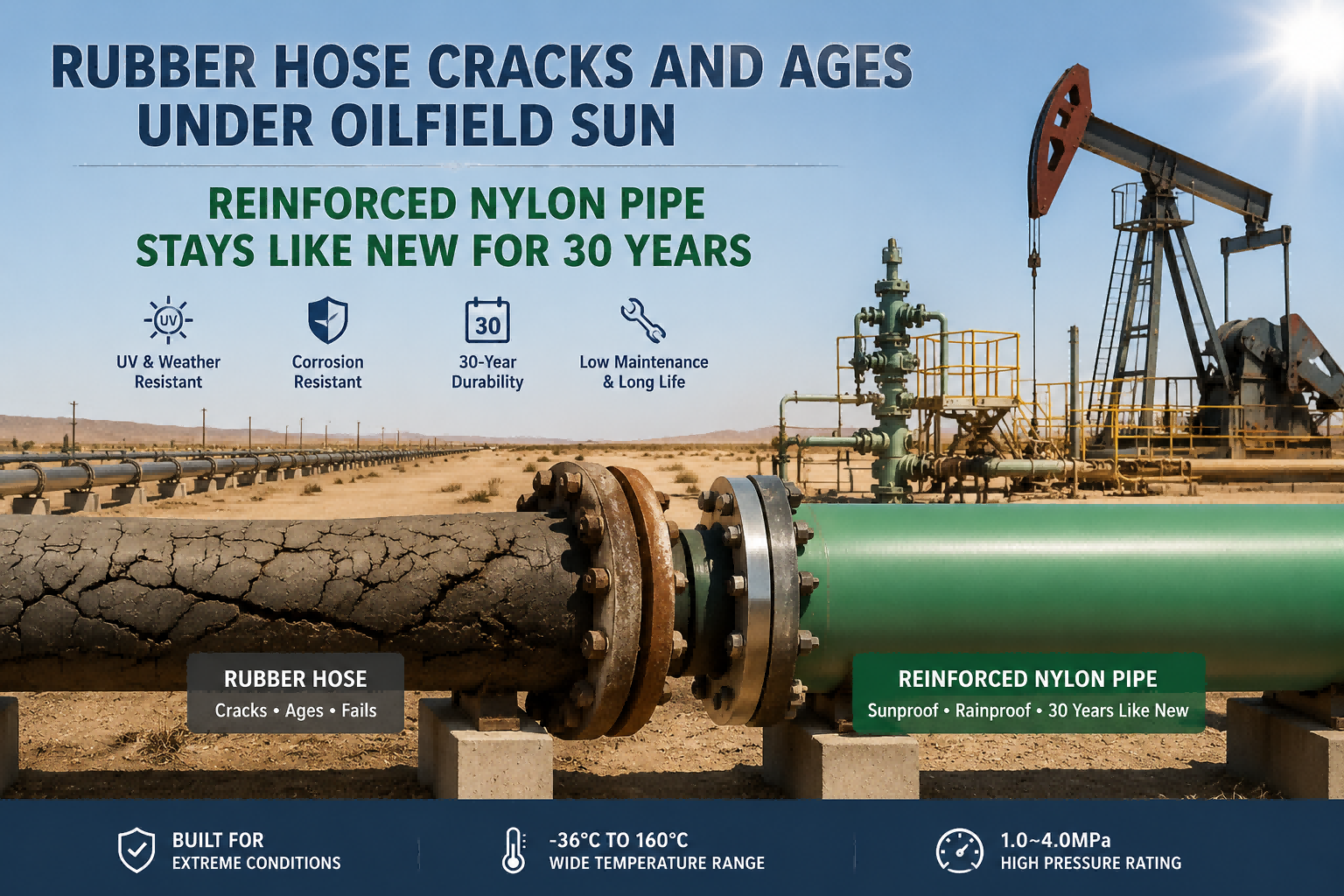
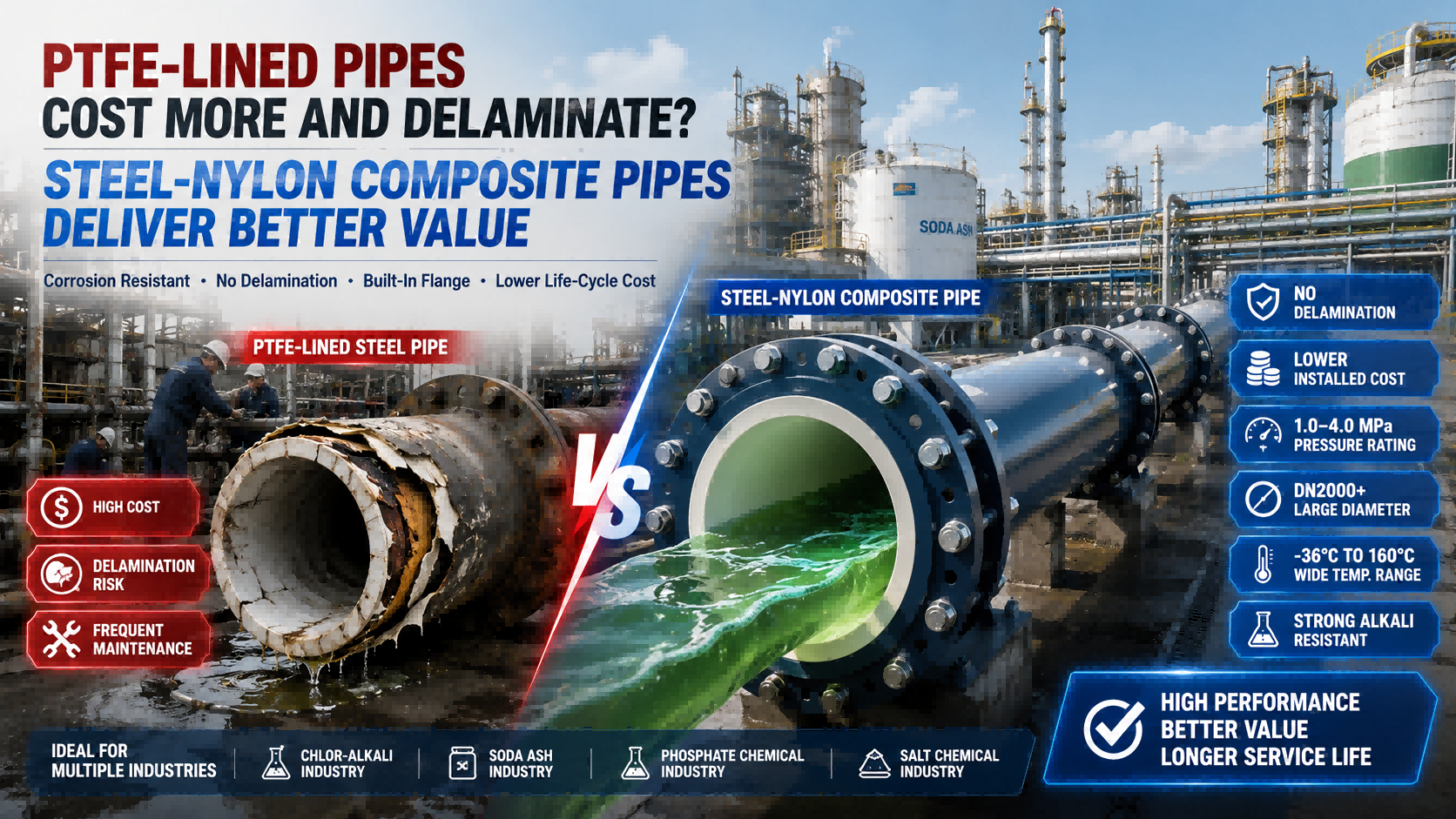
Short Service Life of High-Pressure Oilfield Gathering Pipelines? How Steel–Nylon Composite Pipes Offer a New Solution for Wear Resistance and Pressure Performance
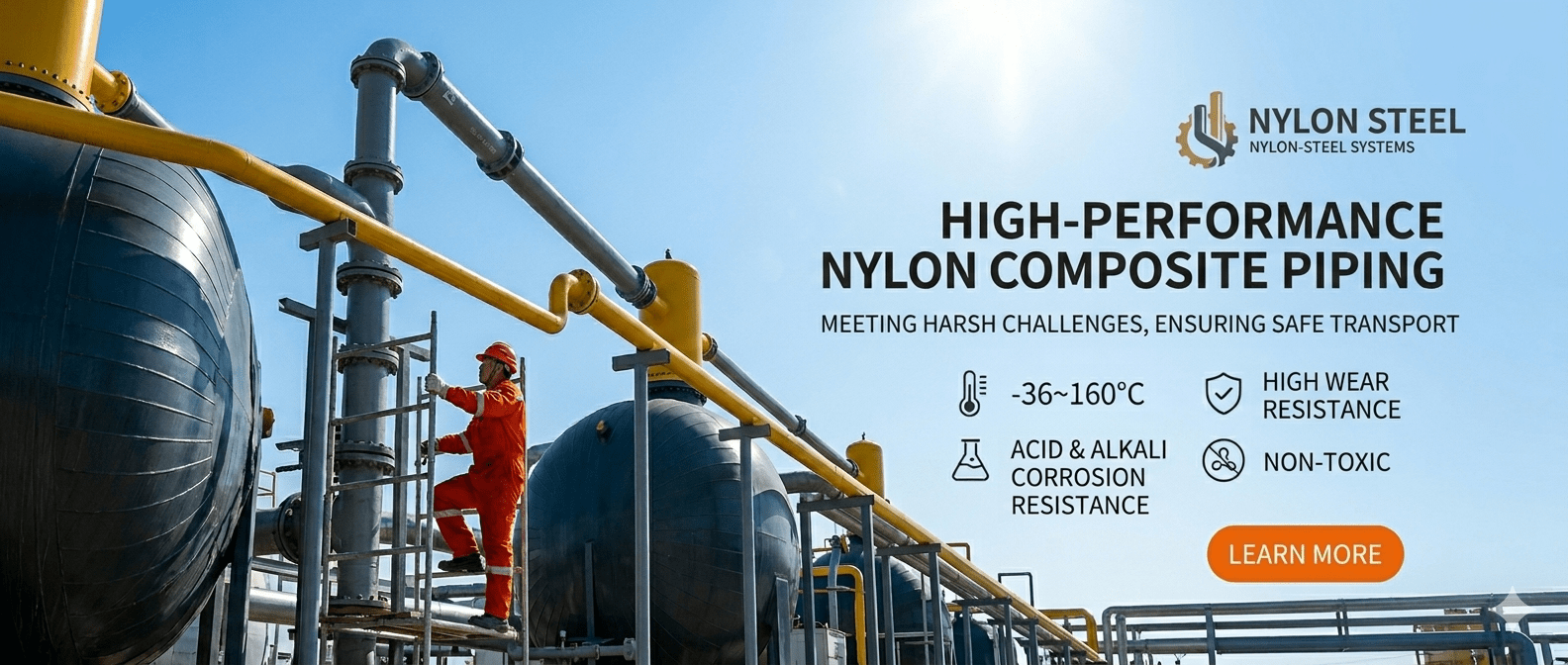
Introduction: Why Is the Service Life of Oilfield Gathering Pipelines Becoming an Increasing Concern?
In oil and gas development, gathering pipelines transport crude oil, natural gas, produced water, and multiphase fluids. They are essential infrastructure connecting production wells, gathering stations, processing facilities, and transportation systems.
As oilfields enter the middle and later stages of development, water cut often increases, while the concentrations of salts, solid particles, and corrosive components in produced fluids may change. At the same time, some gathering systems must accommodate higher operating pressures, more complex pressure fluctuations, and longer transportation distances.
Under these challenging operating conditions, conventional gathering pipelines may face several problems:
-
Corrosion: Highly saline produced water and fluids containing CO₂ and H₂S can accelerate internal corrosion in metallic pipelines.
-
Wear: Sand and other solid particles produced from oil wells can continuously erode pipeline interiors, particularly at elbows and locations with high local flow velocities.
-
Pressure resistance: Pipelines must withstand continuous internal pressure, pressure fluctuations, and transient loads during startup and shutdown within their specified design limits.
-
Maintenance: Corrosion perforation, localized erosion, and leakage at pipeline connections can lead to frequent repairs and increased production downtime.
Internal corrosion can cause wall thinning, pitting, and leakage, reducing a pipeline's ability to withstand internal pressure and external loads. Appropriate material selection, quality control, and operational monitoring are therefore essential for maintaining pipeline integrity.
For oilfield operators, pipeline selection is no longer simply a matter of comparing initial procurement costs. It requires a comprehensive evaluation of corrosion resistance, wear resistance, pressure performance, operational reliability, and total lifecycle cost.
By combining the structural strength of steel with the corrosion-resistant and wear-resistant characteristics of nylon, steel–nylon composite pipes provide an alternative pipeline solution for certain demanding oilfield gathering applications.
1. Why Do High-Pressure Oilfield Gathering Pipelines Often Have a Short Service Life?
1.1 The Combined Effects of High Operating Pressure and Internal Corrosion
Oilfield gathering pipelines must withstand continuous internal pressure while potentially remaining in contact with corrosive fluids for extended periods.
For example, in high-water-cut oilfields, produced fluids may contain high concentrations of dissolved salts, CO₂, and H₂S.
When these components interact with pipeline surfaces, different corrosion mechanisms may occur.
CO₂ can dissolve in water and create a corrosive environment. H₂S can also contribute to corrosion and, under certain combinations of material properties, stress, and environmental conditions, may cause damage mechanisms such as sulfide stress cracking.
For conventional carbon steel pipelines, inadequate internal corrosion protection may lead to localized pitting and wall thickness loss during long-term operation.
It is important to recognize that high pressure does not necessarily accelerate corrosion by itself. However, when corrosion reduces the effective wall thickness of a pipeline, its pressure-bearing safety margin decreases.
Therefore, material selection for high-pressure gathering pipelines must address both structural pressure resistance and long-term corrosion control.
1.2 High Flow Velocity and Solid Particles Cause Localized Erosion
Sand production is a common challenge in certain oil and gas reservoirs.
Sand, mineral particles, and other solid contaminants carried by produced fluids may collide with the internal surfaces of pipelines, resulting in localized erosion.
This phenomenon can be particularly significant at elbows, tees, reducers, and other locations where the direction of fluid flow changes.
For pipelines continuously transporting sand-containing fluids, erosion may cause two major problems.
First, localized wall thinning can reduce the pressure-bearing capacity of the pipeline.
Second, erosion may damage the internal protective layer, exposing the metallic substrate directly to corrosive fluids.
When corrosion and erosion occur simultaneously, the risk of localized pipeline failure may increase.
Consequently, simply increasing the pipeline's pressure rating cannot fully address service-life problems associated with complex oilfield gathering conditions.
1.3 Frequent Pressure Fluctuations Increase the Risk of Pipeline Failure
Operating pressure in oilfield gathering systems does not always remain constant.
Changes in well production rates, pump startup and shutdown, valve operations, and multiphase flow behavior can all cause pressure fluctuations.
For pipelines operating over extended periods, several factors must be considered:
-
Maximum operating pressure and potential transient overpressure.
-
Fatigue risks associated with repeated pressure cycles.
-
Remaining pressure-bearing capacity after internal corrosion or erosion.
-
Long-term reliability of flanges, seals, and other connecting components.
Steel–nylon composite pipes also require comprehensive pressure design and fatigue evaluation.
The actual pressure-bearing capacity of a composite pipeline cannot be determined solely from the mechanical strength of its steel components.
1.4 Localized Pipeline Failures Can Lead to High Maintenance Costs
In remote oilfields, desert production areas, and gathering systems located in difficult terrain, pipeline repairs may require substantial labor, equipment, and transportation resources.
A pipeline leak may involve production shutdown, fluid isolation, pipeline replacement, site cleanup, and pressure testing before operations can resume.
For long-distance gathering systems, even relatively inexpensive individual repairs can result in substantial cumulative operating costs when failures occur repeatedly.
Therefore, improving long-term pipeline reliability can deliver greater engineering value than simply reducing initial procurement costs.
2. Why Are Steel–Nylon Composite Pipes Suitable for Challenging Oilfield Gathering Applications?
The fundamental design concept of steel–nylon composite pipes is to combine the complementary properties of steel and nylon, creating a composite pipeline that addresses both structural load-bearing requirements and internal protection.
Unlike pipelines that rely on a single material to perform all functions, steel–nylon composite pipes use a multilayer structure in which different materials serve different purposes.
2.1 Steel Provides Structural Support and Enhances Pressure-Bearing Capacity
Pressurized transportation systems require pipelines with sufficient strength and stiffness to withstand internal pressure and external loads.
Steel offers high mechanical strength and rigidity, making it an important load-bearing component of steel–nylon composite pipes.
With appropriate structural design, the steel reinforcement provides pressure-bearing capacity while improving resistance to external mechanical loads.
Compared with pipes made entirely from polymer materials, composite pipes incorporating a steel load-bearing structure offer certain design advantages in terms of stiffness and structural stability.
This combination of steel and nylon provides additional engineering options, particularly for industrial projects requiring larger pipe diameters or higher pressure-bearing capacities.
Our steel–nylon composite pipe products are available in pressure classes ranging from 1.0 to 4.0 MPa. Product selection can be tailored to the design pressure, pipe diameter, and operating conditions of different engineering projects.
However, a pressure rating of 1.0–4.0 MPa does not mean these products are suitable for every application classified as high-pressure oil and gas transportation.
Actual project suitability must be determined through comprehensive design and verification of the pipe body and connection system, considering pipe diameter, temperature, pressure fluctuations, fluid characteristics, and applicable engineering standards.
Projects requiring design pressures beyond this range require additional product development and pressure-performance evaluation.
Existing pressure-rated products should not be used beyond their verified design limits.
2.2 The Nylon Inner Layer Forms a Protective Barrier Against Corrosive Fluids
One of the defining characteristics of steel–nylon composite pipes is the incorporation of a nylon layer inside the steel load-bearing structure.
When the material is properly selected, the inner layer remains intact, and the connections are adequately protected, the nylon layer can reduce direct contact between transported fluids and the steel structure.
This design can be valuable for transporting highly saline produced water, saline industrial wastewater, and other compatible liquid media.
Conventional carbon steel pipelines often require internal coatings, corrosion inhibitors, or other protective measures to reduce corrosion risks.
Steel–nylon composite pipes offer an alternative approach by integrating a polymer protective layer with a steel load-bearing structure.
This configuration provides several potential advantages:
First, it reduces direct contact between corrosive liquids and the metallic substrate.
Second, it helps reduce the risk of pressure-bearing capacity loss caused by internal corrosion and wall thinning.
Third, under suitable fluid and operating conditions, it may reduce internal corrosion-related maintenance requirements.
However, the chemical resistance of nylon depends on its specific grade, fluid concentration, operating temperature, and exposure duration.
For highly acidic fluids, oil and gas mixtures containing H₂S, and other chemically complex media, suitability must be confirmed through material compatibility testing, permeability evaluation, and connection-system verification.
Multiphase flow applications containing natural gas, CO₂, or H₂S require particular attention to the potential permeation of gases through the nylon layer and their effects on the steel load-bearing structure and composite interface.
The chemical resistance of nylon alone is insufficient to establish the suitability of the complete pipeline system.
2.3 Nylon Inner Surfaces Help Improve Wear Performance in Particle-Containing Fluid Transportation
Conventional metallic pipelines may experience continuous internal erosion when transporting fluids containing sand or other solid particles.
When particle impact and corrosion occur simultaneously, localized wall thickness loss may accelerate.
Properly modified nylon materials offer useful toughness and wear-resistant properties.
By selecting suitable nylon formulations and optimizing the inner-layer structure and manufacturing process, the wear performance of a pipeline can be improved for specific particle-containing fluid transportation requirements.
In oilfield gathering systems, this material combination may be considered for applications such as:
-
Gathering pipelines transporting sand-containing produced water.
-
Pipelines transporting oil–water mixtures containing solid particles.
-
Highly saline oilfield wastewater transportation systems.
-
Gathering lines exposed to combined corrosion and moderate erosion.
Wear resistance is not determined solely by the name of the material.
It is also influenced by particle hardness, particle size, concentration, flow velocity, impact angle, and operating temperature.
For applications involving high sand concentrations, high flow velocities, or frequent particle impacts, representative erosion testing should be conducted to verify the actual wear performance of the nylon inner layer.
One of our key product development priorities is to improve the overall suitability of steel–nylon composite pipes for industrial transportation applications where corrosion and wear occur simultaneously.
We pursue this objective through material modification and composite structural optimization.
3. How Do Steel–Nylon Composite Pipes Combine Wear Resistance, Corrosion Resistance, and Pressure Performance?
For high-pressure gathering systems, wear resistance, corrosion resistance, and pressure-bearing capacity are not entirely independent properties.
Together, they determine the long-term reliability of a pipeline under demanding operating conditions.
3.1 Composite Structures Allow Different Materials to Perform Different Functions
Conventional carbon steel pipelines primarily rely on the steel pipe wall to withstand structural loads while remaining in direct contact with the transported fluid.
When the fluid is highly corrosive, appropriate protective measures become necessary.
Steel–nylon composite pipes distribute structural and protective functions between different materials.
The steel load-bearing structure primarily provides mechanical strength and structural stability.
The nylon inner layer serves as the fluid-contact surface and provides internal protection for the metallic structure.
This arrangement allows engineers to optimize material selection separately for pressure-bearing requirements and fluid characteristics.
Compared with designs that rely entirely on higher steel grades or increased metallic wall thickness, composite structures provide an alternative approach to transporting challenging industrial fluids.
3.2 Reducing the Impact of Internal Corrosion on Pressure-Bearing Structures
If internal corrosion in conventional carbon steel pipelines is not effectively controlled, pipe walls may gradually become thinner.
When the remaining wall thickness falls below the required safety limit, the pipeline may face a risk of failure even if its actual operating pressure remains below the original design pressure.
By incorporating an internal protective layer, steel–nylon composite pipes can reduce direct contact between compatible transported fluids and the steel load-bearing structure.
As long as the inner protective layer remains intact, this design may reduce the effects of internal corrosion on the steel structure.
For gathering systems requiring stable long-term operation, this structural design offers practical engineering value.
Nevertheless, external corrosion, inner-layer damage, connection leakage, and gas permeation must still be evaluated and controlled separately.
3.3 Optimizing Internal Pipeline Structures to Reduce Localized Erosion
Pipeline wear resistance depends not only on material properties but also on internal flow conditions.
During the design and manufacturing of steel–nylon composite pipes, particular attention should be given to inner-surface continuity, smooth transitions at connections, and appropriate local structural details.
For sand-containing fluids, erosion risks can be reduced through suitable pipe diameter selection, flow velocity control, optimized elbow geometry, and the elimination of unnecessary abrupt changes in flow direction.
Where erosion is particularly severe, localized structural reinforcement or replaceable wear-resistant components may also be considered.
An effective wear-resistant pipeline solution requires more than a suitable material. It must combine material performance with appropriate pipeline system design.
4. What Are the Key Advantages of Our Steel–Nylon Composite Pipes for Challenging Oilfield Applications?
As an industrial pipeline manufacturer specializing in the development and production of reinforced nylon pipes and steel–nylon composite pipes, we focus on combining the structural properties of steel with the functional characteristics of nylon.
Our objective is to provide pipeline products suitable for different industrial transportation environments.
For oilfield gathering applications, we emphasize the following advantages.
Advantage 1: Combining Steel and Nylon for Pressure Resistance and Internal Protection
For projects requiring the transportation of corrosive liquids under pressure, our steel–nylon composite pipes incorporate a steel load-bearing structure and a nylon inner layer.
This configuration provides pressure-bearing capacity while reducing direct contact between transported fluids and the metallic structure.
For liquid gathering systems involving high water cut, high salinity, and moderate erosion risks, our products offer a material selection option that addresses multiple performance requirements.
Advantage 2: Pressure Classes of 1.0–4.0 MPa for Different Engineering Requirements
Our steel–nylon composite pipes are available in pressure classes ranging from 1.0 to 4.0 MPa.
Appropriate specifications can be selected according to actual operating conditions.
For pressurized transportation projects that fall within the product's verified design limits, the composite structure provides the required pressure-bearing performance.
Rather than focusing solely on material strength, we emphasize the compatibility between the pipe body, connection system, and actual operating conditions.
Projects involving frequent startup and shutdown, pressure fluctuations, or complex external loads require additional engineering calculations and appropriate testing to confirm product suitability.
Advantage 3: Combining Corrosion Resistance and Wear Resistance for Complex Liquid Transportation
Oilfield gathering fluids are rarely uniform.
In high-water-cut oilfields, produced fluids may contain high concentrations of dissolved salts, solid particles, and various chemical components.
For these fluids, considering corrosion or erosion alone may be insufficient for reliable material selection.
By combining modified nylon materials with steel load-bearing structures, our steel–nylon composite pipes provide a potential solution for liquid transportation applications involving both corrosion and wear.
After appropriate material compatibility and wear testing, product selection and structural design can be optimized according to specific project requirements.
Advantage 4: Integrally Formed Flange Connections Offer a Non-Welded Installation Option
Pipeline connections are among the critical areas that require particular attention during long-term gathering system operation.
Conventional welded steel pipelines may require welding during installation, modification, and maintenance.
In oilfields and other production areas involving flammable or explosive substances, hot work generally requires strict safety management.
Our steel–nylon composite pipes can incorporate integrally formed flange connections, providing a non-welded installation option for projects that meet the applicable design conditions.
This connection method can reduce the need for onsite pipe-body welding and facilitate the installation, removal, and replacement of certain pipeline sections.
However, the actual reliability of a flanged connection depends on flange design, gasket selection, bolt preload, and installation quality.
For high-pressure systems or pipelines transporting hazardous fluids, connection design, sealing verification, and pressure testing must comply with applicable engineering standards.
Non-welded installation does not eliminate all construction risks. Onsite operations must still comply with relevant oilfield safety requirements.
Advantage 5: Multiple Pipe Diameters and Customized Selection for Complex Applications
Oilfield gathering projects vary significantly in transportation volume, design pressure, pipeline length, and fluid composition.
To address these requirements, we offer reinforced nylon pipes and steel–nylon composite pipes in multiple specifications.
Pipe diameter, pressure-bearing structure, and connection methods can be selected according to project requirements.
For large-diameter gathering pipelines, oilfield wastewater transportation systems, and other industrial liquid transportation projects, suitable composite pipeline configurations can be evaluated based on pipe diameter, operating pressure, and flow requirements.
It is important to recognize that large-diameter manufacturing capability does not automatically imply high-pressure capability.
For specific large-diameter, high-pressure projects, product suitability must be established through structural design and appropriate pressure testing.
5. How Do Steel–Nylon Composite Pipes Compare with Conventional Oilfield Gathering Pipelines?
Common pipeline materials used in oilfield gathering systems include carbon steel, stainless steel, fiberglass-reinforced plastic (FRP), and various composite materials.
Each material has distinct characteristics in terms of pressure resistance, corrosion resistance, wear performance, and installation requirements.
For projects involving simultaneous corrosion, erosion, and pressure-bearing requirements, the following comparison provides a useful starting point.
| Comparison Criteria | Conventional Carbon Steel Pipe | Fiberglass-Reinforced Plastic (FRP) Pipe | Steel–Nylon Composite Pipe |
|---|---|---|---|
| Structural load-bearing | Steel pipe wall carries structural loads | Fiber-reinforced resin structure carries structural loads | Steel structure provides the primary load-bearing capacity |
| Internal corrosion protection | Appropriate corrosion protection may be required depending on the fluid | Good resistance to certain corrosive fluids, depending on the resin system | Nylon inner layer reduces direct contact between compatible fluids and the steel structure |
| Wear resistance in sand-containing fluids | May experience localized erosion and erosion–corrosion | Depends on resin formulation, fiber structure, and wear-resistant layer design | Wear performance can be improved through nylon modification and inner-layer optimization |
| Pressure performance | Determined by steel grade, wall thickness, and applicable design standards | Determined by structural design, manufacturing quality, and testing | Determined by steel load-bearing structure, composite design, and complete-pipe testing |
| Pressure fluctuation resistance | Requires appropriate fatigue and pressure-cycle evaluation | Requires evaluation of composite structure and long-term connection performance | Requires evaluation of the combined performance of steel, nylon, and connecting components |
| Pipeline connections | Welding, mechanical connections, and other methods | Bell-and-spigot, flange, or other specialized connections depending on product design | Integrally formed flange connection options |
| Long-term maintenance priorities | Corrosion, erosion, welds, and connections | Structural damage, connection sealing, and fluid compatibility | Inner-layer integrity, steel structure, composite interface, and connection sealing |
Actual performance varies according to material grade, manufacturer, product design, and manufacturing process.
Therefore, pipeline service life cannot be determined solely by material category.
Specific projects should compare product design data and verified test results under relevant fluid, pressure, temperature, and operating conditions.
The core value of steel–nylon composite pipes lies in combining the structural load-bearing capacity of steel with the internal protective function of nylon, offering an alternative to conventional single-material pipeline designs.
6. How to Select Steel–Nylon Composite Pipes for High-Pressure Oilfield Gathering Systems
For engineering procurement specialists and pipeline design engineers, selecting steel–nylon composite pipes requires more than checking pressure ratings and pipe diameters.
The most important consideration is whether the material and complete pipeline system can meet actual operating requirements.
We recommend evaluating the following six factors.
6.1 Determine Design Pressure and Pressure Fluctuation Range
The first step is to establish the system's normal operating pressure, maximum design pressure, and potential transient overpressure.
For projects considering products with pressure classes of 1.0–4.0 MPa, the allowable working pressure of the selected pipeline and connection system must meet the project's design requirements.
Long-term performance should also be evaluated according to operating temperature and pressure-cycle conditions.
Products must not be used beyond their rated pressure or without appropriate verification.
6.2 Analyze the Composition of the Transported Fluid
Produced fluids can vary significantly between oilfields.
During material selection, engineers should identify:
-
Whether the transported fluid is crude oil, produced water, an oil–water mixture, or gas–liquid multiphase flow.
-
The concentrations of dissolved salts, CO₂, H₂S, and other corrosive components.
-
Solid particle concentration, particle size, and hardness.
-
Actual operating temperature and potential temperature fluctuations.
-
Cleaning chemicals, corrosion inhibitors, and other production chemicals used in the system.
For applications involving gas, H₂S, or elevated permeation risks, comprehensive material compatibility and structural suitability evaluations should be conducted.
6.3 Evaluate Actual Flow Velocity and Erosion Risks
Proper flow velocity design is essential for controlling pipeline wear in sand-containing gathering systems.
Excessively high flow velocities may intensify particle erosion.
However, under certain operating conditions, excessively low velocities may cause particle deposition, blockage, or other operational problems.
An appropriate flow velocity range should therefore be established based on the fluid properties and solid particle characteristics.
For elbows, tees, and other locations with complex flow patterns, targeted protective measures can be developed using erosion calculations and relevant test results.
6.4 Verify the Pressure Performance of the Complete Pipeline and Connection System
For composite pipelines, ensuring that the pipe body meets the design requirements is not sufficient to guarantee the reliability of the entire transportation system.
Flanges, gaskets, fittings, and other components must also meet the applicable pressure and fluid compatibility requirements.
Engineering design should include a comprehensive evaluation of the pipe body and connection system, considering pressure, temperature, external loads, and relevant technical standards.
For reference, API Specification 15S addresses manufacturing and qualification requirements for spoolable reinforced plastic line pipe used in the oil and gas industry.
However, this standard has a specific product scope and should not automatically be treated as a certification basis for rigid steel–nylon composite pipes.
The appropriate pipeline design and product standards must be determined for each project.
6.5 Consider Long-Term Operation and Maintenance Requirements
Inspection, monitoring, and maintenance requirements should be incorporated into pipeline material selection.
Even when a composite pipeline incorporates an internal protective layer, external corrosion, connection integrity, inner-layer condition, and abnormal pressure variations still require attention.
Long-term reliable transportation depends on combining appropriate material selection with effective operational management.
6.6 Choose a Manufacturer with Custom Design and Production Capabilities
Operating conditions vary considerably between oilfield projects.
Standardized products may not meet every engineering requirement without modification.
For applications involving highly corrosive fluids, significant solid particle content, or specialized connection requirements, complete design conditions should be established before product selection and technical confirmation.
Our steel–nylon composite pipes can be selected and structurally optimized according to project design pressure, pipe diameter, fluid characteristics, and installation requirements.
We provide technical support to help customers identify suitable pipeline solutions for their industrial transportation projects.
7. How Can Steel–Nylon Composite Pipes Help Reduce the Total Lifecycle Cost of Oilfield Gathering Systems?
For oilfield operators, initial pipeline procurement represents only one component of total project expenditure.
From a long-term operational perspective, pipeline costs also include installation, routine inspection, maintenance, repairs, production downtime, and replacement.
Therefore, evaluating the economic value of steel–nylon composite pipes requires a Total Cost of Ownership (TCO) approach.
7.1 Reducing Maintenance Requirements Associated with Corrosion and Wear
Under appropriately verified corrosive and abrasive operating conditions, steel–nylon composite pipes can reduce direct exposure of the steel load-bearing structure to transported fluids through their internal protective layer.
If this results in fewer internal corrosion and localized erosion failures, related repair and replacement requirements may decrease.
For oilfield projects involving long gathering pipelines and challenging maintenance conditions, this potential benefit deserves consideration during engineering design.
7.2 Reducing Production Losses Caused by Pipeline Failures
For oilfields operating continuously, unplanned transportation interruptions can generate substantial indirect costs.
For example, a pipeline leak may require production equipment shutdown, fluid isolation, fault investigation, pipeline replacement, and recommissioning.
If a properly selected pipeline material extends maintenance intervals under actual operating conditions, it may reduce unplanned interruptions caused by pipeline failures.
Pipeline economics should therefore not be evaluated solely on the basis of purchase price per unit length.
7.3 Optimizing Installation and Replacement Costs
For projects suitable for flange connections, our steel–nylon composite pipes offer a non-welded connection option.
When engineering design and safety requirements are satisfied, this configuration can reduce onsite welding requirements and facilitate the installation and replacement of certain pipeline sections.
This feature may be particularly valuable for pipeline modification projects that must be completed within limited production shutdown windows.
However, the cost of gaskets, fasteners, installation space, and periodic connection inspections should also be considered.
7.4 Reassessing Pipeline Value from a Long-Term Operational Perspective
Consider an oilfield project comparing conventional carbon steel pipes with steel–nylon composite pipes.
The following model can be used:
Total Pipeline Lifecycle Cost = Initial Procurement Cost + Installation Cost + Inspection and Maintenance Cost + Repair and Replacement Cost + Unplanned Production Downtime Losses + Decommissioning Cost
Within this framework, the economic advantages of steel–nylon composite pipes must be verified using project-specific data.
If the initial investment in composite pipes is higher than that of conventional pipes, but their use significantly reduces maintenance, replacement, and production interruption costs under comparable operating conditions, their long-term total cost may be more favorable.
Conversely, if operating conditions are relatively mild and conventional pipelines already meet service-life and maintenance requirements, the additional investment in composite pipes may not produce a significant economic benefit.
Our priority is therefore to provide pipeline solutions that match actual operating conditions, rather than focusing exclusively on initial material procurement costs.
8. Key Application Areas for Steel–Nylon Composite Pipes in Oilfield Gathering Systems
Considering the structural characteristics of steel–nylon composite pipes, we see potential for further development in several oilfield liquid transportation applications.
8.1 High-Water-Cut Oilfield Produced Fluid Gathering Pipelines
In high-water-cut oilfields, the water phase in produced fluids may expose metallic pipelines to prolonged internal corrosion risks.
If the fluid also contains solid particles, the combined effects of erosion and corrosion must be considered.
For projects where pressure, temperature, and fluid composition fall within the product's verified operating limits, steel–nylon composite pipes may be considered as a candidate material.
8.2 High-Salinity Oilfield Produced Water Transportation Systems
Highly saline produced water can create demanding corrosion protection requirements for conventional metallic pipelines.
Composite pipes combining a nylon inner layer with a steel load-bearing structure provide an alternative internal protection approach for transporting certain high-salinity aqueous fluids.
Before implementation, material compatibility must be confirmed according to salt composition, temperature, chemical additives, and other corrosive components.
8.3 Sand-Containing Oilfield Liquid Gathering Lines
Oilfield liquid transportation systems containing solid particles require a combination of wear resistance and structural pressure-bearing capacity.
Following appropriate material and erosion testing, steel–nylon composite pipes may be evaluated for use in relevant sand-containing fluid transportation projects.
Particular attention should be given to elbows and other locally vulnerable areas in applications involving high flow velocities, severe sand production, or frequent particle impacts.
8.4 Rehabilitation of Aging Oilfield Liquid Gathering Pipelines
Some aging oilfield gathering pipelines require replacement or rehabilitation because of long-term corrosion, erosion, or frequent maintenance.
For pipeline sections that fall within the design limits of steel–nylon composite pipes, composite replacement solutions can be evaluated according to actual fluid characteristics and operating pressure.
Appropriate material selection and connection design may improve internal protection and reduce subsequent maintenance requirements.
However, gathering trunk lines transporting natural gas, high-gas-content multiphase flow, or fluids under specialized high-pressure conditions require separate material, gas-tightness, permeability, and integrity evaluations.
Suitability conclusions established for liquid transportation pipelines should not automatically be extended to these applications.
9. From Pipeline Manufacturer to Industrial Transportation Solution Provider: Our Technology Development Priorities
For challenging oilfield projects, valuable pipeline products must do more than meet basic dimensional and pressure requirements.
They should also allow for material selection and structural design tailored to specific operating conditions.
As a manufacturer of reinforced nylon pipes and steel–nylon composite pipes, we continue to optimize our technology in response to complex industrial transportation requirements.
9.1 Continuous Improvement of Nylon Material Performance
We study how material modification affects nylon wear resistance, mechanical properties, and fluid compatibility under different operating conditions.
These include variations in transported media, solid particle content, and operating temperature.
Through targeted material selection and performance verification, we aim to improve product suitability for challenging applications.
9.2 Enhancing Composite Structural Design and Pressure-Bearing Performance
We continue to optimize the combination of steel load-bearing structures and nylon inner layers for different pipe diameters, design pressures, and external loading conditions.
Key areas of attention include composite structural dimensional stability, long-term pressure-bearing capacity, and the interaction between different materials during temperature variations.
9.3 Optimizing Integrally Formed Flanges and Connection Technology
The sealing reliability of pipeline connections is an important factor in long-term operation.
We continue to focus on flange structure, inner-layer continuity, and connection design optimization.
Our objective is to provide practical installation and maintenance solutions for projects that meet the applicable design requirements.
9.4 Strengthening Product Verification Under Challenging Operating Conditions
For oilfield customers, we emphasize evaluating pipeline performance under representative fluid and operating conditions.
By comprehensively assessing pressure, temperature, fluid composition, erosion risks, and connection-system requirements, we aim to provide product selection recommendations that are better aligned with actual engineering needs.
Our goal is not simply to supply industrial pipeline products.
We seek to address pipeline corrosion, erosion, and operational reliability challenges through continuous improvements in materials, structures, and manufacturing technology.
10. Frequently Asked Questions (FAQ)
Q1: Can steel–nylon composite pipes be used in all high-pressure oilfield gathering pipelines?
No.
Our steel–nylon composite pipe products are available in pressure classes ranging from 1.0 to 4.0 MPa.
Actual suitability depends on specific product specifications, design temperature, transported fluid, and operating conditions.
Applications involving higher pressures, natural gas, or other specialized transportation requirements require additional engineering design and product verification.
Q2: Can steel–nylon composite pipes address both corrosion and wear problems?
Under suitable operating conditions, steel–nylon composite pipes combine the protective function of a nylon inner layer with the mechanical properties of a steel load-bearing structure.
This configuration offers a potential material solution for liquid transportation systems facing both corrosion and erosion risks.
However, actual performance must be evaluated according to fluid composition, particle characteristics, temperature, flow velocity, and relevant material test results.
Q3: Are steel–nylon composite pipes suitable for transporting oil and gas mixtures containing H₂S and CO₂?
Suitability must be evaluated according to the specific fluid composition and operating conditions.
For multiphase flows containing H₂S or CO₂, special attention should be given to nylon material compatibility, gas permeation, corrosion risks affecting the steel load-bearing structure, and the long-term reliability of the connection system.
The corrosion resistance of the nylon inner layer alone does not establish the suitability of the complete pipeline system for every H₂S- or CO₂-containing oilfield application.
Q4: Can steel–nylon composite pipes reduce oilfield pipeline maintenance costs?
For challenging liquid transportation applications where appropriate material selection and verification have been completed, steel–nylon composite pipes may reduce maintenance requirements by lowering the risk of internal corrosion and erosion-related failures.
However, actual economic benefits must be calculated using project-specific data, including initial investment, service life, maintenance frequency, and production downtime losses.
Q5: What is the main difference between steel–nylon composite pipes and conventional carbon steel pipes?
Conventional carbon steel pipes generally rely on the steel pipe wall to carry structural loads while remaining in direct contact with the transported fluid.
Steel–nylon composite pipes combine a steel load-bearing structure with a nylon inner layer, distributing mechanical load-bearing and internal protective functions between different materials.
For liquid transportation applications involving corrosion and moderate erosion risks, this composite structure provides an alternative material selection option.
Conclusion: Long-Term Reliability in Oilfield Gathering Pipelines Begins with Material Selection and Structural Design
The challenges facing oilfield gathering systems are evolving beyond basic pressure-bearing requirements to include corrosion, erosion, pressure fluctuations, and long-term maintenance.
For pipelines operating under demanding conditions, simply increasing steel strength or wall thickness may not effectively address internal corrosion and erosion problems.
Improving internal protection while satisfying pressure design requirements has therefore become an important consideration in certain oilfield gathering projects.
By combining the structural load-bearing capacity of steel with the corrosion-resistant and wear-resistant characteristics of nylon, steel–nylon composite pipes offer a solution that integrates pressure performance with internal protection for selected challenging oilfield liquid gathering applications.
For oilfield liquid transportation projects involving high water cut, high salinity, and moderate particle erosion risks, properly selected steel–nylon composite pipes may improve long-term pipeline performance while reducing maintenance requirements associated with internal corrosion and wear.
As a manufacturer specializing in the development and production of reinforced nylon pipes and steel–nylon composite pipes, we continue to optimize material properties, composite structures, and connection technologies to provide pipeline products that meet the practical requirements of oilfield and industrial customers worldwide.
Our core objective is to help customers achieve more reliable pipeline transportation systems and more sustainable long-term operations while meeting all applicable safety and engineering design requirements.
Contact Us | Find the Right Steel–Nylon Composite Pipe Solution for Your Oilfield Project
Is your oilfield gathering system experiencing pipeline corrosion, sand erosion, frequent maintenance, or insufficient service life?
Whether you are planning a new oilfield liquid gathering project or considering the rehabilitation of existing pipelines, we can provide steel–nylon composite pipe selection guidance and technical support based on your actual operating conditions.
Our Main Products: Reinforced MC Nylon Pipes and Steel–Nylon Composite Pipes.
Product Pressure Classes: 1.0–4.0 MPa, subject to the applicable product specifications and technical documentation.
Key Application Areas: Oilfield liquid gathering, oilfield produced water transportation, industrial corrosive liquid transportation, and other compatible industrial pipeline applications.
Contact us with your pipeline design pressure, operating temperature, transported fluid composition, pipe diameter, flow rate, and expected service life.
Our technical team will help you evaluate suitable steel–nylon composite pipe products and connection solutions based on your specific project requirements, providing technical support for reliable long-term pipeline operation.
Frequent Corrosion Leaks in Chlor-Alkali and Soda Ash Pipelines? Strong-Alkali & Weak-Acid Resistant Reinforced Nylon Pipe Has Become the Industry Standard
Why Are Reinforced Nylon Tubes So Powerful? — Wide Temperature Range (-36°C to 160°C), Wear & Corrosion Resistance, and Integrated Flanges