High-Salinity Produced Water Pipeline Solutions: How to Reduce Corrosion, Scaling, Erosion, and Frequent Leakage
In high-mineralization and high-chloride environments, produced water is far more than ordinary “salt water.”
It may contain:
-
High concentrations of Cl⁻ and other inorganic salts
-
Scale-forming ions such as Ca²⁺, Mg²⁺, Ba²⁺, and Sr²⁺
-
Corrosive gases such as CO₂ and H₂S
-
Dissolved oxygen
-
Microorganisms such as sulfate-reducing bacteria (SRB)
-
Crude oil, emulsified oil, and organic compounds
-
Sand, corrosion products, and suspended solids
-
Various chemicals added during oilfield treatment processes
The total dissolved solids (TDS) concentration of produced water can vary significantly among oil and gas fields, ranging from roughly 1,000 mg/L to more than 400,000 mg/L in some cases.
Therefore, the key question for high-salinity produced-water pipelines is not simply:
“Which pipe material can resist salt water?”
The more important question is:
Which pipeline solution can maintain long-term reliability under the combined effects of high salinity, corrosion, erosion, scaling, pressure, and continuous operation?
This is the real challenge in selecting pipelines for high-salinity produced water.
1. Why Does High-Salinity Produced Water Cause Pipeline Failure So Easily?
The complexity of produced-water pipelines comes from the fact that multiple failure mechanisms often occur simultaneously and reinforce one another.
1.1 High Chloride Concentrations Increase Localized Corrosion Risk
Chlorides are among the most common dissolved salts in produced water.
For carbon steel and some metallic materials, increasing chloride concentrations can destabilize protective corrosion films and significantly increase the risk of localized corrosion.
The typical failure process may develop as:
Localized corrosion → Deep pitting → Wall penetration → Leakage
One of the difficulties with high-salinity produced-water pipelines is that the average pipe wall may still appear relatively sound while one localized pit has already penetrated the pressure-retaining wall.
For this reason, remaining pipeline life cannot always be predicted accurately using average corrosion rates alone.
2. CO₂, H₂S, and Dissolved Oxygen Can Further Accelerate Corrosion
Produced water is rarely just a sodium chloride solution.
It may also contain:
-
CO₂
-
H₂S
-
Dissolved oxygen
-
Organic acids
-
Corrosion-related microorganisms such as SRB
When these factors are present together, the corrosion mechanism becomes much more complicated.
Conditions may also vary significantly between:
-
Gathering systems
-
Separation facilities
-
Produced-water treatment plants
-
Water injection systems
Changes in temperature, pressure, gas content, and oxygen concentration can produce very different corrosion behavior in different sections of the same pipeline.
Areas such as:
-
Low points
-
Elbows
-
Tees
-
Upstream and downstream sections of valves
-
Pump discharge sections
-
Locations where flow patterns change significantly
may experience much more severe localized attack.
Therefore, selecting pipe materials based only on “average salinity” is rarely sufficient.
3. One of the Most Overlooked Problems: Corrosion and Scaling Occur at the Same Time
High-salinity produced-water systems frequently face both corrosion and scaling.
Produced water may contain ions such as:
-
Ca²⁺
-
Ba²⁺
-
Sr²⁺
-
SO₄²⁻
-
HCO₃⁻
When operating conditions change, such as:
-
Temperature variation
-
Pressure reduction
-
CO₂ release
-
Mixing of incompatible water sources
-
Changes in chemical equilibrium
different types of mineral scale may precipitate.
Once scale builds up on the internal pipe wall, several additional problems can occur.
Reduced Effective Flow Area
As deposits accumulate, the effective internal diameter decreases.
For the same required flow rate:
Smaller flow area → Higher velocity → Higher pressure drop → Higher pumping energy consumption
In other words, even before leakage occurs, pipeline efficiency may already be declining.
Under-Deposit Corrosion
Deposits can create localized environments that differ significantly from the bulk fluid.
This may promote:
Scaling → Under-deposit corrosion → Local wall thinning → Perforation and leakage
Increased Cleaning and Maintenance Frequency
Severe scaling may require more frequent:
-
Chemical cleaning
-
Mechanical pigging
-
Descaling
-
Partial pipeline replacement
Therefore, the real cost of a produced-water pipeline cannot be evaluated only by its initial purchase price.
4. Produced Water Containing Sand Also Requires Erosion Resistance
Produced water may carry:
-
Fine sand
-
Rust particles
-
Corrosion products
-
Crystalline solids
-
Other suspended particles
When these solids move through the pipeline at high velocity, they continuously impact and abrade the pipe wall.
This is especially serious at:
-
90° elbows
-
Tees
-
Reducers
-
Pump discharge sections
-
Valve areas
where flow velocity and direction can change rapidly.
As a result, the pipeline may suffer from:
Corrosion + erosion acting together
This explains why straight pipe sections may remain in acceptable condition while elbows and fittings fail repeatedly.
For produced water containing solids, corrosion resistance alone is not enough.
Wear resistance must also be considered.
5. How Should Common Produced-Water Pipeline Materials Be Evaluated?
Common options for produced-water systems include carbon steel, stainless steel, HDPE, FRP, lined steel pipe, and composite pipe systems.
| Pipeline Material | High-Salinity Corrosion Resistance | Wear Resistance | Pressure Capability | Scaling Performance | Main Considerations |
|---|---|---|---|---|---|
| Carbon Steel | Relatively low | Good | High | Relatively poor | Internal corrosion and perforation; requires corrosion control |
| 304 Stainless Steel | Moderate | Good | High | Moderate | Localized corrosion risk in high-chloride environments |
| 316L Stainless Steel | Better | Good | High | Moderate | Higher cost; high-chloride conditions still require evaluation |
| HDPE / PE | Good | Good | Depends on grade | Good | Temperature, pressure, large-diameter stiffness, and installation limitations |
| FRP | Good | Depends on design | Moderate | Good | Impact resistance, joints, and long-term structural reliability require evaluation |
| Plastic-Lined Steel | Good | Depends on liner | High | Good | Liner integrity and connection areas are critical |
| Steel-Nylon Composite Pipe | Strong potential in high-salinity service* | Good | Steel structure carries pressure | Smooth inner surface helps reduce adhesion | Compatibility should be confirmed based on medium composition, temperature, and pressure |
*Final material suitability should be verified according to actual chloride concentration, pH, temperature, H₂S, CO₂, oil content, chemical additives, and other operating conditions.
No single material is ideal for every produced-water application.
A reliable selection process should evaluate:
Medium + Temperature + Pressure + Velocity + Solids + Installation Conditions + Required Service Life
6. Why Is Steel-Nylon Composite Pipe Suitable for High-Salinity Produced Water?
The design principle of steel-nylon composite pipe is not simply to find a material that “corrodes more slowly than steel.”
Instead, it separates two functions:
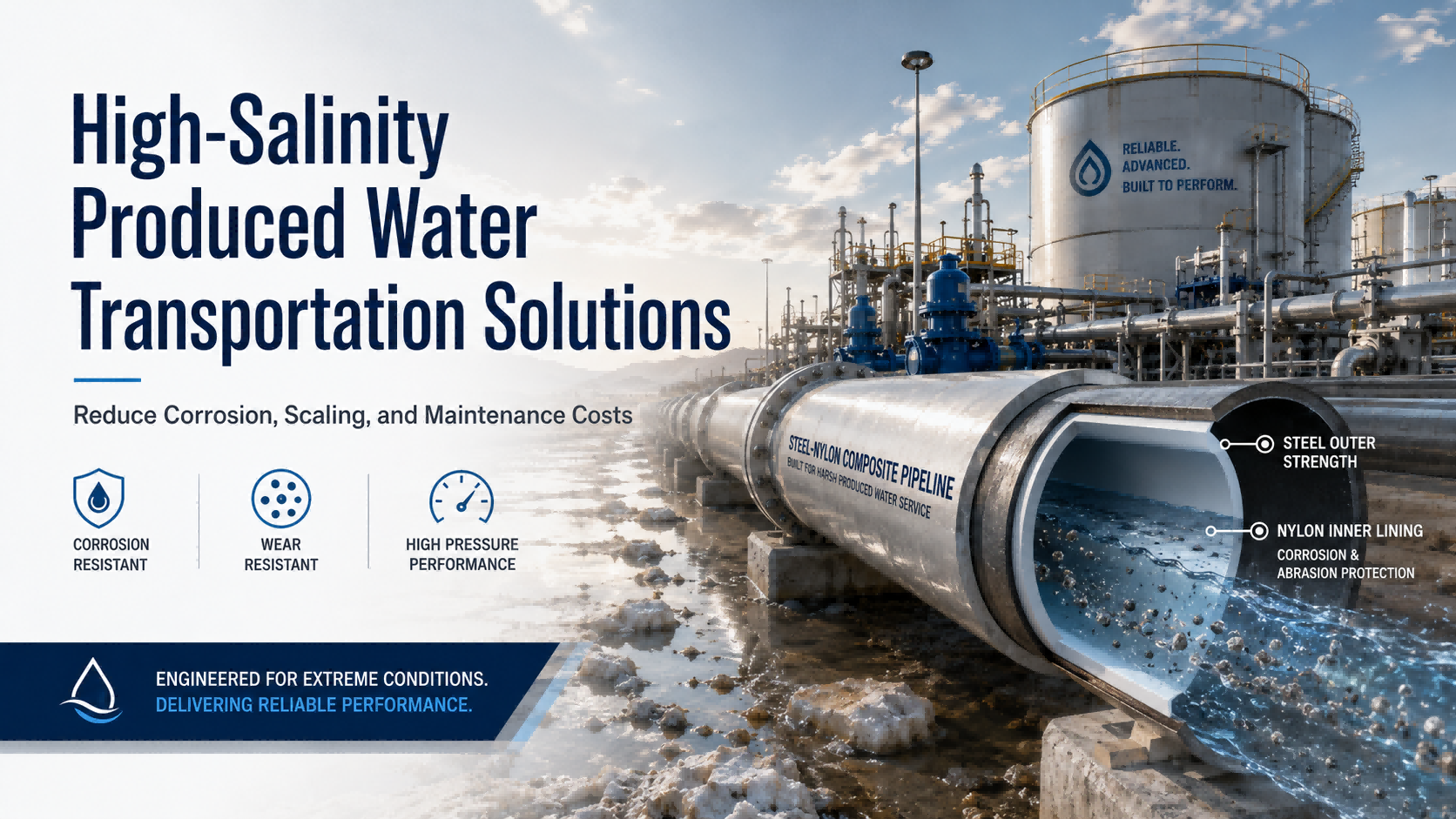
The steel structural layer provides mechanical strength and pressure resistance, while the nylon working layer directly contacts the transported medium.
This division of functions is particularly valuable in complex produced-water environments.
7. Separating Corrosive Produced Water from the Pressure-Bearing Steel Layer
The fundamental weakness of conventional carbon steel pipe is that the steel simultaneously:
-
Carries pressure
-
Contacts the corrosive medium
Once the protective system deteriorates, corrosion directly attacks the pressure-retaining wall.
Steel-nylon composite pipe uses a continuous nylon working layer to reduce direct contact between the produced water and the steel structure.
The design objective is therefore not:
“Make steel corrode more slowly.”
It is:
Reduce the opportunity for corrosive fluid to directly attack the pressure-bearing steel structure.
This is particularly valuable for long-term high-salinity produced-water transportation.
8. Steel Structure + Nylon Working Layer: Combining Pressure Resistance and Corrosion Resistance
Pure non-metallic pipes can offer strong corrosion resistance, but certain projects also require:
-
Higher pressure capability
-
Large diameters
-
Long-distance transportation
-
Above-ground spans
-
Pump discharge service
-
Complex pipe racks
In these applications, mechanical strength and structural rigidity become equally important.
The steel-nylon composite structure combines both requirements.
Steel Structural Layer
Provides:
-
Pressure resistance
-
Ring stiffness
-
Mechanical strength
-
Structural stability
Nylon Working Layer
Provides:
-
Direct contact with the transported medium
-
Corrosion resistance
-
Wear resistance
-
Reduced deposit adhesion
-
Smoother internal flow conditions
This functional combination is one of the main advantages of composite pipeline technology compared with single-material pipes.
9. Wear Resistance Is Critical for Produced Water Containing Sand
When produced water contains sand or suspended solids, chemical resistance alone is not sufficient.
Particles continuously strike and rub against the internal surface.
Nylon offers good wear resistance, allowing steel-nylon composite pipe to address both:
Saline-water corrosion + Solid-particle erosion
This can be particularly valuable in high-wear components such as:
-
Elbows
-
Tees
-
Reducers
-
Pump outlet sections
-
Upstream and downstream valve sections
For existing pipeline systems, it may not be necessary to replace the entire network immediately.
A lower-risk approach is to begin with:
High-wear fittings + High-failure sections + 100–500 m trial sections
This allows operators to validate performance before larger-scale replacement.
10. A Smooth Nylon Inner Surface Can Help Reduce Deposit Adhesion
It is important to clarify one point:
No pipe material should be described as absolutely “scale-free.”
Scaling depends on:
-
Water chemistry
-
Temperature
-
Pressure
-
pH
-
Ion concentration
-
Mixing of different water sources
-
Flow velocity
However, pipe surface condition can influence how easily deposits and crystals adhere.
The nylon working layer has a relatively smooth surface and does not develop the same rough corrosion-product layer often found inside aging carbon steel pipes.
Under suitable water chemistry and hydraulic conditions, this can help reduce deposit adhesion and maintain a more stable internal flow area.
The potential benefit is not limited to reduced cleaning frequency.
Over time, it may also contribute to:
More stable flow rates, lower pressure losses, and more consistent pumping efficiency.
11. Integral Flange Connections Can Reduce Weak Points in the Pipeline System
Another issue in produced-water systems is that:
A corrosion-resistant pipe body does not automatically mean a corrosion-resistant pipeline system.
Many failures occur at:
-
Welds
-
Joints
-
Flange areas
-
Liner termination points
-
Fitting connections
Therefore, high-reliability produced-water systems must evaluate the entire system:
Straight pipe + Fittings + Connections
Our steel-nylon composite pipe uses an integrally formed flange structure.
This allows flange-connected installation of:
-
Straight pipe
-
Elbows
-
Tees
-
Reducers
-
Valves
-
Pump discharge sections
The design can reduce field hot work and complex welding operations, making it suitable for:
-
Oilfield retrofit projects
-
Process stations
-
Existing pipeline replacement
-
Projects where shutdown time must be minimized
This is particularly useful in aging produced-water systems where only selected sections need replacement.
12. Pressure, Temperature, and Diameter Must Be Considered Together
Produced-water pipelines should never be selected based on chemistry alone.
Design Pressure
Higher pressure may be required in:
-
Transfer pump discharge lines
-
Water injection systems
-
Long-distance transportation pipelines
Our steel-nylon composite pipe can be designed for approximately 1.0–4.0 MPa, depending on project requirements.
Operating Temperature
Produced water may leave oilfield processing facilities at elevated temperatures.
At the same time, above-ground pipelines in cold oilfields may face very low winter temperatures.
Depending on the material system and engineering design, steel-nylon composite pipe can be configured for operating conditions of approximately −36°C to 160°C.
Final selection should always consider:
Continuous operating temperature + Peak temperature + Pressure + Medium composition
Pipe Diameter
Produced-water systems may include:
-
Small-diameter process piping
-
Medium-diameter transfer lines
-
Large-diameter trunk lines
The steel structural layer provides additional mechanical support for medium- and large-diameter composite pipelines, allowing more flexibility in complex stations and large-diameter applications.
13. How Should a High-Salinity Produced-Water Pipeline Solution Be Designed?
For new construction or retrofit projects, material selection should not begin with the name of the pipe material.
A more reliable process is to start with operating conditions.
Step 1: Analyze Produced-Water Chemistry
At minimum, obtain data for:
TDS, Cl⁻, pH, Ca²⁺, Mg²⁺, Ba²⁺, Sr²⁺, SO₄²⁻, HCO₃⁻, H₂S, CO₂, dissolved oxygen, oil content, suspended solids, and microorganisms.
Step 2: Define Operating Parameters
Including:
-
Normal operating pressure
-
Design pressure
-
Normal operating temperature
-
Maximum and minimum temperature
-
Flow rate
-
Velocity
-
Solids concentration
-
Sand content
-
Start-stop frequency
Step 3: Identify the Failure Mode of the Existing Pipeline
For retrofit projects, the first question should be:
Why is the existing pipeline failing?
Possible causes include:
-
General corrosion
-
Pitting corrosion
-
Weld corrosion
-
Elbow erosion
-
Scaling
-
Under-deposit corrosion
-
Liner failure
-
Joint leakage
Different failure mechanisms require different material strategies.
Step 4: Establish a Candidate Material List
Potential options may include:
Carbon steel with corrosion control, stainless steel, HDPE, FRP, lined steel pipe, and steel-nylon composite pipe.
The final selection should then be based on the actual project conditions.
14. Compare Total Lifecycle Cost, Not Just Purchase Price
One of the most common procurement mistakes in produced-water pipeline projects is:
Choosing the pipe with the lowest initial price.
But the real project cost is rarely determined by initial procurement alone.
A pipe may be 20% cheaper at the beginning, but if it later requires:
-
Leak repair
-
Emergency shutdown
-
Replacement
-
Cleaning
-
Secondary construction
its total lifecycle cost may be significantly higher.
A more appropriate evaluation method is:
TCO — Total Cost of Ownership
The calculation should include:
**Pipe purchase cost
-
Installation cost
-
Corrosion protection cost
-
Chemical treatment cost
-
Cleaning cost
-
Maintenance cost
-
Replacement cost
-
Production-loss cost
-
Leakage-risk cost**
For continuously operating oilfield systems:
Avoiding even one unplanned shutdown may create more economic value than saving 10–20% on the initial pipe purchase.
15. Aging Produced-Water Systems Do Not Always Need Complete Replacement
Many oilfields already operate produced-water networks extending tens or even hundreds of kilometers.
Replacing the entire system at once is rarely practical.
A phased strategy is usually more realistic.
Phase 1: Replace High-Failure Fittings
Start with:
-
Elbows
-
Tees
-
Reducers
-
Pump discharge sections
-
Upstream and downstream valve sections
Evaluate corrosion and wear performance.
Phase 2: Install a 100–500 m Trial Section
Select a representative section with high salinity, high solids, or severe corrosion.
Compare:
-
Corrosion condition
-
Pressure drop
-
Scaling
-
Maintenance frequency
-
Operating time
This allows actual field data to validate material performance.
Phase 3: Gradually Replace the Highest-Maintenance Sections
Prioritize locations with:
Highest leakage frequency + Highest shutdown losses + Highest maintenance cost
instead of attempting complete system replacement immediately.
This approach reduces the risk of introducing a new material and creates a field performance database before large-scale deployment.
16. What Types of High-Salinity Produced-Water Projects Should Consider Steel-Nylon Composite Pipe?
Steel-nylon composite pipe is worth evaluating when a project combines several of the following conditions:
-
High chloride concentration
-
High TDS
-
High-mineralization produced water
-
CO₂/H₂S corrosion risk
-
Sand or suspended solids
-
Frequent carbon steel perforation
-
Rapid elbow wear
-
Severe scaling
-
High stainless-steel investment cost
-
Pressure requirements of 1.0–4.0 MPa
-
Medium- or large-diameter pipelines
-
Frequent shutdowns caused by pipeline replacement
-
Preference for flange connections and reduced field hot work
Typical applications include:
Oilfield produced-water pipelines, oil and gas gathering systems, wastewater treatment systems, water injection systems, process piping, and high-salinity industrial wastewater transportation.
17. The Real Objective Is Not Simply “Corrosion Resistance” — It Is Lower Maintenance Frequency
In high-salinity produced-water projects, operators are not simply buying pipe.
What they really want is:
Fewer leaks.
Fewer shutdowns.
Less pipe replacement.
Less cleaning.
More stable flow performance.
Lower 10-year lifecycle cost.
Traditional pipeline strategies often focus on:
Reducing the corrosion rate.
Steel-nylon composite pipe provides a different approach:
The steel structure provides mechanical strength and pressure resistance, while the corrosion- and wear-resistant nylon working layer directly contacts the fluid, reducing direct exposure of the pressure-bearing steel structure to aggressive media.
For mature oilfields with high salinity, high water cut, solids, and complex corrosion conditions, this composite-material approach can offer substantial engineering value.
Conclusion: High-Salinity Produced-Water Pipelines Are Moving from “Low Purchase Cost” to “Low Maintenance Cost”
As oilfields enter the middle and late stages of production, water cut continues to rise, and produced-water systems become increasingly important.
The future competition among produced-water pipeline materials will not simply be:
Which pipe is cheaper to purchase?
The more important question will be:
Which pipeline can operate longer and more reliably in complex corrosive environments while reducing maintenance, replacement, and shutdown frequency throughout the project lifecycle?
When high chloride, high TDS, CO₂/H₂S, scaling, solids, erosion, and pressure exist together, no single performance parameter is enough.
A reliable pipeline should balance:
Corrosion resistance, wear resistance, pressure capability, connection reliability, scaling control, and total lifecycle cost.
For produced-water systems experiencing frequent carbon steel perforation, high stainless-steel costs, repeated fitting erosion, or maintenance problems with conventional lined pipe systems, steel-nylon composite pipe provides a technical alternative worth evaluating through operating-condition analysis and field trial sections.
What Information Is Needed for High-Salinity Produced-Water Pipeline Selection?
If you are evaluating a new produced-water pipeline or planning to replace an existing one, the following information is recommended:
Medium composition + TDS/Cl⁻ + pH + H₂S/CO₂ + Temperature + Pressure + Pipe diameter + Flow rate + Sand content + Existing failure conditions
Based on these parameters, the suitability, pressure class, diameter, and connection design of a steel-nylon composite pipeline can be evaluated more accurately, together with a lifecycle cost comparison against the existing pipeline solution.
Steel-Nylon Composite Pipe — Designed for Corrosive, Abrasive, and High-Salinity Industrial Pipeline Service.
Winter Oilfield Low-Temperature Pipeline Solutions: How to Balance Low-Temperature Resistance, Corrosion Resistance, and Long-Term Reliability
Pipeline Selection for High-H₂S Oilfields