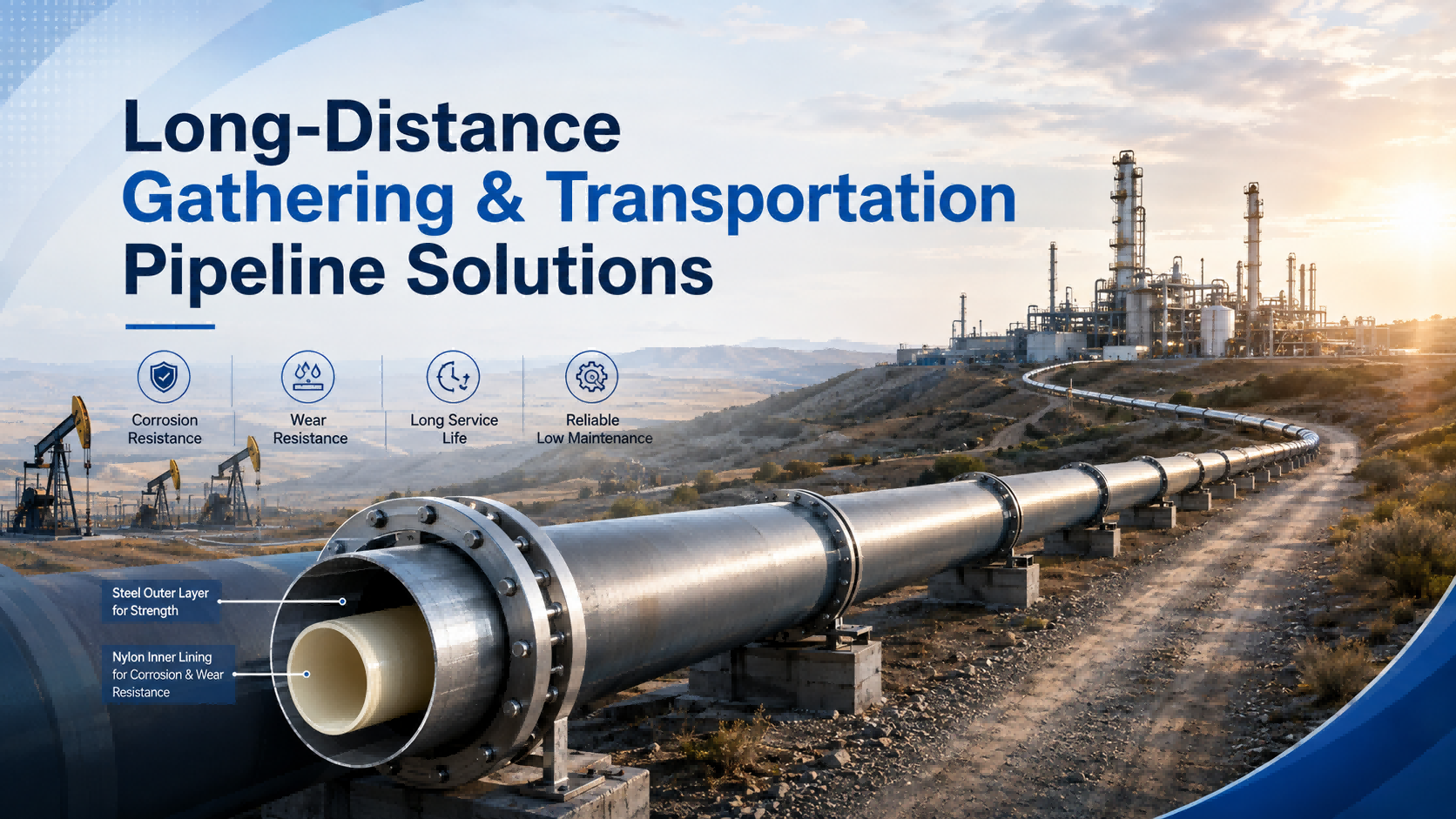
How to Extend the Service Life of Oil & Gas Gathering Pipelines: A Systematic Approach from Corrosion and Erosion Control to Material Upgrading
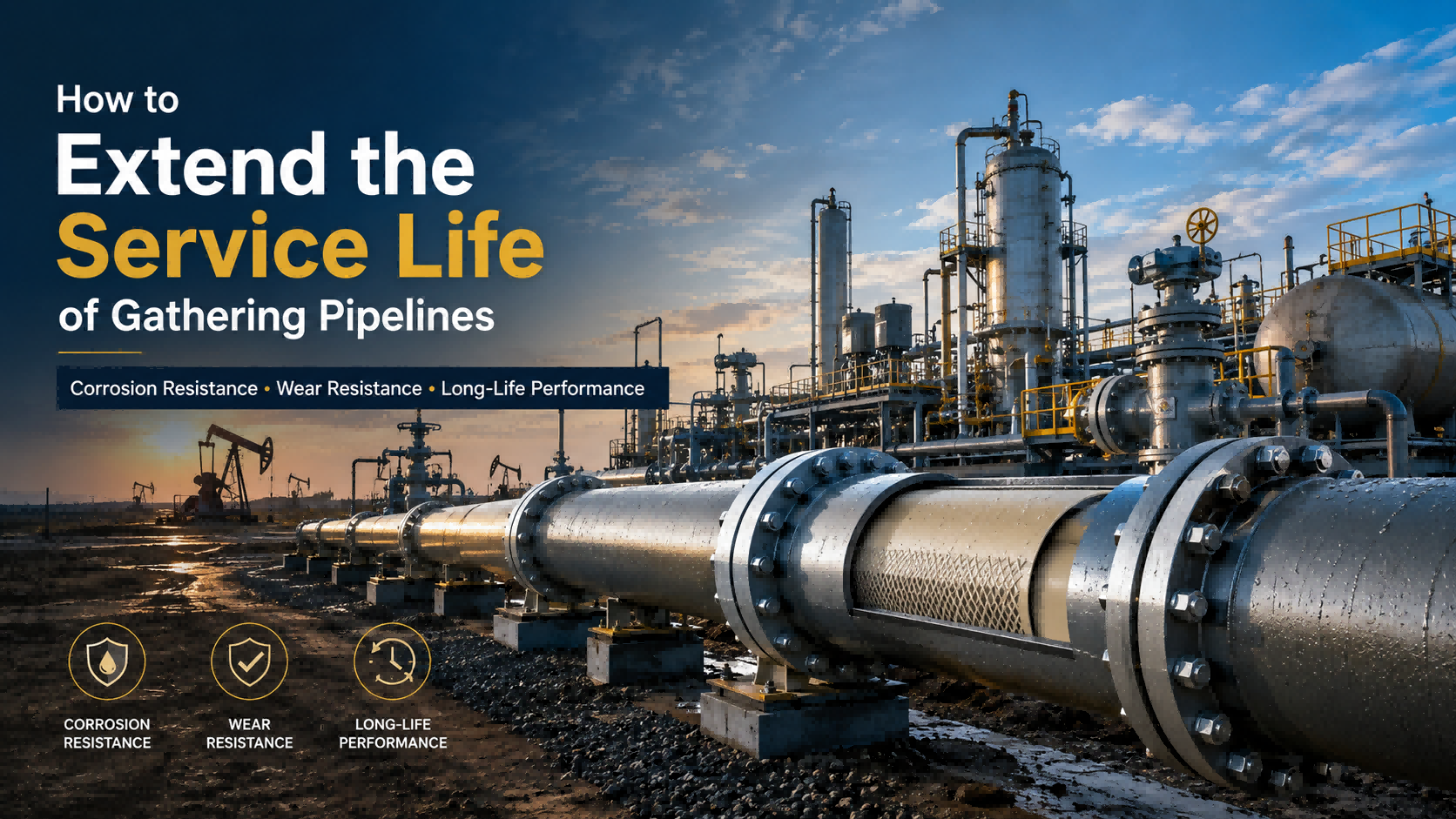
Compared with ordinary industrial pipelines, gathering pipelines often operate under much more complex conditions. High water cut, CO₂, H₂S, chloride ions, highly mineralized water, sand, pressure fluctuations, temperature variations, and multiphase flow may all exist at the same time.
Therefore, the real challenge facing many oilfields is not simply:
“Can the pipeline transport the fluid?”
The more important question is:
“How can the pipeline operate reliably for a much longer period under complex corrosion and wear conditions?”
Traditional carbon steel gathering pipelines may suffer from wall thinning, pitting, perforation, weld leakage, scaling, blockage, and severe elbow wear under harsh service conditions.
Frequent pipeline replacement not only increases material and construction costs, but can also result in production shutdowns, emergency maintenance, and additional safety risks.
Extending gathering pipeline service life, therefore, should not simply mean “increasing pipe wall thickness.”
A more effective approach is to redesign the pipeline system from five perspectives:
corrosion mechanism, wear mechanism, material structure, connection method, and total life-cycle cost.
1. Why Are Oil & Gas Gathering Pipelines Particularly Vulnerable to Failure?
The complexity of gathering systems lies in the fact that the transported medium is usually not a single clean fluid, but a multiphase mixture with both corrosive and abrasive characteristics.
Typical media may include:
-
Crude oil
-
Natural gas
-
Highly mineralized produced water
-
CO₂
-
H₂S
-
Chloride ions
-
Sand and solid particles
-
Chemical additives
-
Oil-water-gas-sand mixtures
This means the pipeline may simultaneously experience:
corrosion + erosion + abrasion + scaling + pressure fluctuations.
More importantly, these factors often interact with each other.
For example, once a corrosion product film is repeatedly removed by high-velocity particles, fresh metal surfaces become exposed again, which can accelerate further corrosion.
This is why some gathering pipelines may perform reasonably well in static laboratory corrosion tests but still experience much shorter service lives under actual oilfield operating conditions.
2. Six Key Factors That Determine Gathering Pipeline Service Life
2.1 CO₂ Corrosion
When CO₂ dissolves into the water phase of an oil and gas mixture, it creates a corrosive environment.
For ordinary carbon steel, long-term exposure can lead to:
-
General corrosion
-
Localized corrosion
-
Pipe wall thinning
-
Pitting
-
Eventual perforation
The problem becomes particularly serious in mature oilfields where the water cut continues to rise.
As the proportion of produced water increases, the steel surface is exposed more frequently and more extensively to the corrosive aqueous phase.
Therefore:
high water cut often means higher internal corrosion risk.
2.2 H₂S Corrosion
When H₂S is also present in the transported medium, the corrosion environment becomes even more complex.
H₂S can participate in electrochemical corrosion processes, and for certain metallic materials, sulfide-related cracking risks must also be considered.
Therefore, in sour oil and gas fields, simply increasing carbon steel wall thickness usually cannot solve the problem fundamentally.
A more effective engineering philosophy is:
Prevent the corrosive medium from directly contacting the load-bearing steel layer whenever possible.
This is one of the key reasons why composite pipeline technology is valuable in harsh oilfield environments.
2.3 Highly Mineralized Produced Water
Oilfield produced water is very different from ordinary fresh water.
It may contain high concentrations of:
-
Cl⁻
-
Ca²⁺
-
Mg²⁺
-
HCO₃⁻
-
SO₄²⁻
-
Na⁺
High salinity can accelerate metal corrosion and may also create severe scaling conditions.
When corrosion and scaling occur simultaneously, a pipeline may gradually enter a destructive cycle:
corrosion products → deposits → local scaling → reduced flow area → altered velocity distribution → intensified local erosion
Over time, this can significantly shorten pipeline life.
2.4 Sand Erosion and Particle Abrasion
Many oil wells produce a certain amount of sand together with oil and water.
When solid particles travel at high velocity, components such as elbows, tees, reducers, and areas around valves often become the most heavily worn locations.
Typical high-risk areas include:
-
90-degree elbows
-
Tee junctions
-
Pump discharge sections
-
Upstream and downstream of valves
-
Sudden expansions or reductions
Because flow direction, turbulence, and velocity change sharply in these locations, particle impact and erosion are often much more severe.
Therefore, gathering pipeline life depends not only on corrosion resistance, but also on whether the material can withstand:
long-term abrasive and erosive wear.
2.5 Scaling
Internal scaling is another common problem in oilfield gathering pipelines.
As operating time increases, deposits may cause:
-
Reduced effective internal diameter
-
Lower flow capacity
-
Higher hydraulic resistance
-
Increased pumping energy consumption
-
More frequent cleaning
-
Accelerated localized corrosion
From a life-cycle perspective, an ideal gathering pipeline should not only “avoid leakage.”
It should also help:
reduce deposition and scaling tendency.
2.6 Pipeline Joints
Many pipeline projects focus heavily on pipe body material while overlooking another critical issue:
pipeline joints are often among the most failure-prone parts of the entire system.
Under frequent maintenance, pressure fluctuations, and complex field conditions, joint design directly affects:
-
Installation reliability
-
Maintenance difficulty
-
Leakage risk
-
Construction time
-
Long-term operating cost
Therefore, extending gathering pipeline service life requires more than improving the pipe body.
The entire system should be optimized:
pipe body + fittings + joints + installation method.
3. Why Is It Difficult for Traditional Carbon Steel to Fundamentally Solve Gathering Pipeline Corrosion?
Carbon steel has obvious advantages:
high strength, good pressure resistance, and a mature engineering system.
That is why it has long been widely used in oilfield pipelines.
However, it also has an inherent weakness:
steel directly reacts with corrosive media.
Under high water cut, high salinity, CO₂/H₂S exposure, and sand-containing conditions, simply increasing wall thickness essentially means:
using more steel to allow more time before corrosion causes failure.
For example, if a design includes a 3 mm corrosion allowance, continuous corrosion may still eventually consume that allowance.
Increasing the corrosion allowance only delays failure.
It does not eliminate the corrosion mechanism.
Therefore, for highly corrosive gathering systems, a more important question is not:
How thick should the steel pipe be?
But rather:
Can we prevent the corrosive medium from directly contacting the load-bearing steel layer?
4. Can Pure Plastic Pipe Solve the Problem?
Since metals are vulnerable to corrosion, one obvious alternative is to use non-metallic pipelines.
PE, HDPE, and other polymer pipes do offer strong corrosion resistance.
However, gathering pipeline material selection cannot be based on corrosion resistance alone.
Other parameters must also be considered:
-
Working pressure
-
Operating temperature
-
Pipe diameter
-
Ring stiffness
-
Long-distance installation
-
Support spacing
-
Vacuum or negative pressure
-
Mechanical loads
-
Above-ground pipe racks
-
Thermal cycling
-
Joint reliability
In high-pressure, large-diameter, or elevated-temperature applications, relying on a single polymer material for both corrosion protection and structural load-bearing can create limitations.
This leads to a long-standing material selection conflict in oilfield pipelines:
Steel provides high strength but is susceptible to corrosion; polymers resist corrosion but may face structural limitations in some demanding pressure and temperature conditions.
So how can both advantages be combined?
This is exactly the engineering logic behind the steel-nylon composite pipe.
5. Steel-Nylon Composite Pipe: From “Corrosion-Protected Steel Pipe” to “Functional Composite Pipeline”
A steel-nylon composite pipe is not simply an ordinary steel pipe with a thin anti-corrosion coating.
Its key concept is to assign different functions to different materials.
Steel Structural Layer
The steel structure mainly provides:
-
Pressure resistance
-
Mechanical strength
-
Pipeline stiffness
-
Resistance to external structural loads
Nylon Functional Layer
The nylon layer mainly provides:
-
Isolation from corrosive media
-
Chemical corrosion resistance
-
Wear resistance
-
Reduced scaling tendency
-
Protection of the steel structural layer
The design philosophy can therefore be summarized as:
Let steel provide strength, and let nylon handle the service environment.
This combination of a structural material + functional material is often more suitable for complex gathering pipeline conditions than simply upgrading to a more expensive metal grade.
6. How Can Steel-Nylon Composite Pipes Extend Gathering Pipeline Life?
6.1 Isolating the Steel Layer from Corrosive Media
In a conventional steel pipeline:
oilfield fluid → direct contact with steel → electrochemical corrosion
In a properly designed steel-nylon composite structure:
corrosive medium → nylon functional layer → steel structural layer
The goal is therefore not simply to “slow down steel corrosion.”
The more fundamental objective is:
to prevent or minimize direct contact between the corrosive medium and the load-bearing steel layer.
These are two very different corrosion-control strategies.
6.2 Combining Corrosion Resistance and Wear Resistance
Oilfield gathering media often contain more than corrosive water.
If sand or solid particles are present, erosion and abrasion must also be considered.
Nylon has good wear resistance, enabling it to perform two important functions in sand-containing, produced-water, and multiphase flow applications:
corrosion protection + wear resistance
This is especially important in gathering systems because many real-world failures are not caused by pure chemical corrosion alone.
Instead, they are often the result of:
corrosion-erosion synergistic failure.
7. Corrosion-Resistant Straight Pipe Is Not Enough: Elbows, Tees, and Reducers Matter Too
A common engineering problem is that straight pipe sections achieve longer service life while elbows and tees continue to fail frequently.
The reason is straightforward.
At an elbow, the fluid changes direction.
Solid particles tend to impact the outer radius of the elbow due to inertia, making this one of the most erosion-prone areas in the entire system.
Therefore, a long-life gathering system should treat the following components as one integrated design:
-
Straight pipes
-
Elbows
-
Tees
-
Reducers
-
Pipe sections around valves
-
Pump outlet pipe sections
-
Headers and manifolds
In severe wear applications, replacing only straight pipes often does not solve the system-wide problem.
A more effective method is to:
Develop a “high-risk wear point map” for the entire gathering pipeline.
Then upgrade materials selectively at the most vulnerable locations.
8. Why Are Flanged Connections Important in Oilfield Applications?
Gathering pipelines are widely distributed, and many projects involve upgrading aging oilfield infrastructure.
If extensive field welding is required, the project may involve:
-
Hot-work permits
-
Welding equipment
-
Qualified welders
-
Gas testing
-
Fire-prevention measures
-
Post-weld inspection
-
Longer installation time
In petroleum and chemical facilities, hot work itself creates additional safety-management requirements.
Steel-nylon composite pipes with flange connections can reduce the need for on-site welding.
For pipeline renovation projects, the workflow may become simpler:
remove old pipe → position new pipe → connect flanges → inspect system → return to operation
This can significantly simplify field installation.
For projects where shutdown windows need to be minimized, this can provide substantial practical value.
9. Why Are Composite Structures Better Suited to Some High-Pressure Gathering Pipelines?
Not all gathering systems operate at low pressure.
Some wellhead pipelines, gathering trunk lines, and process pipelines require relatively high working pressures.
In these applications, the material must provide both:
corrosion resistance + pressure-bearing capability.
If the selection is based only on corrosion performance, structural safety may be overlooked.
One major advantage of the steel-nylon composite pipe is that the steel structure provides mechanical strength and pressure resistance, while the nylon layer isolates the corrosive medium.
For industrial pipeline systems in the 1.0–4.0 MPa pressure range, the structure can be designed according to:
-
Working pressure
-
Design pressure
-
Pipe diameter
-
Temperature
-
Transported medium
-
Safety factor
This makes the steel-nylon composite concept especially suitable for addressing the common material-selection challenge of:
high pressure combined with severe corrosion.
10. Large-Diameter Gathering Pipelines Require More Than Corrosion Resistance
As treatment capacity increases, some oilfield and industrial projects require increasingly large pipeline diameters.
When the pipe size reaches:
DN500, DN800, DN1000, or even larger,
the material-selection logic becomes more complex.
In addition to corrosion resistance, engineers must also consider:
-
Ring stiffness
-
Pipe self-weight
-
Support spacing
-
Flange strength
-
Transportation limitations
-
Lifting and installation
-
Thermal expansion and contraction
-
Pipe rack loads
Large-diameter pipeline design is therefore a combination of:
materials engineering + structural engineering + installation engineering
A steel-nylon composite structure can use steel to provide stiffness and structural stability while nylon protects against internal corrosion and wear.
This is one reason composite pipeline structures are becoming increasingly valuable in large industrial pipeline applications.
11. Do Not Compare Gathering Pipeline Materials Based Only on Purchase Price
Traditional pipeline procurement often starts with one question:
How much does it cost per meter?
But for oil and gas field operators, this metric is not enough.
The more meaningful calculation is:
Pipeline Life-Cycle Cost
A complete evaluation should include:
Life-Cycle Cost = Pipe Cost + Installation Cost + Corrosion Protection Cost + Maintenance Cost + Replacement Cost + Production Loss
The cheapest pipe at the purchasing stage may not be the lowest-cost solution over its service life.
For example, suppose a pipeline has an initial purchase cost of USD 1 million.
If it requires, within five years:
-
Three emergency repairs
-
Two partial replacements
-
Repeated scale removal
-
Several production shutdowns
the real operating cost may be far higher than the original purchase price.
By contrast, if another pipe has a higher initial investment but can significantly reduce:
corrosion, maintenance, shutdowns, and replacement frequency,
its total cost over 10 or 20 years may be much lower.
12. A Practical Technical Route for Extending Gathering Pipeline Life
When planning a new oil and gas gathering pipeline, material selection can follow the process below.
Step 1: Analyze the Transported Medium
Key parameters should include:
-
CO₂ concentration
-
H₂S concentration
-
Cl⁻ concentration
-
pH
-
Total salinity
-
Water cut
-
Sand content
-
Solid particle size
Step 2: Analyze Operating Conditions
Important parameters include:
-
Working pressure
-
Design pressure
-
Operating temperature
-
Maximum temperature
-
Minimum ambient temperature
-
Flow velocity
-
Flow rate
-
Pipe diameter
Step 3: Identify High-Risk Locations
Pay special attention to:
-
Elbows
-
Tees
-
Valves
-
Pump outlets
-
Reducers
-
Headers
-
Low points where liquid may accumulate
These locations often fail earlier than straight pipe sections.
Step 4: Compare Life-Cycle Costs
Do not simply compare:
How much does carbon steel cost per meter?
versus
How much does composite pipe cost per meter?
Instead, compare:
10-year or 20-year total cost.
Only then can the most economical material solution be identified.
13. From “Scheduled Pipe Replacement” to “Long-Life Pipeline Design”
In many traditional oilfield gathering systems, pipeline maintenance follows a recurring cycle:
corrosion → leakage → emergency repair → pipe replacement → corrosion again
Over the long term, this is an expensive operating model.
Modern gathering pipeline design should move in a different direction:
Use material upgrading to reduce the number of repairs and replacements over the entire pipeline life cycle.
In other words, the material-selection objective is evolving from:
meeting design pressure requirements
to:
achieving long-term reliable operation.
The value of steel-nylon composite pipe lies in its ability to address several challenges that are difficult for a single traditional material to solve simultaneously:
High pressure
Severe corrosion
Heavy wear
High water cut
Large diameter
Long service life
14. Which Gathering Systems Are Suitable for Steel-Nylon Composite Pipe Evaluation?
Steel-nylon composite pipes are particularly worth evaluating in the following applications.
Mature Oilfields with High Water Cut
Especially fields where the proportion of produced water continues to increase.
CO₂ and H₂S Corrosive Environments
Gathering systems where conventional carbon steel experiences rapid corrosion.
Oilfield Produced Water Transportation
Especially high-salinity and high-chloride service.
Sand-Containing Crude Oil Transportation
Where corrosion and erosion occur simultaneously.
Aging Gathering Network Upgrades
Where corrosion perforation and leakage occur frequently and operators want to reduce maintenance frequency.
Large-Diameter Gathering Pipelines
Where structural stiffness and corrosion resistance are both important.
1.0–4.0 MPa Industrial Pipeline Systems
Where higher pressure-bearing capability is required together with improved corrosion resistance.
15. Pipeline Life Is Not Determined Simply by “How Thick the Pipe Wall Is”
Gathering pipeline life is fundamentally a question of matching material characteristics to real operating conditions.
If the corrosive environment remains unchanged, simply increasing carbon steel wall thickness only postpones the time to failure.
A true long-life design should ask:
Can corrosion be isolated?
Can wear be controlled at the same time?
Can scaling be reduced?
Can the pipeline operate safely at higher pressure?
Can joint-related risks be reduced?
Can field installation and maintenance be simplified?
When these factors are considered as part of one integrated system, the advantages of steel-nylon composite pipe become much clearer.
The concept is not simply about replacing one material with another.
It combines:
the structural strength of steel + the corrosion and wear resistance of nylon
to address the limitations of single-material pipelines in complex industrial service.
Conclusion: Extending Gathering Pipeline Life Requires a Shift from “Repair After Corrosion” to “Prevention Through Material Design”
For oil and gas operators, the most expensive part of a pipeline is often not the pipe itself.
The real costs come after failure:
-
Emergency repairs
-
Pipe replacement
-
Production shutdowns
-
Leakage
-
Labor
-
Cleanup
-
Safety risks
Therefore, evaluating a gathering pipeline should not begin with the question:
“How much does it cost per meter?”
A better question is:
“How many times will it need to be replaced over the next 10 years?”
By using a steel-nylon composite structure to reduce the impact of CO₂, H₂S, highly mineralized water, sand erosion, and scaling, while maintaining the pressure-bearing strength and rigidity of steel, gathering pipeline design can move away from:
repeated corrosion and repeated replacement
toward:
Long-Life Oil & Gas Gathering Pipeline Systems
For gathering systems already experiencing frequent corrosion perforation, elbow wear, scaling, blockage, or continuously increasing maintenance costs, steel-nylon composite pipe is worth evaluating as a long-term alternative to conventional carbon steel, stainless steel, and other anti-corrosion pipeline solutions.
Key Advantages of Steel-Nylon Composite Pipe for Gathering Pipelines
Corrosion Resistance
Helps reduce direct corrosion of the load-bearing steel layer in CO₂-, H₂S-, and high-salinity environments.
Wear Resistance
Suitable for sand-containing fluids, solid particles, produced water, and multiphase transport.
High Pressure Capability
The steel structure provides a strong mechanical and pressure-bearing foundation.
Smooth Inner Surface
Helps reduce deposition, scaling, and flow-efficiency losses.
Flanged Connection
Reduces the need for on-site welding and hot work, improving pipeline renovation efficiency.
Large Diameter Capability
Suitable for large oil and gas gathering and industrial transport systems.
Lower Life-Cycle Cost
By reducing corrosion, emergency repair, and pipeline replacement frequency, it can help optimize long-term operating costs.
Ultimately, what an oil and gas gathering system needs is not simply a “thicker pipe.”
It needs a long-life pipeline solution capable of simultaneously addressing:
pressure, corrosion, wear, scaling, installation efficiency, and maintenance cost.
How to Reduce Maintenance Costs for Water Injection Pipelines: A Systematic Analysis from Corrosion and Scaling to Total Cost of Ownership
How to Solve CO₂ Corrosion? Corrosion Mechanisms, Engineering Solutions, and the Application of Steel-Nylon Composite Pipes in Oil & Gas Fields