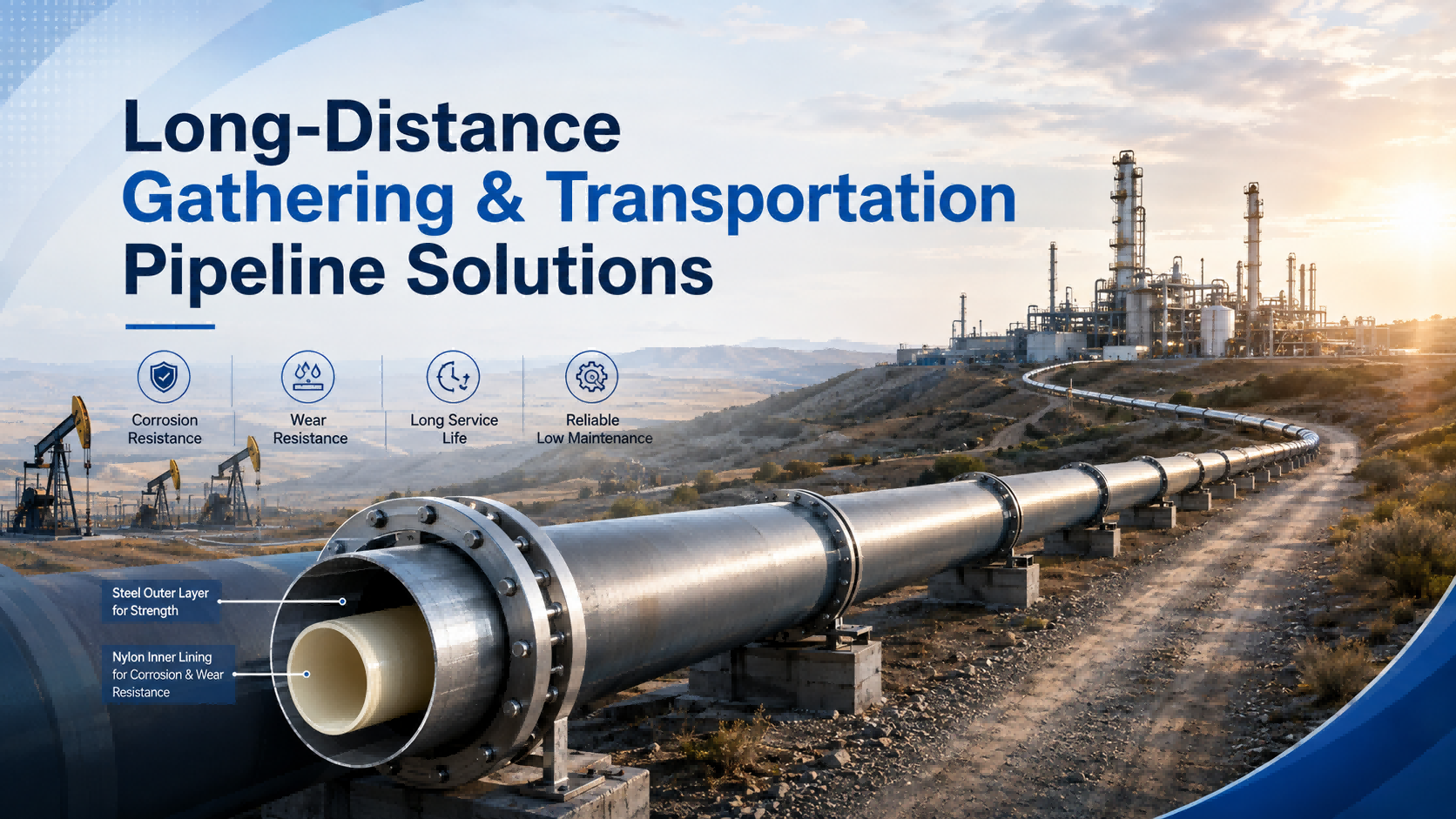
How to Solve CO₂ Corrosion? Corrosion Mechanisms, Engineering Solutions, and the Application of Steel-Nylon Composite Pipes in Oil & Gas Fields
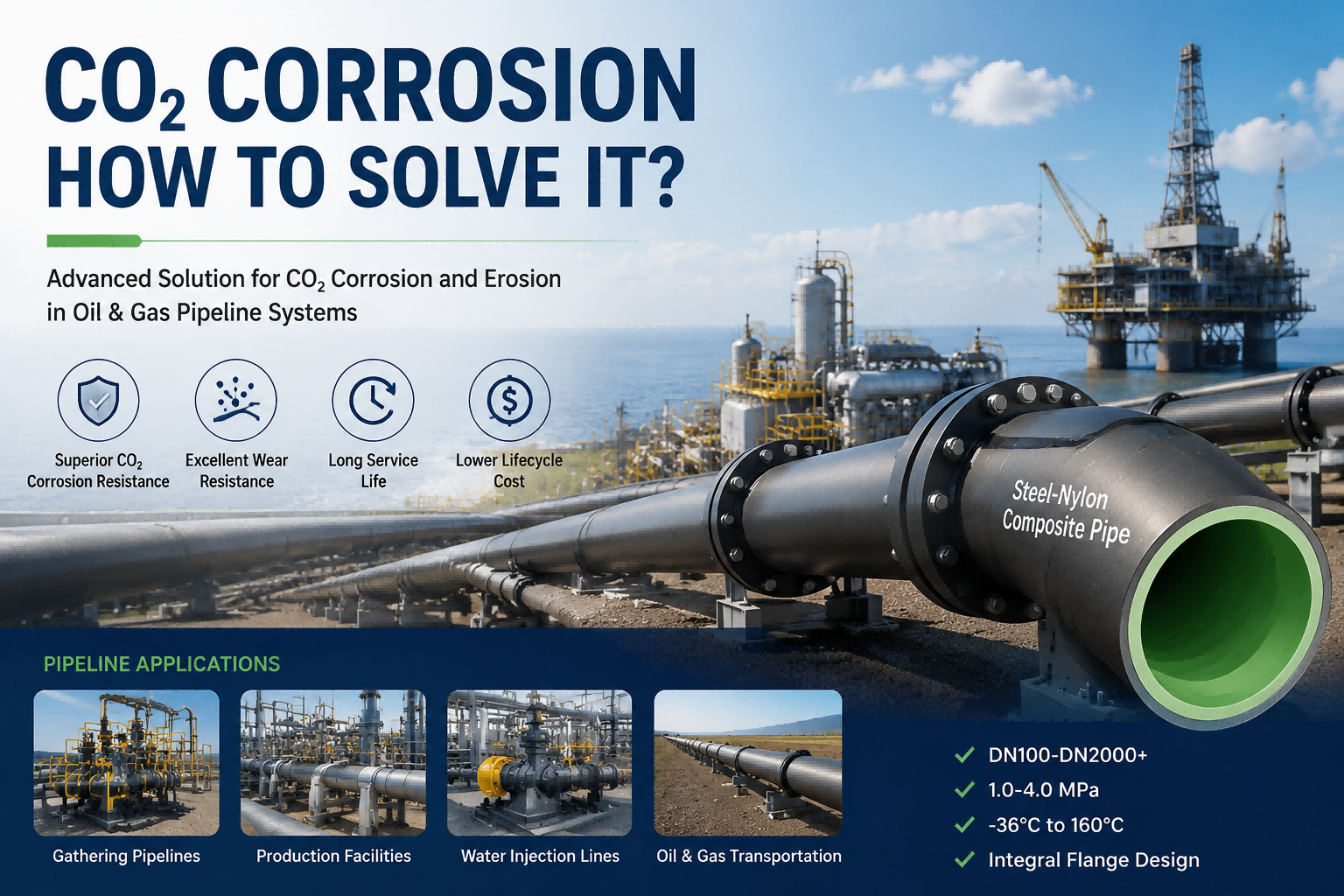
As oilfields move into the middle and late stages of production, transported fluids are often no longer simple oil-and-gas mixtures. Instead, they may become high-water-cut, highly mineralized, CO₂-containing, chloride-containing multiphase fluids, sometimes carrying sand and other solid particles.
At this stage, pipelines may face much more than simple corrosion. Typical combined mechanisms include:
CO₂ corrosion + high-water-cut corrosion + erosion wear + local turbulence + deposition and scaling
Therefore, solving CO₂ corrosion should not be limited to asking:
“Which corrosion inhibitor should we use?”
A more fundamental engineering question is:
How can we reduce direct contact between corrosive media and the load-bearing steel layer while simultaneously addressing erosion, wear, and long-term maintenance?
This is one of the key reasons why steel-nylon composite pipes deserve attention in CO₂-corrosive environments.
1. What Is CO₂ Corrosion?
CO₂ corrosion is commonly known in the oil and gas industry as:
Sweet Corrosion
It mainly occurs in oil and gas transportation environments where both CO₂ and a water phase are present.
When CO₂ dissolves into water, it forms a carbonic acid system:
CO₂ + H₂O ⇌ H₂CO₃
This changes the electrochemical environment at the steel surface and promotes anodic dissolution of iron:
Fe → Fe²⁺ + 2e⁻
As the reaction continues, the pipe wall may gradually thin and eventually develop:
-
General corrosion
-
Localized corrosion
-
Pitting
-
Grooving corrosion
-
Perforation
-
Leakage
Under suitable conditions, FeCO₃, or iron carbonate, may also form as a corrosion product.
This layer can sometimes reduce further corrosion, but if it is discontinuous, locally damaged, or exposed to mechanical erosion, severe localized corrosion may still occur.
Therefore:
CO₂ corrosion is not governed by a fixed corrosion rate. It is a dynamic process influenced by fluid chemistry, temperature, pressure, flow conditions, and the stability of corrosion-product films.
2. Why Does CO₂ Corrosion Become More Severe in High-Water-Cut Oilfields?
The presence of CO₂ alone does not necessarily mean that serious steel corrosion will occur.
The critical factor is:
Water Phase
Without sufficient water, conventional aqueous CO₂ corrosion cannot develop effectively.
However, as oilfields mature, produced-water content often increases significantly, making it more likely that steel surfaces remain continuously wetted.
This is especially relevant in:
-
Oil gathering pipelines
-
Oil-water transportation pipelines
-
Produced water pipelines
-
Central processing facility pipelines
-
Water injection systems
-
Wet gas gathering pipelines
Once CO₂ dissolves into the water phase, conditions become more favorable for corrosion reactions.
In multiphase systems, water wetting, flow regime, and water distribution can strongly influence CO₂ corrosion behavior.
3. Six Key Factors That Determine the Severity of CO₂ Corrosion
CO₂ corrosion cannot be evaluated based only on “CO₂ concentration.”
Engineering material selection should consider at least the following factors.
3.1 CO₂ Partial Pressure
In many cases, engineers should focus not simply on the percentage of CO₂, but on:
CO₂ Partial Pressure
It influences the CO₂-water chemistry and is an important parameter in corrosion assessment for oil and gas pipelines.
3.2 Water Cut and Water Wetting
The higher the water content, the greater the probability that the steel surface remains in contact with a continuous water phase.
This is particularly important in mature oilfields.
Even if a carbon steel pipeline performs well during the early production stage, its internal corrosion behavior may change significantly as water cut increases.
3.3 Temperature
Temperature influences:
-
Electrochemical reaction rates
-
CO₂ solubility
-
FeCO₃ precipitation
-
Density and stability of corrosion-product films
Therefore, CO₂ corrosion should not be simplified as:
Higher temperature = Faster corrosion
Actual corrosion behavior must be evaluated together with pressure, water chemistry, flow velocity, and material properties.
3.4 pH
pH has a direct influence on CO₂ water chemistry and carbonate equilibria.
Changes in pH can affect:
-
Corrosion rate
-
FeCO₃ precipitation
-
Film stability
-
Localized corrosion behavior
3.5 Flow Velocity
Flow velocity is often underestimated in real pipeline projects.
Higher flow rates may increase:
-
Mass transfer
-
Wall shear stress
-
Turbulence
-
Damage to protective corrosion films
The risk becomes even greater at local fittings where the flow direction changes sharply.
3.6 Solid Particles
If the transported medium contains:
-
Formation sand
-
Quartz particles
-
Corrosion products
-
Other suspended solids
the failure mechanism becomes more complex.
The problem can evolve from:
Corrosion
into:
Corrosion + Erosion
or:
Corrosion-Erosion Synergy
In such applications, selecting a merely “corrosion-resistant” material is not enough.
The material must also provide strong:
Wear and erosion resistance.
4. Why Do Elbows, Tees, and Reducers Often Fail First?
A common phenomenon in oilfield pipelines is:
The straight pipe remains in acceptable condition, while elbows fail repeatedly.
This is mainly caused by local flow behavior.
When the fluid passes through:
-
90° elbows
-
Tees
-
Reducers
-
Valves
-
Pump outlets
the flow direction or velocity changes.
These areas may experience:
-
Increased turbulence
-
Higher wall shear
-
High-velocity particle impact
-
Damage to corrosion-product films
-
Local erosion
Therefore, even with exactly the same CO₂ concentration:
The corrosion rate in a straight section and an elbow can be very different.
This is why CO₂ corrosion control should not focus only on straight pipe.
In many systems, the most critical components are actually:
Wear-prone fittings and local high-risk sections.
5. What Are the Main Solutions for CO₂ Corrosion?
Common industrial solutions include:
-
Corrosion inhibitors
-
Internal protective coatings
-
Corrosion-resistant alloys
-
Non-metallic or composite piping systems
Each approach has its own advantages and limitations.
6. Solution One: Corrosion Inhibitors
Corrosion inhibitors are a mature and widely used method in the oil and gas industry.
Their basic function is to form an adsorbed or protective film on the steel surface, thereby reducing the corrosion reaction rate.
Advantages
-
No need to replace the entire pipeline
-
Relatively low initial modification cost
-
Suitable for existing carbon steel systems
However, the key limitation is:
Continuous Management Is Required
This may include:
-
Continuous chemical injection
-
Concentration control
-
Dosing equipment maintenance
-
Corrosion monitoring
-
Verification of inhibitor distribution
In other words:
Corrosion inhibitors do not eliminate the corrosion environment. They continuously manage it.
7. Solution Two: Internal Protective Coatings
Internal coatings follow a different philosophy:
Isolate the corrosive medium from the steel.
Typical options include:
-
Epoxy coatings
-
Polymer coatings
-
Other internal barrier systems
As long as the coating remains intact, the steel is protected from direct exposure to corrosive media.
The real question is:
Can the Coating Remain Intact Over the Long Term?
The protective layer may be affected by:
-
Sand erosion
-
High flow velocity
-
Installation damage
-
Thermal cycling
-
Aging
-
Local defects
Once the steel is locally exposed, corrosion may become concentrated at the damaged area.
Therefore, in environments involving:
CO₂ + High Flow Velocity + Solid Particles
engineers must consider not only corrosion resistance, but also:
Wear resistance + mechanical stability + long-term integrity.
8. Solution Three: 316L or Duplex Stainless Steel
Another direct solution is to use corrosion-resistant alloys such as:
-
316L stainless steel
-
Duplex stainless steel
-
Higher-grade corrosion-resistant alloys
These materials can provide excellent performance in many severe environments.
However, in large-scale pipeline projects, another issue becomes increasingly important:
Cost
For example, the investment implications of:
DN300
and:
DN1000
pipelines are completely different.
As pipe diameter increases:
-
Material costs rise sharply
-
Fitting costs increase
-
Welding requirements become more demanding
-
Installation costs increase
Therefore, the real engineering question for large-diameter corrosive pipelines is not:
Which material has the best theoretical corrosion resistance?
It is:
Which material can meet the required service life while maintaining a reasonable total lifecycle cost?
9. A Fourth Approach: Steel-Nylon Composite Pipe
Steel-nylon composite pipe does not rely solely on improving the inherent corrosion resistance of steel.
Instead, it adopts a:
Functional Separation Design
Outer Steel Structure
Responsible for:
-
Pressure resistance
-
Mechanical strength
-
Ring stiffness
-
Structural stability
Reinforced Nylon Inner Layer
Responsible for:
-
Isolating corrosive media
-
Wear resistance
-
Providing a smooth flow surface
-
Reducing direct contact between the transported medium and the steel layer
In other words:
Steel for Strength. Nylon for Corrosion and Wear Protection.
Each material performs the function it is best suited for.
This is one of the key differences between composite piping systems and single-material metallic pipelines.
10. How Does Steel-Nylon Composite Pipe Address CO₂ Corrosion?
For CO₂ corrosion to continue, the system generally requires:
CO₂ + Water Phase + Metal Surface
The core principle of steel-nylon composite pipe is not to continuously modify the corrosion reaction occurring on steel.
Instead, provided that the nylon layer is chemically compatible with the actual transported medium, the design aims to:
Minimize Direct Contact Between the Medium and the Load-Bearing Steel Layer
This changes the corrosion-control philosophy.
Carbon Steel + Corrosion Inhibitor
Core concept:
Reduce the corrosion rate of steel.
Steel-Nylon Composite Pipe
Core concept:
Reduce the exposure of steel to corrosive media.
For long-term pipeline projects, this approach can offer significant advantages when evaluated on a lifecycle basis.
11. Second Advantage: Corrosion Resistance Plus Wear Resistance
If the only problem were CO₂ corrosion, many material options could be considered.
But actual oilfield fluids often contain:
-
Sand
-
Salts
-
Corrosion products
-
Solid impurities
The real challenge then becomes:
Corrosion + Abrasion + Erosion
The reinforced nylon inner layer of steel-nylon composite pipe combines corrosion resistance with strong wear resistance.
This makes it particularly suitable for evaluating applications involving:
-
Sand-containing oil-water mixtures
-
High-water-cut crude oil
-
Oilfield produced water
-
Slurries
-
High-abrasion fluids
This is an important engineering advantage compared with purely corrosion-resistant coatings:
The system addresses not only corrosion, but also wear.
12. Third Advantage: Reducing the Long-Term Impact of Scaling and Deposits
As conventional carbon steel corrodes, its internal surface may gradually become:
Rougher
This can create a negative cycle:
Corrosion
↓
Increased Surface Roughness
↓
More Deposits
↓
Poorer Flow Conditions
↓
More Severe Localized Corrosion
By contrast, nylon provides a relatively smooth internal surface.
Under suitable operating conditions, this can help reduce deposition and scaling tendencies and reduce the risk of increasing hydraulic resistance over time.
For pipelines expected to operate for 10, 20, or more years:
Hydraulic Performance
is also part of lifecycle cost.
13. Fourth Advantage: Steel Structure Solves the Pressure-Limit Problem of Pure Plastic Pipes
Pure non-metallic pipelines offer excellent corrosion resistance.
However, when a project involves:
-
Higher pressure
-
Large diameter
-
Long-distance transportation
-
Large spans
-
Complex support structures
mechanical strength becomes an essential consideration.
Steel-nylon composite pipe combines:
Steel + Nylon
to integrate the advantages of both materials.
Our steel-nylon composite pipe solutions can be designed for pressure classes from:
1.0 to 4.0 MPa
and are suitable for applications ranging from conventional pipe sizes to large industrial transmission pipelines.
14. Composite Materials Become More Attractive in Ultra-Large-Diameter CO₂-Corrosive Applications
When pipe diameter reaches:
DN500
DN800
DN1000
or even:
DN2000+
using high-grade corrosion-resistant alloys throughout the entire pipeline can result in extremely high project costs.
This is where the advantages of steel-nylon composite construction become more apparent.
The outer steel structure provides mechanical strength.
The reinforced nylon inner layer provides corrosion isolation and wear resistance.
This structure is particularly suitable for technical and economic evaluation in applications such as:
-
High-flow produced water systems
-
Oilfield gathering pipelines
-
Industrial circulating water
-
Chemical media transportation
-
Large-diameter corrosive fluid pipelines
15. Integral Flange Connection Is Also an Engineering Advantage
A pipeline material may perform well in service, but if installation is complicated, overall project cost can still increase significantly.
Steel-nylon composite pipes can adopt:
Integral Flange Design
Pipes, elbows, tees, reducers, and other components can be configured as a complete flange-connected system.
On-site installation becomes:
Flange to Flange
This reduces the need for extensive field welding.
Key benefits include:
-
Easier installation
-
Shorter retrofit time
-
Reduced hot work
-
Easier disassembly
-
Convenient maintenance
-
Strong suitability for old-pipeline retrofit projects
For oil and gas projects where shutdown duration must be minimized, this can provide substantial practical value.
16. Severe CO₂ Corrosion Does Not Always Mean Replacing the Entire Pipeline
When companies consider material upgrades, they often assume:
“Do we need to replace tens of kilometers of pipeline?”
Not necessarily.
A more practical strategy is:
Start with the Most Failure-Prone Sections
For example:
-
Elbows
-
Tees
-
Reducers
-
Pump outlets
-
Upstream and downstream valve sections
-
Gathering manifolds
-
Frequently perforated pipeline sections
Projects can also begin with:
100–500 m Trial Sections
Then compare performance under actual operating conditions, including:
-
Corrosion condition
-
Wear condition
-
Wall thickness changes
-
Scaling
-
Pressure drop
-
Maintenance frequency
-
Operating cost
If field performance meets expectations, the application can then be expanded gradually.
For major oil, chemical, and mining companies:
Real-service field trials often provide greater procurement value than laboratory data alone.
17. How Should Different CO₂ Corrosion Solutions Be Selected?
| Solution | CO₂ Corrosion Protection | Wear Resistance | Ongoing Maintenance | Large-Diameter Economics | Main Characteristics |
|---|---|---|---|---|---|
| Carbon Steel + Inhibitor | Moderate | Average | High | Good | Low initial cost |
| Internally Coated Steel | Good | Depends on coating | Moderate | Good | Depends on coating integrity |
| 316L Stainless Steel | Good | Average | Low | Relatively expensive | Mature corrosion-resistant material |
| Duplex Stainless Steel | Excellent | Good | Low | High cost | Suitable for severe service |
| Pure Non-Metallic Pipe | Excellent | Material-dependent | Low | Good | Pressure and structural limits must be assessed |
| Steel-Nylon Composite Pipe | Isolates steel through inner layer | Excellent | Relatively low | Suitable for large-diameter evaluation | Corrosion resistance + wear resistance + steel pressure strength |
It is important to emphasize:
There is no universal pipeline material suitable for every medium.
Before selecting steel-nylon composite pipe for any project, the following should be evaluated:
-
Temperature
-
Pressure
-
Chemical composition
-
Concentration
-
Flow velocity
-
Solid particles
-
Long-term material compatibility
18. Which CO₂-Corrosive Applications Are Especially Suitable for Evaluating Steel-Nylon Composite Pipe?
Steel-nylon composite pipe is particularly worth considering when a project experiences the following problems.
1. Frequent Carbon Steel Perforation
The pipeline requires repairs every few years or even every few months.
2. Increasing Water Cut
The oilfield has entered a high-water-cut stage.
3. CO₂ and Sand Are Present Simultaneously
The pipeline experiences both corrosion and wear.
4. Elbows Require Frequent Replacement
This may indicate severe local erosion or turbulence-related damage.
5. Corrosion Inhibitor Costs Continue to Increase
A material upgrade may offer better lifecycle economics.
6. Stainless Steel Investment Is Too High
Especially for long-distance, large-diameter pipeline projects.
7. Shutdown Losses Are Significant
The real objective should be to reduce:
Pipeline Lifecycle Cost
rather than simply minimizing the initial purchase price.
19. What Parameters Should Be Provided Before Selecting a Pipe for CO₂ Corrosion Service?
For accurate pipeline selection, it is recommended to provide at least:
-
Pipe Diameter / DN
-
Operating Pressure
-
Design Pressure
-
Operating Temperature
-
CO₂ Content
-
CO₂ Partial Pressure
-
Water Cut
-
pH
-
Chloride Concentration
-
Total Salinity
-
Fluid Velocity
-
Sand Content
-
Solid Particle Size
-
Current Pipe Material
-
Current Service Life
-
Typical Failure Location
-
Replacement Frequency
-
Whether H₂S is also present
These parameters are much more useful than simply telling a supplier:
“Our pipeline has CO₂ corrosion.”
20. What If CO₂ and H₂S Are Present at the Same Time?
This requires special attention.
If the transported medium contains both:
CO₂ + H₂S
the service condition should not be treated as ordinary sweet corrosion.
The presence of H₂S may alter:
-
Corrosion mechanisms
-
Corrosion products
-
Failure modes
-
Steel material requirements
Therefore, a separate:
Sour Service Assessment
is required.
Material selection should not be based solely on experience from pure CO₂ environments.
21. The Real Comparison Should Be 10-Year Lifecycle Cost
Consider two pipeline solutions.
Option A: Conventional Carbon Steel
The purchase price is low.
But over 10 years, the system may require:
-
Corrosion inhibitor injection
-
Corrosion monitoring
-
Elbow replacement
-
Leak repair
-
Shutdowns
-
Pipeline replacement
Option B: Steel-Nylon Composite Pipe
The initial investment may be higher than conventional carbon steel.
However, if it can significantly reduce:
-
Corrosion
-
Wear
-
Replacement frequency
-
Shutdowns
-
Maintenance
then the metric that really matters is:
Total Cost of Ownership
not:
Purchase Price
Because in industrial pipeline systems, the most expensive cost is often not buying the pipe.
It is:
Production lost during shutdowns.
22. From “Managing Corrosion” to “Preventing Corrosive Contact Through Material Design”
The traditional question in CO₂ corrosion management has been:
How can we slow down corrosion?
Composite piping systems introduce another question:
How can we prevent corrosive media from reaching the load-bearing steel layer?
These represent two fundamentally different engineering philosophies.
The first is:
Corrosion Management
Corrosion occurs, but it is continuously controlled.
The second is:
Material-Based Corrosion Prevention
The material structure itself is used to reduce direct exposure of the metal to corrosive media.
For applications involving:
-
High-water-cut oilfields
-
High maintenance costs
-
Long-distance pipeline networks
-
Large-diameter pipelines
-
Sand-containing fluids
-
Frequent perforation
the second approach is increasingly worth including in engineering material-selection studies.
Conclusion: Solving CO₂ Corrosion Means Managing the Relationship Between Material, Medium, and Service Life
CO₂ corrosion cannot be completely solved simply by purchasing a “corrosion-resistant pipe.”
Engineers should answer several fundamental questions:
Why is the medium corrosive?
Where is corrosion most severe?
Is wear occurring at the same time?
Can the protective layer remain intact over the long term?
Can the pipeline meet design pressure requirements?
Is the solution economical for large diameters?
What will the maintenance cost be over the next 10–20 years?
Steel-nylon composite pipes combine:
Steel Structural Strength
Reinforced Nylon Corrosion Resistance
Wear Resistance
Smooth Inner Surface
Integral Flange Connection
This combines pressure-bearing capability, corrosion resistance, wear resistance, installation efficiency, and maintenance convenience within a single pipeline system.
For projects where conventional carbon steel suffers repeated CO₂ corrosion, sand erosion, elbow perforation, or where full stainless steel construction is too expensive, steel-nylon composite pipe provides an alternative material-upgrade route worth evaluating through field trials and lifecycle cost analysis.
Ultimately, the goal of solving CO₂ corrosion should not simply be:
To keep the old pipeline running for a few more years.
It should be:
To select the right material so that corrosion, maintenance, and shutdowns no longer dominate the long-term operating cost of the pipeline system.
How to Extend the Service Life of Oil & Gas Gathering Pipelines: A Systematic Approach from Corrosion and Erosion Control to Material Upgrading
How to Solve H₂S Corrosion? A Pipeline Corrosion Protection and Material Selection Guide for High-Sulfur Oil & Gas Environments