How to Solve H₂S Corrosion? A Pipeline Corrosion Protection and Material Selection Guide for High-Sulfur Oil & Gas Environments

The real challenge is that H₂S does not simply cause gradual pipe wall thinning.
Under wet service conditions, H₂S may contribute to multiple damage mechanisms, including:
-
Uniform corrosion
-
Localized corrosion and pitting
-
Hydrogen penetration
-
Hydrogen-Induced Cracking (HIC)
-
Sulfide Stress Cracking (SSC)
-
Stress-Oriented Hydrogen-Induced Cracking (SOHIC)
-
Combined corrosion involving CO₂, chloride ions, high-salinity water, and sand erosion
Therefore, for high-sulfur oil and gas systems, the real question is not:
“Which pipeline material is completely immune to H₂S?”
A more practical engineering question is:
“How can we minimize direct contact between corrosive H₂S-containing media and the pressure-bearing steel structure while maintaining pressure resistance, wear resistance, temperature capability, installation reliability, and acceptable lifecycle cost?”
This is where Steel-Nylon Composite Pipe can offer significant value in certain corrosive service environments.
1. Why Does H₂S Corrode Steel Pipelines?
H₂S is only one part of the corrosion system.
For steel pipelines, the key concern is often the combined interaction of:
H₂S + Water + Steel + Stress + Temperature + Other Ions
1.1 Wet H₂S Is Often More Critical Than H₂S Alone
When free water, produced water, or condensate is present in a pipeline, H₂S can dissolve into the aqueous phase and participate in electrochemical corrosion reactions.
Iron sulfide corrosion products may form on the steel surface.
From an engineering perspective, the process can be simplified as:
Steel → Corrosion Reaction → Iron Sulfide Products + Hydrogen-Related Reactions
However, the formation of an iron sulfide layer does not necessarily stop corrosion.
If the pipeline is also exposed to:
-
High flow velocity
-
Turbulence
-
Sand
-
Solid particles
-
Pressure fluctuations
-
Temperature changes
-
CO₂
-
High chloride concentration
the corrosion product layer may be damaged or removed, exposing fresh steel to continued attack.
For this reason, many oilfield pipelines are actually exposed to a combined environment of:
Corrosion + Erosion + Hydrogen Damage
2. Why H₂S Corrosion Is More Dangerous Than Simple Wall Thinning
Conventional corrosion is often associated with gradual loss of wall thickness.
H₂S service introduces another serious concern: cracking.
Several hydrogen-related cracking mechanisms may occur in sour environments.
2.1 Sulfide Stress Cracking (SSC)
SSC is generally associated with the interaction of:
H₂S Environment + Susceptible Material + Tensile Stress
This means that even if the general corrosion rate is not extremely high, the pipeline may still face cracking risk.
Factors that can affect SSC susceptibility include:
-
Material hardness
-
Metallurgical structure
-
Welding condition
-
Residual stress
-
Applied stress
-
Actual service environment
2.2 Hydrogen-Induced Cracking (HIC)
Hydrogen generated during corrosion may enter the steel.
Hydrogen atoms can accumulate around inclusions, defects, or specific microstructural regions, eventually contributing to internal cracking.
Unlike visible external corrosion, HIC may develop inside the steel before obvious surface damage becomes apparent.
This makes hydrogen damage particularly dangerous.
2.3 Corrosion, Erosion, and Hydrogen Damage Can Occur at the Same Time
Real oilfield environments are rarely simple laboratory systems.
A produced-fluid pipeline, for example, may contain:
Oil + Water + H₂S + CO₂ + Chlorides + Sand + Solids
In such conditions:
-
H₂S corrosion is one issue
-
CO₂ corrosion is another
-
High-salinity water increases corrosion complexity
-
Sand and particles introduce erosion
When these mechanisms act together, actual pipeline life may be significantly shorter than predictions based on a single corrosion factor.
3. What Parameters Determine the Severity of H₂S Corrosion?
When designing pipelines for H₂S service, it is not enough to ask:
“What is the H₂S concentration?”
A proper evaluation should consider a broader set of parameters.
H₂S-Related Parameters
-
H₂S concentration
-
H₂S partial pressure
-
Gas/liquid composition
-
Presence of free water
Fluid Parameters
-
pH
-
CO₂ concentration
-
Chloride concentration
-
Total dissolved solids
-
Sand content
-
Suspended solids
-
Oil-water ratio
Operating Conditions
-
Temperature
-
Design pressure
-
Operating pressure
-
Flow velocity
-
Flow regime
-
Pressure fluctuations
-
Start-stop frequency
Pipeline Parameters
-
Pipe diameter
-
Wall thickness
-
Steel grade
-
Welding process
-
Hardness
-
Stress level
-
Corrosion allowance
For this reason, pipeline material selection should never be based solely on a single H₂S ppm value.
4. What Are the Common Solutions for H₂S Corrosion?
Several engineering approaches are commonly used.
Solution 1: Sour-Service Steel Plus Corrosion Management
One approach is to control:
-
Steel composition
-
Hardness
-
Heat treatment
-
Welding procedure
-
Residual stress
to improve resistance to cracking in H₂S-containing environments.
This is often combined with:
-
Corrosion allowance
-
Corrosion inhibitors
-
Corrosion monitoring
-
Periodic inspection
This is a mature approach in the oil and gas industry.
However, its long-term effectiveness depends heavily on proper corrosion management.
5. Solution 2: Stainless Steel and Corrosion-Resistant Alloys
For more severe environments, projects may use materials such as:
-
316L stainless steel
-
Duplex stainless steel
-
Super duplex stainless steel
-
Nickel-based alloys
-
Other corrosion-resistant alloys
These materials can provide strong corrosion resistance.
However, the disadvantage is clear:
Cost.
As pipe diameter increases to DN500, DN800, DN1000, or even larger sizes, material, welding, and installation costs can rise significantly.
For pipeline systems extending several kilometers or more, using high-grade alloys throughout the entire system may not always be the most economical solution.
6. Solution 3: Use Different Materials for Pressure Resistance and Corrosion Protection
This is one of the most important concepts behind composite pipeline design.
Traditional steel pipe is expected to provide:
Strength + Pressure Resistance + Corrosion Resistance + Wear Resistance
But it is difficult for one material to optimize all of these properties at the same time while remaining cost-effective.
Composite pipe follows a different design philosophy:
Steel for Strength
Polymer for Corrosion Protection
In this structure:
The steel layer provides:
-
Pressure resistance
-
Mechanical strength
-
Structural rigidity
-
Stability for large-diameter pipelines
The polymer inner layer provides:
-
Corrosion isolation
-
Wear resistance
-
Lower scaling tendency
-
Protection of the steel substrate
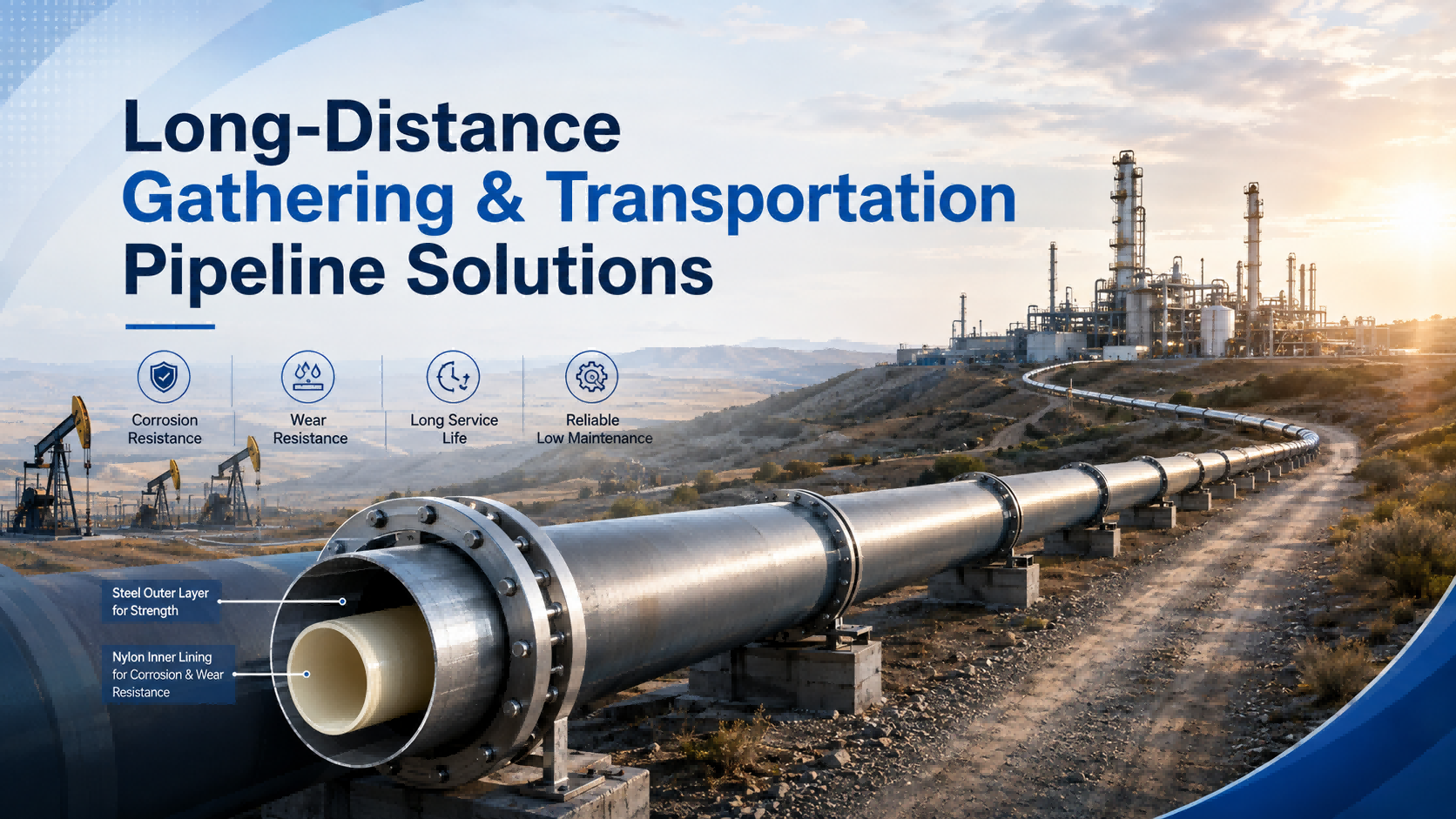
This is the fundamental design concept behind Steel-Nylon Composite Pipe.
7. How Can Steel-Nylon Composite Pipe Reduce H₂S Corrosion Risk?
7.1 The First Principle: Minimize Direct Contact Between H₂S-Containing Fluids and Steel
Steel-Nylon Composite Pipe uses reinforced nylon as the internal fluid-contact layer.
Under normal operating conditions, H₂S, produced water, and other corrosive media contact the nylon layer first rather than the pressure-bearing steel structure.
Its primary value is not:
“Making steel more resistant to H₂S.”
Instead, the goal is:
To reduce direct exposure of the steel pressure-bearing structure to the corrosive medium through a non-metallic protective barrier.
This is a fundamentally different materials strategy.
8. Why Can This Structure Help Reduce HIC and SSC Exposure?
HIC and SSC are both associated with interaction between steel and H₂S-containing environments.
If a stable and intact nylon inner layer separates the process medium from the steel, the direct exposure pathway:
H₂S-Containing Fluid → Steel Surface
can be reduced.
The engineering logic is:
Less direct exposure of steel to corrosive fluids
↓
Less steel-surface corrosion reaction
↓
Reduced opportunity for hydrogen entry into steel
↓
Lower exposure to hydrogen-related damage mechanisms
However, this does not mean that every Steel-Nylon Composite Pipe is automatically suitable for every sour-service condition.
Final suitability should still be evaluated according to:
-
H₂S concentration and partial pressure
-
Temperature
-
Pressure
-
Fluid composition
-
Nylon grade
-
Permeation behavior
-
Flange and sealing design
-
Manufacturing quality
-
Applicable project standards
This is the correct engineering approach to material selection.
9. A Major Advantage of Steel-Nylon Composite Pipe: Corrosion and Wear Protection in One System
This is one of the key differences between Steel-Nylon Composite Pipe and many conventional corrosion protection solutions.
Oilfield pipelines often transport:
-
High-water-cut crude oil
-
Produced water
-
Sand-containing fluids
-
Oil-water-sand multiphase flow
-
High-salinity wastewater
These fluids do not only corrode pipelines. They also cause erosion and abrasion.
The most vulnerable locations are often:
-
Elbows
-
Tees
-
Reducers
-
Valve upstream and downstream sections
-
Pump outlets
-
High-velocity sections
Reinforced nylon offers good wear resistance, allowing Steel-Nylon Composite Pipe to combine:
Anti-Corrosion + Wear Resistance
within the same pipeline structure.
This is especially valuable in oilfield services where corrosion and erosion occur simultaneously.
10. How Does It Compare with Conventional Protective Coatings?
Protective coatings also aim to isolate the steel from corrosive media.
However, one of their key limitations is related to:
Coating Thickness and Mechanical Damage
If a coating develops:
-
Pinholes
-
Scratches
-
Delamination
-
Erosion damage
-
Application defects
the underlying steel may become locally exposed.
A structural nylon inner layer differs from a thin protective coating because it can provide a more substantial mechanical barrier, particularly in applications where both corrosion and abrasion must be considered.
11. If Nylon Resists Corrosion, Why Keep the Steel Layer?
Because industrial pipelines require more than corrosion resistance.
They must also meet requirements for:
-
Pressure
-
Diameter
-
Ring stiffness
-
Support span
-
Temperature
-
External loads
-
Vacuum or negative pressure
-
Mechanical impact
For large-diameter and higher-pressure applications, relying entirely on conventional polymer pipes can create engineering limitations.
The Steel-Nylon Composite Pipe concept is therefore simple:
Use steel to solve structural problems and nylon to solve fluid-contact problems.
Each material performs the function it is best suited for.
12. Steel-Nylon Composite Pipe vs. Conventional Pipeline Materials
| Performance | Carbon Steel | 316L Stainless Steel | FRP | PE/HDPE | Steel-Nylon Composite Pipe |
|---|---|---|---|---|---|
| Isolation from H₂S-containing media | Low | Good | Good | Good | Good |
| Pressure capability | High | High | Medium | Low-Medium | High |
| Wear resistance | Medium | Medium | Medium | Medium | High |
| Large-diameter structural stability | High | High | Medium | Medium | High |
| Electrochemical corrosion | Yes | Must still be evaluated | No | No | No at nylon contact layer |
| Field welding requirement | High | High | Low | Heat fusion/welding | Flanged connection |
| Initial investment | Low | High | Medium | Low-Medium | Medium |
| Long-term maintenance potential | Higher | Medium | Medium | Lower | Lower |
Any final material decision should still be based on actual fluid composition, pressure, temperature, design requirements, and applicable standards.
13. Why Are Flanged Connections Valuable in Oilfield Retrofit Projects?
H₂S corrosion does not always damage an entire pipeline at the same rate.
The first failures often occur at:
-
Elbows
-
Valve groups
-
Pump outlets
-
Gathering manifolds
-
High-velocity short sections
-
Reducers
For this reason, operators do not necessarily need to replace an entire pipeline immediately.
They can first consider:
50–500 m Trial Sections
or replace only highly vulnerable components.
Our Steel-Nylon Composite Pipe uses flanged connections, reducing the need for field hot work.
This can be especially useful for:
-
Existing pipeline retrofits
-
Oilfield stations
-
Chemical plants
-
Flammable and hazardous areas
Flanged installation can simplify replacement and support phased material verification.
14. Which H₂S Applications Are Worth Evaluating for Steel-Nylon Composite Pipe?
Steel-Nylon Composite Pipe is particularly worth evaluating in the following environments.
1. Oil and Gas Gathering Pipelines
Typical fluids may contain:
H₂S + CO₂ + Water + Sand
This is a classic combined corrosion and erosion environment.
2. High-Water-Cut Crude Oil Transportation
As oilfields mature, water cut often increases.
The internal environment can gradually become more similar to a complex corrosive water system.
3. Oilfield Produced Water
High salinity, chloride ions, H₂S, and other dissolved species may act together and accelerate carbon steel corrosion.
4. High-Wear Elbows and Short Sections
If complete pipeline replacement is not yet planned, operators can first consider replacing:
-
Elbows
-
Tees
-
Pump outlet sections
-
Valve upstream/downstream sections
-
High-flow sections
5. Large-Diameter Corrosive Pipelines
As pipeline diameter increases, the cost of using stainless steel or high-grade alloys throughout the entire system rises rapidly.
Composite pipeline solutions can therefore become increasingly attractive from an economic perspective.
15. Typical Engineering Capabilities of Steel-Nylon Composite Pipe
Our Steel-Nylon Composite Pipe series can be designed for a wide range of industrial transportation requirements, including:
-
Diameter: DN100–DN2000+
-
Pressure: 1.0–4.0 MPa
-
Temperature: Approximately -36°C to 160°C
-
Flanged Connection
-
Corrosion Resistance
-
Wear Resistance
-
Large-Diameter Capability
It is especially suitable for applications requiring a combination of:
High Strength + Corrosion Protection + Wear Resistance + Large Diameter + Convenient Installation
Exact temperature, pressure, and chemical compatibility should always be confirmed according to the specific product grade and operating conditions.
16. Do Not Compare Only Purchase Price — Compare 10-Year TCO
One of the most common mistakes in H₂S pipeline procurement is to compare only:
USD per meter
But the true project cost should be evaluated using:
Total Cost of Ownership (TCO)
A simplified model is:
TCO = Initial Pipe Cost + Installation + Maintenance + Replacement + Shutdown Losses
A pipeline material may be 20% cheaper initially, but if it causes repeated:
-
Corrosion perforation
-
Leakage
-
Replacement
-
Production shutdowns
-
Cleaning
-
Repairs
its total cost over 10 years may be far higher than a more durable alternative.
For oil and gas and continuous-process industries:
The cost of one unplanned shutdown can sometimes exceed the purchase cost of the pipeline itself.
For this reason, material selection in highly corrosive environments should move away from:
Lowest Purchase Price
toward:
Lowest Lifecycle Cost
17. What Information Should Be Provided Before Selecting a Pipeline for H₂S Service?
To evaluate whether Steel-Nylon Composite Pipe is suitable for a particular H₂S application, the following information should ideally be provided:
-
Pipeline Diameter / DN
-
Design Pressure
-
Operating Pressure
-
Design Temperature
-
Operating Temperature
-
H₂S Concentration / Partial Pressure
-
CO₂ Concentration
-
Water Content
-
pH
-
Chloride Concentration
-
Solid / Sand Content
-
Flow Velocity
-
Pipeline Length
-
Aboveground or Underground Installation
-
Existing Pipeline Material
-
Current Failure Mode
-
Required Design Life
The more complete the operating data, the more reliable the material selection will be.
18. The Best Solution for H₂S Corrosion Is Not Always “A More Expensive Metal”
For many years, the traditional material upgrade path has often been:
Carbon Steel Is Not Corrosion-Resistant Enough
→ Upgrade to Stainless Steel
→ Stainless Steel Is Still Not Enough
→ Upgrade to Higher-Grade Alloy
But this is not the only engineering direction.
Another important development is:
Composite Pipeline Technology
Instead of forcing one material to deliver every required property, different materials are used for different functions.
Steel-Nylon Composite Pipe follows this approach:
Steel provides:
Strength & Pressure Resistance
Nylon provides:
Corrosion & Wear Protection
This gives the system strong potential when corrosion, wear, higher pressure, and large diameter must all be considered at the same time.
Conclusion: How Can H₂S Corrosion Be Solved?
There is no single universal solution to H₂S corrosion.
A reliable corrosion-control strategy should consider:
Fluid Analysis + Corrosion Mechanism + Material Selection + Structural Design + Manufacturing Quality + Installation + Corrosion Monitoring
For conventional steel pipelines, sour-service steel, corrosion inhibitors, corrosion allowance, and monitoring can all play important roles.
For extremely severe applications, high-grade corrosion-resistant alloys may be appropriate.
However, for industrial transportation systems that combine:
H₂S Corrosion + High Water Content + Sand Erosion + Large Diameter + Higher Pressure
Steel-Nylon Composite Pipe provides another engineering option worth evaluating.
Its design philosophy is straightforward:
Steel provides structural strength, while reinforced nylon isolates the corrosive fluid and adds wear protection.
This is why industrial pipeline selection is increasingly moving away from simply comparing individual materials and toward evaluating:
Material + Structure + Lifecycle Cost
For an H₂S pipeline project, the key question should not simply be:
“Which pipe is the cheapest?”
The better question is:
“Which pipeline solution can operate reliably for a longer period under the actual H₂S service conditions while delivering a lower total lifecycle cost?”
How to Solve CO₂ Corrosion? Corrosion Mechanisms, Engineering Solutions, and the Application of Steel-Nylon Composite Pipes in Oil & Gas Fields
Oilfield Pipeline Corrosion Analysis: From Failure Mechanisms to Steel-Nylon Composite Pipe Solutions