
Industrial Pipe Procurement: Lowest Price vs. Lowest TCO
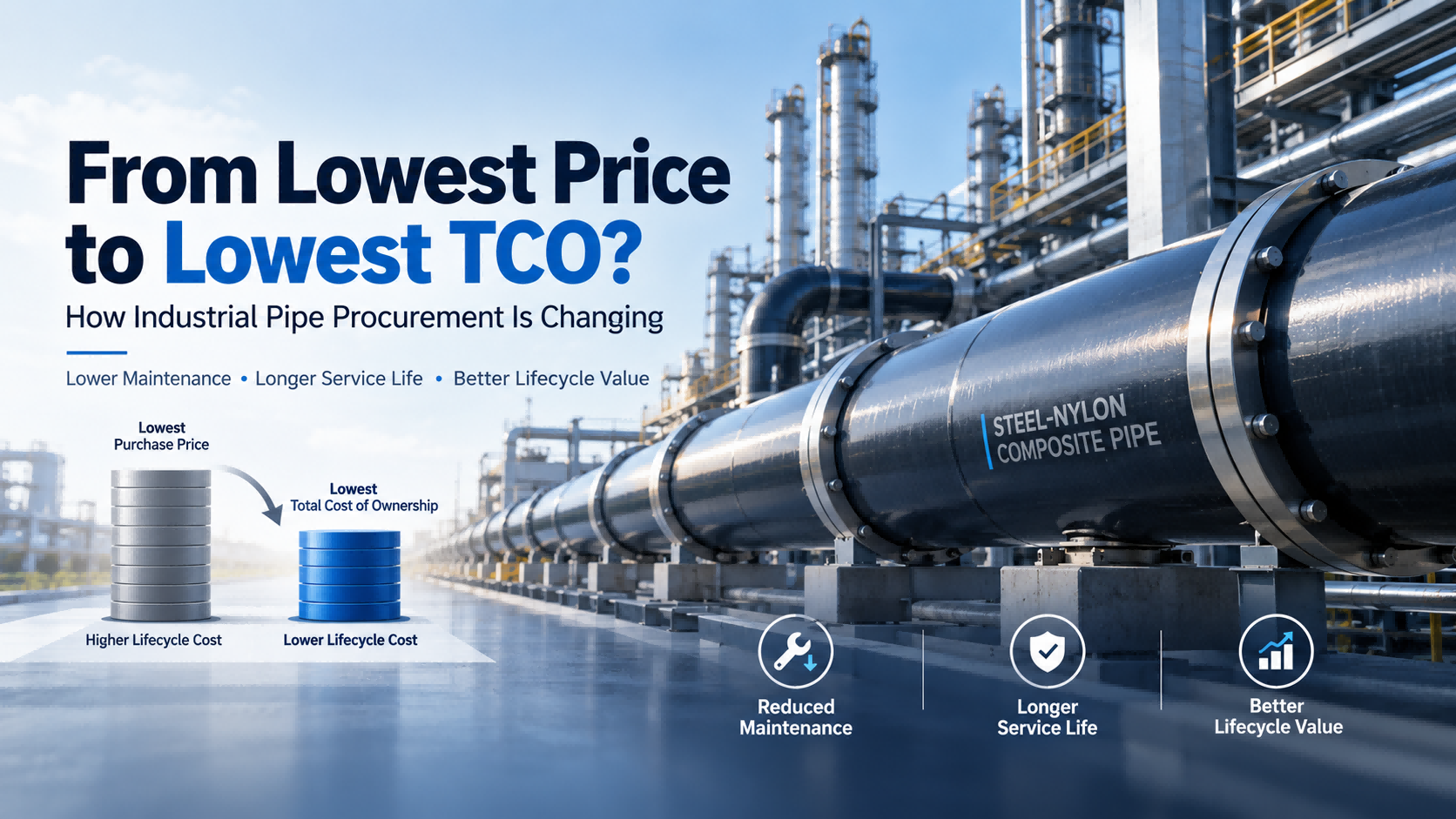
Is Industrial Pipe Procurement Shifting from Lowest Price to Lowest TCO?
Industrial Pipeline Procurement: Why Total Cost of Ownership Is Becoming More Important Than Initial Purchase Price
As global industrial infrastructure continues to expand and existing facilities undergo modernization, industrial pipeline procurement is experiencing an important transformation.
Traditionally, pipeline purchasing decisions have focused on three fundamental questions:
-
What is the purchase price per meter of pipe?
-
Which supplier offers the lowest quotation?
-
How can initial investment be minimized while meeting basic technical requirements?
However, for industries such as chemical processing, mining, oil and gas, power generation, water treatment, and large-scale industrial fluid transportation, procurement teams are increasingly considering a more important question:
How much will a pipeline system actually cost over the next 10, 20, or even 30 years?
This question highlights the growing importance of Total Cost of Ownership (TCO) in industrial pipeline selection.
A pipeline with a relatively low initial purchase price may ultimately become expensive if it requires frequent maintenance, suffers from corrosion or abrasion, causes unexpected shutdowns, or needs premature replacement.
Conversely, a more advanced piping solution with a higher initial investment may deliver substantial long-term economic benefits through reduced maintenance requirements, fewer operational interruptions, and longer replacement intervals.
Among the materials worth evaluating, steel-nylon composite pipes offer an interesting combination of structural strength, corrosion protection, wear resistance, and installation flexibility.
This article explores why industrial pipeline procurement is gradually moving beyond the lowest-price approach, how TCO should be calculated, and why steel-nylon composite piping systems can provide significant economic advantages under suitable operating conditions.
1. Why Has Industrial Pipeline Procurement Traditionally Focused on the Lowest Price?
In conventional industrial projects, pipes are frequently treated as standard construction materials rather than long-term operating assets.
Procurement departments typically receive technical specifications from engineering consultants or EPC contractors, request quotations from multiple suppliers, and compare prices among technically acceptable offers.
Under this approach, the initial purchase price often becomes the most visible decision-making factor.
1.1 Initial Purchase Costs Are Easy to Measure
Industrial pipes are commonly quoted by meter, ton, or piece.
For example, if a project requires 1,000 meters of DN300 industrial piping, procurement teams can easily compare the prices offered by different manufacturers.
However, predicting future maintenance expenses, corrosion failures, production interruptions, and replacement costs is considerably more complicated.
As a result, purchase price frequently receives greater attention than long-term reliability.
1.2 Capital and Operating Budgets Are Often Managed Separately
Many industrial companies separate their budgets into two categories:
CAPEX (Capital Expenditure): Costs associated with purchasing and installing new assets.
OPEX (Operating Expenditure): Costs associated with operating, maintaining, and repairing those assets.
Engineering and construction departments are often evaluated based on their ability to control initial project investment.
Meanwhile, maintenance teams are responsible for managing corrosion repairs, equipment failures, pipeline replacements, and operating expenses after commissioning.
This separation creates a fundamental problem:
Reducing procurement costs does not necessarily reduce the company's overall operating expenses.
A purchasing decision that saves money during construction may create substantially higher costs throughout the operational life of the facility.
1.3 Long-Term Pipeline Risks Are Difficult to Predict
When historical operating data is limited, procurement teams may struggle to evaluate the long-term performance of different piping materials.
For example, conventional carbon steel pipes can be economically attractive under relatively mild operating conditions.
However, in highly saline, corrosive, or abrasive environments, corrosion and wear may significantly affect their service life.
If purchasing decisions consider only initial material prices, these risks can be underestimated.
Therefore, the traditional lowest-price approach is not necessarily incorrect, but it is often insufficient for evaluating the economics of complex industrial pipeline systems.
2. What Is Total Cost of Ownership in Industrial Pipeline Procurement?
Total Cost of Ownership represents the overall cost of purchasing, installing, operating, maintaining, replacing, and eventually disposing of an industrial asset throughout a defined evaluation period.
Unlike conventional price comparisons, TCO examines the long-term economic consequences of material selection.
International asset management and life-cycle costing frameworks, including ISO 15686-5 and ISO 55000, provide useful principles for evaluating long-term asset value and life-cycle costs.
For industrial piping systems, TCO generally includes the following components:
| Cost Category | Main Cost Components |
|---|---|
| Initial procurement | Pipes, fittings, flanges, transportation |
| Installation | Welding, lifting, assembly, pressure testing |
| Maintenance | Inspection, cleaning, corrosion treatment, repairs |
| Energy consumption | Pumping power and hydraulic resistance |
| Downtime | Production interruptions and recovery expenses |
| Replacement | Pipe removal, replacement materials, reinstallation |
| Risk-related costs | Leakage response, environmental remediation, disposal |
2.1 How Is Pipeline TCO Calculated?
A simplified discounted TCO formula can be expressed as:
TCO = C₀ + Σ [Cₜ / (1 + r)ᵗ] − Vₙ / (1 + r)ᴺ
Where:
-
C₀: Initial procurement and installation costs
-
Cₜ: Operating, maintenance, downtime, and replacement costs in year t
-
N: Total evaluation period
-
r: Discount rate
-
Vₙ: Residual value at the end of the evaluation period
Using discounted cash flow allows procurement teams to compare costs occurring at different times on a consistent financial basis.
The objective is not simply to identify the cheapest material.
Instead, it is to determine which technically acceptable piping solution delivers the lowest overall cost while maintaining operational safety, reliability, and performance.
3. Five Factors Driving the Shift Toward TCO-Based Pipeline Procurement
3.1 Increasing Awareness of Corrosion-Related Maintenance Costs
Corrosion is one of the major causes of deterioration in industrial pipeline systems.
Chemical processing plants, chlor-alkali facilities, oilfield water systems, industrial wastewater facilities, and seawater transportation networks frequently handle fluids containing salts, chlorides, or other potentially corrosive substances.
For unprotected carbon steel pipes, corrosion may gradually result in:
-
Reduced pipe wall thickness
-
Localized pitting and internal damage
-
Leakage and loss of containment
-
Reduced pressure-bearing capability
-
Frequent maintenance and premature replacement
-
Unexpected production shutdowns
A traditional procurement evaluation may focus primarily on material costs.
A TCO-based evaluation considers the financial consequences of corrosion over the entire operating period.
Under corrosive operating conditions, improved corrosion resistance can translate directly into long-term economic value.
This is one reason why composite piping materials are increasingly considered during industrial material selection.
3.2 Abrasion Resistance Influences Pipeline Replacement Frequency
In mining, tailings transportation, slurry handling, ash transportation, and other solid-liquid conveying systems, pipelines must withstand abrasive particles as well as chemical exposure.
Wear can be especially severe in:
-
Pipe elbows and bends
-
Tees and branch connections
-
Reducers and transition sections
-
Pump discharge pipelines
-
Areas experiencing turbulent flow or particle impacts
For continuous industrial operations, repeatedly replacing worn pipe sections creates ongoing material, labor, and downtime costs.
A pipe material that extends replacement intervals under comparable conditions can potentially reduce the total cost of ownership.
The financial benefit comes not only from lower material consumption but also from fewer maintenance interventions.
3.3 Unplanned Downtime Can Cost More Than the Pipeline Itself
In major industrial facilities, the failure of a relatively small pipeline section may interrupt an entire production process.
Examples include:
-
Main slurry transportation pipelines in mining operations
-
Circulating pipelines in chemical plants
-
Cooling water pipelines in power stations
-
Oilfield gathering and water injection systems
The total cost of a pipeline failure may include lost production, emergency maintenance, workforce mobilization, equipment recovery, and material losses.
In some critical applications, these indirect expenses can exceed the value of the failed pipe section.
Therefore, procurement teams should ask more than:
"How long will this pipe last?"
They should also ask:
"How frequently is this pipeline likely to require maintenance, and what will each interruption cost our operation?"
This question is central to TCO-based purchasing decisions.
3.4 Energy Efficiency Is Becoming a Long-Term Cost Consideration
For continuously operated pumping systems, the internal condition of a pipeline can affect hydraulic resistance and energy consumption.
Over time, conventional metal piping may develop corrosion products, internal deposits, or increased surface roughness.
These changes can reduce the effective flow area and increase the pressure required to maintain the specified flow rate.
Pipeline materials with relatively smooth internal surfaces and good resistance to internal deterioration may help control long-term hydraulic losses.
Steel-nylon composite pipes provide a potentially useful solution in suitable applications because their nylon contact surfaces can help limit certain forms of internal corrosion-related deterioration.
However, actual energy savings depend on pipe diameter, flow velocity, fluid properties, friction losses, fittings, and pump efficiency.
Energy efficiency advantages should therefore be verified through engineering calculations rather than assumed solely from material characteristics.
3.5 EPC Projects Are Placing Greater Emphasis on Operational Reliability
Large EPC projects frequently involve complex engineering requirements, long operating periods, and significant operational consequences if equipment fails.
Although not every EPC tender explicitly uses TCO as an evaluation criterion, long-term reliability and maintainability are becoming increasingly important in technically demanding projects.
This encourages closer cooperation among:
-
Project owners
-
EPC contractors
-
Engineering consultants
-
Procurement departments
-
Pipeline manufacturers
-
Operations and maintenance teams
Instead of evaluating pipes as isolated products, these stakeholders can assess how piping systems contribute to the overall economics of an industrial facility.
4. Why Steel-Nylon Composite Pipes Deserve Consideration in Low-TCO Pipeline Design
Steel-nylon composite pipes combine the mechanical properties of steel with the functional characteristics of nylon materials.
Rather than relying on a single material to perform every function, the composite structure allows different materials to serve complementary engineering purposes.
The steel component primarily provides structural support and mechanical strength, while the nylon layer serves as the medium-contacting surface.
This design concept can offer several important advantages under appropriate operating conditions.
4.1 Steel Reinforcement Provides Mechanical Strength and Structural Stability
Industrial pipelines must withstand more than internal fluid pressure.
They may also experience external loads, temperature variations, installation stresses, vibration, and support-related forces.
In properly engineered steel-nylon composite pipes, the steel structure provides mechanical support and helps maintain overall dimensional stability.
This can make composite piping an option for applications requiring relatively large diameters or specific pressure-bearing capabilities.
Compared with certain conventional plastic piping solutions, steel reinforcement provides additional design possibilities for structural support and mechanical performance.
However, actual allowable pressure and temperature limits must be determined according to pipe design, material specifications, manufacturing quality, and applicable engineering standards.
4.2 Nylon Layers Provide Internal Corrosion Protection
One of the key advantages of steel-nylon composite piping is the separation of the transported medium from the steel structure.
When the nylon material is chemically compatible with the transported fluid, the internal layer acts as a protective barrier.
This can reduce direct exposure of the steel component to corrosive liquids.
Potential applications include selected:
-
Salt solution transportation systems
-
Alkaline fluid pipelines
-
Industrial wastewater networks
-
High-salinity water systems
-
Chemical processing pipelines
Compared with conventional steel pipes exposed directly to corrosive fluids, a suitable composite design may reduce the need for corrosion-related repairs.
Nevertheless, nylon is not universally resistant to every chemical.
Material compatibility must be assessed using the actual fluid composition, concentration, temperature, pressure, and long-term exposure conditions.
4.3 Wear-Resistant Design Supports Longer Replacement Intervals
Nylon materials can provide useful toughness and abrasion-related properties when suitable grades and designs are selected.
For industrial slurry systems, this creates opportunities to evaluate steel-nylon composite pipes as alternatives to conventional piping materials.
Potential applications include mining slurry pipelines, tailings systems, and selected abrasive industrial fluid services.
Steel-nylon composite elbows, tees, and straight pipe sections can be evaluated particularly where conventional materials experience frequent wear.
The actual wear performance depends on several factors:
-
Particle hardness and size
-
Solid concentration
-
Flow velocity
-
Particle impact angle
-
Fluid chemistry
-
Nylon grade and lining design
Therefore, comparative abrasion testing and field operating data are essential when determining whether steel-nylon composite pipes can extend service life.
4.4 Smooth Internal Surfaces May Help Maintain Hydraulic Performance
The internal surface condition of a pipeline plays an important role in fluid transportation.
In conventional metal pipelines, corrosion products and internal deposits may increase surface roughness over time.
This can contribute to higher friction losses and additional cleaning requirements.
Steel-nylon composite pipes feature a relatively smooth nylon contact surface.
Under suitable operating conditions, this may help reduce deterioration associated with internal corrosion products and support more stable hydraulic performance.
Potential long-term benefits include:
-
Reduced cleaning and maintenance requirements
-
Improved retention of effective flow capacity
-
Lower risk of corrosion-related roughness increases
-
Better control of long-term pumping costs
These benefits depend on the transported medium and operating environment.
A smooth nylon surface does not eliminate scaling, crystallization, or particle deposition under all conditions.
4.5 Integrated Flange Connections Improve Installation Flexibility
Our steel-nylon composite piping solutions incorporate integrated flange connection designs.
Depending on project specifications, this approach can reduce the amount of field welding required during pipeline installation.
Potential advantages include:
-
Simplified on-site assembly
-
Reduced requirements for certain hot-work operations
-
Easier connection to valves and industrial equipment
-
Convenient replacement of individual pipe sections
-
Improved flexibility during maintenance and system modifications
For operational chemical plants, industrial pipeline upgrades, and facilities where shutdown time must be carefully controlled, installation efficiency can contribute to reduced overall project costs.
Proper gasket selection, flange alignment, bolting procedures, and pressure testing remain essential to ensuring reliable connections.
5. A 10-Year TCO Comparison: Can a More Expensive Pipe Actually Cost Less?
To illustrate the economic principles behind TCO-based procurement, consider a hypothetical industrial facility planning a continuously operated pipeline system.
The procurement team is comparing two technically acceptable solutions.
Option A: Conventional Metal Pipeline
Option B: Steel-Nylon Composite Pipeline
Both systems are assumed to meet the same basic engineering requirements and provide equivalent transportation capacity.
The evaluation period is 10 years.
The following figures are illustrative assumptions only. They do not represent verified product quotations, guaranteed service life, or measured performance results.
5.1 Example: 10-Year Pipeline Ownership Costs
| Cost Item | Conventional Metal Pipe | Steel-Nylon Composite Pipe |
|---|---|---|
| Initial pipe purchase | $100,000 | $130,000 |
| Installation | $28,000 | $26,000 |
| Annual maintenance | $8,000 | $4,000 |
| Annual expected downtime losses | $6,000 | $2,000 |
| Annual energy expenses | $12,000 | $11,000 |
| Replacement in Year 6 | $60,000 | $0 |
| 10-Year Undiscounted TCO | $448,000 | $326,000 |
| 10-Year Discounted TCO | Approx. $340,300 | Approx. $270,100 |
Calculation assumptions: An annual discount rate of 8%, year-end cash flows, no residual value, and no double-counting of downtime losses. Both options meet the required performance criteria throughout the evaluation period.
The steel-nylon composite pipe has an initial purchase price that is 30% higher than the conventional metal pipe.
However, under the assumptions used in this example, its 10-year discounted TCO is approximately 20.6% lower.
This difference primarily results from:
-
Reduced annual maintenance costs
-
Lower expected downtime losses
-
Lower assumed energy expenses
-
Avoidance of a major replacement during the evaluation period
5.2 What Does This Comparison Demonstrate?
The example illustrates a fundamental principle:
The lowest initial purchase price does not always produce the lowest long-term ownership cost.
A technically superior piping solution may justify a higher purchase price when it reduces operating and maintenance expenses sufficiently.
However, the economic outcome depends on actual conditions.
If the fluid is non-corrosive, abrasion is negligible, and conventional steel pipes can operate reliably without major maintenance, a composite pipeline may not offer the lowest TCO.
This is why project-specific TCO modeling and sensitivity analysis are essential.
Procurement teams should test how changes in maintenance frequency, replacement timing, downtime costs, and discount rates affect the economic comparison.
6. Which Industries Benefit Most from TCO-Based Pipeline Procurement?
TCO evaluation is valuable for many industrial applications, but it is especially important in environments where maintenance, corrosion, wear, or production interruptions create substantial financial consequences.
6.1 Chemical Processing and Chlor-Alkali Industries
Chemical processing facilities may transport alkaline solutions, salt solutions, and other chemically demanding fluids.
These applications frequently require careful consideration of chemical compatibility, corrosion resistance, mechanical reliability, and maintenance requirements.
Steel-nylon composite pipes can be evaluated for suitable chemical transportation applications where internal corrosion is a significant concern.
In compatible service environments, their composite construction may help reduce corrosion-related maintenance and improve long-term operational economics.
6.2 Mining, Slurry, and Tailings Transportation
Mining pipelines often transport abrasive mixtures containing mineral particles and water.
Depending on the application, wear may occur in straight pipe sections, elbows, tees, and other components subjected to particle impacts.
In long-distance slurry transportation systems, repeated pipeline maintenance can create significant operating expenses.
Steel-nylon composite pipes offer an alternative material approach for selected systems requiring mechanical strength, internal protection, and abrasion resistance.
The potential TCO benefit should be evaluated through comparable wear data and expected replacement intervals.
6.3 Oil and Gas Water Handling Systems
Oilfield produced water, injection water, and certain gathering systems may contain high salt concentrations, suspended solids, and chemically aggressive substances.
Pipeline selection in these environments must consider pressure, temperature, corrosion, material compatibility, and system reliability.
Where engineering requirements permit, steel-nylon composite pipes can be evaluated as an alternative to conventional internally exposed metal piping.
Their steel-supported structure and protective nylon layer may provide advantages for suitable fluid-handling applications.
6.4 Power Generation and Industrial Cooling Water Systems
Power plants rely on numerous pipelines for circulating water, cooling water, and selected industrial slurry services.
Corrosion, deposits, internal wear, and maintenance interruptions may contribute to long-term operating costs.
For large-diameter or continuously operated systems, pipe materials that help control deterioration can provide economic benefits.
Steel-nylon composite pipes may be considered where the fluid properties and operating conditions are compatible with the material and structural design.
6.5 Water Treatment, Wastewater, and Seawater Transportation
Industrial wastewater treatment, water reuse, desalination facilities, and saline water transportation systems often face demanding corrosion conditions.
For these projects, pipe selection should consider more than initial material prices.
Long-term corrosion performance, maintenance requirements, hydraulic behavior, and replacement costs can all influence total ownership costs.
Steel-nylon composite pipes may be suitable candidates for selected applications, subject to chemical compatibility, pressure, temperature, and project certification requirements.
7. How Can Procurement Teams Build an Effective TCO Evaluation Framework?
Moving toward TCO-based procurement requires more than simply requesting longer service-life claims from suppliers.
A reliable evaluation process should combine engineering specifications, material performance evidence, risk assessment, and financial analysis.
Step 1: Establish Common Technical Requirements
All candidate piping systems should be evaluated against consistent engineering conditions.
These include:
-
Design and operating pressure
-
Maximum and minimum temperature
-
Fluid composition and concentration
-
Pipeline diameter and required flow capacity
-
Operating hours
-
Installation environment
-
Expected evaluation period
Comparing pipes with different hydraulic capacities, safety margins, or structural requirements solely by unit price can produce misleading conclusions.
Step 2: Identify Potential Failure Mechanisms
The procurement and engineering teams should identify the most likely causes of pipeline deterioration.
These may include:
-
Internal corrosion
-
Abrasive wear
-
Lining damage
-
Flange leakage
-
Fatigue-related failures
-
Pressure surges
-
Improper installation
Historical maintenance records and comparable operating data can help estimate failure probability and associated costs.
Step 3: Develop a 10-Year or 20-Year Cost Model
The financial model should include initial procurement and installation costs together with projected maintenance, energy consumption, downtime, and replacement expenses.
For significant industrial investments, discounted cash flow analysis is recommended.
Sensitivity analysis should also be performed to determine how uncertain assumptions affect the final decision.
Step 4: Verify Supplier Technical Documentation
When evaluating steel-nylon composite pipes, procurement teams should request relevant technical information, including:
-
Steel structural design and specifications
-
Nylon material identification
-
Lining thickness and uniformity
-
Composite interface integrity
-
Pressure test reports
-
Chemical compatibility information
-
Flange dimensions and connection standards
-
Manufacturing quality control procedures
-
Product traceability documentation
The availability of compatible elbows, tees, reducers, and customized fittings should also be confirmed.
A reliable pipeline system depends on the performance of all its components, not only straight pipe sections.
Step 5: Validate TCO Assumptions Through Field Performance
For critical applications or unfamiliar materials, a trial installation can provide valuable operating data.
Engineering teams can monitor:
-
Internal wear rates
-
Leakage incidents
-
Maintenance frequency
-
Hydraulic pressure losses
-
Cleaning requirements
-
Operating costs
These measurements can be used to improve future material selection and refine TCO assumptions.
Field validation is especially useful when evaluating alternatives to established piping materials.
8. Do Steel-Nylon Composite Pipes Always Deliver the Lowest TCO?
Not necessarily.
No single piping material offers the lowest purchase price, longest service life, and lowest maintenance cost in every industrial environment.
For example, conventional carbon steel pipes may remain the most economical option for applications involving mild fluids, stable operating conditions, and readily accessible maintenance locations.
Similarly, certain non-metallic piping systems may offer strong cost advantages in low-pressure applications.
Steel-nylon composite pipes may also face limitations in environments involving high temperatures, aggressive oxidizing chemicals, incompatible solvents, or demanding vacuum conditions.
Therefore, their strongest economic potential generally appears when several operating challenges occur together:
Mechanical Strength Requirements + Corrosion Exposure + Abrasive Conditions + Continuous Operation + High Maintenance or Downtime Costs
Under these circumstances, combining the structural properties of steel with the protective characteristics of nylon can provide a compelling technical and economic solution.
However, the final material decision should always be based on engineering verification, product quality, operational requirements, and realistic life-cycle cost analysis.
9. From Selling Pipes to Delivering Low-TCO Piping Solutions
As industrial customers increasingly consider total cost of ownership, the role of pipeline manufacturers is also evolving.
Project owners do not simply need a specified quantity of industrial pipes.
They need piping systems capable of supporting safe, efficient, and reliable operations throughout their intended service period.
This requires manufacturers to understand actual operating conditions and provide appropriate engineering solutions.
Our company specializes in the development and manufacturing of reinforced nylon pipes and steel-nylon composite piping systems.
We focus on addressing common industrial pipeline challenges, including corrosion, abrasion, internal surface deterioration, and frequent maintenance.
9.1 Our Steel-Nylon Composite Pipe Advantages
Steel-Reinforced Mechanical Structure
Steel components provide the primary structural support and mechanical strength required for properly designed industrial piping systems.
Protective Nylon Inner Layer
The nylon contact layer helps isolate the transported medium from the steel structure, reducing direct corrosion exposure when the selected material is chemically compatible.
Wear-Resistant Design
The composite construction provides opportunities to improve performance in selected abrasive fluid transportation applications.
Smooth Internal Surface
The relatively smooth nylon surface may help reduce corrosion-related internal deterioration and support more consistent hydraulic performance.
Integrated Flange Connections
Integrated flange designs can simplify installation, reduce certain on-site welding requirements, and facilitate the replacement of individual pipeline sections.
Customized Engineering Solutions
Different pipe diameters, pressure requirements, fittings, and connection configurations can be evaluated according to project specifications and manufacturing capabilities.
9.2 Our Focus Is Long-Term Customer Value
Our objective is not to claim that steel-nylon composite pipes are suitable for every industrial application.
Instead, we aim to help customers identify operating environments where the combination of steel and nylon can provide genuine technical and economic advantages.
By supporting appropriate material selection, reliable manufacturing, and project-specific engineering requirements, we seek to help industrial customers reduce maintenance risks and improve overall piping system economics.
For more information about our piping solutions, visit:
Website: www.nylonpipeline.com
10. The Future of Industrial Pipeline Procurement: From Material Price to System Value
The industrial pipeline market is likely to experience a continued evolution in procurement priorities.
While purchase price will remain an essential consideration, technically demanding and long-life industrial projects increasingly benefit from a broader economic evaluation.
Three important developments are shaping this transition.
10.1 From Unit Purchase Price to Life-Cycle Cost
Instead of focusing exclusively on the price per meter, procurement teams can evaluate the total expected cost over 10, 15, or 20 years.
This approach helps identify situations where a higher-quality material provides greater financial value.
10.2 From Individual Material Properties to System Reliability
Pipeline reliability depends on more than corrosion resistance or pressure ratings.
The performance of fittings, joints, manufacturing processes, installation procedures, and maintenance practices also contributes to overall system reliability.
Future procurement evaluations are likely to place greater emphasis on integrated piping solutions.
10.3 From One-Time Transactions to Long-Term Technical Partnerships
Industrial customers increasingly benefit from suppliers capable of providing more than a product quotation.
Technical consultation, material selection assistance, manufacturing quality assurance, and operational feedback can all contribute to improved project outcomes.
For steel-nylon composite pipe manufacturers, competitive advantages will depend not only on product characteristics but also on engineering capabilities, consistent manufacturing quality, and customer support.
11. Frequently Asked Questions (FAQ)
Q1: What does TCO mean in industrial pipeline procurement?
TCO stands for Total Cost of Ownership. It includes the costs of purchasing, installing, operating, maintaining, repairing, replacing, and disposing of piping systems over a defined evaluation period.
It provides a broader economic comparison than initial purchase price alone.
Q2: Why is the cheapest industrial pipe not always the most economical option?
A low-cost pipe may require more frequent maintenance, corrosion repairs, cleaning, or replacement.
If these additional expenses exceed the initial purchase savings, the lowest-priced material may ultimately have a higher total cost of ownership.
Q3: How can steel-nylon composite pipes reduce total ownership costs?
Under suitable operating conditions, steel-nylon composite pipes can help reduce internal corrosion exposure, provide useful wear resistance, maintain mechanical support, and simplify certain installation procedures.
These characteristics may lower maintenance requirements, extend replacement intervals, and reduce operational interruptions.
Actual savings must be confirmed through project-specific engineering and economic analysis.
Q4: Can steel-nylon composite pipes replace stainless steel or carbon steel pipes?
Steel-nylon composite pipes may serve as alternatives to traditional metal piping in selected corrosive or abrasive applications.
However, replacement decisions must consider chemical compatibility, pressure, temperature, engineering standards, connection requirements, and total cost of ownership.
They should not be considered universal replacements for every metal piping application.
Q5: What is the recommended evaluation period for pipeline TCO?
Industrial pipeline TCO analyses commonly use periods such as 10, 15, or 20 years, depending on project requirements.
The selected period should align with the expected facility operating life, asset replacement strategy, and financial evaluation criteria.
All candidate piping solutions should be compared using the same evaluation period and cost boundaries.
Conclusion: The Future of Industrial Pipe Procurement Is About Long-Term Value, Not Just the Lowest Quote
Industrial pipeline procurement is moving toward a more comprehensive understanding of long-term economic performance, particularly in applications where reliability, corrosion resistance, and maintenance costs are critical.
This does not mean that initial purchase price is becoming irrelevant.
Instead, purchase price should be evaluated alongside maintenance requirements, operating efficiency, downtime exposure, and replacement frequency.
The most economical pipeline is not necessarily the one with the lowest initial price, but the one that delivers the best combination of technical suitability, operational reliability, and long-term cost efficiency.
For industrial projects requiring both mechanical strength and protection against corrosion or wear, steel-nylon composite pipes represent a promising material option.
By combining a steel-supported structure with a protective nylon layer, properly engineered composite piping systems can help address some of the limitations associated with conventional materials.
When applied under suitable operating conditions, they may contribute to lower maintenance requirements, fewer replacements, and improved life-cycle economics.
As industrial asset management becomes increasingly focused on long-term value, the competitive landscape of pipeline procurement will continue to evolve.
The most important question may no longer be:
"Which supplier offers the lowest pipe price?"
Instead, project owners and procurement professionals will increasingly need to ask:
"Which piping solution can deliver the lowest total cost while meeting our technical and operational requirements?"
That is the direction in which industrial pipeline procurement is evolving—and an important reason why advanced composite piping technologies deserve serious consideration.
Contact Us: Explore Cost-Effective Steel-Nylon Composite Piping Solutions
Are you looking for industrial pipes that combine mechanical strength, corrosion protection, and wear resistance?
Does your existing pipeline system experience frequent corrosion, abrasion, leakage, or premature replacement?
Our team can help you evaluate whether steel-nylon composite pipes are suitable for your operating conditions.
By reviewing your application requirements—including transported medium, pressure, temperature, pipe diameter, flow rate, and installation environment—we can support material selection and assess potential long-term economic benefits.
Contact us to discuss your industrial pipeline project, request technical product information, or obtain a customized quotation.
Website: //www.nylonpipeline.com
Email: lloyds.royqiu@gmail.com
Steel-Nylon Composite Pipes — Engineered for Reliability, Designed for Lower Lifecycle Costs.
Why Is Downtime Cost Becoming a Critical Factor in Pipe Material Selection?
What Do EPC Companies Look for When Selecting New Piping Materials?


