The Future of Industrial Piping Competition: From Purchase Price to Life Cycle Cost

“How much does this pipe cost per meter?”
But for oil and gas fields, chemical plants, mining operations, power plants, salt-chemical facilities, and other continuous-process industries, a more important question is increasingly replacing simple purchase-price comparisons:
“How much will this piping system actually cost over the next 10 years—or even longer?”
These two questions may sound similar, but they represent completely different procurement philosophies.
The first focuses on one-time upfront investment. The second considers the entire life of the pipeline—from purchasing, transportation, and installation to operation, maintenance, replacement, and eventual retirement.
As industrial projects place greater emphasis on continuous production, operational safety, reduced downtime, and long-term asset returns, the competitive standard for piping is changing.
The true economic value of an industrial pipeline is no longer determined only by its purchase price, but increasingly by its Life Cycle Cost (LCC).
For long-term industrial service, a low-cost pipeline that requires frequent repairs and replacement may ultimately cost far more than a higher-priced system that offers longer service life and lower maintenance requirements.
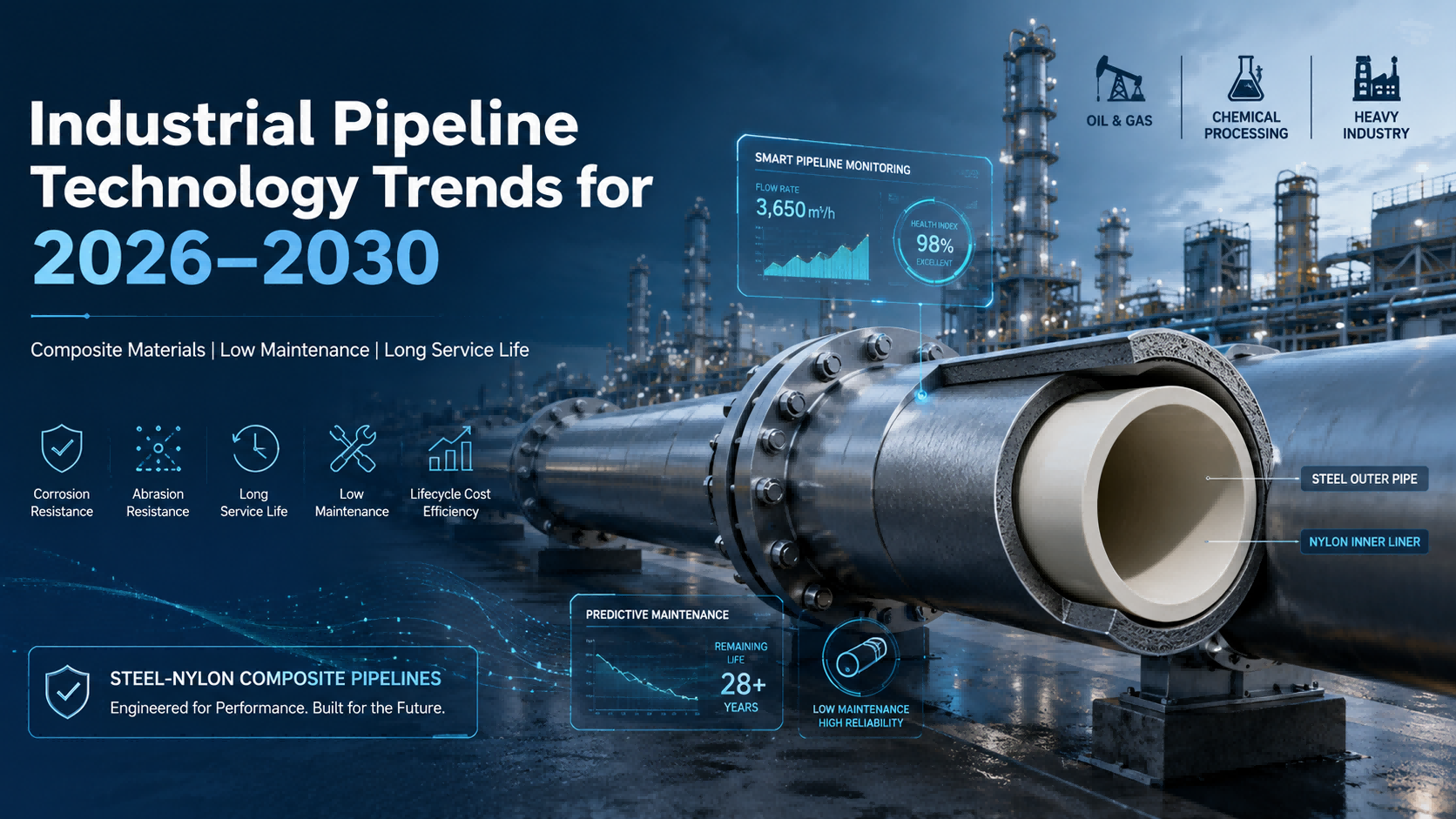
This is exactly why long-life composite piping technologies such as steel-nylon composite pipe deserve increasing attention.
1. Industrial Pipeline Procurement Is Undergoing a Cost-Logic Transformation
Traditional engineering procurement often compares materials primarily by unit price.
For example, for the same DN300 pipeline, procurement teams may compare:
-
Carbon steel pipe
-
PE pipe
-
FRP pipe
-
Stainless steel pipe
-
Lined steel pipe
-
Steel-nylon composite pipe
The lowest initial material price may then appear to be the most economical option.
However, this approach has a fundamental weakness:
It compares only the first cost in the pipeline’s life cycle.
The cost of an industrial pipeline does not end after the purchase order is issued.
In many corrosive, abrasive, scaling-prone, or high-pressure applications, a substantial portion of the real cost appears only after the system has entered service.
A more realistic equation is:
Life Cycle Cost = Initial Purchase + Installation + Operation + Maintenance + Replacement + Downtime Loss + Risk-Related Costs
In some industrial facilities, production losses caused by shutdowns can exceed the value of the pipeline itself.
Therefore, evaluating pipe economics only in terms of price per meter can easily result in a decision that appears economical at the beginning but becomes expensive over the long term.
2. Why Purchase Price Alone No Longer Represents the True Cost of a Pipeline
Consider two piping options.
Option A
The initial purchase price is lower, but:
-
Significant corrosion appears after 3–5 years
-
Local repair welding becomes necessary
-
Elbows suffer rapid wear
-
Periodic anti-corrosion treatment is required
-
Some pipe sections must be replaced
-
Production must be interrupted during replacement
Option B
The initial purchase price is somewhat higher, but:
-
Corrosion resistance is stronger
-
Wear resistance is better
-
Internal scaling tendency is lower
-
Maintenance frequency is reduced
-
Service life is significantly longer
If only initial CAPEX is considered, Option A may appear more attractive.
But over a 10- or 20-year period, the economic result may be completely different.
This is why more industrial companies are gradually shifting from:
Lowest Purchase Price
to:
Lowest Total Cost of Ownership (TCO)
In other words:
Lowest purchase cost → Lowest total ownership cost
3. The Most Expensive Part Is Often Not Buying the Pipe—It Is Replacing It
For continuous-process industries, pipeline failure generates several layers of cost.
3.1 Pipe Purchase Cost
This is the most visible cost and usually includes:
-
Straight pipe
-
Elbows
-
Tees
-
Reducers
-
Flanges
-
Valve connection sections
Traditional procurement often focuses heavily on this part.
However, it may represent only one portion of the total life cycle cost.
3.2 Installation Cost
Different piping materials require very different installation methods.
Installation expenses may include:
-
Welding
-
Heat fusion
-
Flange connection
-
Lifting
-
Supports
-
External corrosion protection
-
Non-destructive testing
-
Skilled labor
-
Hot-work management
Therefore, even if two piping materials have similar purchase prices, their total installed costs may be very different.
3.3 Maintenance Cost
During long-term operation, industrial pipelines may experience:
-
Wall thinning
-
Pitting corrosion
-
Perforation
-
Liner detachment
-
Delamination
-
Abrasive wear
-
Scaling
-
Blockage
-
Flange leakage
-
Weld leakage
Each of these problems creates recurring maintenance expenses.
3.4 Replacement Cost
When a pipeline reaches the end of its service life, replacement involves much more than simply purchasing another pipe.
The actual process may include:
Old pipe removal
↓
Site cleaning
↓
New pipe transportation
↓
Lifting
↓
Welding or connection
↓
Inspection
↓
Pressure testing
↓
Restarting production
Therefore:
The true cost of one pipeline replacement is usually much higher than the price of the replacement pipe itself.
4. The Largest Hidden Cost of Industrial Piping: Downtime
This cost is often underestimated.
Systems such as:
-
Oil and gas gathering lines
-
Chemical process pipelines
-
Mining slurry transportation systems
-
Salt-chemical production lines
-
Power plant desulfurization systems
are usually part of continuous operations.
If a critical pipeline leaks or perforates, the result may be reduced production or a complete shutdown.
At that point, the real question is no longer:
“How much does this section of pipe cost to replace?”
The more important question becomes:
“How much money does the plant lose for every day of shutdown?”
For large industrial facilities, the production loss from an unplanned shutdown may be far greater than the cost of hundreds of meters—or even kilometers—of piping.
From an asset-management perspective:
Pipeline reliability itself has measurable economic value.
5. Why Life Cycle Cost Is Becoming More Important in Industrial Pipe Selection
This shift is not simply a change in procurement philosophy.
It reflects broader changes in industrial operations.
First: Industrial assets are expected to operate for longer cycles
In the past, some projects accepted the idea of replacing pipelines every few years.
Today, more companies expect:
One installation, followed by long-term stable operation.
As a result, service life has become a much more important selection criterion.
Second: Labor and construction costs continue to rise
A growing share of maintenance cost comes not from materials, but from:
-
Labor
-
Lifting
-
Welding
-
Inspection
-
Safety management
-
Shutdown coordination
The more frequently a pipeline requires maintenance, the higher its long-term operating cost becomes.
Third: Production continuity is increasingly valuable
Industrial companies are paying greater attention to:
Plant Availability
In other words, the percentage of time a facility remains available for production.
Frequent pipeline leakage, repair, and replacement reduce plant availability.
Fourth: Decision-making is shifting from CAPEX to CAPEX + OPEX
Traditional procurement focuses heavily on:
CAPEX — Capital Expenditure
Modern asset management increasingly evaluates:
CAPEX + OPEX
That means:
Initial construction cost + Long-term operating cost
Life cycle costing connects these two perspectives.
6. Over 10 Years, the Most Economical Pipe May Be Completely Different
Consider a simplified model.
An industrial project is expected to operate for 10 years.
Pipeline A
Initial investment:
100
Replacement in Year 4:
60
Repair or partial replacement in Year 8:
40
Maintenance cost:
20
Total 10-year cost:
220
Pipeline B
Initial investment:
140
However, during the 10-year period:
-
No major replacement is required
-
Maintenance is limited
-
Downtime is significantly reduced
Maintenance cost:
20
Total 10-year cost:
160
From the purchase-price perspective:
Pipeline A is cheaper.
From the 10-year ownership-cost perspective:
Pipeline B is more economical.
This is the central logic behind life cycle costing:
The cheapest pipe is not necessarily the one with the lowest purchase price. It may be the one that requires the fewest replacements.
These figures are only illustrative. Actual TCO analysis should consider medium composition, pressure, temperature, pipe diameter, maintenance intervals, labor costs, and production-loss risks.
7. A Pipeline Life Cycle Cost Model Should Include at Least Seven Factors
Future industrial pipe selection should use a more complete LCC framework.
| Factor | Impact on Life Cycle Cost |
|---|---|
| Initial purchase cost | Initial CAPEX |
| Installation cost | Project construction cost |
| Expected service life | Determines replacement frequency |
| Maintenance frequency | Determines long-term OPEX |
| Corrosion and wear risk | Influences leakage probability |
| Downtime | Influences production losses |
| Replacement cost | Influences long-term ownership cost |
Additional factors may include:
-
Energy consumption
-
Flow resistance
-
Scaling
-
Safety risks
-
Environmental risks
-
Spare-parts inventory
-
Emergency repair costs
Only by considering these factors together can the economic performance of a pipeline be assessed realistically.
8. Corrosion Is a Major Driver of Pipeline Life Cycle Cost
In oilfields, chemical plants, and salt-chemical industries, corrosion remains one of the main causes of pipeline failure.
Certain media may contain combinations of:
-
Cl⁻
-
H₂S
-
CO₂
-
High-salinity water
-
Strong alkalis
-
Weak acids
-
Dissolved salts
When conventional metallic pipes remain in direct contact with corrosive media, the failure process may develop as follows:
Uniform corrosion
↓
Localized pitting
↓
Wall thinning
↓
Perforation
↓
Leakage
↓
Repair or replacement
Corrosion is therefore not simply a material-performance issue.
Economically, it becomes a:
Cost accumulation chain.
9. Abrasion Also Determines Long-Term Pipeline Economics
In mining, oilfield, chemical, and slurry transportation systems, the fluid may contain:
-
Sand
-
Solid particles
-
Crystals
-
Ore slurry
-
Sediment
These particles continuously impact and scour the pipe wall.
As a result:
Elbows, tees, reducers, pump outlets, and other high-turbulence sections often fail first.
Even if most straight pipe remains in good condition, frequent replacement of these vulnerable sections can significantly increase system maintenance cost.
Therefore, future pipe selection should not only ask:
“Will this pipe corrode?”
It should also ask:
“How long will it last under the combined effects of corrosion and abrasion?”
10. Scaling Is Another Often-Ignored Life Cycle Cost
As scale accumulates inside industrial pipelines, the effective internal diameter gradually decreases.
For example, a pipeline originally designed as:
DN300
may experience a continuous reduction in effective flow area due to internal deposits.
The result can be:
Increased flow resistance
↓
Higher pumping pressure
↓
Higher energy consumption
↓
Reduced transport capacity
↓
Cleaning or descaling requirements
Therefore, internal surface performance can directly influence long-term operating cost.
A smooth inner wall with a low scaling tendency is not merely a material advantage—it can also become an operational-efficiency advantage.
11. Why Steel-Nylon Composite Pipe Fits the Life Cycle Cost Model
Steel-nylon composite pipe is not simply designed to replace one conventional material with another.
Its more important value lies in using different materials for the functions they perform best.
The steel structure primarily provides:
-
Mechanical strength
-
Rigidity
-
Pressure resistance
-
Structural stability for large diameters
The nylon working layer primarily provides:
-
Contact with the transported medium
-
Corrosion resistance
-
Wear resistance
-
Reduced scaling tendency
The concept can be summarized as:
Steel for Strength. Nylon for Protection.
This is one of the fundamental advantages of composite piping technology.
12. Advantage One: Lower Long-Term Maintenance Risk from Corrosion
In many industrial services, direct exposure of ordinary carbon steel to corrosive media can result in serious corrosion.
Steel-nylon composite pipe uses the nylon working layer as the medium-contact surface, helping reduce direct exposure of the steel structure to corrosive fluids.
This makes the system worth evaluating for applications involving:
-
High-salinity water
-
Salt-containing media
-
Oilfield produced water
-
Weak acids
-
Strong alkalis
-
Selected chemical liquids
-
Slurry media
However, any engineering material should always be verified against specific operating conditions, including:
Temperature + Concentration + Pressure + Medium Composition
Material selection should never be based solely on the chemical name of the medium.
13. Advantage Two: Wear Resistance Helps Extend the Service Life of Vulnerable Sections
Many industrial piping systems do not fail uniformly.
The first problem areas are often:
-
Elbows
-
Tees
-
Reducers
-
Pump outlets
-
Sections before and after valves
These locations are exposed to:
Flow-direction change + Turbulence + Particle impact
For this reason, our steel-nylon composite piping approach focuses not only on straight pipes, but also on the durability of the complete fitting system.
From a life cycle cost perspective:
If a piping system can significantly reduce the replacement frequency of high-wear fittings, the economic value may far exceed a small reduction in initial purchase price.
14. Advantage Three: Integrated Flange Connections Can Reduce Installation Complexity
Industrial piping must be evaluated not only for operation, but also for installation and future maintenance.
Steel-nylon composite pipes can use an integrated flange connection design, allowing:
-
Straight pipes
-
Elbows
-
Tees
-
Reducers
to form a complete flanged piping system.
Compared with extensive field welding, flange-based installation can help:
-
Reduce hot work
-
Simplify installation
-
Improve replacement efficiency
-
Lower onsite construction complexity
This is especially valuable in:
-
Oilfields
-
Chemical plants
-
Retrofit projects
because retrofit projects often require:
The shortest possible shutdown and construction window.
15. Advantage Four: Designed for Complex Conditions, Not Just One Failure Mechanism
Real industrial service conditions rarely involve only one challenge.
For example, oilfield produced water may involve:
Corrosion + Scaling + Solids + Pressure + Temperature variation
Mining slurry may involve:
Abrasion + Corrosion + High flow rate + Long-distance transportation
Salt-chemical applications may involve:
High salinity + Strong alkali + Crystal erosion
This means future pipe competition will not simply be about:
“Which material has the highest single performance parameter?”
The more important question will be:
Which piping system can maintain stable performance when several failure mechanisms occur simultaneously?
This is where composite piping technology can create significant value.
16. The Right Comparison Is 10-Year Cost, Not Price per Meter
Suppose a project requires 1,000 meters of pipe.
A procurement department may initially see:
1,000 meters × Unit Price
But management should evaluate:
Over the next 10 years:
How many times will the pipe be replaced?
How many repairs will be required?
How many shutdowns will occur?
How much labor will be needed?
How much lifting work?
How much welding?
How much inspection?
What is the leakage risk?
What is the potential production loss?
Only after these factors are included can a company truly answer:
Which pipeline is actually cheaper?
This also means the competitive model for pipe suppliers will change.
In the past, the market compared:
Price per Meter
In the future, customers will increasingly compare:
Cost per Year of Service
or even:
Cost per Ton of Fluid Transported
That represents a fundamentally different competitive dimension.
17. From “Selling Pipe” to “Reducing the Customer’s Pipeline Life Cycle Cost”
Future industrial pipe manufacturers should provide more than a product quotation.
They should increasingly provide complete engineering support.
1. Operating Condition Analysis
Including:
-
Medium
-
Temperature
-
Pressure
-
Flow velocity
-
Solid content
-
Corrosiveness
-
Pipe diameter
2. Material Selection
Different operating conditions require different piping structures.
3. Failure Mode Analysis
The main system risk may come from:
-
Corrosion
-
Abrasion
-
Scaling
-
Temperature
-
Pressure
-
Connection method
4. Life Cycle Cost Analysis
Compare the actual cost of different materials over:
5 years, 10 years, or longer.
5. Trial Section Verification
For large projects, a practical approach can be to first install:
A 100–500 meter trial section or selected high-failure-risk sections
and evaluate actual field performance.
This can be more valuable than relying only on theoretical material data.
18. Future Industrial Piping Competition May Develop Through Three Levels
Level One: Purchase Price Competition
Whoever offers the lowest price wins.
This is the most traditional form of competition.
Level Two: Performance Competition
Customers compare:
-
Pressure capability
-
Temperature capability
-
Corrosion resistance
-
Wear resistance
-
Service life
Many industrial projects are already moving into this stage.
Level Three: Life Cycle Value Competition
More mature industrial customers will increasingly ask:
Which piping solution can deliver the lowest total cost over the full operating life of the system?
At this level:
Product price becomes only one variable.
The real competition is based on:
Engineering reliability + Service life + Maintenance cost + Downtime risk
19. Procurement Teams Need to Redefine the Key Question
Traditional procurement often asks:
“Is there a cheaper pipe?”
A more valuable question for the future is:
“Is there a piping solution that allows us to replace the pipeline fewer times over the next 10 years?”
The difference between these two questions represents the difference between:
Procurement thinking
and
Asset management thinking.
A pipe that is 20% cheaper initially may not actually be cheaper if it requires one additional replacement cycle.
Conversely, a pipe with a somewhat higher initial cost may generate stronger long-term returns if it avoids one or more major replacement events.
20. Life Cycle Cost Will Redefine the Industrial Piping Market
The future industrial piping market will not simply move toward:
Lower prices.
It will increasingly move toward:
Higher reliability, longer service life, and lower maintenance requirements.
Because industrial companies are not really purchasing a pipe.
What they are purchasing is:
The ability to transport fluids reliably for many years.
When procurement logic changes from:
“How much does this pipe cost?”
to:
“How much will this entire piping system cost over the next 10 years?”
the competitive relationship between traditional piping materials will be redefined.
Conclusion: The Best Pipe Is Not the Cheapest on the Day of Purchase—It Is the One Still Operating Reliably Years Later
Industrial piping is a long-term asset.
The economic value of a piping system should not be judged only on the first day of construction.
It should also be judged in:
Year 5.
Year 10.
And even further into the future.
Once corrosion, abrasion, scaling, maintenance, replacement, labor, and shutdown losses are included in the calculation, one conclusion becomes increasingly clear:
Service life itself is a cost factor.
Reliability itself is an economic value.
This is also one of the core reasons we continue to develop steel-nylon composite piping technology.
We do not see steel-nylon composite pipe as simply another alternative material in the industrial piping market.
Our goal is to combine:
The structural strength of steel + The corrosion and wear resistance of nylon + Integrated fittings and connection solutions
to help customers in oil and gas, chemical processing, mining, power generation, salt-chemical production, and other industries reduce:
-
Pipeline replacement frequency
-
Maintenance requirements
-
Unplanned shutdowns
-
Long-term operating costs
Because the key competitive metric for industrial piping in the future may no longer be:
Price per Meter.
It may become:
Cost per Year of Reliable Service
The future of industrial piping competition will not be about who sells the cheapest pipe, but who helps customers operate longer with fewer replacements.
Why Industrial Projects Are Paying More Attention to Pipeline Reliability
How Composite Materials Are Reshaping the Traditional Industrial Pipeline Market