Is the Global Adoption of High-Performance Composite Piping Accelerating?

For decades, the global industrial piping market has been dominated by carbon steel, stainless steel, alloy steel, and conventional thermoplastic piping systems.
However, as industrial investment enters a new cycle, a significant shift is becoming increasingly visible:
More oil & gas, chemical, mining, power generation, water treatment, and corrosive-fluid handling projects are beginning to seriously evaluate high-performance composite piping systems.
The key question is:
Is this merely a trend in a few niche markets, or does it indicate a broader technological transition in global industrial piping?
Looking at the direction of recent industrial projects worldwide, the answer is becoming increasingly clear:
The adoption of high-performance composite piping is indeed accelerating.
However, this growth is not being driven simply by the term “composite material.”
The deeper reason is that industrial companies are changing the way they evaluate piping systems.
Initial purchase price is gradually giving way to considerations such as:
reliability, maintenance cost, shutdown risk, service life, and total cost of ownership (TCO).
1. What Is Changing in the Global Piping Market?
One important development is that composite piping is no longer limited to low-pressure, auxiliary, or temporary applications.
In recent years, various composite pipe technologies have entered onshore oilfields, deepwater oil and gas developments, chemical transportation systems, and other demanding corrosive environments.
For example, publicly reported projects in 2025 showed thermoplastic composite pipe being used in major Saudi Arabian onshore developments, while Brazil's deepwater sector has also adopted TCP systems for applications at significant water depths.
Composite pipe technologies have also been introduced in offshore gas developments in Egypt and deepwater projects in Southeast Asia.
The specific composite material systems used in these projects are not identical to steel–nylon composite pipes.
However, they reveal a much broader trend:
Industrial piping design is increasingly accepting the concept of combining different materials so that each material performs the function it does best.
This may ultimately be more important than the growth of any single composite pipe technology.
2. Why Are Traditional Single-Material Piping Systems Being Challenged?
Industrial piping materials have always faced a fundamental engineering trade-off:
It is difficult for one single material to simultaneously optimize strength, corrosion resistance, wear resistance, temperature capability, pressure resistance, and cost.
Carbon steel, for example, offers excellent structural strength and a mature engineering ecosystem.
However, in environments containing high-salinity water, CO₂, H₂S, acids, alkalis, or continuous moisture exposure, corrosion can become one of the primary factors limiting pipeline life.
Stainless steel can improve corrosion resistance in many applications, but it is not immune to pitting, crevice corrosion, or failure under certain aggressive chemical conditions. Its material cost can also be significant.
Thermoplastic pipes such as HDPE provide excellent corrosion resistance, but their engineering limits can become more obvious under higher temperatures, higher pressures, large diameters, and applications requiring substantial structural rigidity.
FRP piping can combine corrosion resistance with high specific strength, but long-term reliability depends heavily on the resin system, structural design, manufacturing process, connection method, installation quality, and operating conditions.
As a result, industrial piping engineering is gradually moving away from:
“Finding one material that solves every problem.”
Instead, designers are increasingly asking:
“Can different materials be combined so that each solves the problem it is best suited to solve?”
This is one of the fundamental engineering principles behind the development of composite piping.
3. The Real Driver Behind Composite Pipe Growth: Corrosion Costs Are Becoming Impossible to Ignore
Historically, many industrial piping purchasing decisions started with one simple question:
How much does the pipe cost per meter?
Today, more project owners are asking different questions:
-
How many years can the pipeline operate?
-
When will the first major maintenance intervention be required?
-
How likely is leakage?
-
Will corrosion protection need to be repeatedly renewed?
-
Is the pipe prone to scaling?
-
What is the cost of an unplanned shutdown?
-
What will the pipeline actually cost over 10 or 20 years?
This represents a major change in procurement logic.
Consider a conventional pipeline with a relatively low initial purchase price.
If it begins to experience:
corrosion
→ perforation
→ leakage
→ repair
→ replacement
→ corrosion again,
then the pipe itself may not be the largest cost.
The real cost can include:
maintenance labor + shutdown losses + product losses + environmental risk + replacement construction.
This is why high-performance composite pipes are becoming increasingly competitive.
Their main advantage is not necessarily that they always have the lowest initial price.
Their potential advantage lies in reducing:
Lifecycle Cost.
4. Another Major Driver: Industrial Fluids Are Becoming More Complex
Modern industrial piping systems increasingly operate under complex service conditions.
Oilfields, for example, may simultaneously involve:
high water cut, high mineral content, CO₂, H₂S, chloride ions, sand particles, temperature fluctuations, and pressure variations.
Chemical plants may need to transport:
strong alkalis, salt solutions, slurries, crystallizing fluids, and media containing abrasive particles.
Mining pipelines may experience:
high solids concentration + long-distance transportation + continuous abrasion.
The most challenging characteristic of these environments is that failure is rarely caused by only one mechanism.
Instead, pipelines may face:
corrosion + erosion + scaling + pressure + temperature simultaneously.
This is also why simply “changing to another metal” is becoming less effective in solving some industrial piping problems.
5. Industrial Companies Are Increasingly Pursuing Low-Maintenance Piping
For large industrial facilities, the true value of a pipeline is not simply that it can be installed successfully.
The ideal pipeline is one that, after installation, requires as little attention as possible.
A reliable industrial piping system should ideally provide three things:
fewer leaks, fewer repairs, and fewer replacements.
This is particularly important in:
oilfields, mines, chemical complexes, remote industrial facilities, offshore projects, and buried pipeline networks.
In these environments, maintenance itself can be extremely expensive.
As a result, concepts such as:
Low-Maintenance Pipeline Systems
and, in suitable applications,
Maintenance-Free Pipeline Design
are becoming increasingly important.
This creates significant opportunities for advanced composite piping technologies.
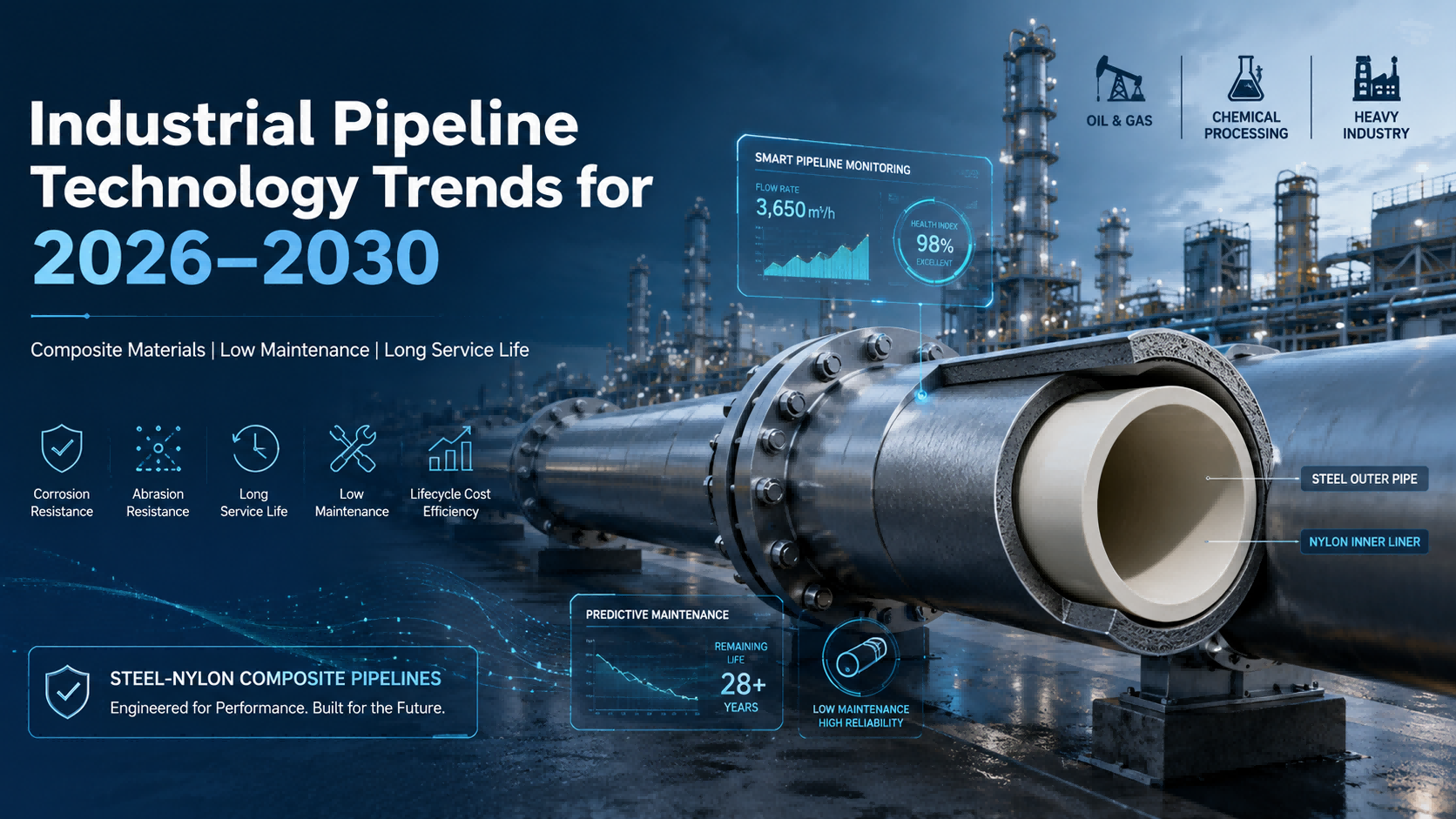
6. Why Do Steel–Nylon Composite Pipes Fit This Technology Trend?
A steel–nylon composite pipe is not simply a steel pipe with an ordinary plastic lining.
Its fundamental engineering philosophy is:
Let steel provide the structure, while nylon handles the transported medium.
The steel structure provides:
-
Structural rigidity
-
Pressure-bearing capability
-
Large-diameter dimensional stability
-
Suitability for industrial pipe racks and structural installations
The nylon working layer provides:
-
Isolation from corrosive media
-
Corrosion resistance
-
Wear resistance
-
Reduced scaling tendency
-
A smooth internal surface
This reflects an important principle of composite-material engineering:
Instead of forcing one material to solve every problem, allow different materials to perform the functions they are best suited for.
7. A Major Advantage of Steel–Nylon Composite Pipe: Combining Steel-Pipe Engineering with Non-Metallic Material Benefits
Many industrial companies are interested in non-metallic materials but still have practical engineering concerns:
What happens when the pipe diameter becomes very large?
How does the pipeline perform across long pipe-rack spans?
What about pressure capability?
How are valves connected?
What happens at pump outlets?
How are large flanges handled?
Can complex fittings be manufactured?
Can an existing steel piping system be upgraded without redesigning the entire plant?
These questions illustrate why industrial piping engineering cannot focus only on material properties.
It must also consider:
Engineering compatibility.
This is where steel–nylon composite pipe becomes particularly interesting.
It can take advantage of nylon's corrosion resistance, wear resistance, and smooth inner surface in compatible media, while maintaining many of the structural characteristics expected from traditional steel piping systems.
Our steel–nylon composite pipes can be designed for operating pressure classes of approximately 1.0–4.0 MPa, depending on engineering conditions, and can be manufactured in large diameters exceeding DN2000.
The pipes use an integrally formed structure and flange connection design, helping reduce dependence on field welding or hot-melt joining.
In suitable service conditions, they can be applied in systems including:
oil & gas gathering, produced water transportation, water injection, high-salinity water, chemical salt solutions, chlor-alkali, soda ash, phosphate chemicals, mining slurry, power plants, and industrial water supply and drainage.
8. Corrosion Resistance Is Only the Beginning — Corrosion Plus Erosion Is the Real Challenge
One common misunderstanding in industrial piping is that once corrosion is solved, pipeline life will automatically become much longer.
In reality, many oilfield, chemical, and slurry transportation systems suffer from a more complex problem:
Corrosion + Erosion
Solid particles continuously damage the protective surface of metallic pipes.
Fresh metal is then exposed to the corrosive fluid.
Corrosion accelerates.
The weakened surface becomes even more vulnerable to erosion.
This interaction can create a continuous cycle of material loss.
As a result, pipeline deterioration can occur much faster than under pure corrosion alone.
This is why corrosion resistance and wear resistance must often be considered together.
One of the objectives of steel–nylon composite pipe design is to address precisely this type of multiple-failure environment:
the steel structure carries pressure and structural loads, while the nylon working layer isolates the transported medium and provides wear-resistant performance.
9. Why Is a Smooth Inner Surface Becoming Increasingly Important?
Another issue that is often underestimated in industrial pipeline lifecycle management is:
Scaling.
Scaling can cause:
Reduced internal diameter
→ Lower flow capacity
→ Increased pressure loss
→ Higher pumping energy consumption
→ More frequent cleaning
→ Eventual blockage.
This can be particularly important in applications involving:
oilfield produced water, high-salinity water, soda ash production, salt chemical processing, and certain slurry systems.
A relatively smooth nylon inner surface can reduce the conditions that encourage deposits to adhere to the pipe wall.
Therefore, when evaluating a high-performance industrial pipe, engineers should not only ask:
“Will this pipe corrode?”
They should also ask:
“What will the inside of this pipeline look like after ten years of operation?”
10. The Global Composite Pipe Industry May Be Entering Its Second Stage
The development of industrial composite piping can broadly be divided into three stages.
Stage 1: Material Substitution
The main question is:
“Traditional steel pipe is corroding too quickly. Can we replace it with another material?”
Stage 2: System Optimization
The question becomes:
“Can we reduce corrosion, wear, maintenance, and shutdown risk at the same time?”
Stage 3: Lifecycle Engineering
The question becomes:
“Which piping system can provide the lowest total cost and lowest operational risk over 20 years or longer?”
An increasing number of industrial projects are moving from Stage 1 into Stage 2.
Some high-value projects are already beginning to think in terms of Stage 3.
This means future competition in the piping industry may no longer simply be:
Carbon Steel vs Stainless Steel vs FRP vs HDPE vs Composite Pipe.
The more important question may become:
Which piping system provides the lowest lifecycle risk?
11. Not Every Composite Pipe Will Experience Rapid Growth
Although the overall direction of composite piping is promising, another misconception should be avoided:
Composite pipe does not automatically mean better pipe.
Engineering reliability still depends on factors such as:
-
Material system
-
Structural design
-
Operating temperature
-
Operating pressure
-
Chemical compatibility
-
Pipe diameter
-
Joint design
-
Manufacturing quality
-
Long-term aging behavior
-
Proven project experience
The future will therefore not simply involve replacing the “steel pipe era” with a “composite pipe era.”
A more likely outcome is:
Different material systems will dominate different operating conditions.
Conventional steel pipes will continue to serve many standard industrial applications.
Advanced alloys may remain necessary for extremely high-temperature, high-pressure, or highly specialized corrosive services.
PE and similar thermoplastics will remain highly competitive in many low-pressure applications.
However, in applications characterized by:
severe corrosion + wear + moderate pressure + large diameter + long-term reliability requirements,
composite structures such as steel–nylon composite piping may offer increasingly significant engineering value.
12. The Key Global Shift: From CAPEX to TCO
Traditional procurement systems have often focused heavily on:
CAPEX — Capital Expenditure
In other words:
How much does the pipeline cost to purchase and install?
Increasingly, industrial companies are also looking at:
TCO — Total Cost of Ownership
A mature pipeline-material selection process should consider:
Purchase cost
-
Installation cost
-
Corrosion protection cost
-
Maintenance cost
-
Cleaning cost
-
Replacement cost
-
Shutdown losses
-
Leakage risk
-
Energy consumption
-
Service life.
Once all of these factors are calculated, a piping system with a higher initial purchase price but a longer service life and lower maintenance requirements may ultimately become the more economical solution.
This transition from CAPEX-focused purchasing toward TCO-based decision-making is one of the most important forces supporting the global growth of high-performance composite piping.
13. Which Markets Could See Faster Composite Pipe Adoption Over the Next 5–10 Years?
Based on current industrial requirements, several sectors deserve particular attention.
1. Oil & Gas
Especially:
-
Produced Water
-
Water Injection
-
Gathering Pipelines
-
High-Salinity Water
-
CO₂-Containing Fluids
-
H₂S-Containing Fluids
Corrosion-related maintenance costs can be extremely high in these applications, creating strong demand for longer-lasting piping systems.
2. Chemical Industry
Including:
-
Chlor-Alkali
-
Soda Ash
-
Salt Chemical Processing
-
Phosphate Chemical Processing
These industries frequently face a combination of corrosion, scaling, crystallization, and erosion.
3. Mining
The primary challenge in slurry transportation is:
wear.
However, many mining slurries are also chemically aggressive.
This creates opportunities for composite piping systems capable of providing both:
corrosion resistance + wear resistance.
4. Power Generation and Environmental Engineering
Potential applications include:
-
Flue Gas Desulfurization Slurry
-
Industrial Wastewater
-
High-Salinity Wastewater
-
Circulating Water Systems
5. Large-Diameter Industrial Water Systems
When pipeline diameter increases to DN500, DN1000, DN1600, or even DN2000 and above, structural rigidity, installation methodology, and long-term dimensional stability become increasingly important.
This is another area where combining structural steel with high-performance polymer materials can provide valuable engineering options.
14. High-Performance Composite Pipes Are Changing More Than Materials — They Are Changing Pipeline Design Philosophy
Traditional pipeline design often followed this process:
Choose a material first, then try to manage that material's weaknesses.
The future may increasingly follow a different approach:
Identify the failure mechanisms first, then design the material system around them.
If pressure is the challenge, provide structural strength.
If corrosion is the challenge, isolate the corrosive medium.
If wear is the challenge, improve the working surface.
If large-diameter rigidity is required, use a structural material capable of carrying the load.
This is the fundamental engineering value of composite materials.
Conclusion: Is the Global Adoption of High-Performance Composite Piping Accelerating?
The answer is:
Yes — but the most important transformation may still be at an early stage.
From Middle Eastern onshore oil and gas developments to Brazilian deepwater projects, as well as offshore developments in Egypt and Southeast Asia, composite piping technologies are increasingly entering more demanding and more critical industrial applications.
What is driving this transition is not simply enthusiasm for “new materials.”
The real issue is much more practical:
Industrial companies around the world are increasingly unwilling to accept pipelines that repeatedly corrode, leak, require maintenance, and need premature replacement.
The future of industrial piping may therefore not be determined by who can manufacture the cheapest pipe.
Instead, competition may increasingly focus on who can provide a piping system with:
longer service life, lower maintenance requirements, higher operating reliability, and lower total lifecycle cost.
Steel–nylon composite pipe is one engineering solution that deserves increasing attention within this transition.
It is not intended to replace every carbon steel pipe, every stainless steel pipe, or every non-metallic pipeline.
Its real value lies in addressing some of the most persistent problems faced by industrial operators:
Corrosion.
Wear.
Scaling.
Leakage.
Frequent maintenance.
Repeated pipeline replacement.
As global industrial pipeline procurement continues to shift from Purchase Price toward Lifecycle Value, the market opportunity for high-performance composite piping may only be beginning to open.
The Industrial Piping Market Is Shifting from “Material Procurement” to “System Solutions”
2026–2030 Industrial Piping Technology Trends: From Material Breakthroughs to System Elevation