The Industrial Piping Market Is Shifting from “Material Procurement” to “System Solutions”

For a long time, industrial piping procurement revolved around a relatively simple question:
“What material is this pipe made of?”
Carbon steel, stainless steel, HDPE, FRP, rubber-lined steel, plastic pipe, or some type of composite material.
Procurement teams typically compared material grades, wall thicknesses, pressure ratings, and unit prices before selecting a pipe that appeared to meet the basic design requirements.
Today, however, an increasing number of industrial projects are changing the way piping decisions are made.
More mature project teams are no longer asking only:
Which pipe material should we buy?
Instead, they are asking:
Which piping solution can keep the system operating reliably for the longest possible time?
This may seem like a subtle change in wording, but it reflects a fundamental transformation in the competitive logic of the industrial piping market.
The market is gradually shifting from “material procurement” to “system solutions.”
This transition is particularly evident in industries such as oil and gas, chemicals, mining, power generation, and other applications involving highly corrosive or abrasive media.
1. Why Comparing Pipe Prices Alone Is Becoming Increasingly Meaningless
Industrial piping is not an isolated material.
A piping system operating in a real industrial environment involves many interconnected factors, including:
-
Conveyed media
-
Operating temperature
-
Pressure
-
Flow velocity
-
Corrosive conditions
-
Solid particle content
-
Pipe diameter
-
Fittings and component design
-
Flange and valve connections
-
Support spacing
-
Thermal expansion and contraction
-
Installation conditions
-
Maintenance requirements
-
Expected service life
If pipes are purchased simply based on “price per meter,” many of the factors that truly determine project cost can easily be overlooked.
For example, a piping material may have a relatively low initial purchase price. But if it begins to suffer from corrosion perforation, scaling, liner failure, joint leakage, wall thinning, or frequent replacement after only a few years of operation, the real cost of the project will be far greater than the cost of purchasing replacement pipe.
Additional costs may include:
Production losses + labor costs + lifting and installation costs + replacement costs + safety risks + environmental risks.
As a result, industrial users are increasingly looking beyond:
CAPEX — How much does the pipe cost to purchase initially?
They are paying more attention to:
TCO — How much will the entire piping system cost throughout its lifecycle?
This is one of the most important reasons why industrial piping procurement is moving from a material-based mindset toward a system-based approach.
2. The Real Value of Industrial Piping Is System Reliability, Not the Material Alone
For continuous-process industrial facilities, the primary value of a pipeline is not simply that the pipe exists.
Its real value lies in its ability to:
transport media safely and reliably over long periods of operation.
A pipe only creates real value when it operates as part of a complete system consisting of kilometers of pipelines, hundreds of fittings, valves, pumps, and equipment connections.
Therefore, an effective industrial piping solution must address several challenges simultaneously.
Corrosion
Produced water, high-salinity wastewater, chlor-alkali media, salt chemical solutions, chemical mother liquor, and certain acidic or alkaline media can cause severe corrosion in conventional metallic pipelines.
Corrosion does not merely lead to gradual wall-thickness reduction.
The more serious problem is that:
corrosion is often localized and difficult to predict.
A single localized corrosion point may be enough to force an entire production line to shut down.
Abrasion and Erosion
Slurries, mineral particles, crystallized solids, sand, and high-velocity fluids can continuously erode the inner surface of a pipeline.
Many industrial pipelines do not fail because of corrosion alone.
Instead, failure is often caused by:
the combined effects of corrosion and abrasive wear.
For this reason, corrosion resistance alone may not be sufficient for many demanding applications.
Scaling
In oilfield produced water, industrial brine, chemical mother liquor, and certain slurry transportation systems, scaling can lead to:
-
Reduced effective internal diameter
-
Increased flow resistance
-
Higher pumping energy consumption
-
Reduced transportation capacity
-
More frequent cleaning requirements
The internal surface characteristics of a pipe can therefore have a direct impact on the efficiency of the entire transportation system.
Connection Reliability
In real engineering projects, many pipeline leaks do not occur in the straight pipe body itself.
They occur at:
connection points.
Weld seams, fusion joints, lining interfaces, and field-fabricated connections can all become weak points within a piping system.
This is why future competition in the industrial piping industry cannot focus only on the pipe body.
What should really be evaluated is the reliability of the complete connection system, including:
straight pipes, elbows, tees, reducers, valves, flanges, and equipment interfaces.
3. What Industrial Customers Are Really Buying Is Operating Uptime
For a chemical plant, an oilfield gathering station, or a slurry transportation system, the most expensive part of a pipeline failure is usually not the pipe itself.
It is:
Unexpected Downtime.
Imagine that a critical process pipeline develops a leak.
The operator may need to:
Shut down the system → drain the medium → clean the pipeline → remove the failed section → install a replacement → conduct pressure testing → restart production.
Even if the pipe itself represents only a relatively small investment, the economic loss caused by production shutdown can be several times higher than the value of the pipe.
Therefore, the real value provided by the industrial piping industry in the future should be:
More Operating Time.
Less Maintenance.
Lower Lifecycle Cost.
In other words:
longer operating periods, fewer maintenance interventions, and lower total lifecycle costs.
4. Why Composite Piping Fits This Market Transformation
Traditional industrial piping materials often involve a fundamental engineering trade-off:
Materials with excellent mechanical strength are not always highly corrosion-resistant, while highly corrosion-resistant materials may not always provide sufficient structural strength.
For example:
Carbon steel provides excellent structural strength, but internal corrosion and scaling can become major long-term problems.
Certain non-metallic piping materials offer strong corrosion resistance, but in large-diameter, high-pressure, high-temperature, or complex support conditions, structural stiffness can become a critical consideration.
The fundamental value of composite piping, therefore, is not simply that:
“two materials are combined.”
The more important principle is:
each material performs the function for which it is best suited.
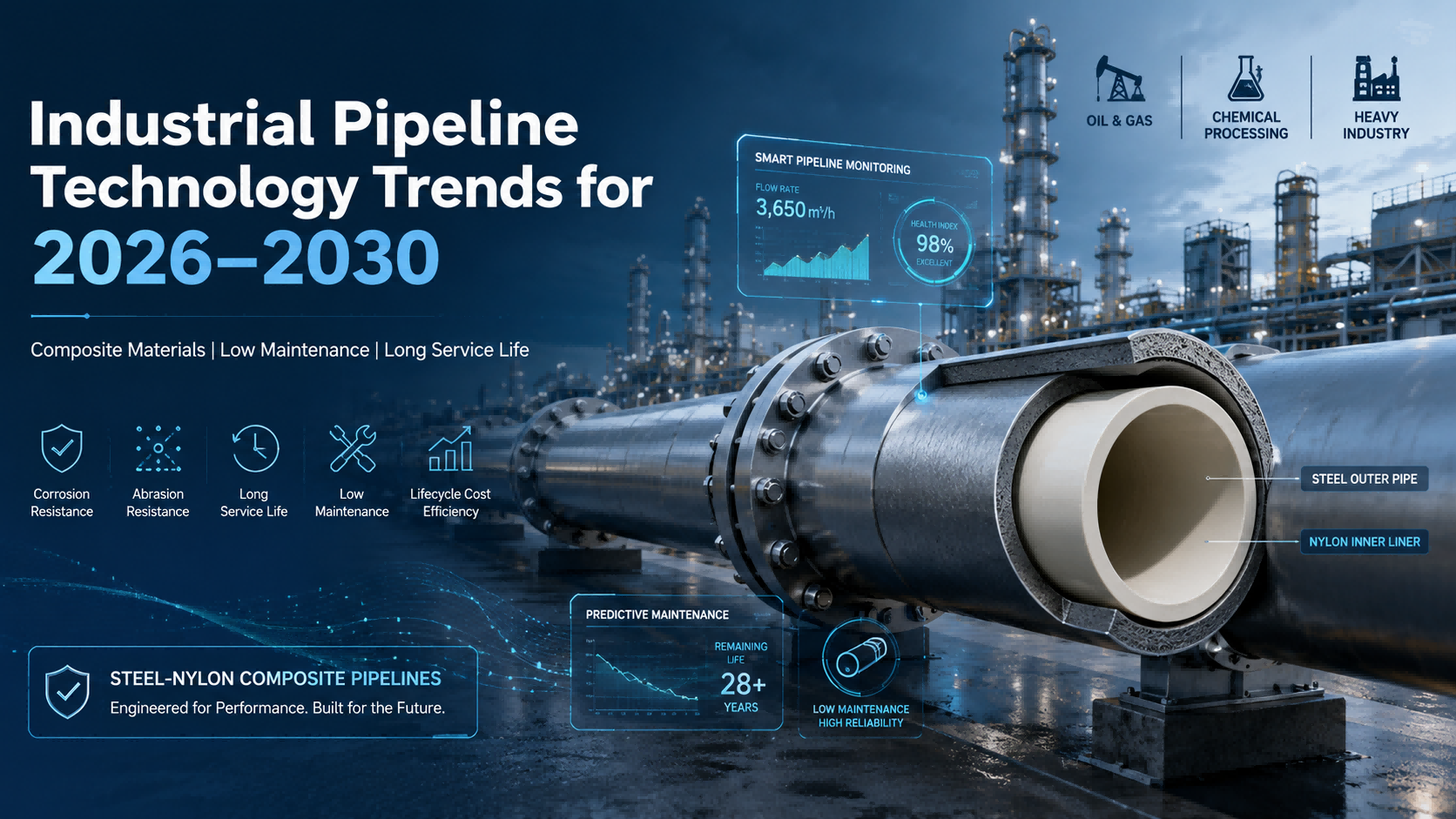
This is also the core engineering philosophy behind steel-nylon composite pipe.
5. Steel-Nylon Composite Pipe: From a Single Material to Functional Integration
The value of steel-nylon composite pipe goes far beyond simply combining steel and nylon.
What matters is the functional division between the two materials within the piping structure.
Steel Structural Layer
The steel structure is primarily responsible for:
-
Mechanical strength
-
Pipe rigidity
-
Pressure resistance
-
Structural stability in large diameters
-
Adaptability to industrial pipe racks and support systems
Nylon Working Layer
The nylon layer is primarily exposed to the transported medium and provides:
-
Corrosion resistance
-
Wear resistance
-
A smooth internal surface
-
Reduced scaling tendency
-
Isolation between corrosive media and the steel structure
This structural concept essentially separates two major challenges traditionally faced by industrial pipelines:
external structural load-bearing requirements
and
internal corrosion caused by the transported medium.
Instead of requiring a single material to perform every function simultaneously, a composite structure allows different materials to perform different roles.
This can create a more balanced engineering solution.
6. A True Industrial Piping Solution Must Extend from Pipes to Fittings
In real industrial projects, supplying straight pipe alone is far from sufficient.
A complete industrial transportation system normally includes:
-
Straight pipes
-
Elbows
-
Tees
-
Reducers
-
Valve inlet and outlet sections
-
Pump outlet sections
-
Flange connections
-
Equipment connection sections
In many conventional corrosion-protection systems, these complex areas are precisely where failures are most likely to occur.
For this reason, our approach to steel-nylon composite piping focuses not only on the straight pipe itself but also on the integrity of the complete conveying system.
Through integrated structural design and flange connection systems, straight pipes, fittings, valves, and equipment interfaces can be integrated into a more complete piping network.
This means that a supplier is no longer providing only a pipe.
The supplier is providing a:
Pipeline System Solution.
7. Reducing On-Site Construction Is Becoming an Important Source of Project Value
Industrial projects are placing increasing emphasis on installation efficiency.
This is because extensive on-site construction typically means:
-
More labor
-
More quality-control points
-
Greater exposure to weather conditions
-
More potential installation errors
-
Longer project schedules
In complex environments such as oilfields, chemical plants, and mining sites, reducing field welding and complicated fabrication procedures can significantly reduce installation uncertainty.
Steel-nylon composite pipes can be designed with integrated flange connections, reducing the need for field welding and thermal fusion in many applications.
The benefit is not simply:
easier installation.
More importantly, it helps:
standardize connection quality.
Future competition in industrial piping will therefore increasingly move beyond material performance toward:
installation efficiency and engineering standardization.
8. Industrial Procurement Is Moving from CAPEX to TCO
The traditional procurement model can be summarized as:
Lowest purchase price = Best solution
The emerging procurement model is becoming:
Lowest lifecycle cost = Best solution
This is a major change.
The total cost of ownership of an industrial piping system can generally be considered as:
TCO = Procurement + Installation + Maintenance + Replacement + Downtime
In other words:
Total Cost = Purchase Cost + Installation Cost + Maintenance Cost + Replacement Cost + Production Downtime
In many industrial projects, the initial procurement cost represents only a portion of the total lifecycle expenditure.
If a piping system can substantially reduce:
-
Corrosion-related leakage
-
Scaling and cleaning
-
Pipeline replacement
-
Unplanned shutdowns
then even if its initial purchase price is not the lowest, it may still become the more economical solution over the long term.
This is why more industrial customers are beginning to focus on:
Service Life rather than simply Pipe Price.
9. The Future Industrial Piping Market May Be Divided into Two Types of Suppliers
As the market evolves, industrial piping suppliers may increasingly fall into two categories.
The first category will continue to be:
Pipe Manufacturers
They provide information such as:
-
Pipe diameter
-
Pressure rating
-
Material
-
Price
-
Delivery time
These capabilities will remain important.
However, a second category of supplier is becoming increasingly valuable to large industrial projects:
Pipeline Solution Providers
Instead of beginning with the product, they begin with questions such as:
-
What medium are you transporting?
-
What is the primary corrosion mechanism?
-
Does the medium contain solid particles?
-
What is the flow velocity?
-
Is negative pressure possible?
-
How does the operating temperature change?
-
What service life does the project require?
-
Which parts of the system are most likely to fail?
-
How can maintenance frequency be reduced?
-
How can total lifecycle cost be optimized?
The biggest difference between these two types of suppliers is not necessarily the product itself.
It is:
whether the supplier truly understands the customer's process system.
10. Our Position: We Do Not Only Manufacture Steel-Nylon Composite Pipes — We Solve Industrial Transportation Problems
Our focus has never been limited to simply manufacturing a new type of pipe.
What continues to drive the development of our products is the range of real problems encountered in industrial operations:
Oilfield pipeline corrosion.
High-salinity produced water.
Chemical mother liquor erosion.
Strong alkaline environments.
Slurry abrasion.
Pipeline scaling.
Delamination of conventional liners.
Structural stability in large-diameter pipelines.
Low-temperature operating conditions.
Long-term outdoor service.
All of these challenges ultimately lead to the same question:
How can industrial transportation systems operate more reliably for longer periods of time?
For this reason, we prefer to define steel-nylon composite pipe as a:
Corrosion-Resistant Industrial Piping Solution
rather than simply another piping material.
By combining the structural strength of steel with the corrosion- and wear-resistant properties of nylon, steel-nylon composite piping can maintain industrial structural performance while improving adaptability to corrosive, abrasive, and complex media environments.
The system can be engineered for a wide range of industrial specifications and operating conditions, including large diameters, multiple pressure ratings, and a broad temperature range.
Integrated flange connections can also reduce the need for complex field welding or fusion processes.
These characteristics make steel-nylon composite piping particularly suitable for applications such as:
-
Oil and gas gathering and transportation
-
Oilfield water injection
-
High-salinity produced water transportation
-
Chlor-alkali processing
-
Soda ash production
-
Salt chemical processing
-
Phosphate chemical processing
-
Mining slurry transportation
-
Power plant industrial water systems
-
Industrial and municipal water supply and drainage
11. The Next Stage of Industrial Piping Competition Will Be About System Reliability
The future of industrial piping competition may no longer depend primarily on:
Which material is cheaper?
Instead, the question will increasingly become:
Which system can operate reliably for longer?
Competition will also move beyond:
Which pipe has better laboratory test data?
Toward:
Which piping solution delivers a lower failure rate under real industrial operating conditions?
And the market will move beyond asking:
Who can manufacture a pipe?
Toward:
Who can understand and optimize the entire transportation system?
The transition from “material procurement” to “system solutions” is therefore not simply a marketing concept.
It reflects a more mature approach to industrial procurement and engineering decision-making.
Customers are no longer buying only:
Pipe.
They are buying:
Reliability.
They are no longer buying only:
Material.
They are buying:
Lifecycle Performance.
And they are no longer buying only:
Product.
They are buying:
A Complete Industrial Piping Solution.
Conclusion
For decades, competition in the industrial piping industry has largely centered on materials.
Over the next decade, however, the competitive landscape is likely to change significantly.
A truly valuable industrial piping solution must answer three fundamental questions:
Can it operate reliably over the long term?
Can it reduce maintenance and unplanned shutdowns?
Can it lower the total lifecycle cost of the system?
These questions represent the core direction behind the continued development of our steel-nylon composite pipe technology.
Our goal is not simply to provide another industrial piping material.
It is to deliver a more reliable transportation solution for oil and gas, chemical processing, mining, power generation, and other demanding industrial environments through piping systems designed for corrosion resistance, wear resistance, structural reliability, and reduced maintenance.
Because the future value of industrial piping will not be determined by how much money is saved per meter at the time of purchase.
It will be determined by a much more important question:
Ten years from now, will the system still be operating reliably?
Is the Global Adoption of High-Performance Composite Piping Accelerating?