Why Industrial Projects Are Paying More Attention to Pipeline Reliability

“How much does this pipe cost per meter?”
However, as oil and gas, chemical, mining, power generation, salt chemical, and large industrial infrastructure projects move toward continuous production, larger scale, and higher operating loads, more companies are beginning to realize an important fact:
What truly determines the economics of a pipeline system is not its purchase price, but whether it can operate reliably, continuously, and predictably over the long term.
A pipeline that costs less initially but requires frequent maintenance and replacement may ultimately be far more expensive than a pipeline with a higher upfront cost but a longer service life and lower maintenance requirements.
As a result, the procurement logic of industrial pipelines is undergoing a major shift:
From buying pipes to buying long-term, reliable fluid transportation capability.
This is why pipeline reliability is becoming one of the most important criteria in industrial pipeline material selection.
1. What Does Industrial Pipeline Reliability Really Mean?
Many people simply understand pipeline reliability as:
“The pipeline does not leak.”
But for modern industrial systems, reliability means much more than that.
True pipeline reliability includes multiple factors:
-
Corrosion resistance
-
Abrasion resistance
-
Stable pressure performance
-
Temperature resistance
-
Chemical resistance
-
Long-term sealing reliability of connections
-
Resistance to scaling and blockage
-
Long-term structural stability
-
Installation quality consistency
-
Predictable service life
-
Controllable maintenance frequency
-
Safety margins under severe operating conditions
Therefore, pipeline reliability cannot be evaluated based on a single parameter.
It is the combined result of material properties, structural design, connection methods, manufacturing quality, and actual operating conditions.
This is one of the reasons industrial pipeline selection is becoming increasingly specialized.
2. Why Is the Traditional “Lowest Purchase Price” Approach Changing?
In traditional industrial procurement, pipes were often treated as standardized products.
For example, when purchasing a DN300 pipeline, procurement departments might first compare:
-
Price per meter
-
Flange cost
-
Installation cost
-
Transportation cost
The lowest initial purchase price could easily become the preferred option.
However, for industrial projects expected to operate for 5, 10, or even more years, the pipe purchase price represents only part of the total cost.
The truly expensive costs often appear later:
maintenance, shutdowns, repairs, replacements, and production losses.
When a production pipeline leaks, the total cost may include:
Repair materials
-
Labor
-
Lifting equipment
-
Scaffolding
-
Pipeline cleaning
-
Environmental treatment
-
Production shutdown losses
-
Plant restart costs
For chemical plants, oilfield gathering systems, or continuous-process facilities, the economic loss caused by a single unplanned shutdown can sometimes be much greater than the purchase cost of the entire affected pipeline section.
This is why more industrial operators are beginning to reconsider the economics of pipeline selection.
Initial Cost ≠ Total Cost
What should really be considered is:
Total Cost of Ownership (TCO)
In other words:
the total lifecycle cost of the pipeline system.
3. Pipeline Failure Is No Longer Just a Maintenance Problem
Another major reason industrial companies are paying more attention to pipeline reliability is that the consequences of pipeline failure are becoming increasingly significant.
Decades ago, a leaking pipeline might have been regarded mainly as a maintenance issue.
Today, one pipeline failure can simultaneously affect:
production, safety, environmental compliance, product quality, equipment utilization, and operating costs.
For example:
Corrosion Perforation
It may cause fluid leakage, plant shutdowns, or even environmental contamination.
Severe Pipe Wall Wear
It can result in sudden pipeline rupture and increase operational uncertainty.
Liner Delamination
It may reduce the effective flow area or even cause blockage.
Pipeline Scaling
It may increase hydraulic resistance, reduce flow capacity, and increase pumping energy consumption.
Weld Corrosion
It can create localized weak points within the pipeline system.
Therefore, for modern industrial projects:
Pipeline reliability is evolving from an equipment maintenance indicator into a business performance indicator.
4. Continuous Industrial Production Magnifies the Cost of Pipeline Failure
Modern industrial plants increasingly emphasize:
-
Continuous production
-
High equipment utilization
-
Minimum shutdowns
-
Automation
-
Centralized process control
These developments significantly improve overall production efficiency.
But they also mean that:
The impact of a single weak point in the system can become much greater.
Consider a chemical plant designed to operate 8,000 hours per year.
If a critical process pipeline must be shut down twice a year because of corrosion, with each repair requiring 24 hours, the plant loses:
48 hours of production every year.
If the production value per hour is high, the resulting shutdown losses may greatly exceed the additional investment required for a more reliable pipeline system.
Therefore, more industrial projects are asking a different question during the design stage:
Which pipeline material can reduce unplanned shutdowns over the next 10 years?
Instead of simply asking:
Which pipeline material is the cheapest to purchase today?
This represents a significant change in industrial pipeline procurement logic.
5. Corrosion Is One of the Biggest Challenges to Pipeline Reliability
In the oil and gas, chemical, and salt chemical industries, corrosion has long been one of the major causes of shortened pipeline service life.
Typical corrosion factors include:
-
H₂S
-
CO₂
-
Chloride ions
-
Brine
-
Alkaline solutions
-
Weak acids
-
High-salinity produced water
-
Electrochemical corrosion
-
Oxygen corrosion
Traditional carbon steel offers excellent mechanical strength and pressure resistance, but in corrosive environments it often requires additional protection measures such as:
-
Protective coatings
-
Corrosion inhibitors
-
Cathodic protection
-
Internal linings
-
Regular inspection
If any component of the corrosion protection system fails, pipeline service life may be affected.
This is one reason composite pipeline materials are attracting increasing attention.
They attempt to solve a long-standing engineering challenge:
How can we combine the structural strength of metal with the corrosion resistance of non-metallic materials?
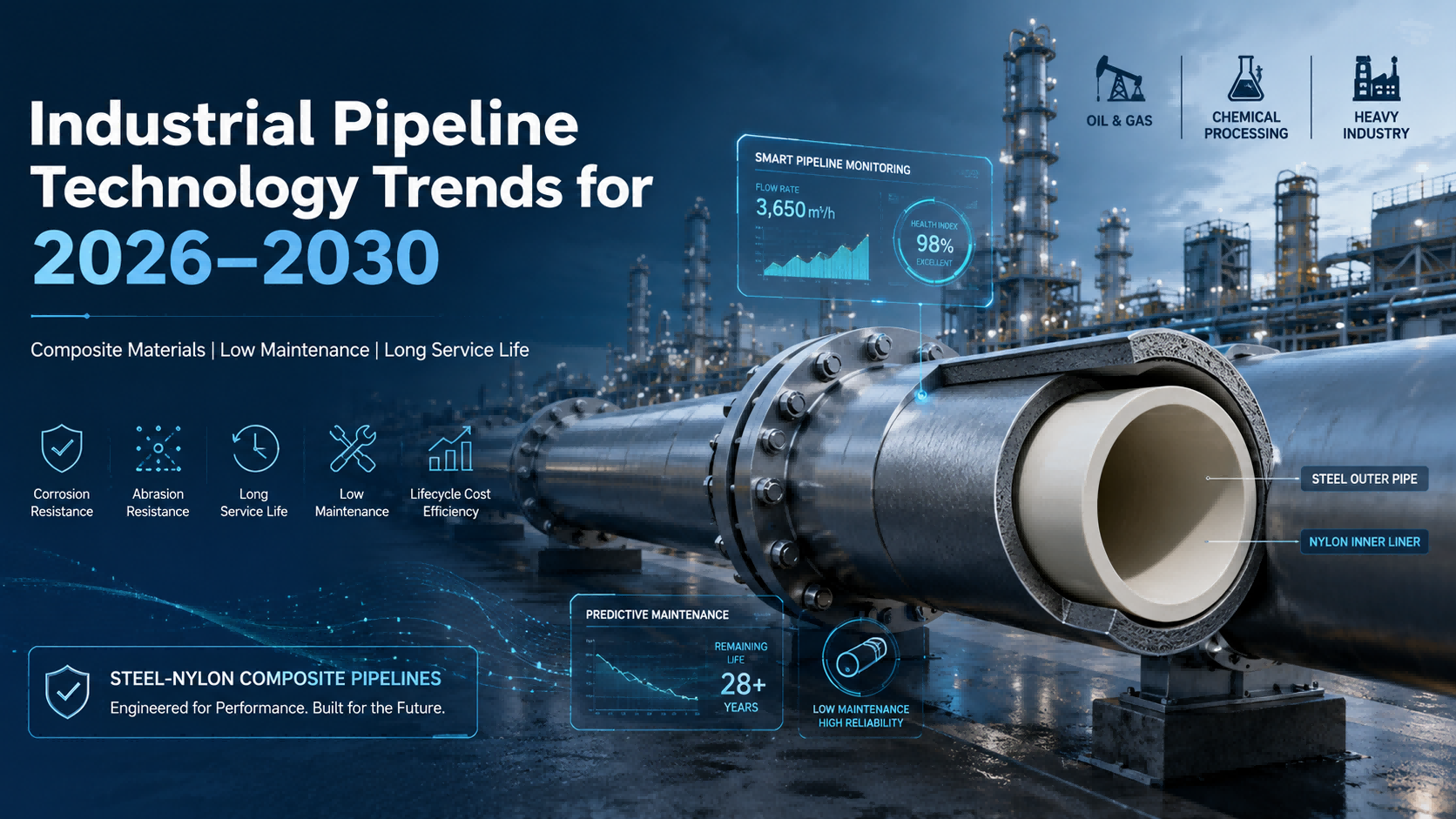
Steel-nylon composite pipe is one solution based on this engineering concept.
6. Abrasion Is an Underestimated Pipeline Reliability Problem
In slurry, mud, sand-containing crude oil, industrial wastewater, and solid-liquid two-phase transportation systems, pipelines are exposed not only to corrosion.
They are also subjected to:
continuous particle erosion and abrasion.
Wear is particularly severe in areas such as:
-
Elbows
-
Tees
-
Reducers
-
Pump outlet sections
-
Upstream and downstream sections of valves
-
High-velocity flow zones
In many industrial systems, straight pipeline sections may still be in acceptable condition while elbows and fittings require frequent replacement.
Modern pipeline engineering therefore increasingly focuses on:
Corrosion + Abrasion
In other words:
combined corrosive and abrasive service conditions.
Under these conditions, simply upgrading to a higher-grade metal does not always provide the most economical solution.
Corrosion-resistant and wear-resistant composite materials can therefore offer significant value.
7. Why Is Steel-Nylon Composite Pipe Suitable for High-Reliability Industrial Pipeline Systems?
The purpose of steel-nylon composite pipe is not simply to “replace steel pipe.”
Its design philosophy is to combine the advantages of two different material systems.
Steel Structure
Primarily provides:
-
Mechanical strength
-
Internal pressure resistance
-
Structural support
-
Rigidity for large-diameter pipelines
Nylon Functional Layer
Primarily provides:
-
Corrosion resistance
-
Abrasion resistance
-
Reduced scaling tendency
-
Isolation between the conveyed medium and the steel structure
Together, they create:
Steel Strength + Nylon Corrosion Resistance
In other words:
the structural capability of steel combined with the media resistance of nylon.
For complex applications involving corrosion, abrasion, and pressure simultaneously, this composite structure offers considerable engineering value.
8. Reliability Step One: Reduce Corrosion Risk
One of the key characteristics of steel-nylon composite pipe is that the conveyed medium primarily contacts the nylon functional layer rather than directly contacting the steel structure.
This means:
Steel provides structural strength,
while nylon provides media isolation.
In chemical environments compatible with nylon, this design can significantly reduce the risks associated with internal corrosion of traditional metal pipelines.
Potential applications include certain:
-
Oilfield produced water systems
-
Oil and gas gathering systems
-
Brine pipelines
-
Strong alkaline environments
-
Weak acid media
-
Chemical mother liquor systems
-
Industrial wastewater pipelines
This represents one of the fundamental differences between composite pipeline systems and conventional single-material metallic pipelines.
9. Reliability Step Two: Improve Abrasion Resistance
Many industrial fluids are not pure liquids.
They may contain:
-
Sand
-
Crystals
-
Solid particles
-
Mineral particles
-
Sediments
These particles continuously impact and rub against the inner wall of the pipeline.
Erosion can become particularly severe in high-velocity areas and elbows.
Nylon materials offer good abrasion resistance, making steel-nylon composite pipes particularly suitable for certain industrial systems where:
corrosion and abrasion occur simultaneously.
This can be especially valuable in applications such as sand-containing oilfield fluids, slurry transportation, and salt-chemical mother liquor systems.
10. Reliability Step Three: Reduce Scaling and Increasing Flow Resistance
Some pipelines are not replaced because they have completely failed.
They are replaced because:
their performance gradually becomes unacceptable.
As operating time increases, some conventional pipelines may experience:
-
Scaling
-
Reduced internal diameter
-
Increased pressure loss
-
Lower flow capacity
-
Higher pumping energy consumption
Eventually, the pipeline may require shutdown, cleaning, or replacement.
The relatively smooth inner surface of nylon can help reduce material adhesion and scaling risk under suitable operating conditions.
This means pipeline value should not be evaluated only by asking:
“Can the pipeline still operate?”
A more important question is:
“Can the pipeline maintain stable performance throughout long-term operation?”
That is the true meaning of pipeline reliability.
11. Reliability Step Four: Reduce Risks at Pipeline Connections
In industrial pipeline systems, many failures do not occur in the straight pipe itself.
They occur at:
connection points.
Traditional welded pipeline systems often contain a large number of field welds.
Every weld introduces requirements related to:
-
Welding quality control
-
Heat-affected zones
-
Corrosion protection repair
-
Non-destructive testing
-
On-site construction management
In some corrosive environments, welds and heat-affected zones can also become long-term weak points.
Steel-nylon composite pipes can use integrated flange connection structures, allowing straight pipes, elbows, tees, reducers, and other fittings to form a complete pipeline system while reducing the need for field hot work.
For retrofit projects and industrial facilities with strict construction safety requirements, this approach can help:
-
Simplify installation
-
Shorten installation time
-
Improve connection consistency
-
Reduce field welding risks
Stable installation quality is itself an important component of long-term pipeline reliability.
12. Reliability Step Five: Adapt to More Complex Pressure and Temperature Conditions
Many non-metallic pipelines offer excellent corrosion resistance, but industrial applications also require engineers to consider:
-
Internal pressure
-
Temperature
-
Pipe diameter
-
Support spacing
-
Vacuum conditions
-
Mechanical loads
For large-diameter and relatively high-pressure systems in particular, corrosion resistance alone is not enough.
One major advantage of the steel-nylon composite structure is that:
the steel structure provides the primary mechanical support.
Depending on product design, steel-nylon composite pipes can cover pressure classes of approximately:
1.0–4.0 MPa
and can be engineered for a wide range of industrial temperature conditions depending on the medium, pressure, and specific project requirements.
For industrial projects that need to combine:
corrosion resistance + pressure capability + large diameter
this composite structure provides another material selection option.
13. Why Is “Predictable Service Life” More Important Than a Long Theoretical Service Life?
Industrial facilities do not necessarily fear equipment replacement.
The bigger concern is:
not knowing when failure will occur.
If a pipeline can operate consistently and its maintenance can be incorporated into a planned shutdown schedule, companies can prepare in advance by:
-
Stocking spare parts
-
Scheduling maintenance personnel
-
Coordinating shutdowns
-
Adjusting production plans
Maintenance costs can therefore remain manageable.
But if a pipeline:
-
Operates normally this year
-
Suddenly leaks next year
-
Fails in another location the following year
the result is repeated unplanned maintenance.
That is why modern industrial operators increasingly value:
Predictability
In other words:
the ability to predict pipeline behavior and maintenance requirements.
A reliable pipeline system is not valuable simply because it has a long service life.
More importantly:
its performance degradation should be stable, its risks manageable, and its maintenance requirements predictable.
14. Pipeline Selection Is Shifting from CAPEX to TCO
Traditionally, many projects focused heavily on:
CAPEX
Capital Expenditure
or the initial investment.
Today, however, more companies are focusing on:
TCO
Total Cost of Ownership
In simple terms:
TCO = Initial Purchase Cost + Installation Cost + Maintenance Cost + Replacement Cost + Shutdown Cost + Energy Cost + Risk Cost
From this perspective, a pipeline that appears “cheap” at the purchasing stage may not actually be economical.
Consider two options:
Option A
Lower initial investment,
but requires replacement three times within 10 years.
Option B
Slightly higher initial investment,
but provides stable long-term operation.
When the full 10-year cost is calculated, Option B may ultimately be more economical.
Therefore:
Pipeline reliability is also fundamentally an economic issue.
15. Why Are More Industrial Projects Adopting a “Partial Upgrade” Strategy?
For industrial plants that have already been operating for many years, replacing the entire pipeline network at once is often unrealistic.
As a result, more companies are adopting:
Critical Pipeline Upgrade
In other words:
upgrading the most critical pipeline sections first.
Typical priority areas include:
-
Elbows
-
Tees
-
Reducers
-
Pump outlets
-
Upstream and downstream sections of valves
-
High-frequency leakage areas
-
Sections with the most severe corrosion
Another approach is to install:
100–500 meter trial sections.
After operating for a period of time, the new pipeline can be compared with the existing material using real operating data such as:
-
Wall thickness changes
-
Wear condition
-
Scaling condition
-
Maintenance frequency
-
Actual operating performance
If performance is stable, the application can then be expanded gradually.
For companies considering steel-nylon composite pipe for the first time, this approach can significantly reduce the risk of introducing a new pipeline material.
16. Which Industrial Applications Require the Greatest Focus on Pipeline Reliability?
If a pipeline system experiences any of the following conditions, it may be worth reassessing the material selection:
Severe Corrosion
Examples include:
brine, produced water, alkaline solutions, and certain chemical media.
Severe Abrasion
Examples include:
slurry, mud, and sand-containing liquids.
Frequent Leakage
Pipelines require repeated repair welding or replacement.
Serious Scaling
Frequent cleaning is required.
High Shutdown Costs
The production line must operate continuously.
Difficult Maintenance Conditions
Pipelines are installed at height, underground, or in densely packed equipment areas.
Large Diameter
Replacement, transportation, and installation costs are high.
In these applications:
Every additional year of pipeline service life can create significant economic value.
17. Pipeline Reliability Is Redefining “Cost-Effectiveness”
The industrial pipeline market is gradually developing a new standard for evaluating value.
In the past:
Lower Purchase Price = Better Value
In the future:
Longer Service Life + Lower Maintenance + Fewer Shutdowns = Better Value
This is one reason why:
-
Long-life pipeline materials
-
Composite materials
-
Corrosion-resistant materials
-
Abrasion-resistant materials
-
Low-maintenance pipeline systems
are receiving increasing attention from industrial projects.
Industrial companies are no longer trying only to reduce:
Pipe Cost
They are increasingly trying to reduce:
Cost per Year of Reliable Operation
This may become one of the most important economic indicators in future industrial pipeline selection.
18. The Value of Steel-Nylon Composite Pipe Is Not Simply Replacing One Pipe Material — It Is Reducing System Risk
For steel-nylon composite pipe, the true product value is not limited to the material itself.
Its greater value lies in helping industrial customers address three long-term challenges:
1. Reduce Pipeline Failure
Lower the risk of premature failure caused by corrosion, abrasion, scaling, and other operating factors.
2. Reduce Maintenance Frequency
Reduce repeated repair welding, replacement, and production shutdowns.
3. Extend Effective Operating Cycles
Enable the pipeline system to support the industrial production process more consistently over the long term.
Therefore, in oil and gas fields, chemical plants, mining operations, power plants, salt chemical facilities, and other demanding industrial transportation systems, the criteria used to evaluate pipeline materials are changing.
The most important question is no longer simply:
“How much does this pipe cost?”
Instead, the question is:
“How much reliable operating time can this pipeline provide over the next 10 years?”
That may be the question industrial pipeline selection should truly answer.
Conclusion: The Future of Industrial Pipeline Competition Is About Reliability
Industrial projects are becoming larger, production continuity is becoming more important, and the cost of downtime is becoming increasingly expensive.
Under these conditions:
Pipelines are no longer just ordinary components connecting equipment.
They are an integral part of overall production system reliability.
Competition in industrial pipeline materials is therefore gradually shifting from:
price competition
toward:
service life, reliability, and total lifecycle cost.
By combining the mechanical strength of steel with the corrosion resistance, abrasion resistance, and low-scaling characteristics of nylon, steel-nylon composite pipe provides an alternative solution for demanding industrial fluid transportation systems.
In applications involving:
severe corrosion, high abrasion, high maintenance costs, and demanding continuous-production requirements, the long-term value created by pipeline reliability can far exceed the initial difference in material price.
Therefore, when selecting an industrial pipeline for your next project, perhaps the most important question is no longer:
“Which pipeline is the cheapest to purchase?”
but rather:
“Which pipeline can keep the entire system running reliably for longer?”
That may be the real question industrial pipeline material selection needs to answer.
2026–2030 Industrial Piping Technology Trends: From Material Breakthroughs to System Elevation
The Future of Industrial Piping Competition: From Purchase Price to Life Cycle Cost