How Integrated Flanges Prevent Leakage in Steel-Nylon Pipes?
How Do Integrally Formed Flanges Prevent Leakage? A Technical Guide to Steel–Nylon Composite Pipe Sealing
In industrial piping systems, leakage remains one of the most critical factors affecting operational safety, equipment reliability, and long-term maintenance costs.
Whether in oil and gas transportation, chemical processing, slurry pipelines, seawater desalination, or municipal water supply and drainage systems, flanged connections are widely used to connect pipes, valves, pumps, and other equipment.
However, conventional flange connections can present several long-term operational challenges:
-
Corrosion, cracking, or manufacturing defects in welded flange areas.
-
Uneven gasket compression leading to localized leakage.
-
Changes in connection stresses caused by temperature fluctuations and pressure variations.
-
Corrosive media penetrating flange ends and causing localized corrosion.
-
Separation or delamination between the internal lining and metal flange in composite pipes.
-
Pipe vibration, external loads, and loss of bolt preload affecting sealing performance.
For industrial projects involving corrosive, abrasive, or continuously transported media, flange leakage can lead to more than fluid loss. It may result in unplanned shutdowns, environmental contamination, safety incidents, and expensive maintenance operations.
This raises an important engineering question:
Can flange leakage risks be reduced through improved pipe-end structural design rather than relying solely on gaskets and bolts?
Integrally formed flanges provide a practical approach to addressing this challenge.
In particular, steel–nylon composite pipes combine the mechanical strength of steel with the corrosion-resistant properties of nylon. Through integrated flange structures and mechanical interlocking technology, these pipes can improve connection stability, lining retention, and protection against fluid penetration.
This article explores the engineering principles behind integrated flange technology and explains how steel–nylon composite piping systems can contribute to more reliable industrial fluid transportation.
1. Why Do Conventional Industrial Pipe Flanges Leak?
Understanding the advantages of integrated flange technology begins with examining the most common failure mechanisms associated with conventional flanged connections.
1.1 Welded Areas May Become Potential Weak Points
Traditional steel pipelines frequently use flanges welded to the ends of pipe sections.
When properly designed and manufactured, welded flanges can provide reliable connections. However, welding quality, corrosion exposure, and cyclic mechanical loads can influence long-term performance.
In corrosive environments, insufficient protection around welded areas may cause localized corrosion, gradually affecting the structural integrity of the connection.
Thermal deformation during welding may also increase the difficulty of controlling flange alignment and sealing surface accuracy.
For industrial projects requiring extensive on-site welding, these issues can increase installation complexity and quality-control requirements.
1.2 Uneven Gasket Compression
Flange sealing depends on the clamping force generated by bolts, which compresses a gasket between two mating flange surfaces.
Leakage may occur when:
-
Bolt preload is insufficient or uneven.
-
Flange sealing surfaces are not properly aligned.
-
Gasket materials are incompatible with operating conditions.
-
Sealing surfaces are scratched or damaged.
-
Bolt preload decreases during operation.
These issues become particularly important in large-diameter piping systems, where flange stiffness, bolt-load distribution, and installation accuracy significantly influence sealing reliability.
1.3 Weak Interfaces Between Pipe Linings and Flanges
In conventionally lined pipes, the metal structure and non-metallic lining form an interface between different materials.
If the lining retention design is inadequate, pressure fluctuations, thermal expansion, or prolonged mechanical loading may cause localized movement, separation, or deformation.
Once corrosive media penetrate the lining interface, they may reach the underlying metal structure and initiate corrosion.
Preventing this type of interface-related failure is an essential consideration in composite pipe engineering.
1.4 Temperature and Pressure Fluctuations
Industrial pipelines rarely operate under completely constant conditions.
Start-up and shutdown cycles, pressure pulsations, thermal expansion, and mechanical vibration can change the forces acting on flanges, bolts, and gaskets.
If the remaining gasket compression falls below the level required to maintain a seal, leakage may develop even when the connection was initially leak-tight.
Therefore, reliable flange design must account for both initial assembly conditions and long-term operating conditions.
2. What Is an Integrally Formed Flange?
An integrally formed flange is designed to function as part of an integrated pipe-end assembly rather than as an independent connection component.
The objective is to reduce unnecessary interfaces and improve the structural continuity, load transfer, and stability of the connection.
For steel–nylon composite pipes, this integrated design approach provides several important engineering advantages.
Integrated Structure of Steel–Nylon Composite Pipes
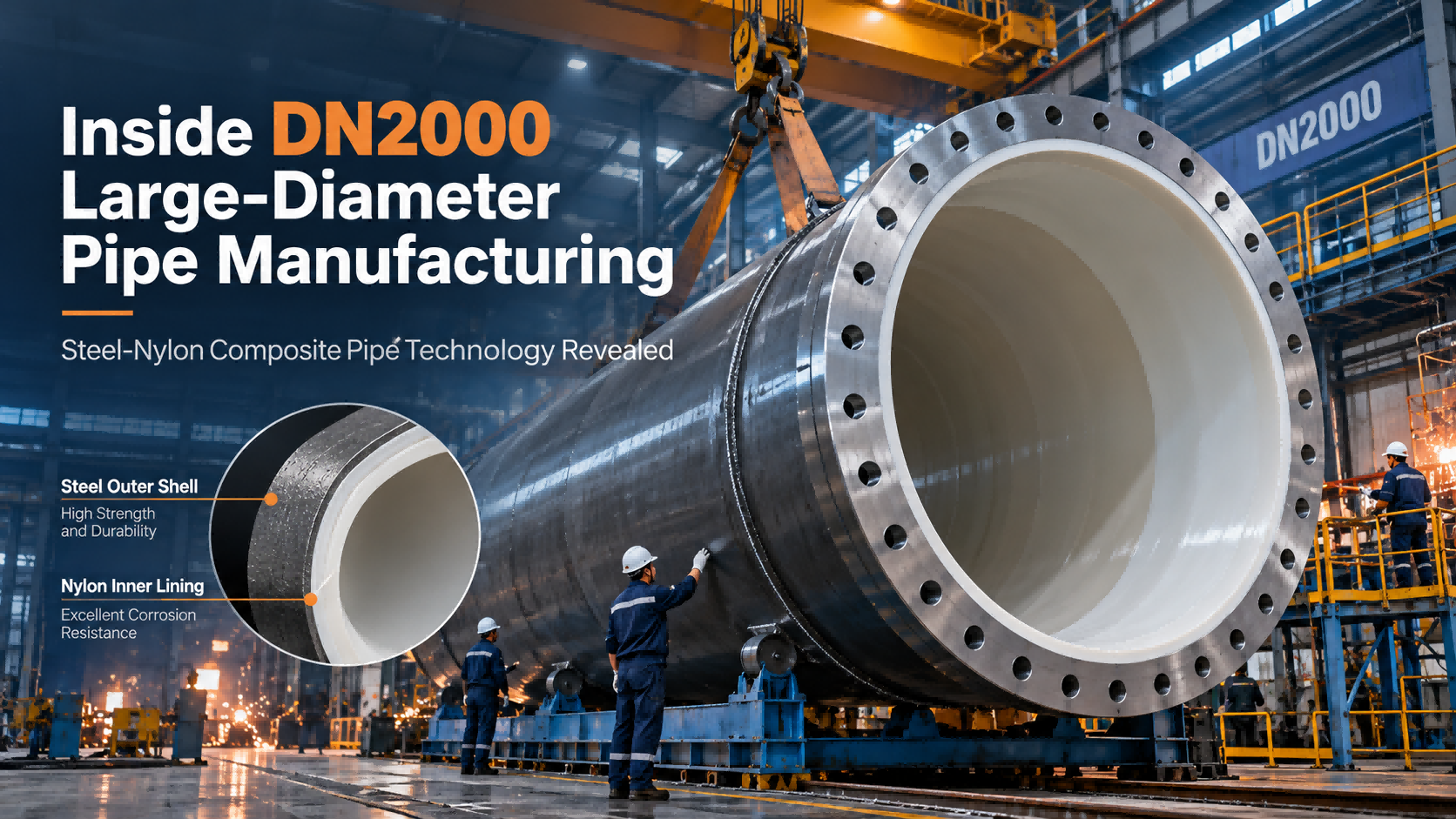
At Guangdong Kejin New Materials Co., Ltd., our steel–nylon composite pipes combine a steel structural layer with a nylon working layer.
Each material performs a specific function.
The steel structure provides mechanical strength.
Steel contributes structural rigidity and load-bearing capacity, supporting the design requirements of large-diameter and higher-pressure piping applications.
The internal nylon layer provides protection against transported media.
The nylon lining reduces direct contact between compatible transported fluids and the underlying steel structure, helping address corrosion and abrasion challenges.
The integrated flange structure supports connection stability.
Rather than treating the flange as a separate accessory, the pipe-end structure is designed as an important part of the complete composite piping system.
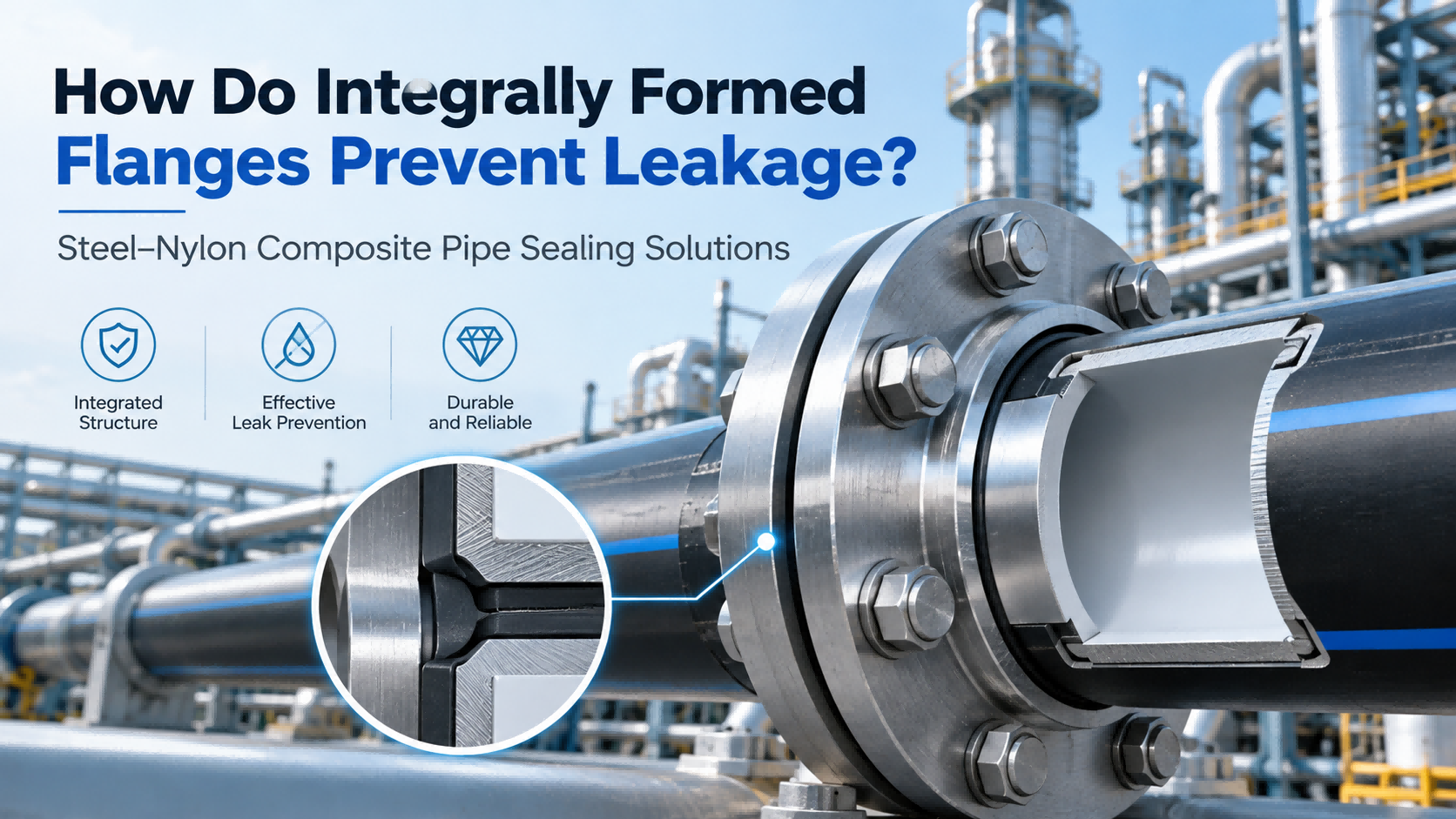
A particularly important feature of our steel–nylon composite pipes is the mechanical interlocking structure formed by specially designed grooves inside the steel flange.
During the nylon forming process, nylon material enters these engineered grooves and forms a mechanical interlock after solidification.
This design improves the retention of the nylon layer through physical engagement instead of relying exclusively on surface adhesion between the two materials.
3. How Do Integrally Formed Flanges Reduce Leakage Risks? Five Key Engineering Principles
3.1 Reducing Additional On-Site Welding and Connection Defects
Traditional pipeline installation may require extensive on-site flange welding.
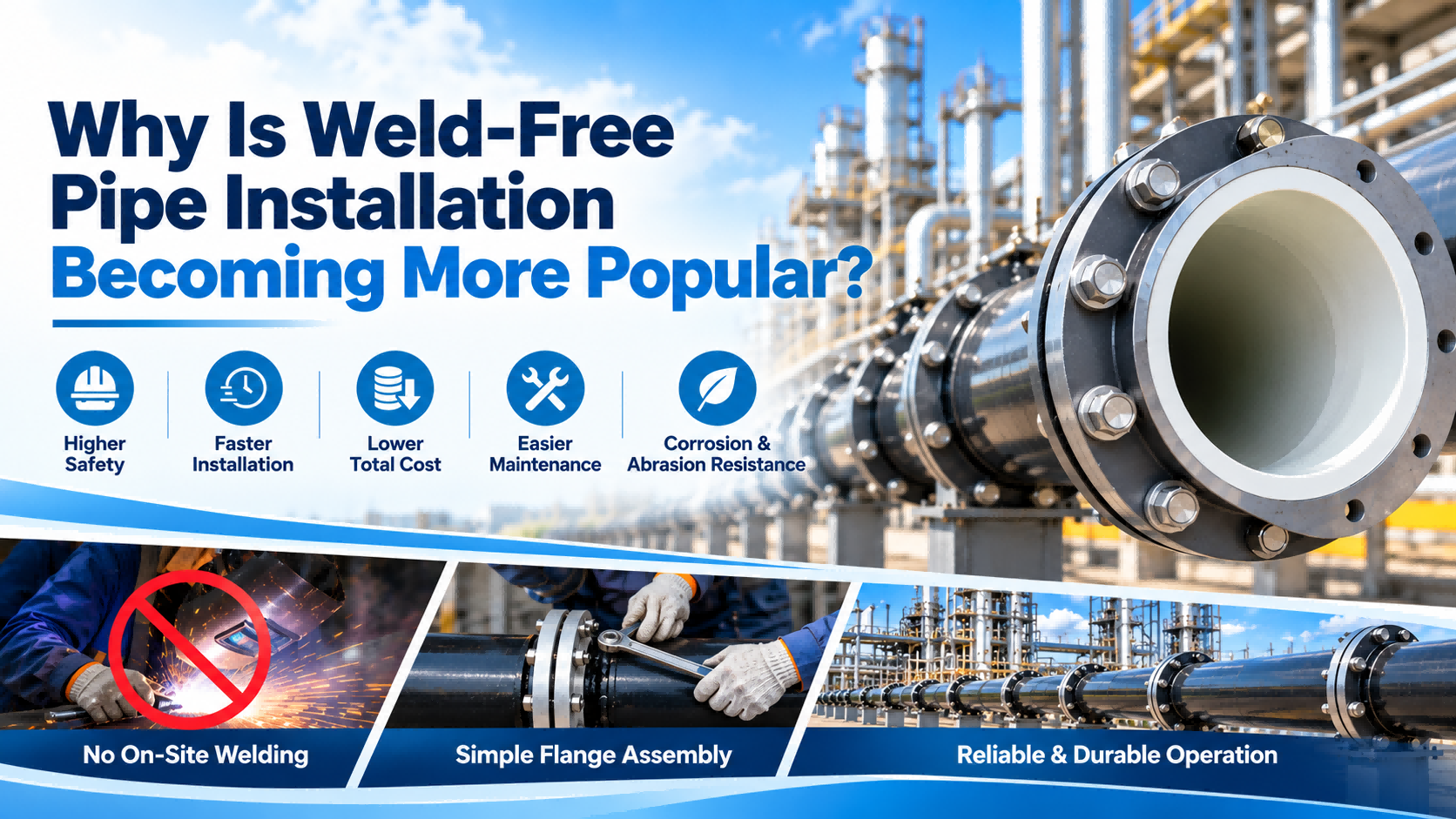
By comparison, prefabricated pipe sections with integrated flanges can be assembled using bolts and compatible mating flanges, reducing the need for additional field welding where the project design permits.
This approach can offer several advantages:
-
Fewer on-site welding operations.
-
Reduced exposure to variations in field welding quality.
-
Less risk of thermal distortion caused by field welding.
-
Reduced need for welding-related rework.
-
More predictable installation procedures.
These benefits can be particularly valuable in offshore facilities, chemical plant renovations, and projects with restricted installation space.
However, integrated flange technology does not necessarily mean that no welding is involved during pipe manufacturing.
Its advantage is primarily the reduction of additional connection welding during field installation.
3.2 Mechanical Interlocking Helps Prevent Nylon Lining Separation
For steel–nylon composite pipes, a strong steel flange alone is not sufficient.
The long-term stability of the internal nylon lining is also essential to maintaining corrosion protection.
Our steel–nylon composite pipes incorporate specially designed grooves inside the steel flange.
During manufacturing, nylon material enters these grooves and forms a mechanical interlocking structure after solidification.
This design provides three important benefits.
First: Improved resistance to relative movement.
When the pipeline experiences internal pressure, temperature changes, or external mechanical loads, the interlocking structure helps restrain movement of the nylon lining.
This can reduce the risk of lining displacement or separation near the pipe end.
Second: Improved mechanical load transfer.
The steel structure provides mechanical support to the nylon layer, helping prevent excessive connection loads from being carried solely by the non-metallic material.
Third: Reduced risk of fluid penetration along the material interface.
When the nylon lining remains securely retained at the flange end, the continuity of the corrosion-protection structure can be better maintained.
This feature can be especially valuable for pipelines transporting saltwater, industrial wastewater, and compatible chemical solutions.
However, actual resistance to interface penetration depends on groove geometry, nylon forming quality, interface conditions, and operating parameters.
Appropriate testing is necessary to verify performance.
3.3 Combining Steel Strength With Nylon Corrosion Protection
One of the fundamental advantages of steel–nylon composite pipes is the separation of structural and protective functions between two materials.
In non-metallic flange designs, long-term creep, temperature sensitivity, and local compressive deformation may influence bolted connection performance.
In steel–nylon composite pipes with steel load-bearing flange structures, bolt preload and associated mechanical loads can be transmitted primarily through the steel components.
The nylon layer primarily provides protection against contact with the transported medium.
This combination allows the piping system to take advantage of the different properties of both materials.
Steel provides structural strength, while nylon provides corrosion protection and abrasion resistance in suitable operating environments.
Nevertheless, the overall flange design must still account for local compressive stresses in the nylon, long-term creep behavior, and differences in thermal expansion between steel and nylon.
3.4 Optimized Sealing Structures Improve Gasket Stability
Reliable flange sealing requires more than selecting a high-quality gasket.
The gasket must maintain appropriate and reasonably uniform compression during both installation and operation.
Specialized flange sealing geometries may incorporate grooves or other positioning features to improve gasket placement and contact conditions.
For example, our enhanced MC nylon pipes can incorporate specially designed grooved sealing surfaces that help position and restrain compatible gaskets.
Such features may reduce the risk of lateral gasket displacement under certain operating conditions.
In steel–nylon composite pipes, the mechanical interlocking structure and the flange sealing surface serve different purposes.
The internal steel-flange grooves improve retention of the nylon lining, while the sealing surface and gasket provide the fluid-tight connection between mating flanges.
These two functions should not be confused.
The appropriate sealing surface configuration and gasket must be determined according to the actual flange design and approved sealing arrangement.
3.5 Preventing Corrosive Media From Reaching the Steel Structure
Flange leakage is not always caused by loose bolts or damaged gaskets.
Over time, corrosion at the flange end, sealing surface, or lining interface may also weaken connection reliability.
Steel–nylon composite pipes use an internal nylon working layer to reduce direct contact between compatible transported media and the steel structure.
Compared with ordinary carbon steel pipes directly exposed to corrosive fluids, this design can reduce failure risks associated with internal electrochemical corrosion.
It can be beneficial for suitable applications involving saltwater, certain alkaline solutions, and industrial wastewater.
However, nylon is not universally resistant to all chemicals.
Material compatibility must be carefully evaluated when handling strong acids, powerful oxidizing agents, elevated temperatures, or complex chemical mixtures.
4. Why Are Integrated Flanges Particularly Important for Large-Diameter and Higher-Pressure Pipelines?
As pipeline diameter increases, the pressure-induced separating force acting on a flanged connection can increase significantly.
A simplified engineering relationship illustrates this principle:
F = P × A
Where:
-
F = Axial separating force generated by internal fluid pressure.
-
P = Internal pressure.
-
A = Effective pressure area.
This simplified relationship is intended to explain the mechanical principle and does not replace a complete flange and bolt design calculation.
Because effective pressure area increases rapidly with diameter, large-diameter flanges require careful consideration of flange stiffness, bolt preload, gasket stress, and external piping loads.
If flange rigidity is inadequate or the load distribution is unfavorable, flange rotation and insufficient local gasket compression may occur.
Integrated flange design allows engineers to consider the pipe body and flange as a coordinated structural assembly.
This can help reduce unnecessary local weaknesses and improve load distribution.
Our steel–nylon composite pipe product range includes nominal diameters from DN100 to DN2000, combining a steel structure with a cast MC nylon lining.
The publicly specified pressure range includes 0.25–2.5 MPa, depending on product configuration.
Actual allowable pressure and temperature must be verified for each pipe specification.
The maximum diameter, maximum pressure, and maximum temperature should not be assumed to be simultaneously permissible.
5. Integrated Steel–Nylon Composite Flanges vs. Conventional Flange Connections
| Comparison Factor | Conventional Field-Welded Flange | Prefabricated Integrated Steel–Nylon Composite Flange |
|---|---|---|
| Installation | May require on-site welding | Bolted assembly can reduce field welding |
| Pipe-end structure | Depends on welding and lining design | Coordinated design of steel, nylon, and flange components |
| Lining retention | Depends on conventional lining method | Engineered groove-based mechanical interlocking |
| Structural load bearing | Primarily metal pipe and flange | Primarily steel structural components |
| Corrosion protection | Depends on base material and protective system | Nylon working layer isolates compatible transported media |
| Sealing reliability | Depends on design, gasket, and installation quality | Also depends on sealing design, with opportunities for improved pipe-end stability |
| Field construction | May involve welding and nondestructive testing | Greater prefabrication and convenient field assembly |
| Long-term maintenance | Depends on corrosion exposure and connection quality | Potential reduction in corrosion- and interface-related maintenance |
Well-manufactured conventional flanges can also provide reliable sealing.
The value of integrated flange technology lies in optimizing the connection structure for composite materials, improving installation efficiency, and reducing specific failure mechanisms under appropriate industrial conditions.
6. Does an Integrally Formed Flange Guarantee Zero Leakage?
No.
No industrial flange design can guarantee permanent leak-free operation under all conditions.
Reliable sealing depends on correct engineering design, manufacturing quality, installation procedures, and operating conditions.
Two fundamental requirements must be considered.
During installation, gasket compression must remain within the allowable limits of the gasket material.
During operation, sufficient residual gasket stress must be maintained despite pressure, temperature, and relaxation effects.
This means that applying more bolt torque is not always better.
Excessive tightening may damage the gasket, deform the flange, or place excessive stress on connection components.
Insufficient tightening may fail to establish an effective seal.
International engineering references provide useful guidance.
ASME PCC-1 addresses the assembly of pressure-boundary bolted flange joints.
EN 1591-1 provides calculation methods for circular flange connections with gaskets within its specified scope.
Therefore, integrated flange technology should be understood as a method of reducing certain structural leakage risks, not as a replacement for comprehensive flange sealing design.
7. Which Industries Benefit Most From Integrated Steel–Nylon Composite Pipes?
7.1 Chemical Processing and Chlor-Alkali Industries
Chemical piping systems often face a combination of corrosion exposure, pressure fluctuations, and continuous operation.
For compatible alkaline solutions, salt solutions, and other verified media, steel–nylon composite pipes can provide corrosion protection through the nylon lining while maintaining structural support through steel components.
Integrated flange structures can also simplify installation procedures.
7.2 Oil and Gas Applications
Oilfield produced water, certain gathering and transportation systems, and water injection pipelines may experience saline corrosion, aggressive fluid components, and particle-related abrasion.
Steel–nylon composite pipes offer a material configuration that can be evaluated for both corrosion and abrasion challenges.
For applications involving high-pressure pulsations or complex gas compositions, additional assessments of pressure rating, gas compatibility, temperature, permeation behavior, and flange sealing performance are essential.
7.3 Mining Slurry and Tailings Transportation
Slurry pipelines continuously transport solid particles that can cause severe internal abrasion.
Steel–nylon composite pipes can use a suitably validated nylon working layer to provide abrasion protection while the steel structure supports major mechanical loads.
A stable pipe-end connection can also help address connection-related problems associated with vibration, repeated maintenance, and long-term operation.
7.4 Seawater Transportation and Desalination
Seawater presents significant corrosion challenges for many metallic piping materials.
Combining steel structural components with a nylon contact layer reduces direct exposure of the internal steel structure to seawater.
For suitable intake, pretreatment, and associated piping applications, prefabricated flange connections may also improve installation convenience.
Material selection should account for water temperature, flow velocity, water chemistry, cleaning agents, and long-term operating requirements.
7.5 Municipal Water Supply, Drainage, and Industrial Water Treatment
In large-diameter water transportation systems, connection quality directly affects maintenance requirements and operational continuity.
Prefabricated flange connections facilitate segmented installation, inspection, and equipment connections.
Steel–nylon composite pipes combine structural strength and corrosion-control capabilities, making them a potential material option for suitable industrial water treatment and municipal infrastructure projects.
For drinking water applications, the piping system must also comply with applicable local hygiene certifications and material safety requirements.
8. How Can Engineers Ensure Reliable Sealing Performance?
Even when advanced integrated flange technology is used, correct engineering practices remain essential.
Step 1: Verify Flange Standards and Pressure Ratings
Check the flange dimensions, bolt-hole arrangement, sealing surface geometry, and applicable connection standards.
Confirm compatibility with mating flanges and equipment interfaces.
Depending on project requirements, relevant GB/T, HG, or ASME flange standards may apply.
Step 2: Select the Correct Gasket Material
Gasket selection must account for:
-
Chemical compatibility.
-
Operating temperature.
-
Design pressure.
-
Flange sealing surface geometry.
-
Long-term compression behavior.
Special grooved sealing surfaces require approved matching gasket arrangements.
Step 3: Inspect the Steel–Nylon Interface
Quality inspections should address:
-
Continuity of the nylon lining.
-
Pipe-end dimensional accuracy.
-
Visible material defects.
-
Manufacturing quality of the interlocking structure.
-
Any additional inspections required by the approved quality-control plan.
These inspections help ensure that the lining retention structure has been manufactured correctly.
Step 4: Control Bolt Preload
Follow approved tightening procedures and tightening sequences.
Use suitable methods to achieve the specified preload while avoiding excessive or uneven gasket compression.
Step 5: Minimize External Piping Loads
Properly design pipe supports, anchors, and expansion compensation systems.
Avoid transferring excessive bending moments, vibrations, or thermal displacement directly into flange connections.
Step 6: Perform Appropriate Pressure and Leakage Testing
Complete pressure and leakage testing according to applicable design codes and project acceptance requirements.
For demanding applications, additional evaluations may include:
-
Thermal cycling tests.
-
Pressure cycling tests.
-
Interface retention testing.
-
Long-term sealing performance evaluation.
Reliable leakage prevention results from the combined performance of structural design, material selection, manufacturing quality, and correct installation.
9. How Can Integrated Flanges Reduce Total Cost of Ownership?
Many industrial piping procurement decisions initially focus on the price per meter of pipe.
However, the actual financial impact of a piping system extends far beyond its purchase price.
Total Cost of Ownership (TCO) can be expressed as:
TCO = Initial Procurement Cost + Installation Cost + Maintenance Cost + Downtime Losses + Replacement and Disposal Costs
Integrated steel–nylon composite pipes may improve lifecycle economics in several ways.
9.1 Reduced Installation Requirements
Prefabricated flange connections can reduce certain field welding, pipe-end processing, and related installation operations.
For industrial projects with limited construction access, these advantages may help shorten installation schedules.
9.2 Lower Corrosion-Related Maintenance Requirements
In chemically compatible applications, the nylon lining reduces direct exposure of the steel structure to corrosive fluids.
If this results in fewer corrosion-related failures and pipe replacements, long-term maintenance expenditure may decrease.
9.3 Reduced Risk of Unplanned Shutdowns
In continuous industrial operations, a significant pipeline leak can generate losses far exceeding the original cost of the pipe.
Integrated pipe-end structures improve lining retention and connection stability, potentially reducing certain structural failure mechanisms.
9.4 Improved Long-Term Investment Value
For industrial pipelines with long design lives, difficult maintenance access, or high shutdown costs, procurement decisions should extend beyond the lowest initial quotation.
Instead, projects should evaluate reliability, maintenance convenience, and lifecycle economics supported by relevant testing and operating experience.
Integrated flange technology is therefore valuable not only as a connection method but also as part of a broader approach to operational risk management.
10. Why Choose Our Steel–Nylon Composite Pipes With Integrated Flange Technology?
Guangdong Kejin New Materials Co., Ltd. specializes in the research, development, and manufacturing of industrial nylon pipes and steel–nylon composite piping systems.
Our product design philosophy focuses on combining mechanical strength, corrosion protection, and reliable connections to meet different industrial piping requirements.
10.1 Composite Structure Combining Steel and Nylon
The steel structural layer provides mechanical support, while the nylon working layer protects against compatible transported fluids.
This material combination allows the piping system to be evaluated for corrosion resistance, abrasion performance, and structural loading.
10.2 Specially Engineered Mechanical Interlocking Technology
Our steel–nylon composite pipe-end design incorporates grooves inside the steel flange.
During nylon forming, the nylon material engages these grooves to create a mechanical interlocking structure.
This improves nylon lining retention and contributes to the integrity of the composite pipe-end assembly.
It represents an important technical feature of our composite pipe connection design.
10.3 Large-Diameter Manufacturing Capabilities
Our steel–nylon composite pipe portfolio includes a wide range of diameters and pressure classes.
Depending on project requirements, pipe section lengths, flange standards, and matching fittings can be evaluated for specific applications.
10.4 Solutions for Multiple Industrial Applications
Our piping products are intended for applications involving:
-
Oil and gas production and processing.
-
Chemical and chlor-alkali industries.
-
Mining and slurry transportation.
-
Seawater transportation and treatment.
-
Industrial wastewater treatment.
-
Municipal water supply and drainage.
-
Other piping applications requiring consideration of corrosion, abrasion, and structural strength.
Product suitability must be verified against the actual operating conditions of each project.
10.5 Focus on Long-Term Piping Reliability
Our objective is not simply to offer a corrosion-resistant pipe.
We aim to help customers evaluate the complete piping solution, including material selection, connection design, installation efficiency, maintenance requirements, and operating costs.
For each project, pipe selection should account for:
-
Transported medium and chemical composition.
-
Design pressure.
-
Operating temperature.
-
Nominal pipe diameter.
-
External mechanical loads.
-
Installation environment.
-
Applicable engineering standards.
By considering these parameters together, engineers can select appropriate steel–nylon composite pipes and flange connection configurations.
11. Frequently Asked Questions (FAQ)
Q1: Do integrally formed flanges eliminate the need for gaskets?
Not necessarily.
Most bolted flange connections using gasket-based sealing still require suitable gaskets.
Integrated flange technology primarily improves the structural relationship between the pipe body and its flange.
It does not automatically replace the sealing system between mating flange surfaces.
Q2: Are integrated flanges safer than welded flanges?
The answer depends on manufacturing quality, operating conditions, and engineering design.
In suitable applications, prefabricated integrated flange assemblies can reduce field welding and improve the retention of composite pipe linings.
However, correctly designed, manufactured, and inspected conventional welded flanges can also provide reliable service.
Q3: Why do steel–nylon composite pipes require mechanical interlocking structures?
Steel and nylon have different material properties, including elastic modulus, thermal expansion behavior, and long-term deformation characteristics.
A mechanical interlocking structure at the flange end provides geometric restraint to the nylon lining.
This helps reduce the risk of relative movement or separation caused by changing mechanical and thermal loads.
Q4: Can integrated flanges be used in high-pressure and large-diameter piping systems?
Yes, provided that the complete piping assembly is designed and verified for the intended conditions.
Engineers must evaluate flange strength, gasket stress, bolt loading, pipe support arrangements, and the allowable operating conditions of the materials.
The presence of an integrated flange alone does not establish the pressure rating of a piping system.
Q5: Are steel–nylon composite pipes suitable for long-term transportation of corrosive fluids?
They can be suitable for corrosive fluids that have been verified as chemically compatible with the selected nylon material.
However, material selection must consider chemical composition, concentration, temperature, pressure, flow velocity, and possible cleaning chemicals.
Actual product performance data and project-specific engineering assessments are essential.
12. Conclusion: Preventing Flange Leakage Through Better Structural Design
Industrial flange leakage is rarely caused by a single factor.
It results from interactions between material properties, connection geometry, gasket selection, bolt preload, corrosion exposure, and long-term operating loads.
The key value of integrated flange technology extends beyond installation convenience.
By improving structural integration, load transfer, and pipe-end stability, integrated flange designs can reduce certain potential failure mechanisms.
For steel–nylon composite pipes, the combination of a steel load-bearing structure, nylon protective lining, and mechanically interlocked flange-end design provides a promising engineering approach for demanding industrial fluid transportation systems.
Reliable pipeline sealing does not depend on a single component. It depends on the coordinated design and performance of the entire connection system.
For corrosive fluid transportation, large-diameter industrial pipelines, and projects with high maintenance or shutdown costs, improving the connection structure from the design stage deserves serious consideration.
Looking for Steel–Nylon Composite Pipes With Integrated Flange Technology?
Guangdong Kejin New Materials Co., Ltd. provides industrial nylon pipes, steel–nylon composite pipes, and associated flanged piping solutions for a wide range of industrial applications.
If you are planning a chemical processing, mining, oilfield, seawater treatment, or industrial water transportation project, we welcome your technical inquiries.
Share your pipe diameter, transported medium, design pressure, operating temperature, and other engineering requirements with our team.
We can help you evaluate suitable pipe structures, flange connection options, and technical solutions for your project.
Website: //www.nylonpipeline.com
Email: lloyds.royqiu@gmail.com
Explore Our Products: Steel–Nylon Composite Pipes and Fittings
Learn More: Our Integrated Flange Technology
Choose a piping solution designed for strength, corrosion protection, and reliable connections.
Weld-Free Pipe Installation | Steel-Nylon Composite Pipes
Industrial Pipes with Integrated Flanges: 8 Major Advantages