Weld-Free Pipe Installation | Steel-Nylon Composite Pipes
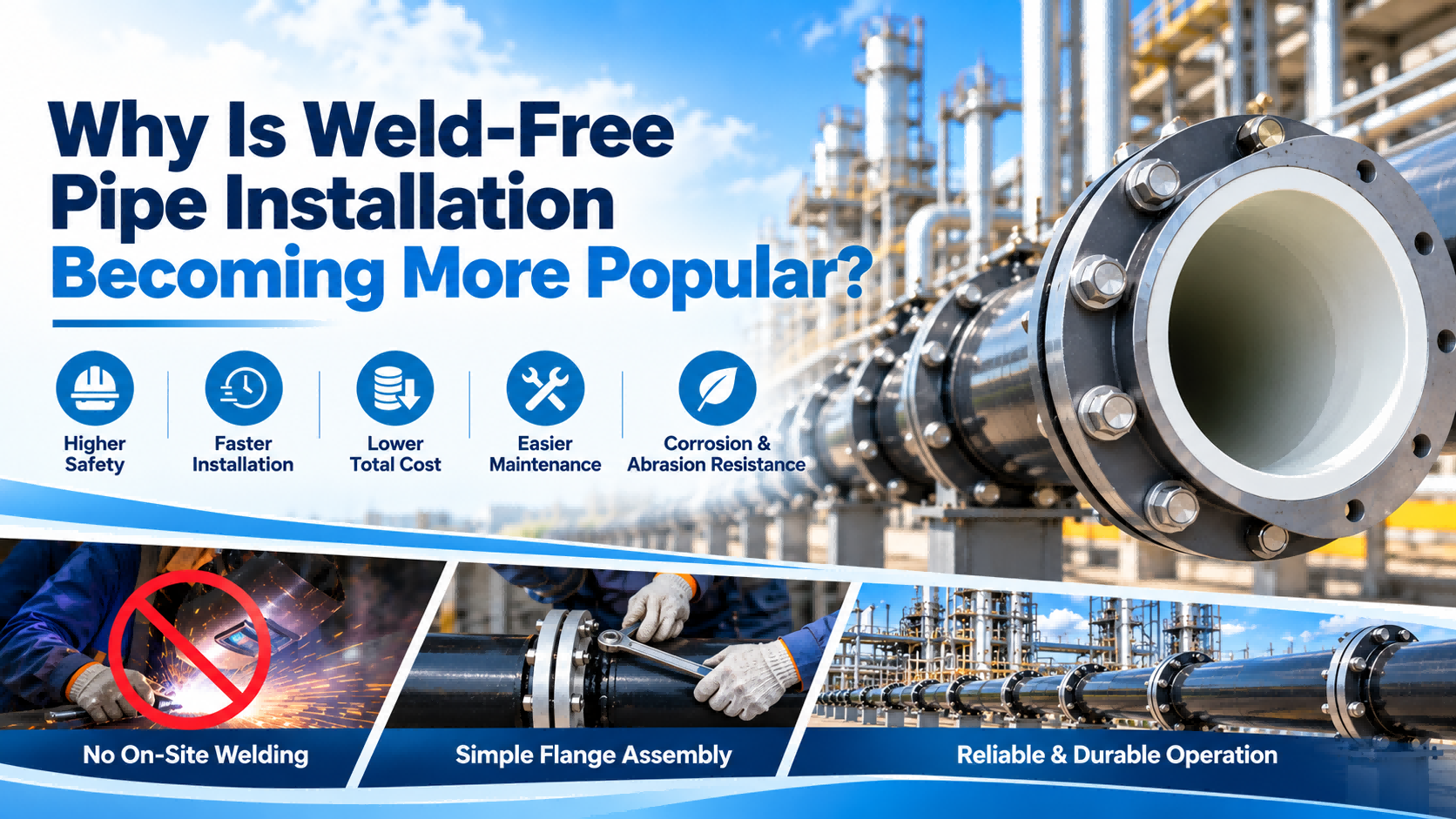
Why Is Weld-Free Pipe Installation Becoming More Popular?
From Installation Efficiency and Safety to Lifecycle Cost Savings: Understanding the Shift in Industrial Piping Systems
Introduction: Industrial Pipe Installation Is Moving Toward Modular Connections
In industrial piping projects, material performance is essential, but the installation method is equally important in determining project efficiency, construction safety, and long-term operating costs.
For decades, welding has been one of the most widely used methods for connecting steel pipelines. From chemical plants and water treatment facilities to mining operations and municipal infrastructure, welded piping systems have played a central role in industrial construction.
However, as industrial projects become larger and more complex, project owners and contractors face increasing pressure to shorten construction schedules, improve workplace safety, and reduce total lifecycle costs.
As a result, weld-free on-site pipe installation is attracting greater attention from engineering companies, EPC contractors, and industrial end users.
Among the available solutions, steel-nylon composite pipes with prefabricated flange connections offer an alternative to conventional welded piping systems.
By combining the structural strength of steel with the corrosion and abrasion resistance of Nylon 6 (PA6), these composite pipes can provide both material performance and installation advantages for suitable industrial applications.
So why is weld-free pipe installation becoming increasingly popular? What benefits can it offer industrial projects? And why are steel-nylon composite pipes particularly well suited to this installation approach?
This article explores the engineering, economic, and operational factors driving the adoption of weld-free piping solutions.
1. What Is Weld-Free Pipe Installation?
Weld-free pipe installation refers to a piping installation method in which pipe sections are connected on-site without welding the main pipe joints.
Instead, connections are completed using prefabricated flanges, mechanical couplings, grooved fittings, or other engineered connection systems.
An important distinction is that weld-free installation does not necessarily mean that welding is completely eliminated from the pipe manufacturing process.
Rather, it means that welding is reduced or avoided during on-site assembly.
For example, steel-nylon composite pipes manufactured with prefabricated flange ends can undergo connection-end fabrication, lining installation, and quality inspection under controlled factory conditions.
Once delivered to the construction site, individual pipe sections can be connected using flanges, gaskets, and bolts according to the approved engineering design.
This approach transfers certain complex fabrication processes from the construction site to the factory, supporting more standardized and modular installation.
Traditional Welding vs. Weld-Free Flanged Installation
| Comparison | Traditional On-Site Welding | Prefabricated Flanged Installation |
|---|---|---|
| Connection method | Welded pipe joints | Bolted flange connections |
| Installation personnel | Generally requires qualified welders | Requires trained pipe installation technicians |
| Hot work | Usually required | Not required for the pipe joint assembly itself |
| Installation preparation | Welding equipment, consumables, and joint preparation | Flange alignment, gaskets, bolts, and assembly tools |
| Quality control | Welding procedures and weld inspection | Flange surface inspection, bolt preload, and sealing checks |
| Maintenance | Cutting or reworking may be required | Connections can be disassembled after safe isolation |
| Installation efficiency | Affected by welding and inspection procedures | Standardized assembly can improve installation efficiency |
| Main risks | Welding defects and hot-work hazards | Misalignment, gasket failure, and incorrect bolt preload |
Both connection methods have their own engineering applications.
The purpose of weld-free installation is not to replace welding in every situation, but to provide a more efficient and flexible alternative where mechanical connections are technically appropriate.
2. Why Are More Industrial Projects Choosing Weld-Free Pipe Installation?
2.1 Reduced Hot Work and Improved Construction Safety
On-site welding requires strict safety management, particularly in petrochemical facilities, oil and gas operations, ports, and industrial plants.
Welding introduces several potential hazards, including:
-
Fire and ignition risks
-
High-temperature exposure
-
Welding fumes
-
Electrical hazards
-
Additional safety requirements in confined spaces
In the United States, the Occupational Safety and Health Administration (OSHA) establishes safety requirements for welding, cutting, and related hot-work operations.
For industrial facilities handling flammable materials, hot work may also require additional permits, inspections, and protective measures.
Using prefabricated flanged connections can reduce the need for on-site hot work during pipe assembly.
This provides several practical advantages.
First, it reduces welding-related fire and heat exposure risks.
Second, it decreases dependence on on-site welding equipment and consumables.
Third, it simplifies certain construction activities in operating plants and other challenging environments.
Although weld-free connections do not eliminate all construction hazards, they can contribute to a safer and more manageable installation process when combined with appropriate lifting, isolation, and site safety procedures.
2.2 Faster Installation and Shorter Project Schedules
Construction schedules directly affect project profitability, especially in large industrial facilities.
Traditional welded pipe installation generally involves several sequential operations:
Pipe positioning → Joint preparation → Alignment → Welding → Weld inspection → Potential repairs → Corrosion protection → System testing
Some of these activities cannot be performed simultaneously.
If welding or inspection is delayed, downstream construction tasks may also be affected.
Prefabricated flanged piping systems can simplify this process by reducing the number of welding-related operations required at the construction site.
For steel-nylon composite pipes, the flange connections and protective inner lining can be completed during manufacturing.
On-site work can then focus on pipe positioning, flange assembly, and quality inspection.
This approach can be particularly beneficial for projects involving:
-
Large numbers of pipe connections
-
Standardized pipe dimensions
-
Modular construction
-
Limited installation windows
-
Remote industrial facilities
However, actual time savings depend on pipe diameter, connection quantity, lifting conditions, construction organization, and dimensional accuracy.
2.3 Reduced Dependence on Specialized Welding Labor
High-quality welding depends on qualified personnel, approved procedures, appropriate equipment, and controlled working conditions.
For overseas projects, remote mining operations, island infrastructure, or regions with limited construction resources, sourcing qualified welding personnel can create additional logistical challenges.
Weld-free flanged installation reduces the need for specialized welders during the assembly of main pipe sections.
Instead, installation work can be performed by personnel trained in flange assembly, gasket handling, alignment, and bolt-tightening procedures.
This does not mean that flange installation requires no technical expertise.
Incorrect assembly can still cause leakage or mechanical damage.
Nevertheless, the change in required skills can help EPC contractors improve labor allocation and reduce certain workforce constraints.
2.4 Easier Maintenance, Disassembly, and Future Expansion
Industrial piping systems must be maintained throughout their operating lives.
Over time, facilities may require:
-
Valve replacement
-
Equipment upgrades
-
Pipe cleaning
-
Localized maintenance
-
Pipeline modifications
-
System expansion
For welded systems, certain maintenance operations require cutting and rewelding pipe sections.
This can increase shutdown work and extend maintenance schedules.
Flanged connections, however, allow pipe sections to be separated by removing bolts after the system has been safely isolated, depressurized, and drained.
This feature is especially valuable in applications involving frequent inspection or equipment replacement.
Examples include pumping stations, industrial water systems, mining slurry pipelines, and chemical processing facilities.
For plant operators, the ability to maintain and modify a piping system efficiently can be as important as the initial installation cost.
2.5 Greater Compatibility with Prefabrication and Modular Construction
Modern industrial construction increasingly relies on factory prefabrication, standardized components, and modular assembly.
For piping projects, this means that more fabrication and quality-control activities can be completed before materials arrive at the construction site.
Factory prefabrication provides a more controlled environment for manufacturing operations.
With prefabricated flanged steel-nylon composite pipes, manufacturers can prepare pipe sections according to approved engineering drawings.
Key parameters may include:
-
Pipe diameter and length
-
Flange dimensions
-
Connection configuration
-
Lining specifications
-
Required installation tolerances
This approach can improve coordination between procurement, manufacturing, transportation, and on-site construction.
However, accurate dimensions and careful installation planning remain essential.
Prefabricated flange positions and pipe lengths must match actual site conditions.
3. Why Are Steel-Nylon Composite Pipes Particularly Suitable for Weld-Free Installation?
Weld-free installation is a connection method, while steel-nylon composite piping is a material and structural solution.
When these technologies are properly combined, they can deliver complementary engineering benefits.
3.1 Combining Steel Strength with Nylon 6 Protection
Conventional carbon steel pipes may experience internal corrosion when transporting certain industrial liquids, saline water, or other corrosive media.
Over time, internal corrosion may contribute to wall-thickness loss, deposits, leakage, and increased maintenance requirements.
Steel-nylon composite pipes use a combination of metallic and polymer materials.
The steel structure provides mechanical strength, rigidity, and structural support.
The Nylon 6 (PA6) inner lining separates compatible transported media from the steel surface and can provide corrosion and abrasion resistance under suitable operating conditions.
This combination enables the piping system to benefit from the structural properties of steel while using an engineered polymer lining for internal protection.
Potential applications include:
-
Industrial water transportation
-
Cooling water circulation
-
Selected mining slurry systems
-
Industrial wastewater pipelines
-
Other compatible fluid transportation applications
However, Nylon 6 is not universally resistant to all chemicals.
Its long-term suitability must be evaluated against operating temperature, chemical concentration, pressure, moisture absorption, and other service conditions.
3.2 Prefabricated Flange Connections Simplify On-Site Assembly
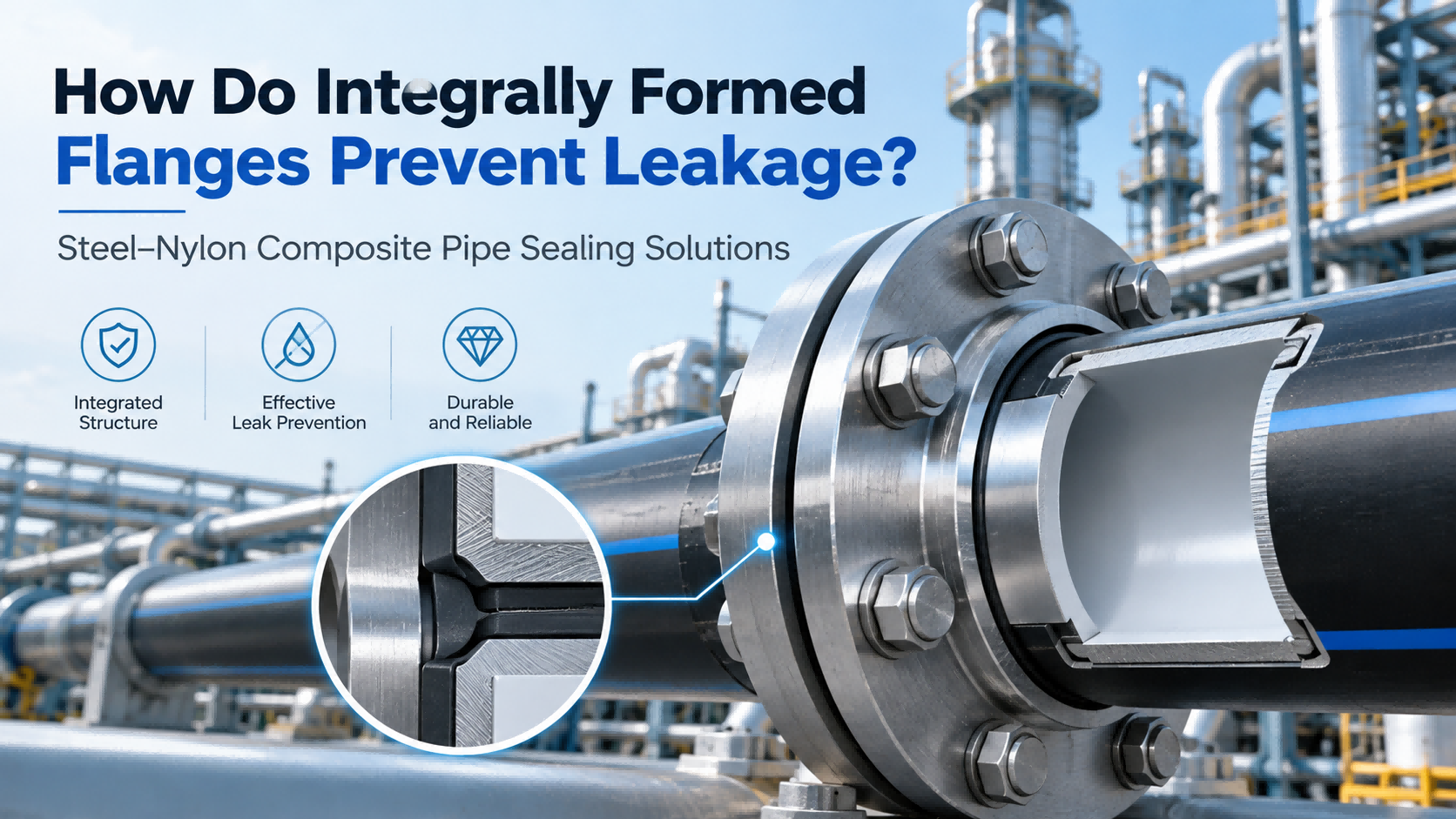
One important advantage of steel-nylon composite pipes is their compatibility with prefabricated flange-end designs.
Where properly engineered, these connections eliminate the need to weld the main pipe sections together during site installation.
This provides three key benefits.
Reduced installation procedures
Pipe sections can be connected through mechanical flange assembly rather than on-site fusion welding.
Protection of the Nylon 6 lining
Polymer materials can be sensitive to high temperatures.
Uncontrolled welding near completed polymer-lined pipe ends may damage the lining or compromise the interface.
By using properly designed prefabricated flange connections, unnecessary heat exposure during field assembly can be avoided.
More standardized installation
Consistent flange dimensions, gasket specifications, and bolt configurations allow installation teams to follow repeatable assembly procedures.
This is particularly useful for international projects involving large quantities of pipe sections and standardized installation requirements.
3.3 Improved Control of Connection-End Corrosion Protection
The corrosion resistance of a composite piping system depends not only on the straight pipe sections but also on the connection areas.
Even when the internal lining provides effective protection, exposed metal at pipe ends or poorly designed sealing interfaces may create localized corrosion risks.
Therefore, flange-end design is a critical consideration for steel-nylon composite pipes.
Engineers should evaluate:
-
Continuity of the Nylon 6 lining near pipe ends
-
Potential exposure of steel surfaces to transported media
-
Compatibility between flange sealing faces and gaskets
-
Protection of the lining during transportation and installation
Properly engineered factory-prefabricated ends can reduce the need for field modification of the polymer lining.
They can also help maintain more consistent connection quality.
3.4 Corrosion and Abrasion Resistance Can Reduce Maintenance Requirements
Many industrial piping systems are exposed to both corrosion and mechanical wear.
In mining, water treatment, and industrial fluid transportation, internal pipe deterioration can result from:
-
Chemical exposure
-
Suspended solids
-
Particle impact
-
Abrasive flow
-
Localized erosion
Nylon 6 is an engineering polymer with useful wear-related properties.
With suitable material formulation, lining thickness, and pipe design, steel-nylon composite pipes can be optimized for specific abrasion conditions.
When combined with flange connections, the piping system can offer two potential advantages.
The inner lining can help protect the steel structure from compatible transported media, while the detachable connections make localized inspection and pipe replacement more convenient.
Actual service life must be verified based on fluid characteristics, flow velocity, particle properties, and operating conditions.
4. How Much Can Weld-Free Pipe Installation Save?
One of the main attractions of weld-free piping systems is their potential to reduce project costs.
However, comparing the purchase price per meter of pipe does not provide a complete picture.
Industrial piping economics should be evaluated using Total Cost of Ownership (TCO).
A simplified calculation is:
TCO = Pipe Procurement Cost + Transportation Cost + Installation Cost + Inspection and Testing Cost + Maintenance Cost + Downtime Losses + End-of-Life Costs
Traditional welded systems may involve expenses related to:
-
Specialized welding labor
-
Welding machines and consumables
-
Joint preparation
-
Welding inspection
-
Possible weld repairs
-
Site safety management
Prefabricated flange connections can reduce some of these expenses.
However, they also introduce costs associated with flanges, bolts, gaskets, factory fabrication, and mechanical assembly inspections.
Therefore, weld-free installation does not automatically offer the lowest initial cost in every application.
Its economic benefits should be assessed at three levels.
Level 1: Direct Installation Costs
This includes labor hours, equipment requirements, connection procedures, inspections, and potential rework.
For projects with many pipe joints, standardized flange assembly can reduce certain installation activities.
Level 2: Project Delivery Costs
Construction delays can increase indirect expenses.
These may include equipment rental, site management, labor coordination, and delayed commissioning.
If prefabricated flange connections shorten the project's critical construction path, the resulting economic benefits may extend beyond direct labor savings.
Level 3: Long-Term Operating Costs
Long-term costs include pipe repairs, corrosion-related maintenance, component replacement, and shutdown losses.
In industrial systems designed for many years of operation, these costs can become a major part of the overall investment.
The real value of steel-nylon composite pipes with prefabricated flange connections is their ability to address installation efficiency, internal protection, and maintenance accessibility together.
This integrated approach is more meaningful than focusing only on welding cost savings.
5. Which Industries Can Benefit from Weld-Free Steel-Nylon Composite Piping?
5.1 Municipal Water Supply and Wastewater Infrastructure
Municipal water and wastewater projects often involve long pipelines, multiple installation locations, and demanding maintenance requirements.
Where pressure ratings, regulatory requirements, and material suitability are satisfied, prefabricated flanged steel-nylon composite pipes can be evaluated as an alternative for selected water infrastructure applications.
Potential benefits include:
-
Convenient on-site assembly
-
Structural support from steel
-
Internal corrosion protection
-
Easier localized disassembly
For drinking-water applications, the materials must also meet applicable potable-water contact requirements and local regulatory approvals.
5.2 Mining and Slurry Transportation
Mining pipelines frequently operate in demanding environments.
Challenges may include abrasive particles, remote installation locations, and significant maintenance requirements.
Where the Nylon 6 lining has been validated for the specific slurry conditions, steel-nylon composite pipes can be considered for selected mining applications.
Prefabricated flange connections also facilitate localized inspection and replacement.
This can be especially useful near bends, valves, and other areas exposed to concentrated mechanical wear.
5.3 Chemical Processing and Industrial Cooling Water Systems
Industrial cooling water and chemical processing systems may experience corrosion, deposits, and operating challenges associated with fluid chemistry.
For chemically compatible media, steel-nylon composite pipes can help reduce direct contact between the transported fluid and the steel structure.
In plant modification projects, weld-free flange connections can also reduce hot-work requirements.
Nevertheless, material compatibility must always be evaluated against the specific chemical composition, operating temperature, and system pressure.
5.4 Ports, Coastal Facilities, and Seawater Transportation
Ports, coastal industrial facilities, and selected seawater transportation systems are exposed to saline environments and challenging installation conditions.
Prefabricated flange connections can simplify assembly in some of these projects.
Meanwhile, a properly designed Nylon 6 lining may help isolate seawater from the steel inner surface when long-term material suitability has been demonstrated.
However, the external steel structure still requires appropriate corrosion protection based on environmental exposure.
For long-term seawater applications, engineers should also evaluate water absorption, dimensional stability, and the mechanical properties of Nylon 6 under actual operating conditions.
5.5 Industrial Pipeline Replacement and Upgrading
Industrial operators often need to replace aging pipelines within limited shutdown windows.
Prefabricated piping systems can move part of the work into the pre-shutdown stage.
Engineering measurements, pipe manufacturing, connection preparation, and quality inspection may be completed before installation begins.
Where existing interfaces are compatible and engineering requirements are satisfied, flanged steel-nylon composite pipes can help reduce the amount of on-site welding needed during pipeline replacement.
6. Weld-Free Does Not Mean Inspection-Free: How to Ensure Reliable Flange Connections
Although weld-free installation can simplify construction, flanged joints remain critical components of the pressure boundary.
Incorrect installation can cause leakage, gasket damage, or mechanical failure.
The American Society of Mechanical Engineers publishes ASME PCC-1, Guidelines for Pressure Boundary Bolted Flange Joint Assembly, which provides guidance for applicable bolted flange connections.
For steel-nylon composite piping systems, several factors deserve particular attention.
6.1 Flange Dimensions and Pressure Ratings
Flange dimensions, tolerances, materials, and pressure ratings must comply with the approved piping design.
6.2 Gasket Selection
Gaskets should be selected based on the transported medium, operating pressure, temperature, and flange sealing-face configuration.
6.3 Proper Flange Alignment
Installation teams should avoid using excessive bolt force to correct major pipe misalignment.
Such practices may introduce unwanted mechanical stresses.
6.4 Controlled Bolt Tightening
Bolts should be tightened according to the approved assembly procedure, tightening sequence, and preload requirements.
A single universal torque value should not be assumed suitable for every connection.
6.5 Lining and Connection-End Inspection
Before assembly, the Nylon 6 lining and flange-end protection should be examined for transportation damage, deformation, scratches, or discontinuities.
6.6 Pressure Testing and Leak Inspection
After installation, the complete piping system should undergo the applicable pressure testing and leak inspection procedures.
For specialized flange configurations or composite sealing interfaces, assembly requirements should be confirmed by the engineering designer and manufacturer.
Reliable weld-free piping depends on the combination of correct product design, manufacturing quality, and installation procedures.
7. Is Weld-Free Steel-Nylon Composite Piping Suitable for Every Project?
No piping material or connection method is suitable for every operating condition.
Although prefabricated flange connections offer installation advantages, several limitations must be considered.
High-temperature operation
Nylon 6 performance depends on both temperature and exposure conditions. The allowable operating temperature must be established for the complete composite pipe system.
High-pressure and pressure-cycling applications
The pressure capacity and fatigue performance of the pipe body, flanges, seals, and connecting components must be verified.
Strong acids and oxidizing chemicals
Certain aggressive chemicals can damage PA6. Chemical compatibility testing or validated material data may be necessary.
Frequent thermal cycling
Differences in thermal expansion between steel and polymer components can affect dimensional behavior and joint preload.
Long-term water or seawater exposure
Nylon 6 can absorb moisture, potentially affecting dimensions and mechanical properties. These effects must be considered during design.
Large-diameter piping systems
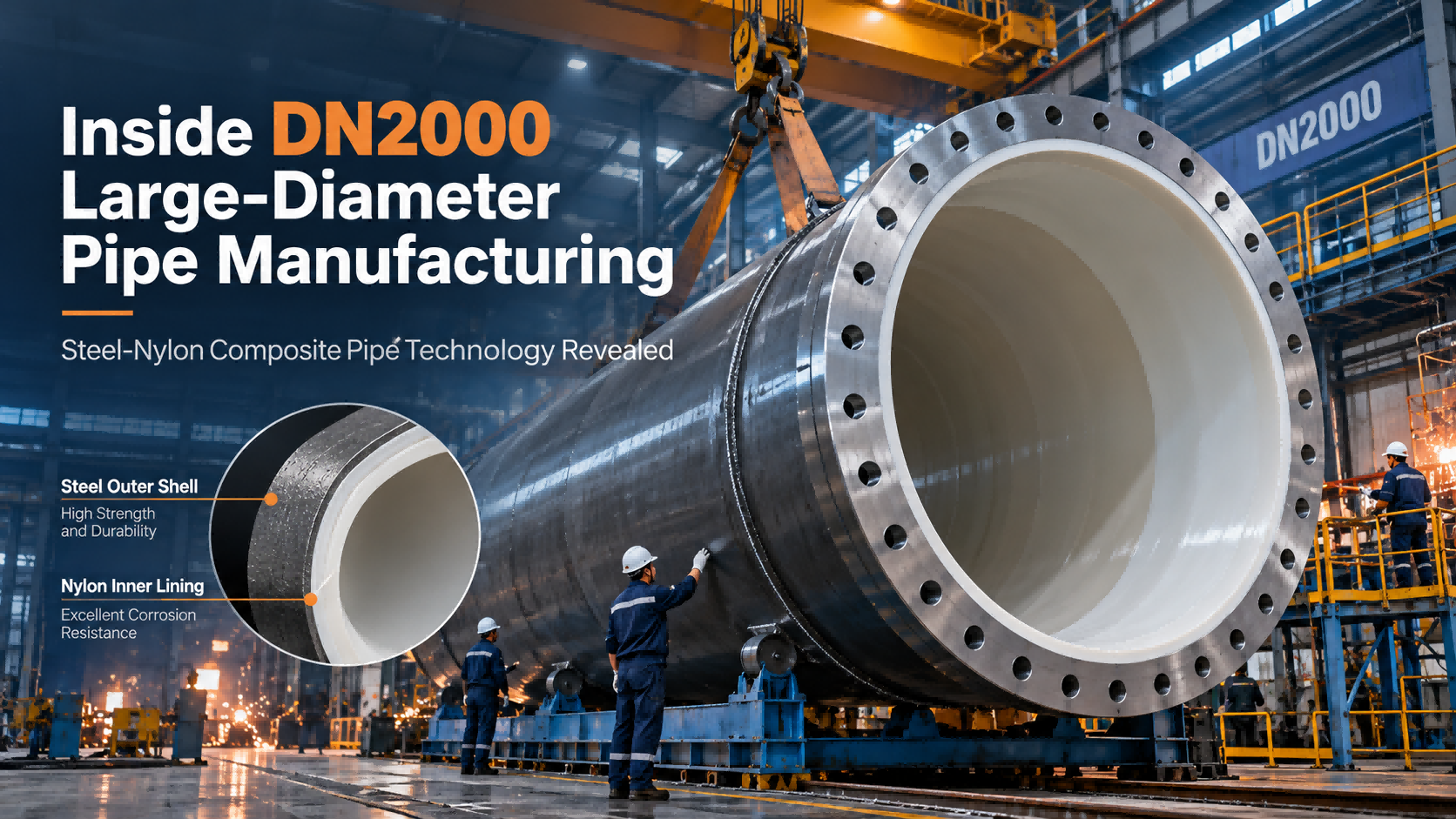
Transportation, lifting, flange alignment, and bolt assembly become increasingly important as pipe diameter increases.
Additionally, for very long straight pipelines with numerous joints, flange connections may not always be the most economical option.
Final material and connection selection should be based on verified product performance, applicable design standards, and project-specific cost analysis.
8. The Future of Industrial Pipe Procurement: Easy Installation, Easy Maintenance, and Long-Term Reliability
Industrial pipe procurement is becoming more comprehensive.
Purchasing decisions are no longer based solely on pipe material and initial price.
Instead, project stakeholders increasingly evaluate the complete performance of a piping solution.
EPC contractors want products that reduce installation complexity and improve construction coordination.
Engineering consultants require reliable technical data, verified connection designs, and compliance with applicable standards.
Industrial end users focus on operating safety, maintenance requirements, and downtime costs.
International project developers must also consider transportation, local installation capabilities, and construction resources.
As these requirements become more important, piping solutions that support prefabrication, standardized assembly, and convenient maintenance are likely to attract continued interest in suitable applications.
Steel-nylon composite pipes offer a promising approach within this broader development.
Their structural concept combines:
-
Steel for mechanical strength and rigidity
-
Nylon 6 for suitable internal corrosion and abrasion protection
-
Prefabricated flange connections for weld-free on-site assembly
Together, these features support a more integrated approach to industrial piping design.
Instead of treating the pipe as a standalone material product, engineering teams can evaluate it as part of a complete installation, operation, and maintenance solution.
9. Why Choose Our Steel-Nylon Composite Pipe Solutions?
As a manufacturer specializing in steel-nylon composite pipes, we focus not only on material performance but also on practical installation requirements and long-term project value.
We aim to provide piping solutions that address the engineering challenges faced by industrial customers, EPC contractors, and international procurement teams.
9.1 Steel Structure Combined with Nylon 6 Protection
Our steel-nylon composite piping approach combines the mechanical advantages of steel with the protective properties of a Nylon 6 inner lining.
The goal is to provide structural support while reducing direct contact between compatible transported media and the steel surface.
9.2 Prefabricated Flange Connection Solutions
For suitable product configurations, prefabricated flange ends can reduce the need for on-site welding during pipe installation.
This helps simplify assembly procedures and supports modular construction.
9.3 Solutions for Multiple Industrial Applications
Our steel-nylon composite pipe solutions can be evaluated for a range of industrial applications, including:
-
Municipal water and wastewater projects
-
Industrial cooling water systems
-
Selected mining transportation applications
-
Compatible chemical processing systems
-
Industrial pipeline rehabilitation projects
Material and structural suitability should be confirmed for each application.
9.4 Focus on Lifecycle Performance
We recognize that purchasing industrial piping involves more than selecting a material at the lowest initial price.
Pipe reliability, installation efficiency, maintenance accessibility, and long-term operating costs are all important considerations.
By combining protective lining technology with detachable flange connections, we aim to help customers evaluate more economical piping solutions over the entire project lifecycle.
9.5 Engineering-Oriented Product Selection
Different projects require different piping specifications.
Important parameters include:
-
Nominal pipe diameter
-
Operating pressure
-
Operating temperature
-
Transported media
-
Flow velocity
-
Installation environment
-
Connection requirements
-
Maintenance conditions
By considering these factors together, we can help customers assess appropriate steel-nylon composite piping and flange connection options.
Our goal is not simply to supply pipes, but to support industrial customers in finding solutions that balance technical performance, installation efficiency, and long-term economic value.
10. Frequently Asked Questions (FAQ)
Q1: Does weld-free pipe installation mean that no welding is required at all?
Not necessarily.
Weld-free pipe installation generally means that the main pipe sections are connected on-site using flanges or other mechanical connection methods rather than field welding.
Welding or other fabrication processes may still be used during factory manufacturing.
Q2: Are flanged pipe connections as reliable as welded connections?
Both flanged and welded connections can provide reliable performance when properly designed, manufactured, installed, and maintained.
Welded joints require appropriate welding procedures and inspection.
Flanged joints require correct gasket selection, alignment, bolt preload, and sealing control.
The most suitable connection depends on operating conditions and engineering requirements.
Q3: Why are steel-nylon composite pipes suitable for flanged connections?
Prefabricated flanged connections reduce the need for welding near completed Nylon 6 linings during on-site installation.
They also support standardized assembly and facilitate future inspection, maintenance, and pipe replacement.
Q4: Can Nylon 6-lined pipes be used for seawater and corrosive fluids?
Nylon 6 offers useful resistance to certain aqueous media, oils, and chemicals.
However, it is not compatible with every corrosive substance.
Seawater and chemical applications require careful evaluation of fluid composition, concentration, temperature, pressure, moisture absorption, and long-term performance.
Q5: Is weld-free pipe installation always cheaper than welding?
Not always.
Flanges, gaskets, bolts, and factory fabrication may increase initial material and manufacturing costs.
However, savings in on-site welding labor, installation time, and future maintenance may improve the overall lifecycle economics of a project.
A project-specific Total Cost of Ownership analysis is recommended.
Conclusion: Weld-Free Installation Is Changing How Industrial Piping Value Is Evaluated
The growing interest in weld-free pipe installation reflects an important shift in industrial engineering priorities.
Modern projects demand more than pipes that simply meet mechanical and fluid transportation requirements.
They increasingly require piping systems that support safer construction, efficient installation, standardized delivery, and cost-effective maintenance.
For suitable applications, steel-nylon composite pipes with prefabricated flange connections provide an integrated solution.
The steel structure delivers mechanical support, the Nylon 6 lining provides internal protection under compatible operating conditions, and the flange connections simplify on-site assembly.
Together, these characteristics offer a competitive alternative for industrial projects seeking to optimize installation efficiency and long-term operating performance.
Looking ahead, industrial piping solutions will increasingly be evaluated not only by their purchase price, but also by their contribution to overall project efficiency, reliability, and lifecycle cost.
A truly valuable industrial piping system should not only transport fluids effectively—it should also be easy to install, reliable in operation, and convenient to maintain.
Contact Us: Explore Weld-Free Steel-Nylon Composite Piping Solutions
Are you looking for industrial pipes that combine convenient installation, corrosion resistance, abrasion resistance, and long-term economic value?
We specialize in steel-nylon composite pipes and related flanged connection solutions for industrial projects.
Whether you are an EPC contractor, engineering consultant, industrial end user, distributor, or international purchasing company, we welcome the opportunity to discuss your project requirements.
Share your pipe diameter, operating pressure, temperature, transported media, and installation requirements with our team.
We can help you evaluate suitable steel-nylon composite piping solutions for your application.
Visit Our Website: //www.nylonpipeline.com
Steel-Nylon Composite Pipes | Nylon 6 Lined Pipes | Weld-Free Flanged Connections | Corrosion-Resistant Industrial Piping Solutions
DN2000 Large-Diameter Pipes: Steel-Nylon Manufacturing Guide
How Integrated Flanges Prevent Leakage in Steel-Nylon Pipes?