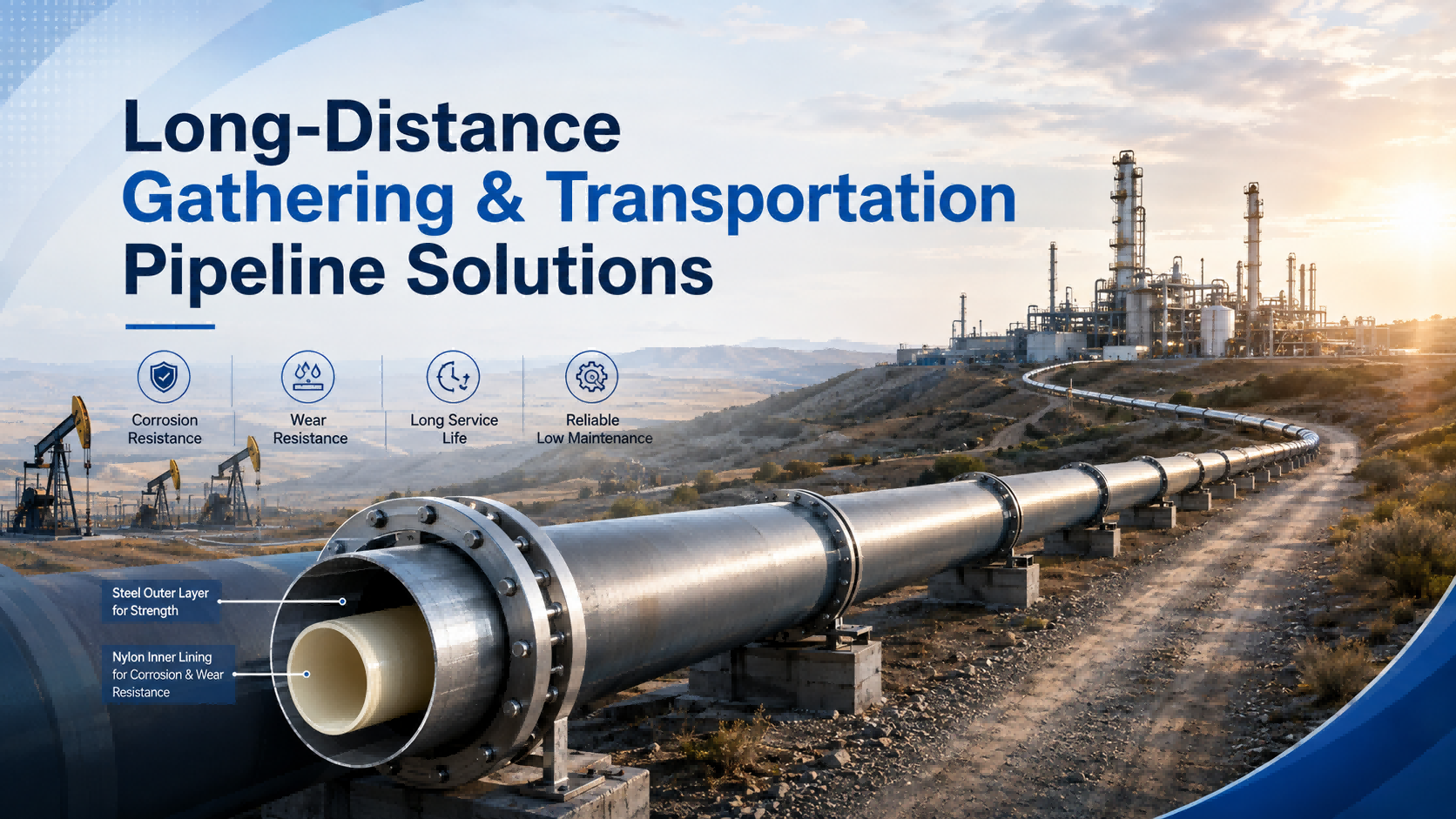
Maintenance-Free Pipeline Case Study for Oil & Gas Fields: How Steel-Nylon Composite Pipes Reduce Corrosion, Leakage, and Lifecycle Maintenance Costs

In oil and gas surface facilities, pipelines are rarely the most expensive individual asset. However, they are often among the most critical components affecting the reliability of the entire production system.
As oilfields enter high-water-cut production stages and pipelines are exposed to high salinity, sand, corrosive gases, and complex multiphase fluids, conventional carbon steel pipelines may gradually face a series of problems:
-
Internal corrosion and progressive wall thinning
-
Accelerated corrosion caused by CO₂, H₂S, and high-salinity produced water
-
Erosion at elbows and localized pipeline sections caused by solid particles
-
Scaling caused by mineral deposits and corrosion products
-
Leakage around welds, elbows, tees, valves, and other vulnerable sections
-
Repeated welding repairs, partial replacement, or even complete pipeline replacement
Ultimately, the true cost borne by an oilfield operator is far greater than the cost of purchasing a new section of pipe.
It may also include labor, maintenance equipment, transportation, production shutdowns, oil recovery, environmental remediation, safety management, and continuously increasing inspection requirements.
This raises an important question for modern oil and gas operators:
Can pipeline material selection transform pipelines from frequently repaired consumable assets into long-life infrastructure designed for stable operation?
This is where steel-nylon composite piping systems can create significant value.
1. What Does a “Maintenance-Free Pipeline” Really Mean in an Oilfield?
Strictly speaking, no industrial pipeline system should operate without inspection.
Pressurized piping systems still require routine inspection, condition monitoring, and safety management in accordance with project specifications and applicable regulations.
Therefore, the term “maintenance-free pipeline” is better understood as:
A pipeline system designed to significantly reduce unplanned repairs and replacement caused by corrosion, erosion, scaling, and connection failures.
The traditional maintenance cycle of an oilfield pipeline often looks like this:
Corrosion → Wall Thinning → Leakage → Repair Welding → Corrosion Again → Leakage Again → Partial Replacement
An optimized low-maintenance pipeline system should instead follow a different pattern:
Stable Transportation → Routine Inspection → Long-Term Operation → Minimal Structural Repair
The main difference between these two operating models is not the initial price per meter of pipe.
It is the number of maintenance interventions required throughout the pipeline's service life.
For oil and gas facilities designed to operate for 10, 20, or even more years, this difference can become substantial.
2. Why Do Oilfield Pipelines Often Become High-Maintenance Assets?
Oilfield gathering and transportation pipelines operate under much more complicated conditions than ordinary water pipelines.
A seemingly simple pipeline may simultaneously transport or be exposed to:
-
Crude oil
-
Produced water
-
Dissolved salts
-
CO₂
-
H₂S
-
Sand
-
Corrosion products
-
Chemical additives
-
Solid particles
As an oilfield enters the middle or late stages of development, the water cut of produced fluids may continue to increase.
A pipeline system originally designed primarily for crude oil transportation may gradually become a high-water-content multiphase transportation system.
This significantly changes the dominant pipeline failure mechanisms.
2.1 High Water Cut Increases Corrosion Risk
The aqueous phase is essential to many electrochemical corrosion processes in oil and gas pipelines.
As the water content of produced fluids increases, a larger area of the carbon steel surface may come into contact with corrosive water.
If the produced water also contains high concentrations of dissolved salts, ions such as chlorides may further increase the risk of localized corrosion.
2.2 CO₂ Corrosion Can Remain a Long-Term Threat
When CO₂ dissolves in water, it forms a carbonic acid system.
Under certain temperature, flow velocity, pressure, and water chemistry conditions, conventional carbon steel pipelines may suffer significant CO₂ corrosion.
If the corrosion-product layer is unstable or unable to provide sufficient protection, corrosion may continue throughout operation.
2.3 H₂S Creates Additional Material Challenges
Some oil and gas fields contain H₂S in the transported medium.
H₂S can create more complicated material reliability challenges in addition to general corrosion.
Simply increasing the wall thickness of carbon steel therefore does not fundamentally eliminate the interaction between corrosive fluids and the steel substrate.
2.4 Sand and Solid Particles Cause Erosion
Oilfield production fluids may contain sand and other solid particles.
When these particles pass through:
-
Elbows
-
Tees
-
Reducers
-
Valve sections
-
Pump outlets
local flow velocity and flow direction can change significantly.
As a result, erosion may become much more severe at these locations.
This is why elbows, tees, reducers, valve sections, and other flow-disturbance areas often fail before straight pipeline sections.
3. Oilfield Case Study: From Frequent Corrosion Repairs to Long-Term Stable Operation
In some high-water-cut production areas of China's Shengli Oilfield, increasingly complex operating conditions have placed significant pressure on conventional gathering pipelines.
At the Gudong Oil Production Plant, for example, some production areas have entered an extremely high-water-cut stage.
The combined water cut has reached approximately 97.2%, while certain blocks exceed 98%.
At the same time, the transported fluids involve challenging characteristics such as:
-
Heavy crude oil
-
High viscosity
-
High water content
-
Sand content
-
Complex produced water chemistry
Under these operating conditions, conventional gathering systems have historically faced problems including:
corrosion, erosion, leakage, and frequent maintenance.
To improve pipeline reliability, PAMC steel-nylon composite pipes were gradually introduced to upgrade corrosion- and wear-prone sections of the oil and gas gathering system.
Since 2015, steel-nylon composite pipes have been installed in multiple phases, with a cumulative application length of approximately 2.6 kilometers.
The application covers areas such as:
-
Well drainage valve groups
-
Gathering pipeline sections
-
Elbows
-
Reducers
-
Manifolds
-
Main process pipelines within stations
The significance of long-term operation is not simply that the pipeline “did not fail.”
More importantly, the operating philosophy changed.
Instead of continuously responding to corrosion, leakage, and emergency repairs, pipeline management could gradually shift toward routine inspection and condition management.
That is the real objective of a low-maintenance oilfield pipeline system.
4. Why Are Steel-Nylon Composite Pipes Suitable for Low-Maintenance Oilfield Systems?
A steel-nylon composite pipe is not simply two materials placed together.
Its engineering philosophy is to allow each material to perform the function it handles best.
The steel structure primarily provides:
-
Mechanical strength
-
Pressure-bearing capability
-
Structural rigidity
The reinforced nylon layer primarily provides:
-
Corrosion isolation
-
Wear resistance
-
Protection against direct contact between the transported medium and the steel structure
The result can be summarized as:
Steel Strength + Nylon Corrosion Resistance
In other words:
the structural advantages of steel combined with the corrosion and wear resistance of reinforced nylon.
5. Advantage One: Isolating Corrosive Media from the Steel Structure
The fundamental weakness of conventional carbon steel pipe is that the transported medium comes into direct contact with the steel surface.
As long as corrosive conditions remain present, corrosion may continue.
Steel-nylon composite pipes use a continuous nylon medium-contact layer to isolate transported fluids from the steel structural layer.
The engineering approach therefore changes from:
“How can we make steel corrode more slowly?”
to:
“How can we minimize direct contact between corrosive media and the steel structure?”
These represent two very different corrosion-control strategies.
This approach can be particularly valuable for:
-
High-water-cut production fluids
-
Produced water
-
High-salinity water
-
Certain complex corrosive oilfield media
6. Advantage Two: Combining Corrosion Resistance with Wear Resistance
Many pipeline solutions can address corrosion.
However, corrosion resistance alone may not solve erosion problems.
Oilfield pipelines frequently experience both:
Corrosion + Erosion
This is particularly important at:
-
Elbows
-
Tees
-
Reducers
-
Valve sections
-
Pump outlets
-
Other high-turbulence locations
Reinforced nylon offers good wear resistance.
As a result, steel-nylon composite piping can be considered not only for corrosive fluids but also for applications involving a certain level of suspended solids and erosive particles.
This is also why elbows, tees, reducers, and pipeline sections upstream and downstream of valves are important candidates for oilfield pipeline upgrading.
7. Advantage Three: Integral Flange Connections Reduce Field Welding
Connection design is extremely important in oilfield retrofit projects.
Traditional steel piping systems often require extensive on-site welding.
This can involve:
-
Welding operations
-
Weld inspection
-
Repair of external corrosion protection
-
Hot-work permits
-
Additional safety procedures
-
Longer installation schedules
Steel-nylon composite pipes can be manufactured with integrally formed flange connections.
Straight pipe sections, elbows, tees, reducers, and other fittings can therefore be connected through a flanged piping system.
One important advantage is:
reduced dependence on field welding and hot work.
This can be particularly valuable when upgrading existing operating oilfield stations where installation efficiency and hot-work management are major concerns.
8. Advantage Four: Steel Structure Provides Higher Pressure Capability
Pure polymer pipelines offer clear benefits in many low-pressure corrosive applications.
However, oil and gas projects often require a combination of:
-
Corrosion resistance
-
Wear resistance
-
Pressure capability
-
Resistance to external loads
-
Long-term dimensional stability
Steel-nylon composite pipes use steel as the principal structural and pressure-bearing framework.
Depending on project requirements, different pressure classes can be designed, typically covering approximately:
1.0–4.0 MPa
The objective is therefore not simply to replace steel with plastic.
Instead, the composite structure is designed to solve two engineering challenges simultaneously:
pressure containment + corrosion isolation.
9. Advantage Five: Smooth Internal Surface Helps Reduce Scaling and Deposits
Scaling is another major issue in high-salinity produced-water systems.
As deposits accumulate inside pipelines, they may cause:
-
Reduced effective internal diameter
-
Higher pressure losses
-
Increased pumping energy consumption
-
Reduced flow capacity
-
More frequent cleaning
-
Severe blockage in extreme cases
The relatively smooth nylon internal surface provides less favorable conditions for some deposits to adhere strongly to the pipe wall.
This does not mean that scaling can be completely eliminated under every operating condition.
However, the surface characteristics can help reduce deposition tendencies and potentially make cleaning easier.
Therefore, a low-maintenance oilfield pipeline strategy should not focus only on corrosion.
It should consider three major challenges together:
Corrosion + Wear + Scaling
10. The Real Comparison Should Not Be Initial Pipe Price
Consider two pipeline options.
Option A
The initial purchase price is relatively low, but every few years the operator must perform:
-
Repair welding
-
Elbow replacement
-
Replacement of corroded sections
-
Scale removal
-
Shutdown maintenance
Option B
The initial investment may be higher, but the pipeline operates reliably for a much longer period with mainly routine inspection.
Which option is actually less expensive?
If only the initial procurement price is considered, Option A may appear cheaper.
But over a 10-year operating period, the conclusion may be completely different.
Industrial pipeline projects should therefore evaluate:
Total Cost of Ownership
or:
TCO
A simplified calculation can be expressed as:
TCO = Pipeline Procurement Cost + Installation Cost + Maintenance Cost + Replacement Cost + Production Shutdown Losses + Safety and Environmental Costs
For oil and gas operators, one of the most underestimated components is often:
Production Downtime
A leak in a critical gathering pipeline may create losses significantly greater than the purchase price of the pipe itself.
The real value of a low-maintenance pipeline is therefore not:
“The pipe is cheaper to buy.”
It is:
“The system reduces the probability and cost of repeated pipeline repairs over the next decade or more.”
11. Why Should Oilfield Retrofit Projects Start with the Most Failure-Prone Sections?
For mature oilfields with extensive existing pipeline networks, replacing every pipeline at once is usually unnecessary.
A more practical strategy is:
Critical Section Replacement
In other words:
Upgrade the Highest-Risk Pipeline Sections First
Operators can review three to five years of maintenance records and identify:
-
Pipeline sections with the highest leakage frequency
-
Elbows
-
Tees
-
Pump outlets
-
Sections upstream and downstream of valves
-
High-velocity areas
-
High-sand-content sections
-
Highly corrosive produced-water pipelines
These locations can then be prioritized for replacement with corrosion- and wear-resistant materials.
A practical first step is to install:
100–500 Meter Trial Sections
After a defined operating period, engineers can compare:
-
Corrosion condition
-
Wear condition
-
Maintenance frequency
-
Pressure drop
-
Scaling
-
Shutdown time
-
Total maintenance cost
If actual field performance meets expectations, the application can then be expanded progressively.
For large oil and gas operators, this approach provides a lower-risk path toward material upgrading than replacing an entire pipeline network at once.
12. Which Oilfield Pipeline Applications Are Suitable for Steel-Nylon Composite Pipes?
Based on operating conditions and transported media, steel-nylon composite pipes are particularly worth evaluating for the following applications.
Oil and Gas Gathering Pipelines
Suitable for surface gathering systems where pressure capability, corrosion resistance, and long-term reliability must all be considered.
High-Water-Cut Production Fluid Pipelines
As mature oilfields produce increasing quantities of water, corrosion-resistant pipeline materials become increasingly important.
Produced-Water Pipelines
Particularly relevant for systems transporting high-salinity produced water with complex ionic compositions.
Water Injection Systems
Material upgrades can be evaluated where long-term corrosion and scaling are persistent problems.
Sand-Containing Fluid Pipelines
Especially important at elbows, tees, reducers, and localized high-velocity sections.
Valve Groups and Station Process Piping
These areas contain numerous fittings, complicated flow patterns, and often represent some of the most maintenance-intensive locations in conventional piping systems.
13. The Future of Oilfield Pipeline Competition Is Reliability, Not Simply Material Price
In the past, one of the most common questions in industrial pipeline procurement was:
“How much does the pipe cost per meter?”
Increasingly, a more important question is becoming:
“How many times will this pipeline need to be repaired over the next 10 years?”
This represents a fundamental change in industrial pipeline purchasing philosophy.
The industry is moving from:
Purchase Price
to:
Lifecycle Cost
and ultimately toward:
Pipeline Reliability
For oil and gas operators, an effective pipeline system should aim to deliver:
-
Lower corrosion risk
-
Lower wear risk
-
Lower probability of leakage
-
Less field maintenance
-
Fewer production shutdowns
-
Longer operating cycles
-
More predictable lifecycle costs
This is where the value proposition of steel-nylon composite piping becomes clear.
It is not simply intended to replace one traditional pipe material.
Instead, it addresses a fundamental challenge that has affected oilfield pipeline systems for decades:
How can pipelines be transformed from frequently repaired equipment into reliable, long-life infrastructure?
Conclusion: The Best Maintenance Strategy Starts with Better Material Selection
As oilfields enter middle and late stages of production, increasing water cut, high salinity, CO₂, H₂S, sand, and complex multiphase fluids can place growing maintenance pressure on conventional pipeline systems.
If operators continue relying on the traditional approach of:
repairing after corrosion and replacing after leakage,
maintenance requirements and operating costs may continue to rise as the infrastructure ages.
A more advanced pipeline engineering strategy is to address future maintenance requirements during the material-selection stage.
Steel-nylon composite pipes combine:
steel structural strength + reinforced nylon corrosion and wear resistance + integral flange connections
to provide an alternative solution for oil and gas gathering pipelines, produced-water systems, water injection lines, and other corrosive or erosive pipeline applications.
True “maintenance-free” operation does not mean that pipelines should never be inspected.
Instead, it means:
minimizing the need for repairs caused by corrosion, erosion, scaling, and leakage while maintaining normal safety inspection and condition monitoring.
For an oilfield project expected to operate for 10, 20, or even more years, long-term reliability can be far more valuable than saving a small amount on the initial pipe purchase price.
Longer Service Life. Less Maintenance. Lower Lifecycle Cost.
That is the direction in which modern oilfield pipeline engineering is moving.
Oilfield Pipeline Leakage: Root Causes, Failure Mechanisms, and How to Reduce Long-Term Leakage Risk
Why Are Oilfields Starting to Adopt Steel–Nylon Composite Pipes?