Eliminating FRP Pipes in the Soda Ash Industry: Modified PA6 Nylon Pipes Resist Alkali Without Leaching, Eliminating Glass Fiber Contamination Risks
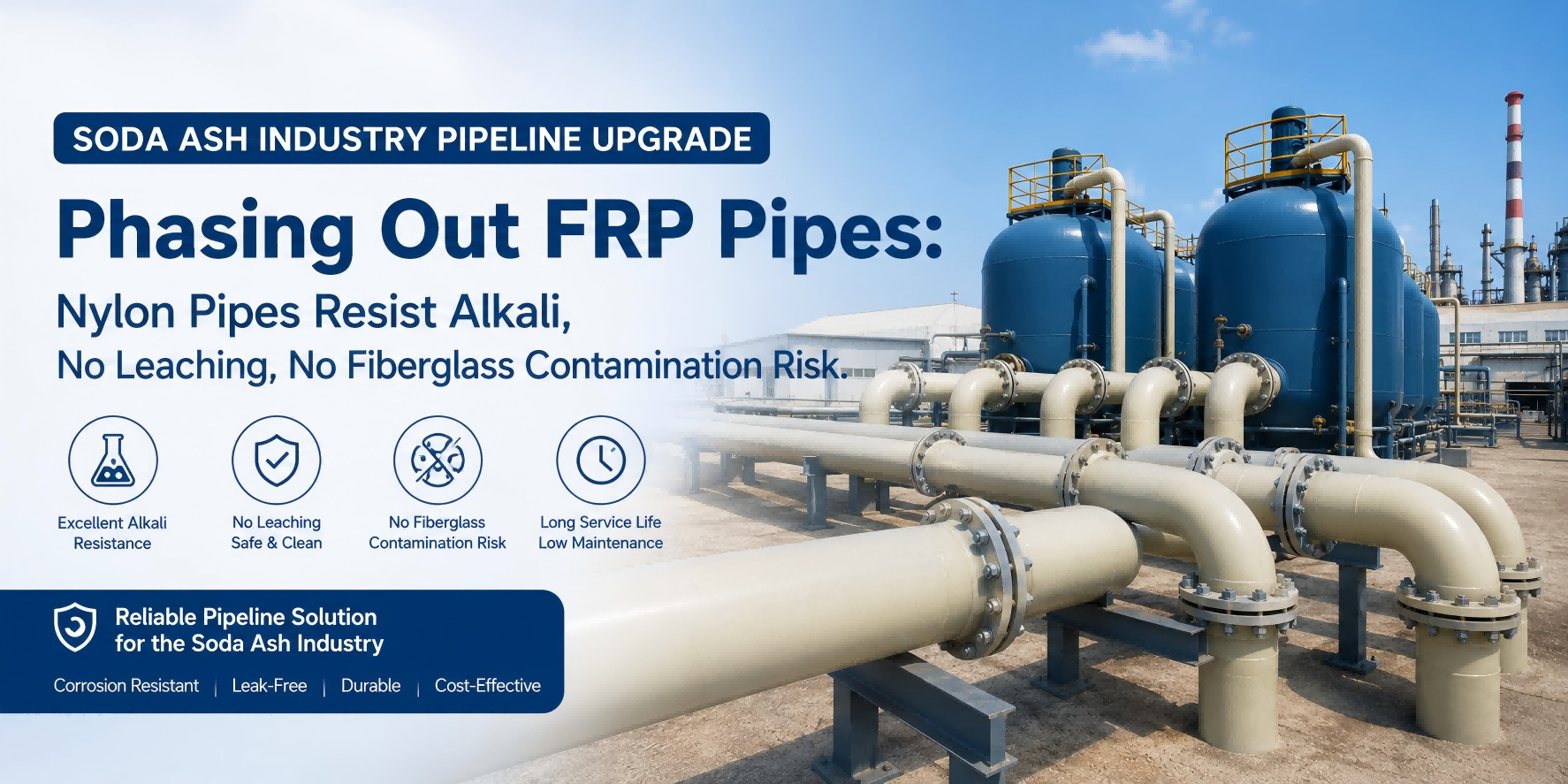
In the modern soda ash industry’s pursuit of high purity and safe production, a materials revolution is accelerating. Fiberglass Reinforced Plastic (FRP) pipes, once the standard for corrosion resistance, are being phased out of high-end projects due to the irreducible risk of **glass fiber leaching**. Rising to prominence is an innovative solution based on a proven nylon platform: **Specialty Modified PA6 Nylon Pipe**. It shatters the traditional belief that "regular PA6 cannot withstand strong alkali." With its homogeneous, fiber-free structure and non-leaching alkali resistance, it has become the ultimate safeguard for soda ash purity.
The "Original Sin" of FRP: Why Leached Glass Fiber Fatal for Soda Ash?
The failure of FRP pipes in hot, strong alkalis stems from the fundamental flaws of their composite “resin + glass fiber” structure.
**1. Alkali Penetration and Structural Collapse**
When hot caustic solution (>80°C) contacts FRP, the resin matrix undergoes saponification, swelling, and micro-cracking. Alkali penetrates these cracks and reacts directly with the glass fibers:
[SiO2+2NaOH→Na2SiO3+H2O】
The fibers dissolve into water glass, hollowing out the structural wall and risking catastrophic rupture.
The fibers dissolve into water glass, hollowing out the structural wall and risking catastrophic rupture.
**2. The Deadly Contamination of Shed Fibers**
Detached glass fiber debris inevitably flows into the final soda ash product. For food-grade, pharmaceutical-grade, or photovoltaic glass-grade soda ash, **micron-sized fiberglass impurities** cause stones and spots in downstream glass, triggering massive claims. This physical contamination is irreversible and cannot be fixed with pipe liners.
The Modified PA6 Breakthrough: A Materials Science "Fiber-Free Revolution"
The industry's hesitation toward PA6 stems from the fact that **standard PA6 undergoes amide bond hydrolysis in hot, strong alkalis.** Our proposed solution, however, is not standard PA6. It is a reinforced-grade nylon pipe enhanced through **toughening blends, hydrolysis-resistant crosslinking, and specialized elastomeric alloy modification.**
Core Advantage 1: Homogeneous Material, Zero Fiber Leaching
Modified PA6 pipe is a single-polymer thermoplastic with absolutely no glass fiber added to its wall, eliminating the root cause of “fiber contamination.” Even under long-term erosion by high-velocity, solids-laden caustic slurry, any minute wall abrasion merely yields inert nylon micro-powder. This introduces no inorganic silicon or iron impurities and produces no sharp fiberglass shards. **“Non-leaching” is the ultimate safety guarantee for high-purity soda ash processes.**
Core Advantage 2: Breaking Limits with Superior Modified Alkali Resistance
By incorporating specialized **hydrolysis stabilizers** and **long-chain block copolymers**, we have effectively end-capped and protected the molecular chain ends of PA6. The modified crystalline structure is far denser, drastically reducing alkali permeability. Lab immersion data shows that this modified PA6 maintains excellent mechanical retention in mixed alkali media **at concentrations up to 50% and temperatures up to 100°C**. Its surface resists the swelling and delamination typical of resins, thoroughly overturning the stereotype that "PA6 cannot handle alkali."
Core Advantage 3: Self-Lubrication and Seamless Joints Prevent Scaling
Modified PA6 inherits the excellent self-lubricating properties of polyamides, with an extremely low friction coefficient that effectively inhibits caustic brine crystallization and scaling on pipe walls. Combined with **butt-fusion welding**, this creates a seamless, leak-free system that removes structural dead spots prone to scaling at flange connections, significantly extending continuous operation cycles.
In-Depth Comparison: Not Just Replacement, But a Purity Upgrade
In core process sections like carbonation mother liquor and caustic circulation, Modified PA6 delivers a quantum leap over FRP:
| Key Indicator | Traditional FRP Pipe | Modified PA6 Nylon Pipe (Specialty Alkali-Resistant PA6) |
|---|---|---|
| Impurity Leaching Risk | High (glass fibers, silicates, resin fragments) | Zero (fiber-free, homogeneous polymer) |
| Hot Caustic Temperature Limit | Resin-dependent (typically <90°C) | Breakthrough to 100-110°C |
| Impact / Water Hammer Resistance | Brittle, prone to external damage | Superb toughness, vibration fatigue resistance |
| Joint Reliability | Butt-and-wrap joints, high leakage risk | Butt-fused, system-wide zero leakage |
| Product Purity | Prone to glass fiber foreign matter | Silicon-free, fiber-free, safeguarding high purity |
International Trade Perspective: Modified PA6 – The Compliance Choice for High-End Global Markets
In international soda ash EPC projects, end-users in Europe and America place a top priority on **hygienic compliance and traceability documentation** for piping. Due to their complex composition, FRP pipes struggle to meet FDA or EU food contact standards. Our specialty modified PA6, built on the mature PA6 platform, not only carries clean base resin certifications but also delivers **full-process batch traceability reports** from raw material to finished pipe. This provides soda ash exporters with an unmatched soft power advantage in regulatory compliance.
**Conclusion: Eliminating fiber contamination starts with embracing Modified PA6.**
When your soda ash targets photovoltaic glass coatings, high-end personal care, or food and pharmaceutical applications, a single stray glass fiber shedding from the pipe system can escalate into a brand catastrophe. Choosing specialty modified PA6 pipe means equipping your production line with a **"silicon-free, fiber-free, leach-free" purity assurance system.**
**For detailed physical property data and corrosion resistance test reports for modified PA6 under high-temperature caustic brine conditions, please contact our technical team.**
Struggling with Large-Diameter Water Conveyance Pipe Selection? The DN2000 Nylon Composite Pipe – More Impact-Resistant Than FRP – Is Here
FRP Pipes Become Brittle from UV Aging, While Reinforced Nylon Pipes Still Perform Well After Years of Outdoor Exposure
Related blog