
PE Pipe Pressure Rating Stuck at 1.6MPa? Steel‑Nylon Composite Pipe Handles 4.0MPa High Pressure with Ease
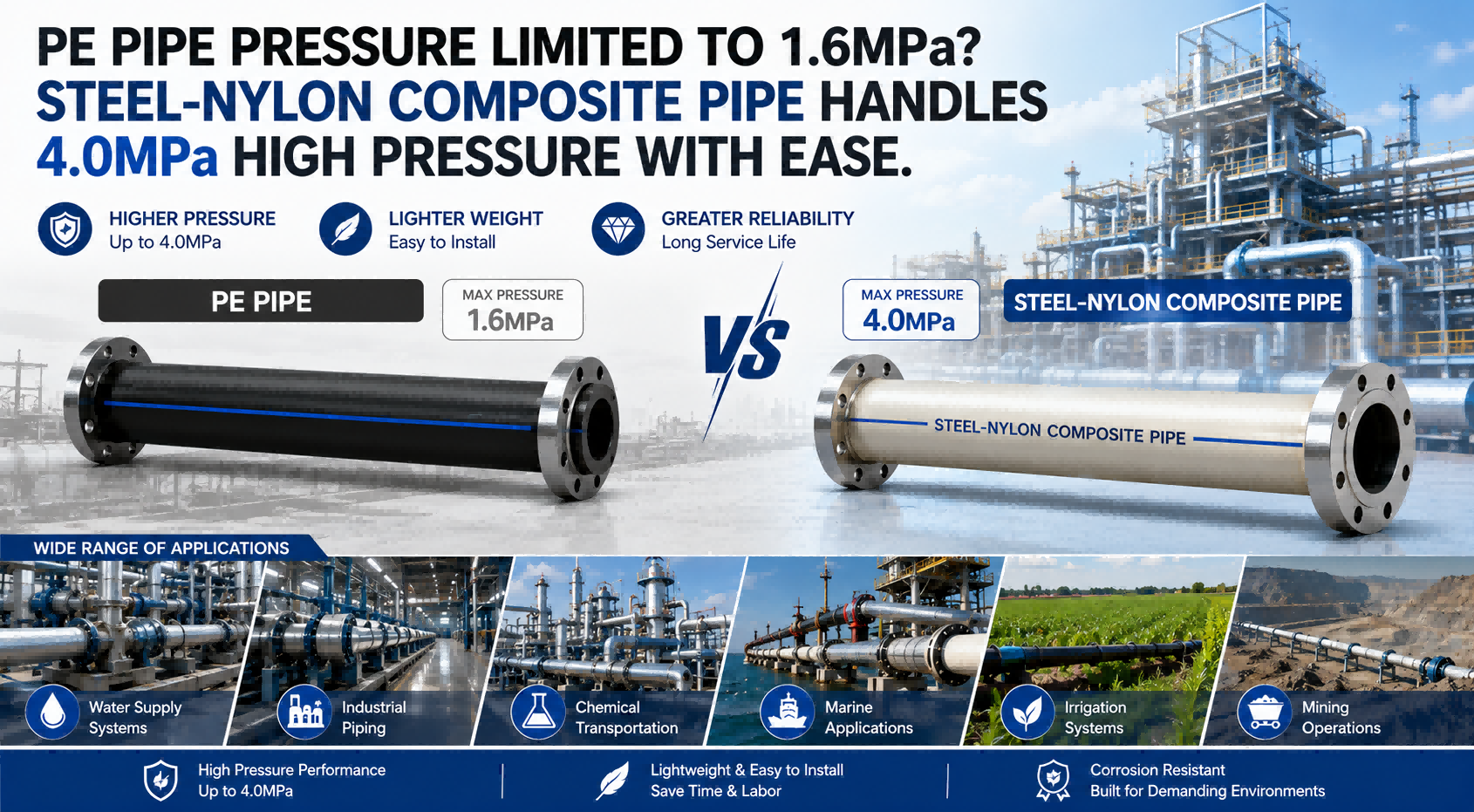
In the world of pipeline engineering, pressure rating is one of the most critical performance benchmarks. Polyethylene (PE) pipes have long dominated low‑ and medium‑pressure applications such as water supply and gas distribution, thanks to their excellent corrosion resistance and ease of installation. However, their 1.6MPa ceiling remains a hard limit that cannot be easily surpassed. When project demands rise to higher pressure levels, the steel‑nylon composite pipe – with an outer steel layer and an inner nylon lining – delivers a compelling answer: a working pressure of 4.0MPa and a burst pressure of 10.2MPa. High‑pressure conveyance no longer has to be constrained by the inherent limits of polymeric materials.
1. Where Does PE’s 1.6MPa “Ceiling” Come From?
According to national standard GB/T 13663, the nominal pressure rating for PE water pipes ranges from 0.32MPa to 1.6MPa, with common grades of 0.6, 0.8, 1.0, 1.25, and 1.6MPa. Even in specialised applications such as marine use, the maximum operating pressure (MOP) is still capped at 1.6MPa; for gas distribution PE pipes, the limit is even stricter at 1.0MPa.
This restriction is not a failure of the material’s short‑term strength, but rather a necessary consequence of the long‑term service behaviour of thermoplastics. As a semi‑crystalline polymer, PE’s pressure‑bearing capacity is highly temperature‑sensitive – for every 10°C increase in operating temperature, the allowable stress drops markedly. Even if higher‑grade PE100 resin is used and the SDR (standard dimension ratio) is reduced to increase wall thickness, the short‑term pressure rating can be improved theoretically, yet engineering standards still firmly set the practical upper limit at 1.6MPa. This is a prudent boundary that considers long‑term creep, slow crack growth, and temperature fluctuations. In other words, 1.6MPa is not PE’s “absolute maximum” – it is the “engineering red line” where reliability and economy are carefully balanced.
2. How Does the Steel‑Nylon Composite Pipe Achieve 4.0MPa?
The steel‑nylon composite pipe follows a fundamentally different technological philosophy. Its structure is elegantly simple and efficient: **an outer layer of high‑strength thin‑walled steel (usually spiral‑welded or seamless) and an inner layer of tightly bonded nylon (MC nylon or nylon 6) lining**. The outer steel shell bears the entire internal pressure load, while the inner nylon layer serves as a functional lining that provides corrosion resistance, abrasion resistance, and a low‑friction surface.
This clear division of labour – steel for strength, nylon for protection – endows the composite pipe with far superior pressure capacity compared to PE:
**Working pressure of 4.0MPa and burst pressure ≥10.2MPa**, giving a safety margin of more than 2.5 times – well suited for long‑distance high‑pressure transmission.
**Outer steel yield strength ≥235MPa** (depending on the steel grade), far exceeding the creep strength of PE, so the pipe experiences virtually no deformation under high pressure.
Compared with PE pipes of the same dimensions, **short‑term burst pressure increases by 129%**, and pressure fluctuations have negligible impact on service life.
**Outer steel yield strength ≥235MPa** (depending on the steel grade), far exceeding the creep strength of PE, so the pipe experiences virtually no deformation under high pressure.
Compared with PE pipes of the same dimensions, **short‑term burst pressure increases by 129%**, and pressure fluctuations have negligible impact on service life.
**3. Beyond High Pressure: Comprehensive Advantages of Steel‑Nylon Composite Pipes**
High‑pressure capability is just the starting point. The composite pipe offers a range of additional performance benefits that are equally noteworthy:
**Wider Temperature Range**
PE pipes are generally limited to –20°C to +40°C; outside this range, their strength drops sharply. In contrast, the steel‑nylon composite pipe can be used continuously from –36°C to 130°C, with special variants reaching up to 150°C. The outer steel provides thermal stability, while the inner nylon maintains excellent chemical inertness even at elevated temperatures – making it suitable for steam‑traced lines, hot oil transfer, and other thermal applications.
PE pipes are generally limited to –20°C to +40°C; outside this range, their strength drops sharply. In contrast, the steel‑nylon composite pipe can be used continuously from –36°C to 130°C, with special variants reaching up to 150°C. The outer steel provides thermal stability, while the inner nylon maintains excellent chemical inertness even at elevated temperatures – making it suitable for steam‑traced lines, hot oil transfer, and other thermal applications.
**Superior Abrasion Resistance – Outperforming Both Plastics and Metals**
The nylon lining has inherent self‑lubricating and high‑wear‑resistant properties. Under identical conditions, its wear resistance is 8 times that of carbon steel and 6 times that of PE100. In slurry, coal powder, and tailings transport, this translates directly into extended maintenance intervals and lower operating costs.
The nylon lining has inherent self‑lubricating and high‑wear‑resistant properties. Under identical conditions, its wear resistance is 8 times that of carbon steel and 6 times that of PE100. In slurry, coal powder, and tailings transport, this translates directly into extended maintenance intervals and lower operating costs.
**Inside‑Out Corrosion Resistance**
The inner nylon layer resists most acids, alkalis, salts, and organic solvents, effectively neutralising the corrosive effects of the process medium. The outer steel can be protected with anti‑corrosion coatings (e.g., epoxy, galvanising, or 3PE) as needed, ensuring structural integrity while resisting external soil or atmospheric corrosion. Compared with PE‑lined steel pipes (which are prone to liner peeling and blistering), the nylon lining bonds more firmly to the steel through preheating and mechanical interlocking processes, virtually eliminating the risk of detachment.
The inner nylon layer resists most acids, alkalis, salts, and organic solvents, effectively neutralising the corrosive effects of the process medium. The outer steel can be protected with anti‑corrosion coatings (e.g., epoxy, galvanising, or 3PE) as needed, ensuring structural integrity while resisting external soil or atmospheric corrosion. Compared with PE‑lined steel pipes (which are prone to liner peeling and blistering), the nylon lining bonds more firmly to the steel through preheating and mechanical interlocking processes, virtually eliminating the risk of detachment.
**Lightweight Yet Strong – Easy Installation**
The mass per unit length of the steel‑nylon composite pipe is only 1/7 that of an equivalent steel pipe, and its weight in water is 1/45 that of steel. This greatly reduces lifting, transport, and joining difficulty (flanged or quick‑coupling connections are commonly used), making it especially advantageous for mountainous terrain, offshore platforms, and overhead pipelines.
The mass per unit length of the steel‑nylon composite pipe is only 1/7 that of an equivalent steel pipe, and its weight in water is 1/45 that of steel. This greatly reduces lifting, transport, and joining difficulty (flanged or quick‑coupling connections are commonly used), making it especially advantageous for mountainous terrain, offshore platforms, and overhead pipelines.
**Excellent Hydraulic Performance**
The smooth inner surface (roughness coefficient ≤0.009) reduces frictional pressure loss to only about 2/3 of that in metal pipes. Over long‑term operation, this can cut pumping energy consumption by 5%–10%.
The smooth inner surface (roughness coefficient ≤0.009) reduces frictional pressure loss to only about 2/3 of that in metal pipes. Over long‑term operation, this can cut pumping energy consumption by 5%–10%.
**Long Service Life**
With proper corrosion protection, the outer steel can last over 30 years, while the nylon lining is virtually unaffected by medium‑induced aging. The overall service life is comparable to – or even longer than – that of PE pipes.
With proper corrosion protection, the outer steel can last over 30 years, while the nylon lining is virtually unaffected by medium‑induced aging. The overall service life is comparable to – or even longer than – that of PE pipes.
**4. Application Scenarios – From Replacement to New Frontiers**
PE pipes remain the workhorse for low‑ and medium‑pressure water supply and gas distribution networks. However, the 4.0MPa rating of steel‑nylon composite pipes allows them to enter areas where PE simply cannot go:
**Oil and gas gathering, transportation, and injection lines** – suitable for high‑pressure water injection, polymer injection, and oil‑gas mixed transport. Industry standard SY/T 6662.3 already covers such composite pipes.
**Corrosive chemical media transport** – the nylon lining resists strong acids, alkalis, and salt solutions, while the steel shell provides pressure containment – an ideal choice for chemical plant pipe racks.
**Mining heavy‑medium and tailings pipelines** – the high abrasion resistance greatly extends the life of elbows and straight sections, reducing unscheduled downtime.
**Fire‑fighting and industrial high‑pressure water supply** – the 4.0MPa rating meets the requirements of super‑high‑rise buildings and petrochemical fire‑protection systems.
**Marine and offshore engineering** – seawater corrosion is handled by the nylon lining, while the steel outer layer provides structural strength. The composite has already received approvals from several classification societies.
**Corrosive chemical media transport** – the nylon lining resists strong acids, alkalis, and salt solutions, while the steel shell provides pressure containment – an ideal choice for chemical plant pipe racks.
**Mining heavy‑medium and tailings pipelines** – the high abrasion resistance greatly extends the life of elbows and straight sections, reducing unscheduled downtime.
**Fire‑fighting and industrial high‑pressure water supply** – the 4.0MPa rating meets the requirements of super‑high‑rise buildings and petrochemical fire‑protection systems.
**Marine and offshore engineering** – seawater corrosion is handled by the nylon lining, while the steel outer layer provides structural strength. The composite has already received approvals from several classification societies.
**5. Conclusion**
The 1.6MPa limit of PE is not a “defect” – it is the reasonable boundary set by engineering standards for thermoplastic materials. But when a project exceeds that boundary, the steel‑nylon composite pipe offers a proven upgrade path: **the outer steel bears the high pressure, and the inner nylon resists corrosion and wear**. The two layers work in synergy, achieving a clean separation of structural strength and functional performance.
From 1.6MPa to 4.0MPa – the jump is not merely a numerical increase; it represents a paradigm shift from single‑material piping to composite structural design. For engineers and decision‑makers facing challenging conditions of high pressure, corrosion, and abrasion, the steel‑nylon composite pipe is not just an alternative – it may be the key to unlocking difficult operating envelopes with confidence.
Let me know if you would like any adjustments to the tone, technical detail, or formatting.
HDPE Pipes Suffer Stress Cracking in Strong Alkalis – Reinforced Nylon Pipes Are Engineered for Soda Ash and Chlor-Alkali
HDPE Pipe Collapses at 160°C? Reinforced Nylon Pipe Handles High‑Temperature Chemical Conditions with Ease
Related blog


SEND MESSAGE