Frequent Pipe Blockage Due to Carbon Steel Pipe Lining Detachment: Integrated Steel‑Nylon Composite Pipe Never Delaminates

I. An Underestimated Industry Pain Point
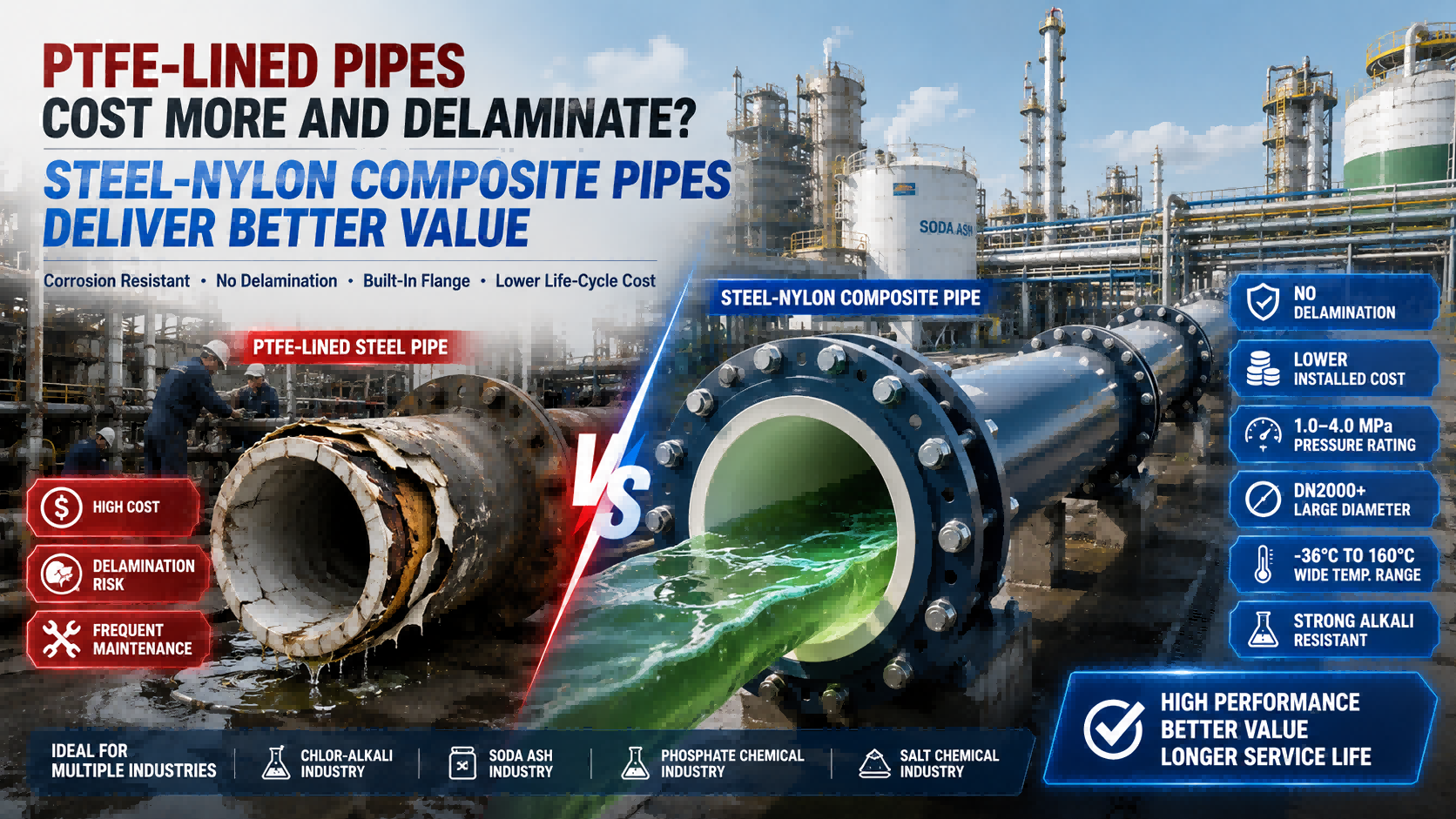
In industrial sectors such as petrochemicals, mining, metro air conditioning, and power plant desulfurization, pipeline system reliability directly determines production continuity and operational safety. Yet one problem has long plagued countless engineers: **lining detachment in carbon steel pipes**.
Carbon steel pipes are widely used across industries because of their high pressure resistance, moderate cost, and ease of installation and maintenance. However, carbon steel itself has poor corrosion resistance—its inner wall easily rusts when in prolonged contact with the conveyed medium. Therefore, the industry commonly adopts internal lining anti‑corrosion solutions, placing a plastic, rubber, or epoxy coating layer inside the carbon steel pipe to isolate it from the medium.
This approach is sound in principle. The real problem is: **the bonding between conventional linings and steel pipes is fundamentally unreliable.**
II. From “Minor Issue” to “Major Failure” – Lining Detachment
2.1 Physical Mechanism of Detachment
Failure of traditional lined carbon steel pipes is no accident. In pipeline systems, pump start‑stop actions generate instantaneous negative pressure. Linings made of plastic, rubber, or similar materials have low stiffness, making them highly prone to detachment or tearing under negative pressure. Once the lining detaches, not only is the anti‑corrosion function lost entirely, but the detached fragments also travel with the medium, accumulating at bends, valves, and connections—**directly causing pipe blockage**.
Temperature variation is another fatal factor. Steam purging, fluctuating operating temperatures, and frequent start‑up/shutdown cycles impose thermal shocks that create enormous differential thermal stress between the lining material and the steel substrate. When this stress exceeds the adhesive or interfacial bonding strength, delamination becomes inevitable.
Moreover, construction defects such as weld spatter, untreated sharp edges, and inadequate surface preparation further plant the seeds for future detachment.
2.2 Real‑World Industry Lessons
These technical deficiencies have led to numerous alarming incidents in practice:
**Metro systems**: In a northwestern Chinese city, coated steel pipes used in its Metro Line 2 suffered coating detachment within just about two years of operation, causing system blockage, soaring energy consumption, and eventually overheating and combustion of the main chiller unit. In an eastern city, Metro Line 1 used plastic‑lined steel pipes; by the second cooling season, severe delamination had occurred, drastically reducing cooling efficiency and even paralysing the entire air‑conditioning system. In a central city’s Metro Line 2, after five years of service, the plastic lining had severely delaminated, causing blockage and shutdown of the air‑conditioning pipeline.
**Oilfield gathering**: At a western oilfield, an L245 carbon steel manifold failed due to coating detachment near welds, leading to perforation when transporting highly corrosive media with high Cl⁻ and CO₂ content. In a CO₂ gas condensate field, carbon steel pipes experienced wall thinning and perforation due to flow‑accelerated corrosion at flow‑transition zones.
**Power and chemical sectors**: A nuclear power plant’s essential service water system suffered large‑scale rubber lining detachment over an area of 4.2 m × 0.95 m, leaving the exposed steel surface covered with corrosion products. In a desulfurisation tower using carbon steel lined with stainless steel, corrosion perforation occurred only three months into operation.
These cases reveal a harsh reality: **the service life of traditional lined carbon steel pipes falls far short of design expectations**, and the resulting emergency shutdowns and system replacements incur staggering costs.
III. Root Cause: The Interface Is “Glued On”, Not “Grown In”
Why do traditional lined pipes delaminate so frequently? The fundamental reason is: **conventional processes rely on adhesives or mechanical expansion to bond the lining to the steel pipe**—this is a “post‑applied” attachment, not an “inherently integrated” structure.
Adhesives age; mechanical expansion loosens under fluctuating temperature and pressure; and the coefficient of thermal expansion of lining materials differs greatly from that of steel, so repeated thermal cycles will inevitably fatigue any adhesive interface.
It is like wallpaper on a wall—freshly pasted it looks smooth and attractive, but over time and with environmental changes, blistering, curling, and peeling are only a matter of time.
IV. The Breakthrough: Integrated Steel‑Nylon Composite Pipe
4.1 What Does “Integrated” Mean?
The core idea of the “integrated steel‑nylon composite pipe” is **not to “stick” nylon onto the steel pipe, but to let the nylon “grow” out from inside the steel pipe.**
Specifically, this technology employs a **centrifugal casting process**: the reactive raw materials of modified MC nylon are injected into a steel pipe mould that rotates at high speed. Under centrifugal force, the materials are uniformly distributed on the inner wall, and the polymerisation reaction takes place during rotation—so that material formation and product finishing occur simultaneously.
MC nylon (cast nylon) is a high‑strength, high‑rigidity engineering plastic with low density, excellent wear resistance, friction reduction, oil resistance, and corrosion resistance. Through centrifugal casting, the nylon layer **polymerises in‑situ and forms integrally** on the steel pipe’s inner wall, achieving a truly “steel‑nylon integrated” structure.
4.2 Why It Never Delaminates – Triple Assurance
The integrated steel‑nylon composite pipe achieves “never delaminating” through three layers of assurance:
**First: Chemical bonding** – During polymerisation, the nylon forms chemical bonds with the steel pipe’s inner wall, rather than mere physical adhesion. This bond strength far exceeds that of any adhesive.
**Second: Mechanical interlocking** – Advanced designs also incorporate multiple longitudinal fan‑shaped grooves on the steel pipe’s inner wall, creating an **interlocking structure** between the outer steel layer and the inner nylon lining, making them tightly fit as one inseparable unit. Some technologies further use a roughened (scalloped) inner surface to increase adhesive strength and reduce the nylon’s thermal expansion/contraction coefficient.
**Third: End anchoring** – At the pipe ends, stainless steel ferrules are crimped over the nylon lining and secured with anti‑pull‑out teeth, ensuring that it **remains unaffected by changes in temperature, pressure, or flow velocity and will not detach or cause blockage.**
With these three safeguards, the nylon lining is no longer “attached” to the steel pipe but forms an integrated composite—**the lining is not “pasted” on; it is “grown” on the steel.**
4.3 Comprehensive Performance Advantages
Beyond solving delamination, the integrated steel‑nylon composite pipe delivers overall performance enhancements:
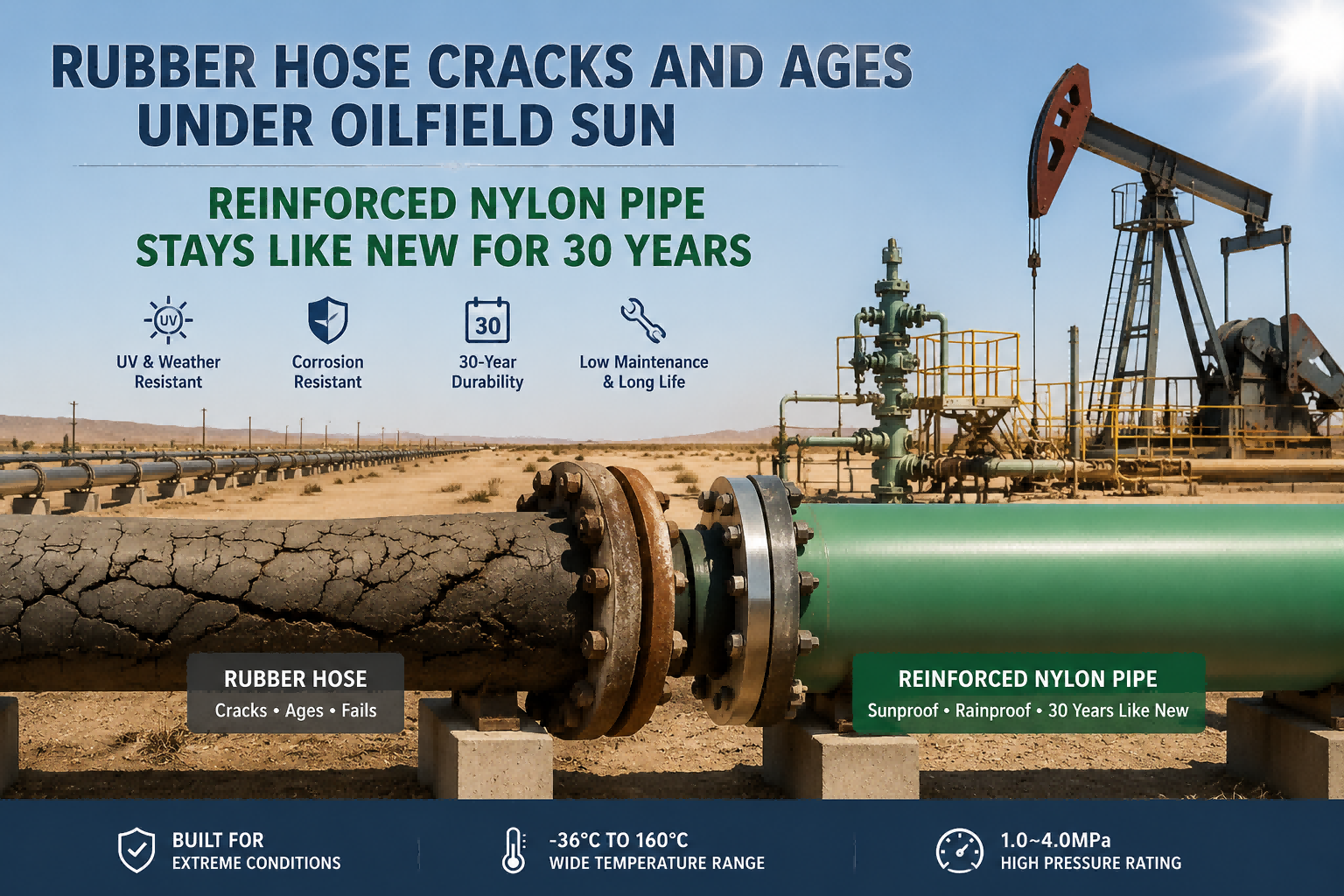
**Wide temperature range**: Adaptable from ‑50 °C to 150 °C, with some improved versions reaching ‑36 °C to 160 °C.
**Excellent corrosion and wear resistance**: Nylon inherently resists acids, alkalis, and abrasion, making it suitable for highly saline and corrosive media.
**Smooth inner surface**: Low fluid resistance, no scaling, and no secondary contamination.
**High pressure capacity**: The steel substrate provides strong structural support, with pressure ratings up to 1.0‑4.0 MPa and diameters ranging from DN50 to DN2000 mm.
**Lightweight**: Significantly lighter than solid steel pipes.
**Excellent corrosion and wear resistance**: Nylon inherently resists acids, alkalis, and abrasion, making it suitable for highly saline and corrosive media.
**Smooth inner surface**: Low fluid resistance, no scaling, and no secondary contamination.
**High pressure capacity**: The steel substrate provides strong structural support, with pressure ratings up to 1.0‑4.0 MPa and diameters ranging from DN50 to DN2000 mm.
**Lightweight**: Significantly lighter than solid steel pipes.
Pilot validation and field evaluations have shown that the anti‑corrosion and overall performance of steel‑reinforced composite pipes and nylon composite pipes **significantly outperforms** alternatives such as FRP pipes, PE‑lined pipes, and glass‑enamelled pipes.
V. Conclusion: A Paradigm Shift from “Pasted” to “Grown”
The frequent detachment and blockage problems of traditional lined carbon steel pipes are essentially the inherent weakness of a **“post‑applied” composite structure**. In contrast, the integrated steel‑nylon composite pipe, through centrifugal casting in‑situ polymerisation, mechanical interlocking, and end anchoring, achieves a **“inherently integrated” composite**—the nylon is not wallpaper stuck onto the steel, but skin that has grown into one with the steel.
This paradigm shift means that pipeline systems can be liberated from frequent maintenance and replacement, truly realising long‑life, maintenance‑free reliable operation. In industries such as petrochemicals, mining, metallurgy, metro infrastructure, and power desulfurisation—where pipeline reliability requirements are increasingly stringent—the integrated steel‑nylon composite pipe is rapidly becoming the definitive replacement for traditional lined carbon steel pipes.
**Delamination was never an inevitable fate for pipelines.**
Carbon Steel Pipeline Perforated by Corrosion in 3 Years, While Reinforced Nylon Pipe Keeps Even Flange Bolts Rust-Free for 10 Years – Where Does This “Lifespan Divide” in Material Selection Come From?
Is Stainless Steel Pipe Theft Risk Zero? Switch to Non-Metallic Nylon Pipe to Completely Eliminate Theft Losses
Related blog