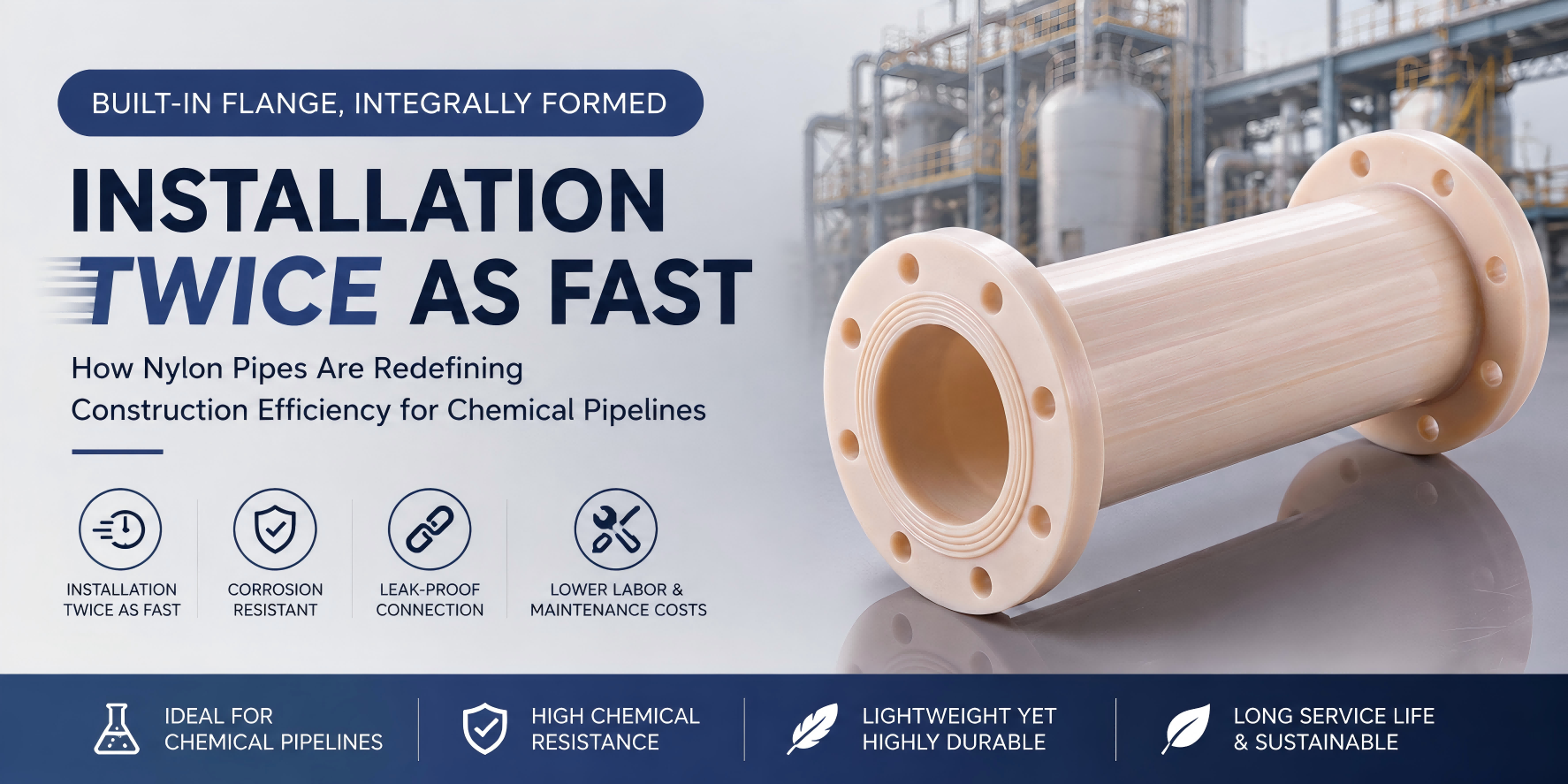
Built-In Flange, Integrally Formed – Installation Twice as Fast: How Nylon Pipes Are Redefining Construction Efficiency for Chemical Pipelines
Abstract: In chemical pipeline construction, the connection link is often the "bottleneck" that limits the entire project's speed. Traditional pipes require flanges and pipe bodies to be manufactured separately and then assembled on-site through segment-by-segment welding or clamp assembly, resulting in tedious procedures and low efficiency. Nylon pipes adopting the "built-in flange, integrally formed" technical route fundamentally reconstruct the efficiency logic of pipeline construction. Starting from industry pain points, this article deeply analyzes the technical principles of integrally formed flanges, the engineering logic behind the doubled installation efficiency, and its impact on the overall cost of chemical projects, helping readers understand the industrial value behind this technological path.
1. Efficiency Bottleneck: Pipe Connections – the "Invisible Time Black Hole" in Chemical Construction
Chemical pipeline construction has never been an easy task.
In a typical chemical pipeline project, processes ranging from prefabrication, transportation, alignment, welding to inspection are tightly interlocked. However, engineering practices repeatedly demonstrate that what truly slows down progress is often not the pipe material itself, but the **connection process**. For traditional steel pipes, flanges must be manufactured separately from the pipe body. On-site welding not only relies heavily on the skill level of welders but is also constrained by weather, workspace, and the cycle of non-destructive testing. Even for stainless steel pipes, pickling passivation and weld inspection after welding consume considerable time and effort.
The steel clamp connection method previously commonly used for nylon pipes also has obvious shortcomings. As pointed out in relevant patent literature, the entire set of steel clamps is bulky, complex in structure, demands high processing technology, results in high overall costs, provides poor sealing, and brings many inconveniences during transportation and assembly. It can be said that the efficiency of the pipe connection method directly determines the time cost and manpower input of the entire construction project.
This is precisely the core issue that the "built-in flange, integrally formed" nylon pipe seeks to resolve.
2. Process Innovation: What Does "One-Shot Forming" of Flange and Pipe Body Mean?
Traditional pipe flange connections are essentially a "divide first, then combine" process – the pipe body belongs to the pipe body, and the flange belongs to the flange. The two are manufactured separately and then "merged into one" at the construction site through welding, threading, or clamping. Every additional step translates to more time and one more potential leakage risk point.
The "built-in flange, integrally formed" nylon pipe fundamentally changes this logic. By consulting relevant technical documentation, it is evident that this type of pipe achieves "integration of flange and pipe body" during the manufacturing phase. Whether through centrifugal casting or compression molding, the flange is not an independent component assembled later but a **natural extension** of the pipe body during the forming process.
The changes brought about by this design are comprehensive:
**First, structural integrity.** The flange and the pipe body form a single whole, eliminating any strength weakening issues caused by weld seams, threads, or adhesive interfaces. On the flange surface, structures like cylindrical platforms and "V"-shaped grooves can be designed to enhance the fitting precision of the sealing surface and improve sealing effectiveness.
**Second, sealing reliability.** The flanges are connected using bolts and sealed with rubber gaskets, requiring no open flames or welding equipment during installation. This avoids the problem of uneven flange surfaces caused by welding deformation. In some structural designs, multiple concentric grooves set on the flange platform further enhance the grip on the gasket, reducing the risk of leakage from the source.
**Third, standardization degree.** The dimensions and sealing surface parameters of the integrally formed flange can be precisely controlled at the factory. On-site installation no longer depends on the "craftsmanship" of individual workers, thus minimizing fluctuations caused by human factors.
3. The Logic of "Twice as Fast" Installation: The Efficiency Accounting from the Engineering Site
"Installation twice as fast" is not an exaggerated marketing phrase but a genuine difference in efficiency observed in engineering practice.
In traditional pipe construction, taking a section of DN200 steel pipe as an example, flange welding typically involves the steps of beveling → fit-up tack welding → multi-layer welding → weld grinding → non-destructive testing → anti-corrosion treatment. Even under ideal conditions in a prefabrication workshop, completing the welding and inspection of a pair of flanges takes at least tens of minutes to several hours, and the time required for on-site work at heights or in confined spaces is even longer.
For the integrally formed nylon pipe with a built-in flange, the core on-site installation actions are essentially three: **transport to position → align flange faces → tighten bolts.** Because the specific gravity of nylon pipe is only about 1/7 that of steel, two workers can easily carry and position a pipe of the same specification without the need for lifting equipment. For the entire project, this combined effect of "lightweight + no welding" means a significantly accelerated construction pace, with pipeline assembly efficiency more than doubling and the overall construction period being notably shortened.
More importantly, the precision of the integrally formed flange is controlled by factory molds. Unlike on-site welded flanges, which risk angular deviation or welding deformation, no repeated adjustments are needed during installation. The engineering team can quickly complete pipeline assembly like building with blocks, drastically reducing downtime and rework.
4. Not Just Speed: When Installation Efficiency Leverages Total Cost
For chemical projects, the direct benefit of doubling installation speed goes far beyond saving labor costs. The deeper value is reflected in the **total cost optimization across the entire chain driven by the compressed project timeline.**
First, the shortened construction period means that the project can start production and generate revenue sooner. In the chemical industry, the timing of a plant's commissioning has a tremendous impact on economic benefits. The value of starting production one month earlier often far exceeds the purchase price difference of the pipe materials themselves.
Second, the simplified installation method reduces dependence on professional welders and specialized equipment (welding machines, lifting machinery, inspection devices). Against the backdrop of an increasing shortage of skilled welders and continuously rising labor costs, this advantage is being valued by more and more project stakeholders.
Furthermore, from a life cycle cost (LCC) perspective, the maintenance advantages of nylon pipes are equally significant. Nylon material inherently possesses good corrosion resistance, wear resistance, and self-lubricating properties, eliminating the need for regular anti-corrosion coating maintenance required by steel pipes. Data from the polyolefin pipe market indicate that the industry increasingly emphasizes "life cycle performance over minimum upfront cost," with material selection and connection technology becoming core factors in purchasing decisions. This aligns highly with the value proposition of integrally formed nylon pipes.
5. Performance Backbone: The Material Confidence Behind the Efficiency Gain
If installation were merely fast without sufficient performance, superior construction efficiency would be meaningless. The reason integrally formed nylon pipes have gained a firm foothold in the chemical sector lies fundamentally in the comprehensive properties of nylon material itself, which are adequate to support demanding industrial scenarios.
**Corrosion resistance** is the core advantage of nylon pipes in chemical applications. Nylon can withstand the erosion of various acid and alkali media and organic solvents, and there is no risk of electrochemical corrosion. Modified nylon materials (such as Kingfa's PA66-G43 product), after being immersed in 30% hydrochloric acid and 50% sodium hydroxide solution for 1000 hours, show a weight change rate controlled within 1.0% and a tensile strength retention rate exceeding 85%, far surpassing ordinary nylon materials.
**Wear resistance** is equally outstanding. Relevant product data shows that the wear resistance of steel-reinforced nylon pipes when conveying slurry is 8-10 times that of carbon steel and stainless steel, and 6 times that of PE100. MC nylon pipes demonstrate wear resistance 3-6 times that of steel under equivalent working conditions. This is particularly important for conveying chemical media containing solid particles.
**Temperature resistance** covers the common operating conditions of chemical production. Nylon pipes can be used long-term within a temperature range of -40°C to 120°C, and after reinforcement modification, the long-term service temperature can reach 150°C.
The transportation and handling advantages brought by **light weight** should not be underestimated. The weight of the pipe is only about 1/6 that of steel pipes, yielding significant overall economic benefits. This advantage is particularly prominent in construction scenarios in the field or mountainous areas.
6. Practical Validation: From Domestic Chemical Parks to "Belt and Road" Projects
Technological advantages only possess true persuasive power when validated in real engineering projects. In recent years, the application of nylon pipes in the chemical sector has been accelerating.
In August 2025, the salt solution conveying pipeline project of China Pingmei Shenma Group's nylon division was successfully completed. The construction team overcame difficulties such as high temperatures, heavy rain, and complex geology through innovative management mechanisms, compressing the originally planned 3-month construction period to 80 days. After the project was put into operation, nylon 66 salt solution was transported directly to downstream factories via pipelines, achieving targeted and precise raw material delivery. It is estimated that annual transportation costs could be reduced by millions of yuan, increasing overall corporate profits by approximately 30 million yuan, while effectively reducing material volatilization losses and environmental pollution. The completion of this project realized the transformation from traditional "wheel" transport to modern "pipe" transport, laying a solid foundation for the collaborative development of the nylon industry chain.
In the international market, the Kazakhstan Soda Ash Plant project also adopted steel-lined nylon pipes and materials for its soda ash section, with the tender completed in May 2025. In the same period, Sinopec Shengli Oilfield Company initiated the public bidding for the 2025-2026 framework agreement on nylon-steel composite pipes, indicating that nylon pipes have entered the mainstream procurement system of large energy enterprises.
From domestic chemical parks to overseas "Belt and Road" projects, integrally formed nylon pipes are proving their engineering practicality in multiple scenarios.
7. Industry Trends: The Transformation of Pipelines Amid the "Replacing Steel with Plastic" Wave
The rise of integrally formed nylon pipes is not an isolated phenomenon but a significant component of the broader "replacing steel with plastic" trend in the chemical pipeline industry.
Looking at the global market, the plastic-lined pipe market is projected to grow from $3.3 billion in 2025 to $3.52 billion in 2026, with a compound annual growth rate (CAGR) of 6.8%. Its growth drivers include the expansion of the chemical industry, increased use of corrosive fluids, replacement demand for traditional metal pipe systems, and heightened awareness of plant safety. The thermoplastic pipe market is also showing steady growth, forecasted to expand from $3.37 billion in 2025 to $3.6 billion in 2026, at a CAGR of 6.6%.
On the technical front, the polyolefin pipe industry is undergoing a transformation driven by stricter environmental regulations and technological maturation. Circular economy principles and low-carbon raw material choices are influencing resin supply chain decisions, while digital quality assurance and supply chain traceability are becoming new standards for procurement and field operations. The gradual improvement of industry standard systems (such as CJ/T 438-2013 "Monomer cast nylon-steel composite pipes and fittings" and CJ/T 439-2013 "Monomer cast reinforced nylon pipes and fittings") also provides a fundamental guarantee for the standardized application of nylon pipes.
Of course, nylon pipes are not a panacea. In locations requiring fire protection, plastic pipes like nylon pose a combustion risk, and a fire could potentially cause valve control failure. This requires careful assessment based on specific scenarios. However, this minor flaw does not overshadow the overall strengths; in the vast majority of non-fire-rated chemical conveying scenarios, the comprehensive advantages of integrally formed nylon pipes remain significant.
Conclusion: Efficiency is Competitiveness
Returning to the statement in the title – "Installation twice as fast."
In the chemical industry, which increasingly pursues optimal engineering efficiency and total cost optimization, this is not merely a promotional slogan but a genuine engineering advantage – an efficiency gain that can be quantified and verified. The built-in flange, integrally formed nylon pipe not only reshapes the efficiency standards for pipeline construction but also redefines the value measurement scale for material selection in chemical pipelines.
In an era where efficiency equals competitiveness, the choice of pipe determines the project rhythm and cost structure.
*The product parameters, case data, and industry trends mentioned in this article are sourced from publicly available patent literature, industry reports, and corporate product information, for reference only. Actual material selection and construction plans should be determined based on comprehensive evaluation of specific working conditions, design requirements, and applicable standards.*
Mastering Extreme Temperatures and Strong Alkali? The New Benchmark for Oil & Gas Specialty Pipes: A Hardcore Performance Breakdown of Nylon-Steel Composite Pipes
A Must-Read for Pipe Selection in the Soda Ash Industry: Why Non-Toxic, Weak-Acid-Resistant Nylon-Steel Composite Pipes Are the Top Safety Choice
Related blog