
How to Extend the Lifespan of Urban Water Supply and Drainage Pipes by 50 Years? The Secret Lies in the Corrosion-Resistant Genes of Nylon Pipes
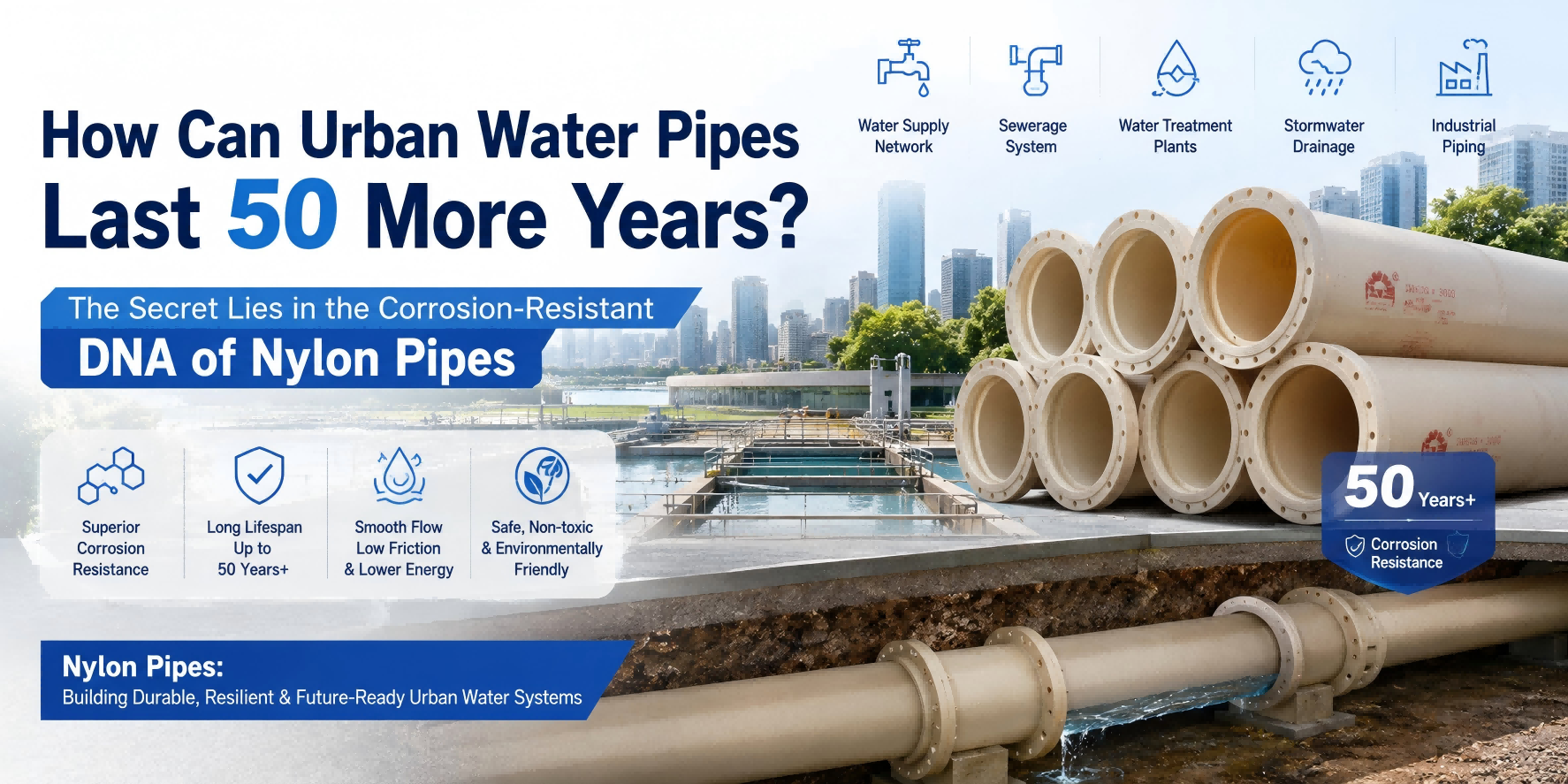
If we were to give the urban underground pipe network a thorough "physical examination," we would receive a shocking diagnosis: **corrosive aging**. Traditional metal pipes, in their long struggle with the surrounding soil and water environment, are constantly oxidized, pitted, and scaled. Their average effective service life often falls short of 25 years. Replacing these deeply buried "arteries" requires performing costly "open-chest surgeries" on the city's chest time and time again.
Thus, a disruptive question arises: Can we make pipes inherently "immune" to corrosion from the very beginning? The answer lies in a seemingly ordinary material that embodies profound polymer wisdom — **the nylon pipe**. It is increasingly regarded by municipal engineers worldwide as the "longevity gene" for water supply and drainage pipes, and its secrets go far beyond what you might imagine.
The Nature of Corrosion: A "Battle for Electrons" Between Metals and Ions
To understand the revolutionary nature of nylon pipes, one must first see why traditional pipes fail. The corrosion of steel, cast iron, and ductile iron pipes is fundamentally an electrochemical process where metal atoms lose electrons, become ions, and dissolve into the surrounding soil and water. Urban stray currents, acidic soils, saline groundwater, and microbial secretions constantly accelerate this "battle for electrons."
Even when an anti-corrosion coating is applied, if a pinhole-sized breach occurs during transportation or installation, corrosion will silently spread along the bond line between the coating and the metal surface, forming a highly destructive "underfilm corrosion." What you see might be just an inconspicuous small bulge on the outer wall, while the pipe wall inside has already been hollowed out into a deep cavity. This is a chronic death disguised in a defensive coat.
**The breakthrough of nylon pipes is that they completely exit this game — because they simply do not have metal electrons available for oxidation.**
The "Corrosion-Resistant Genes" of Nylon: An Immunity Code Written in the Molecular Chain
Nylon, scientifically known as polyamide (PA), is a class of semi-crystalline thermoplastic engineering plastics. In the field of water supply and drainage, long-carbon-chain nylons such as PA12 and PA11, or modified and reinforced nylon composite formulations, are typically used. Its corrosion resistance is not dependent on an external coating, but stems from four inherent "talents" determined by its molecular structure:
**1. Absolute "Insulating Body": It Can Never Become a Galvanic Cell**
Nylon is a high molecular polymer, its molecular chains tightly connected by covalent bonds between carbon, hydrogen, oxygen, and nitrogen atoms, with no freely moving electrons and an extremely high electrical resistivity. This means that neither the galvanic cell effect in the soil, nor the stray currents generated by urban subways or high-voltage power lines, can trigger an electrochemical corrosion reaction on it. For nylon pipes, concepts like "pitting" and "galvanic corrosion" are physical impossibilities.
Nylon is a high molecular polymer, its molecular chains tightly connected by covalent bonds between carbon, hydrogen, oxygen, and nitrogen atoms, with no freely moving electrons and an extremely high electrical resistivity. This means that neither the galvanic cell effect in the soil, nor the stray currents generated by urban subways or high-voltage power lines, can trigger an electrochemical corrosion reaction on it. For nylon pipes, concepts like "pitting" and "galvanic corrosion" are physical impossibilities.
**2. Dense Crystalline Barrier: Making Corrosive Media Halt in Their Tracks**
The molecular chains of nylon are regular, and strong hydrogen bonds form between amide groups (-CONH-), enabling a high degree of crystallization. These tiny but densely arranged crystalline regions form a natural barrier that stops the penetration of water molecules, oxygen molecules, and chloride ions. Taking PA12 as an example, its water absorption rate is extremely low, and its dimensional stability in humid environments far exceeds other engineering plastics. This means that even in perpetually damp, highly saline-alkaline underground conditions, corrosive media can hardly penetrate deep into the material to cause degradation, keeping the pipe wall thickness intact for decades.
The molecular chains of nylon are regular, and strong hydrogen bonds form between amide groups (-CONH-), enabling a high degree of crystallization. These tiny but densely arranged crystalline regions form a natural barrier that stops the penetration of water molecules, oxygen molecules, and chloride ions. Taking PA12 as an example, its water absorption rate is extremely low, and its dimensional stability in humid environments far exceeds other engineering plastics. This means that even in perpetually damp, highly saline-alkaline underground conditions, corrosive media can hardly penetrate deep into the material to cause degradation, keeping the pipe wall thickness intact for decades.
**3. Broad-Spectrum Chemical Inertness: Even the City's "Digestive System" Can't Break It Down**
Urban sewage and stormwater runoff often contain complex chemical cocktails such as sulfides, weak acids, weak bases, oils, and microbial metabolites. Metal pipes are constantly eroded in this "chemical cocktail," while nylon demonstrates excellent tolerance. It possesses high chemical inertness to inorganic salts, weak acids and alkalis, microbial organic acids, and greases, and it does not suffer from stress cracking even in high-concentration hydrogen sulfide environments. It can be called a reliable carrier in urban drainage systems that fears no "heavy-duty" media.
Urban sewage and stormwater runoff often contain complex chemical cocktails such as sulfides, weak acids, weak bases, oils, and microbial metabolites. Metal pipes are constantly eroded in this "chemical cocktail," while nylon demonstrates excellent tolerance. It possesses high chemical inertness to inorganic salts, weak acids and alkalis, microbial organic acids, and greases, and it does not suffer from stress cracking even in high-concentration hydrogen sulfide environments. It can be called a reliable carrier in urban drainage systems that fears no "heavy-duty" media.
**4. A "Low Surface Energy" Surface Resistant to Biofouling**
The flip side of corrosion is scaling. Polysaccharides secreted by microorganisms and mineral deposits form rough rust tubercles on the metal pipe wall. The inner surface of a nylon pipe is extremely smooth, has low surface energy, and is hydrophobic, making it very difficult for microorganisms and calcareous substances to adhere. Even if a small amount does attach, it is easily dislodged under water flow. This allows the "hydraulic lifespan" of nylon pipes to almost equal its material lifespan — a key factor in extending life by half a century.
The flip side of corrosion is scaling. Polysaccharides secreted by microorganisms and mineral deposits form rough rust tubercles on the metal pipe wall. The inner surface of a nylon pipe is extremely smooth, has low surface energy, and is hydrophobic, making it very difficult for microorganisms and calcareous substances to adhere. Even if a small amount does attach, it is easily dislodged under water flow. This allows the "hydraulic lifespan" of nylon pipes to almost equal its material lifespan — a key factor in extending life by half a century.
The Scientific Foundation for a 50-Year Lifespan Extension: From "Maintenance-Free" to "Cross-Generational Asset"
In international standards for the pipe industry, the design life of plastic pipes based on long-term hydrostatic strength is typically 50 years. For nylon pipes, thanks to their excellent resistance to hydrolysis and chemicals, this figure can be taken as a very conservative lower limit. When we talk about "extending life by 50 years," it means that once laid, a nylon pipe can span the careers of two generations of engineers without requiring large-scale intervention. Here is the scientific basis for this assertion:
**Metal Pipes**: Have a designed service life of 20-30 years, but often by the 15th year, rust-induced decline in conveying capacity and frequent leaks become apparent. A single infrastructure investment must be depreciated within one accounting cycle, creating enormous financial pressure.
**Nylon Pipes**: Their design and actual lifespan can comfortably extend to 50-70 years. During this period, they require neither a cathodic protection system nor regular internal lining repairs. More critically, their internal smoothness is maintained throughout the entire lifecycle; the system flow rate will not decay due to rust tubercles, and pumping energy consumption will not increase year by year. A 50-year lifespan means this asset can be transformed from a "liability needing repair" into a "net asset merely to be accounted for."
**Nylon Pipes**: Their design and actual lifespan can comfortably extend to 50-70 years. During this period, they require neither a cathodic protection system nor regular internal lining repairs. More critically, their internal smoothness is maintained throughout the entire lifecycle; the system flow rate will not decay due to rust tubercles, and pumping energy consumption will not increase year by year. A 50-year lifespan means this asset can be transformed from a "liability needing repair" into a "net asset merely to be accounted for."
**Furthermore, another aspect of nylon pipe's "longevity" lies in its wear and fatigue resistance:**
Water supply and drainage pipes are often subject to high-speed erosion by sand and gravel. When the rust layer of a metal pipe wears away, the base metal corrodes even faster. Nylon, however, has excellent abrasion resistance — its Taber abrasion index is far superior to that of steel and polyethylene pipes. Conveying raw water with solid particles over the long term results in almost negligible wall thickness loss. At the same time, nylon's high-toughness, low-modulus characteristics enable it to absorb uneven ground settlement and traffic vibrations without the risk of brittle failure seen in traditional plastic pipes, greatly reducing fatigue leaks at pipe joints. This "resilient survival" capability is the physical cornerstone that guarantees an ultra-long service period.
Water supply and drainage pipes are often subject to high-speed erosion by sand and gravel. When the rust layer of a metal pipe wears away, the base metal corrodes even faster. Nylon, however, has excellent abrasion resistance — its Taber abrasion index is far superior to that of steel and polyethylene pipes. Conveying raw water with solid particles over the long term results in almost negligible wall thickness loss. At the same time, nylon's high-toughness, low-modulus characteristics enable it to absorb uneven ground settlement and traffic vibrations without the risk of brittle failure seen in traditional plastic pipes, greatly reducing fatigue leaks at pipe joints. This "resilient survival" capability is the physical cornerstone that guarantees an ultra-long service period.
Lifecycle Cost Accounting: A Half-Century Vision, Today's Value Choice
International trade procurement decision-makers are accustomed to evaluating projects using Total Cost of Ownership (TCO), and over a 50-year time span, the performance of nylon pipes almost overwhelmingly outperforms all traditional solutions.
**One-Time Investment**: Although the unit price of nylon pipe material is higher than that of ordinary steel or HDPE pipes, its light weight (density is only 1/7th that of steel) significantly reduces the cost of transportation, lifting, and heat-fusion joint installation. Small-diameter pipes can even be supplied in coils with single lengths reaching hundreds of meters, drastically reducing the number of joints, which also means leak points are reduced by over 80%.
**Zero Operating Expenditure**: No need for external coating repairs, no cathodic protection monitoring, no regular CCTV inspection and pipe scraping to remove tubercles. This eliminates the social indirect costs of repeatedly excavating road surfaces, setting up temporary drainage, and traffic diversions. Over a 50-year cycle, these "invisible costs" are often 5 to 10 times the price of the pipe material itself.
**Decommissioning and Legacy**: Even after an ultra-long service life, the nylon material can be recycled and pelletized, re-entering the production cycle. This "cradle-to-cradle" material gene perfectly aligns with the future trends of ESG investment and green infrastructure.
**Zero Operating Expenditure**: No need for external coating repairs, no cathodic protection monitoring, no regular CCTV inspection and pipe scraping to remove tubercles. This eliminates the social indirect costs of repeatedly excavating road surfaces, setting up temporary drainage, and traffic diversions. Over a 50-year cycle, these "invisible costs" are often 5 to 10 times the price of the pipe material itself.
**Decommissioning and Legacy**: Even after an ultra-long service life, the nylon material can be recycled and pelletized, re-entering the production cycle. This "cradle-to-cradle" material gene perfectly aligns with the future trends of ESG investment and green infrastructure.
Taking an urban raw water transmission main with a 50-year design cycle as an example, replacing anti-corrosion steel pipes with nylon pipes can reduce the total comprehensive cost by 50% to 70%. This calculation is not only the Net Present Value (NPV) valued by financial managers, but also the infrastructure resilience pursued by city administrators.
Conclusion: Making Pipeline Engineering a Legacy That Cities Leave to the Future
The reason urban water supply and drainage pipes have short lives is largely because we have been using "materials that get sick" and then developing various "medicines to treat them." The emergence of nylon pipes introduces a new municipal philosophy: **eliminate the biological basis of corrosion at the source, and endow the pipe itself with powerful corrosion-resistant genes.**
When a pipe can, from its birth, remain indifferent to soil acidity and alkalinity, stray currents, microbial decomposition, and chemical erosion; when its inner wall can resist half a century of sand scouring and dirt adhesion — then "extending life by 50 years" is no longer a miracle but a rigorous scientific conclusion. This is the most valuable revelation nylon pipes offer to the global municipal water sector: the highest engineering wisdom is not in fast repairs, but in long-lived construction.
**Are you looking for a long-lasting solution for the next generation of urban pipe networks that can span generations? Contact our engineering team for tailored nylon pipe selection recommendations and 50-year long-term performance verification data specific to your project conditions.**
Salt Chemical Pipes Scrapped in Two Years? Try the 4.0 MPa Nylon-Steel Composite Pipe – Multiply Its Service Life Several Times
Mastering Extreme Temperatures and Strong Alkali? The New Benchmark for Oil & Gas Specialty Pipes: A Hardcore Performance Breakdown of Nylon-Steel Composite Pipes
Related blog


SEND MESSAGE