
PE Pipe Connections Rely on Heat Fusion – Which Hides Risks. Nylon Pipe with Integral Flanges Makes Joints Safer.
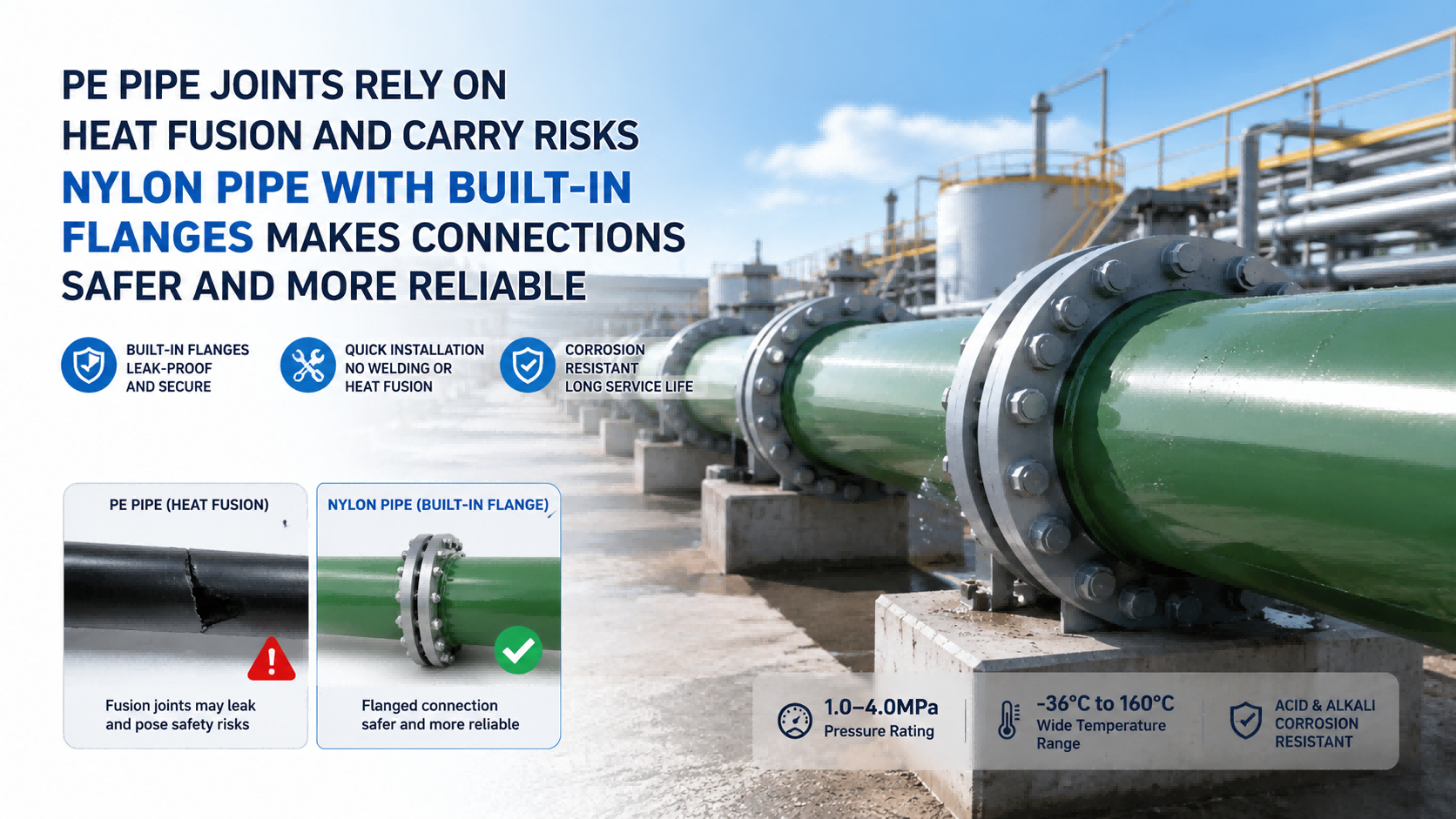
In industrial fluid transport, municipal pipelines, pneumatic systems, and many other fields, the reliability of pipe connections directly affects the safety and service life of the entire system. Polyethylene (PE) pipes, thanks to their corrosion resistance, good flexibility, and relatively low cost, have been widely used in many scenarios for a long time. However, the dominant heat‑fusion joining method for PE pipes carries structural risks that cannot be ignored. In contrast, nylon (polyamide) pipes combined with integrally moulded flanges are increasingly seen by engineers as the “safer” choice.
1. The Inherent Weaknesses of Heat‑Fusion Joints
Heat‑fusion joining of PE pipes is essentially a “welding” process: the pipe ends are heated until molten and then pressed together to form a joint. This method appears simple, but in fact it places extremely high demands on construction conditions, operational procedures, and equipment precision. Any lapse in any step can create hidden dangers.
**Cold welds and false welds are the most serious quality defects in PE heat‑fusion joints.** A “cold weld” means the pipe ends were not fully melted despite being heated, so the fusion after pressing is incomplete. A “false weld” is even more insidious – the joint looks normal on the outside, but internally there is no effective molecular entanglement. Joints with cold‑weld defects are visually indistinguishable from sound joints and often pass hydrostatic tests without incident. However, they compromise the long‑term safety of the system. This “good on the outside, fragile on the inside” characteristic makes heat‑fusion joints a ticking time bomb that cannot be detected by visual inspection.
Beyond cold and false welds, PE heat‑fusion joints also suffer from uneven bead heights on both sides, misalignment, localised bead deformation, and narrow or tall beads. Defects in pipe‑end preparation, contaminated joint surfaces, or axial deviations during assembly all affect joint quality. Even more concerning is that the success of heat‑fusion joining depends heavily on the operator’s experience and diligence – parameters such as heating temperature, heating time, applied pressure, and cooling time must be strictly controlled. In real‑world projects, however, site conditions vary widely and installer skill levels differ greatly. These variables collectively make heat‑fusion joint quality inherently difficult to control.
From a failure‑mechanism perspective, PE fusion joints develop crazes and shear bands under stress. These micro‑damages gradually grow into macroscopic cracks and eventually lead to joint fracture. In a northern China project, outdoor circulating‑water PE pipes using heat‑fusion joints developed widespread cracking at connections to manholes. In another case, a residential community in Guangdong experienced heat‑fusion joint failures in its PE drinking‑water supply line. These examples repeatedly remind us that the risks of heat‑fusion joining are not just theoretical – they have been repeatedly validated by engineering practice.
2. Nylon Pipe with Integral Flanges: A Reliability Revolution Through Integrated Design
In contrast to PE’s reliance on field “welding,” nylon pipe with flanged connections fundamentally avoids the problems described above.
**The integral moulding of flange and pipe body is the core technical advantage of this solution.** The flange and the straight pipe are formed in a single moulding cycle, creating a seamless, monolithic structure. This design means there is no weld seam or adhesive joint between the pipe and the flange – the weakest link in any connection is eliminated entirely. The flange face typically features annular grooves and ridges to accommodate an elastomeric sealing gasket. When the bolts are tightened, the gasket is compressed uniformly, ensuring reliable sealing. Some advanced designs also incorporate an outward protruding pressure‑reinforcing ring on the flange face; when the nylon pipe is threaded into the flange, this ring wraps around the outer wall of the pipe, further preventing rupture under high operating pressures.
**The simplicity and reliability of installation are equally remarkable.** Flanged assembly requires only aligning the two flange faces, placing the gasket between them, and tightening the bolts with a wrench. The entire process needs no heating equipment, no specialised training, and no complex parameter control – a single wrench is enough to produce a high‑quality joint. Even if minor misalignments occur during installation, they can be corrected by adjusting the bolt tension. For parts that require frequent disassembly for maintenance, the flange advantage is even clearer – disassembly and reassembly are just as quick and straightforward.
**From a material‑performance standpoint,** nylon pipe already has a superior mechanical foundation compared to PE. Nylon’s tensile strength and rigidity are significantly higher than those of polyethylene, and its pressure‑rating is roughly 1.5 to 3 times that of equivalent‑sized PE pipe. Nylon pipes can operate from ‑40°C up to over 100°C, whereas PE softens noticeably above 60°C. Nylon also offers excellent wear resistance and low friction coefficient. In short, nylon pipe itself provides a stronger material platform for “safer joints.”
3. From “Welding” to “Assembly”: An Evolution in Piping Connection Philosophy
The contrast between PE heat‑fusion joining and nylon flanged connections reflects two fundamentally different engineering philosophies.
Heat‑fusion is essentially about “fabricating a joint” on site – heating and pressing two pipe ends to “weld” them together. In this process, the joint quality depends on the perfect interplay of countless variables: temperature, pressure, time, environment, operator skill, and more. A deviation in any one variable can produce a joint that looks acceptable but is actually weak, only to be buried underground or inside walls, becoming a long‑term hazard.
Flanged connection, on the other hand, is about “assembling an interface.” The pipe and flange are already integrated at the factory, and the field work is reduced to assembling standard mechanical components (bolts and gaskets). Joint quality no longer depends on the “craftsmanship” of the site installer – it is ensured by standardised, verifiable mechanical fastening. **Moving from “relying on people” to “relying on design” marks a qualitative leap in piping connection reliability.**
Conclusion
PE heat‑fusion joints are not without merit – under ideal conditions and with strict procedural control, they can meet the demands of ordinary service. But “ideal conditions” are rarely found in real‑world projects. The existence of concealed defects such as cold and false welds makes heat‑fusion joint quality difficult to verify and guarantee.
Nylon pipe with integral flanges, through its two core principles – eliminating the joint seam and relying on standardised mechanical assembly – fundamentally sidesteps the structural dilemmas of heat‑fusion joining. For engineering projects that demand long‑term reliability and low maintenance costs, the “safety” offered by nylon flanged connections lies not only in higher pressure and temperature ratings, but also in the controllability and predictability of joint quality.
As pipeline safety gains increasing attention worldwide, moving from “heat‑fusion welding” to “flanged assembly” may well be a direction the industry should seriously consider.
Feel free to adjust any terminology or examples to better suit your target audience. Let me know if you need a shorter summary version or any other modifications.
Rubber-Lined Pipes Suffer from Collapse and Bulging Under Negative Pressure? Reinforced Nylon Pipes, Formed as an Integral Structure, Withstand Vacuum Conditions with Ease.
Insufficient Ring Stiffness Causing Deformation in Large-Diameter HDPE Pipes? Steel–Nylon Composite Pipes Offer Both Rigidity and Flexibility
Related blog


SEND MESSAGE